


On my first visit to Bahariya Oasis, I did what almost everyone does: arrived from Cairo in a dusty minibus, climbed straight into a 4x4, and rattled off toward the White Desert before I had even learned how to pronounce Bawiti properly. On my most recent trip in September 2026, I came back with a different rule for myself. This time I would spend real time in the oasis itself, not just the national park beyond it. I wanted to see what daily life looked like among the palms, springs, and low basalt hills that barely register in most tour itineraries. Over two nights and one full unhurried day in Bahariya, I walked its villages, cycled its farm tracks, soaked in hot water and dust, and tried to piece together what this place is when it is not being a launchpad for the White Desert.
Arriving in Egypt’s Closest Western Desert Oasis
Bahariya is often described, including by Egypt’s official tourism materials, as the Western Desert oasis closest to Cairo, roughly 360 to 370 kilometers southwest of the capital by road. In practical terms that means about four to five hours by bus or private transfer, depending on traffic leaving Cairo and military checkpoints on the desert highway. Most organized White Desert safaris still start here, with 4x4 convoys heading south past the Black Desert and on to the chalk formations of the White Desert National Park. For many travelers, Bahariya is therefore a changing room: a place to swap city shoes for desert boots and nothing more.
Staying in Bahariya itself changes the rhythm completely. I checked into a small family-run lodge on the edge of Bawiti, the main town of the oasis, late in the afternoon after the drive from Cairo. White Desert jeeps were parked out front, sand still clinging to jerrycans and spare tires, but on this trip I did not climb into one. Instead, I dropped my bags and walked out into town before sunset, determined not to treat Bahariya as a foyer to somewhere else.
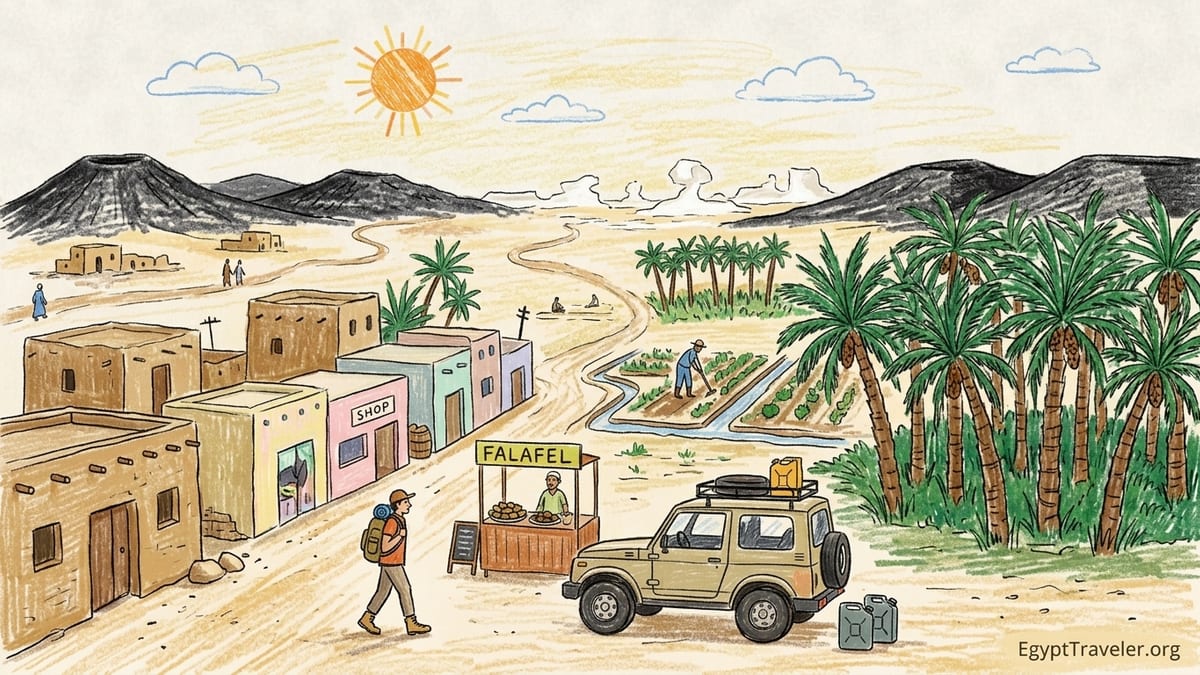
The first surprise was how green everything felt. After hours of dun-colored plateau, the sudden density of date palms, vegetable plots, and acacia trees around the road into Bawiti was a genuine shock. If the White and Black Deserts are long essays in minimalism, Bahariya is a crowded notebook of small human interventions: irrigation channels, mudbrick walls, low cement houses painted in pastels, pens of goats and donkeys, kids weaving through it all on Chinese motorbikes.
Because most visitors only see Bawiti in the half-hour between bus and 4x4, they rarely notice that it blends directly into the older village of Qasr al-Bawiti and, farther east, the farming settlements of Mandisha and el-Zabu. The oasis is not a single dot in the sand but a string of communities stretched across a broad depression rimmed by black hills. Spending a night in town lets that geography start to make sense.
Walking Bawiti and Qasr: Streets, Shops and Slow Conversations
My first morning “off” from the desert was spent on foot. From the lodge near the highway, I walked into the heart of Bawiti just after eight, before the sun became brutal. There is no formal walking circuit, but a simple loop works well: from the main square with its small cluster of cafes and phone shops, I followed the road toward the market, then ducked into the older lanes that feed into Qasr, the traditional core of the oasis.
The main commercial street is a mix of travel reality and local necessity. A couple of safari offices advertise White Desert overnights with photos of chalk mushrooms and black volcanic cones in their windows. In between them are workshops repairing agricultural pumps, grocery stores selling flatbread and long-life milk, and phone shops where teenagers gather around a single charging strip. A basic falafel breakfast with tea from one of the snack stands cost me the equivalent of just a few US dollars, even after the sharp currency devaluation earlier in 2024 that pushed many desert tour prices much higher. Locals, not tourists, set the tone here; visitors are a thin layer on top.
Qasr is different. As I left the asphalt and stepped onto harder-packed earth between mudbrick walls, the sound of engines dropped away. Here older houses with timber lintels and internal courtyards lean into narrow alleys. Children appeared from doorways to practice “hello” and “what is your name,” while an older man invited me to sit for sweet tea in front of his house. I had been told in Cairo that Bahariya could feel pushy or over-touristed, but in these backstreets the encounters were gentle and curious rather than transactional.
Nothing in Bawiti or Qasr is dramatically beautiful in the way the White Desert is, but that is exactly the point. When you slow down to walk the grid of lanes and irrigation channels you see the oasis as a working place: men heading for the fields with hoes over their shoulders, women carrying vegetables in plastic crates, a group of boys in school uniforms piling into the back of a pickup. Between desert excursions, this is the texture that most travelers miss.
On a Bicycle Between Palms and Fields
To see more than the central streets, I rented a battered mountain bike from a small handicraft and rental shop at the edge of town. A couple of local outfits, often attached to guesthouses, still keep a handful of bikes for travelers who want to explore under their own steam. The daily rate was modest, roughly the cost of a simple lunch, and the owner insisted I take extra water before pedaling away.
The most rewarding direction for a short ride is east, toward Mandisha and el-Zabu. Within ten minutes, the town thins into a quilt of small fields, each patch a different shade of green. Date palms form the upper layer, with their loaded fronds heavy with late-summer fruit. Beneath them, olive trees and pomegranate bushes crowd the intermediate level, while on the ground farmers coax clover, onions, and medicinal herbs out of the narrow spaces left over. Simple gravity-fed canals and diesel pumps pull water from the aquifer to keep everything alive.
With a bicycle it is easy to leave the road and follow the rough tracks that separate fields. I passed groups of women sorting dates into crates, boys watering a donkey, and an elderly farmer trimming an irrigation channel with a shovel. The Black Desert hills ringed the horizon in a low, broken circle, but out here they were only scenery. Unlike the White Desert or Black Desert, where your guides will warn you not to walk far without them, Bahariya’s farm belt felt safely human-scale. If I had a flat tire I could have walked back to town in under an hour.
There are neglected corners too. Some older mudbrick houses have been abandoned for modern cement boxes, and derelict pumps stand rusting beside canals lined with plastic trash. A couple of half-built guesthouses on the edge of the fields, construction halted mid-way, were reminders that tourism plans here often run ahead of demand. But even those scars belonged to a living place trying to balance agriculture, migration, and an unpredictable visitor economy.
Springs, Wells and the Quiet Pleasure of Doing Very Little
Ask operators in Cairo about Bahariya and they are likely to mention its hot and cold springs almost as an afterthought. On the ground, those springs remain part of daily life. The oasis has dozens of wells, many of them thermal and mineral-rich, although not all are in ideal condition for bathing. Local guides talk fondly of names like Bir Ramla, Bir en-Naqba, Bir al-Mattar and Bir al-Ghaba. Some, like Bir al-Mattar and Bir al-Ghaba, still draw visitors specifically for their scenery and reputation for relaxation.
Late on my first afternoon I rode north with a local guide to see one of the popular spring areas beyond the palm belt. The track left the asphalt and crossed a low, stony rise before dipping into a shallow basin lined with palms and tall eucalyptus trees. A concrete pool surrounded one of the thermal wells. The water was clear but very hot, and the edge was ringed with black mineral deposits. Local families were using it in a very practical way: a man washing his pickup, a teenager filling jerrycans to take home, two children soaking their feet at the margin.
A short walk farther brought us to another spring shaded by eucalyptus, with just a trickle of water feeding a small channel. My guide explained that this was one of several wells that once saw steady tourism groups but had declined over the past decade as more attention shifted to the White Desert. The pool was shallow and partially silted, the concrete edges cracked. It was still peaceful and atmospheric, but clearly in need of maintenance that had not yet come.
Sitting there in the late afternoon, listening to wind in the eucalyptus and the distant putter of a motorbike, felt like the opposite of the White Desert experience. There were no sculpted chalk towers or choreographed sunset stops, no rush to get dinner cooked over an open fire. Instead I had the rare luxury of doing very little, with the oasis stretching quietly around me.
Golden Mummies, Tombs and What Is Actually Open
Bahariya shot into international headlines in the late 1990s when archaeologists announced the discovery of the so-called Valley of the Golden Mummies near Bawiti. Thousands of Greco-Roman era burials, many with gilded masks, were found in a sprawling necropolis. For a while, tourists could visit parts of the valley and see mummies in situ, but access has changed repeatedly since then, and this is where current, on-the-ground information is essential.
As of my visit in September 2026, travelers could not simply wander freely into the original Valley of the Golden Mummies excavation zone. The site itself remained under the control of the antiquities authorities, and open hours or permissions were not prominently advertised in town. Several local guides confirmed that wider public access had been curtailed in recent years, both for conservation and security reasons, and that it was not realistic to plan a DIY visit there without arrangements through an official channel.
Instead, Bahariya’s accessible archaeological window into that world now comes through smaller, well-managed tombs and a modest local museum. On a mid-morning tour arranged via my lodge, I visited the decorated tombs at Qarat Qasr Salim, a low ridge overlooking Bawiti where 26th Dynasty officials were buried. Accompanied by a local guide and a site guardian, I climbed down into two painted chambers where vibrant yellow, blue, and green figures still walked across the walls under stars. Photography rules changed from site to site, so I left my camera in my bag and concentrated on looking.
Nearby, a small museum space displayed several of the golden-masked mummies and burial objects from the wider oasis. The vitrines were simple, the labels basic, and not all rooms were open, but standing face to face with one of the gilded mummies just a few minutes’ drive from the fields where those people once lived was quietly powerful. Compared with Cairo’s blockbuster museums, this was an intimate experience, grounded in a local landscape that you could cycle through after lunch.
The key lesson for travelers is that local guiding in Bahariya remains very useful. Not only do guides sort permits and transport for the tombs, they also know what is actually open in a given week, since minor sites sometimes close without notice. My guide rerouted us on the fly when one small temple remained locked, taking us instead to a hilltop viewpoint used during the First World War and later known as Gabal al-Ingleez, or English Mountain. Without his local phone calls and knowledge of caretakers, half the doors we passed would have stayed shut.
Viewpoints and Hills: Seeing the Oasis from Above
Much of Bahariya’s charm is at ground level among the fields, but to understand how it fits into the Western Desert it helps to climb. Gabal al-Ingleez, a basalt-capped hill north of Bawiti, offers one of the best chances to see the contrast between the green depression and the bare plateaus around it. In the late afternoon my guide drove partway up a rough track, then we continued on foot to a crumbling stone structure on the summit, built by British forces during the First World War.
From the top, the oasis spread out below like an elongated island: dark green palms and fields forming a band between low, dark volcanic hills. Beyond that ring, to the south and west, lay the beige and black tones that announce the approach of the Black Desert and, far beyond, the White Desert. Here the difference between oasis and desert was not theoretical. You could see the exact line where cultivation stopped and the sand began, and understand why every palm and irrigation channel below mattered.
Another, more neglected viewpoint lay on the lower slopes of Gabal Maghrafa, a hill associated with historic iron ore mining and dinosaur fossil finds. The drive there crossed an industrial-looking zone with rusting mining equipment and piles of ore. There was no visitor center, no landscape interpretation signs, and no obvious trail markers, just a rough track used by local drivers and the occasional fossil-hunting group on a special permit. My guide was frank that most visitors rarely come here now unless they have a specific geological interest.
Standing on a shoulder of Gabal Maghrafa, looking back toward the dense palms around Bawiti, reinforced how different Bahariya felt from the desert circuits beyond. The White Desert and Black Desert are essentially excursion landscapes: grand, spectacular, and mostly uninhabited. Bahariya is lived-in. It has school timetables, wedding halls, bus schedules, and power cuts. Give yourself one clear afternoon for a hilltop view and you will start to see those worlds as distinct, not just consecutive stops on a single route.
Comparing Oasis Life with the White and Black Deserts
Most travel marketing treats Bahariya, the Black Desert, and the White Desert as a single experience, but after a few days on the ground I came to think of them as three separate chapters. The Black Desert, about an hour south of Bawiti by 4x4, greets safari vehicles with hundreds of low, burnt-looking volcanic cones rising out of tan sand. It is almost completely barren at human scale, with only hardy shrubs appearing in sheltered hollows. Guides may lead short walks up one of the cones, but nobody lives here; the Black Desert is scenery and geology.
The White Desert, farther south, feels like another planet altogether, its chalk towers and mushroom shapes carved by wind into delicate, improbable forms. Regulations on camping and access have shifted in recent years, particularly after changes in Egypt’s permit system and currency devaluations in 2024, but most trips still involve at least one night under the stars among the formations. Out there, the color palette narrows to white, creamy beige, and blue sky. Wildlife is subtle, services minimal, and the human footprint limited to tire tracks and fire pits.
Returning from that world to Bahariya’s inhabited strip is a shock in the opposite direction. Birds chatter in the palms, irrigation pumps thump rhythmically, bread ovens breathe out warm air onto lanes. Even in dusty backstreets that felt neglected, with piles of plastic and stray dogs, there was a sense of continuity that the desert lacked. The oasis landscape is intensely shaped by human hands; the deserts beyond are shaped almost entirely by wind and time.
This contrast is precisely why it makes sense to consciously separate Bahariya from the White Desert in your planning. Rather than treating Bawiti as simply the jeep yard where you start and end your safari, respect it as a parallel destination: one green, inhabited world framed by two largely lifeless ones.
What Felt Neglected, Closed or Not Quite Ready
Spending time in Bahariya also meant acknowledging what did not work. After the boom of attention around the Valley of the Golden Mummies and years of pre-2020 tourism growth, parts of the oasis feel stalled in an awkward in-between stage. Several guesthouses I walked past near the highway had clearly been expanded in hopeful years, with new wings partially finished or closed off. Some older hot springs infrastructure showed its age, with broken tiles and rusting railings that no one had yet budgeted to repair.
Information for independent travelers is patchy. There was no clear central tourist office signposted in Bawiti, and public transport within the oasis was limited. In practice, this meant that most of my movements beyond walking distance relied on either a bicycle rental or arranging a pick-up with my lodge or a local driver. For visitors used to hopping in informal microbuses between Egyptian Nile Valley towns, the dependence on pre-arranged cars in Bahariya can feel restrictive.
Culturally, some spaces felt half-formed. A heritage museum complex on the edge of town, set beside the main road, was intriguing from the outside with its fortress-like walls and traditional design. Inside, however, only part of the compound was open, and interpretive panels were minimal. A craft workshop that once hosted demonstrations sat closed and silent when I walked by in late morning. When I asked my guide, he shrugged and said that staffing and funding had become erratic as visitor numbers swung up and down.
Yet those gaps were themselves informative. Bahariya is not a polished resort or an open-air museum with carefully curated narratives. It is a working oasis adjusting to fluctuating tourism and national economic shifts. Anyone arriving expecting the polished visitor services of Luxor or Giza will find edges and frustrations here. Approached with curiosity and patience, those imperfections are part of understanding what life on the desert’s edge looks like right now.
The Takeaway: Is a Full Oasis Day Worth It?
After two nights based in Bahariya, with one unhurried full day between desert excursions, I came away convinced that the oasis deserves more than its usual role as a transfer point. For travelers planning a White Desert safari, the decision is simple but important: arrive from Cairo and go straight into the 4x4s, or build in a pause to walk, cycle, and soak in the oasis first.
My recommendation is clear. If your schedule allows, add at least one full day and night in Bahariya before or after your White Desert trip. Use that time to walk Bawiti and Qasr’s backstreets, rent a bicycle to wander the fields, visit the accessible tombs and small museum with a local guide, and spend an afternoon at one of the springs, even if it is a little rough around the edges. That combination turns a desert outing into a more complete Western Desert journey, where you see both the landscapes that people cross and the place where they actually live.
There is also a practical argument. After hours of driving across open desert and a night’s camping in the White Desert, many travelers simply tumble back into a car for the long return to Cairo. A night in Bahariya on the way back lets you shower, sleep in a proper bed, and recalibrate gradually from silence and stars to city traffic. In 2024 and 2025, as desert tour prices rose significantly with Egypt’s economic shifts, many operators began encouraging guests to pack their itineraries tightly. Resisting that pressure and keeping one day for the oasis may be one of the most rewarding choices you make.
Bahariya is not as instantly dazzling as the White Desert nor as visually dramatic as the Black Desert. Its charm lies in the accumulation of small scenes: a farmer adjusting a canal gate at dawn, schoolkids biking home under date palms, a golden-masked mummy in a simple local museum, hot water steaming in a cracked concrete pool. To see those things you have to slow down and stay. For anyone heading into Egypt’s Western Desert, I would recommend it.
FAQ
Q1. How long does it take to reach Bahariya Oasis from Cairo?
Travel time by road from Cairo to Bahariya is usually around four to five hours each way, depending on traffic leaving the city and any delays at checkpoints on the desert highway.
Q2. Is the Valley of the Golden Mummies open to individual visitors now?
As of late 2026, the original excavation zone known as the Valley of the Golden Mummies is not freely open for unguided visits. Access focuses instead on nearby tombs and a small local museum where some mummies and artefacts are displayed.
Q3. Do I need a guide to explore Bahariya itself, or only for the White Desert?
You can walk and cycle around Bawiti and the surrounding fields independently, but a local guide is strongly recommended for archaeological sites, hilltop viewpoints like Gabal al-Ingleez, and up-to-date information on which tombs or springs are currently accessible.
Q4. Are the hot springs in Bahariya clean and safe for swimming?
Conditions vary by spring. Some wells remain popular for bathing, while others are very hot, silting up, or used mainly for washing vehicles and filling containers. It is best to visit with a local guide, inspect the water, and follow their advice on where to bathe.
Q5. Can I rely on public transport inside the oasis to get around?
Public transport within Bahariya is limited. Most visitors either walk within Bawiti, rent a bicycle through a guesthouse or handicraft shop, or arrange cars with local drivers for trips to villages, springs, and viewpoints.
Q6. How many days should I spend in Bahariya if I am also doing a White Desert safari?
Allow at least one full day and one or two nights in Bahariya in addition to your desert safari. This gives enough time to explore villages, farms, springs, and key archaeological sites without rushing.
Q7. What is the difference between Bahariya Oasis and the White and Black Deserts?
Bahariya is an inhabited green depression of villages, farms, and springs. The Black Desert is a barren volcanic landscape of dark cones, and the White Desert is a protected chalk formation area used mainly for overnight camping and 4x4 excursions.
Q8. Is Bahariya suitable for independent travelers, or should I book everything from Cairo?
Independent travelers can arrange accommodation and basic services on arrival in Bahariya, but pre-booking at least your first night and a local guide or safari operator is wise, especially during peak seasons or national holidays.
Q9. What should I budget for a night in Bahariya compared with a White Desert safari?
Recent examples suggest that a simple guesthouse night in Bahariya can cost several dozen US dollars, while shared 4x4 White Desert overnights are typically well over one hundred dollars per person after Egypt’s currency shifts. Exact figures vary, so check current rates when planning.
Q10. Is it better to spend my extra day in Bahariya before or after the desert safari?
Both options work. Spending it before the safari lets you adjust gradually from Cairo and understand the oasis context first, while staying after gives you time to recover from camping and reflect on the contrast between the inhabited oasis and the empty desert.