


From a distance on the map, Kharga Oasis sounded like the romantic ideal. It was described as the largest oasis in Egypt’s Western Desert and the administrative center of the New Valley, with palm groves, archaeological sites, and desert roads that once carried caravans between the Nile and Sudan. On the ground, as the bus rolled past concrete apartment blocks, wide traffic circles, and government buildings, it felt more like a workaday provincial city than the palm-fringed mirage that so many travelers imagine. That gap between expectation and reality is at the heart of how many visitors experience Kharga Oasis today.
Expectation: A Storybook Oasis in the Sand
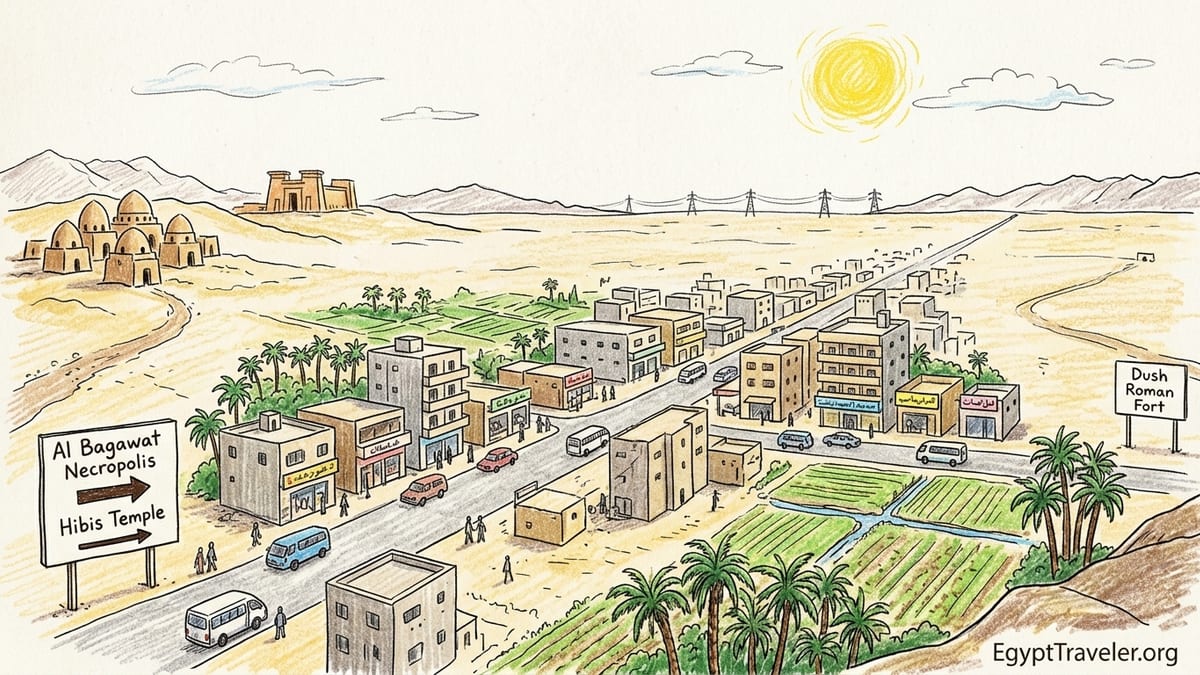
If your mental picture of an oasis is a compact bowl of date palms cupping a blue pool in an otherwise endless dune sea, Kharga will almost certainly surprise you. Egypt’s official tourism platform, Experience Egypt, presents Kharga as the largest of the Western Desert oases and the administrative capital of the New Valley Governorate, stretching along a broad north south depression rather than clustering around a single spring. In practice, that means a sizeable town, low concrete housing blocks, ministries, schools, and hospitals spread over many kilometers rather than a tiny palm-ringed hamlet.
Arriving from the Nile Valley, especially if you come overland from Luxor or Asyut, the first impression is not of whispering palms but of tarmac and traffic circles. Long-distance buses stop at a modern station on the edge of town, and taxis shuttle back and forth along a dual carriageway lined with supermarkets, mobile phone shops, and bakeries that would not look out of place in any mid sized Egyptian governorate capital. It can feel abrupt if you were expecting to step straight from asphalt into sand.
Even the topography challenges the postcard ideal. Instead of a small green patch surrounded on all sides by dunes, Kharga occupies a depression roughly 160 kilometres long and up to 80 kilometres wide, with cultivated fields, scattered villages and modern agricultural projects spread along both sides. Official material stresses that it is one of the sunniest places in Egypt, with thousands of hours of sunshine a year, so the sky has a hard, white blaze rather than the soft shimmer many travelers associate with “hidden” oases.
For visitors who chose Kharga because it appeared on Western Desert safari itineraries alongside places like Bahariya and Farafra, this modern, linear sprawl can be a shock. You may step off the bus expecting a remote frontier outpost yet find yourself instead at a traffic light, surrounded by honking microbuses and students crossing to afternoon classes.
Reality: A Working Desert Capital, Not a Mirage
Kharga’s modern face is not accidental. As the capital of New Valley, the town has been shaped by state led development since the mid twentieth century, when the New Valley Project sought to turn parts of the surrounding desert into cultivable land through deep well irrigation. Administrative compounds, apartment districts for public employees, and broad road grids reflect that planning-first mentality. Where older oases like Siwa still center on adobe villages squeezed between cliffs and palms, Kharga’s heart is a government square and a main boulevard.
Walking through town, you will see broad pavements, traffic lights, and concrete facades rather than winding mudbrick alleys. Everyday life revolves around schools, government offices, and small businesses. You can buy a SIM card from a major telecoms brand, pick up bottled water and snacks from a chain style mini market, and find a reasonably priced local restaurant serving plates of grilled chicken or ful and taameya for the equivalent of only a few US dollars. The very ordinariness of it can feel at odds with the mental image many visitors carry with them of a timeless caravan town.
This ordinariness extends to the landscape around town. Instead of a sharp boundary between “oasis” and “desert,” Kharga blends fields, palm groves, and new agricultural circles irrigated by center pivot systems into the sand sea beyond. It is an oasis scaled up to the dimensions of a governorate capital. For visitors seeking a curated sense of escape, the sight of tractors, concrete irrigation channels, and power pylons can feel jarring compared with the poetic marketing copy that often accompanies Western Desert tours.
None of this makes Kharga unattractive in itself. It simply means that it functions first and foremost as a living, working desert city rather than a museum-piece mirage. If you arrive expecting a small, palm-ringed village, the gulf between what you imagined and what you find can overshadow the real reason Kharga matters historically.
Heat, Distance, and the Practical Obstacles to Romance
Kharga’s climate and geography also shape how it feels to the casual visitor. The area is one of the hottest in Egypt, with summer temperatures frequently climbing well above 40 degrees Celsius in the shade. The light is fierce even in winter, and the combination of reflective sand, pale concrete, and wide open streets can make walking around at midday physically draining. Travelers who step out intending to explore on foot often retreat quickly to shaded hotel lobbies or air-conditioned taxis.
Then there are the distances. The monuments that make Kharga historically important are not clustered compactly around the town center. The Christian necropolis of al Bagawat lies several kilometres outside town along the desert edge. The temple of Hibis sits nearby but still requires transport, and the Roman sites of Dush and other forts lie much farther away, strung along old caravan roads that now run through almost empty desert. Without your own vehicle, you are negotiating with taxi drivers, arranging local guides, or booking a multi stop excursion through a small agency.
Tourist infrastructure is present but relatively thin compared with Egypt’s better known destinations. You might find a couple of midrange hotels used by domestic groups and archaeological teams, and a few basic guesthouses, but do not expect the profusion of boutique lodgings, polished desert camps, or English-language signage that you see in Siwa or the White Desert circuit closer to Cairo. Local guides exist, often working with small safari companies that operate across several oases, yet their availability can fluctuate with demand and seasons.
Practical realities like negotiating a private taxi to Dush for several hours on rough roads, or discovering that a site is closed at short notice because a caretaker has gone home, can erode the easy romance of the place. That does not make Kharga unworthy of a visit, but it means that the experience depends heavily on preparation, realistic expectations, and a willingness to accept inconveniences as part of traveling in a remote governorate rather than in Egypt’s main tourist corridors.
The Crossroads Beneath the Concrete
To understand why Kharga’s history can redeem that first underwhelming impression, it helps to look past the modern grid and remember its place on the map of the Sahara. For centuries, Kharga sat on the Darb al Arba’in, the Forty Days Road, a long-distance caravan route that tied the Nile at Asyut to the Darfur region of western Sudan. Caravans moving north carried ivory, animals, and other goods, while those moving south brought wheat, textiles, and manufactured items. The oasis offered one of the critical water and rest points along this demanding crossing.
Research cited by scholars and cultural institutions describes Kharga as a major crossroads where north south and east west desert routes intersected. From the oasis, traders and pilgrims could head east towards the Nile and Thebes, west to other Western Desert oases, south to Nubia, or southwest toward more remote plateaus. These routes were not simply lines on a map, but lifelines that made possible long distance connections across what would otherwise be an almost impassable desert.
This geography drew the attention of successive powers. In late antiquity, the Roman Empire built a chain of forts and fortified settlements across the Kharga depression to control these desert roads, tax caravans, and mark the southern edges of imperial influence. Modern archaeological surveys have documented mudbrick fortresses perched on low hills or near water sources, forming what UNESCO has described as an unusually coherent late Roman defensive and logistical system in a desert environment. This network, more than any single monument, is what makes Kharga historically exceptional.
When you know that the road leaving town toward Dush once connected to Nubia, or that a seemingly isolated fort on a ridge controlled the junction of multiple tracks leading to the Nile, the modern sprawl begins to feel less like an intrusion and more like a new layer in a very long story of people and power in the desert.
Al Bagawat and the Early Christian Desert
Nowhere is Kharga’s depth of history more tangible than at al Bagawat, an early Christian cemetery located on low hills at the edge of the oasis. From a distance, it looks like a cluster of mudbrick beehives pressed against the desert slopes. Up close, you realize you are walking among hundreds of small chapels and tombs that were in use roughly between the third and seventh centuries AD, making it one of the oldest large-scale Christian cemeteries in Egypt.
Al Bagawat is not polished in the manner of a temple on the Nile. Paths wind between eroded chapels. Some structures stand almost intact, their domes still curved against the sky, while others crumble back into the sand. In several interiors, you can still see wall paintings and decorative plaster, sometimes showing biblical scenes, saints, or geometric patterns in faded reds, ochres, and blues. Arabic graffiti scratched by later visitors, including Ottoman era soldiers, adds another layer of human presence to the walls.
Standing among these chapels with the modern town of Kharga just visible on the horizon, it is easier to feel the sense of a desert frontier where faith, trade, and empire overlapped. Early Christian communities chose to live and bury their dead here, reusing older sacred landscapes and adapting desert spaces that had already seen Pharaonic and Roman use. The quiet and the steady desert wind work against the initial impression of Kharga as just another concrete town.
Visiting al Bagawat does require some logistics. It lies a short drive outside town, often combined with a visit to Hibis temple. There is a small ticket office, and access conditions or opening hours can change depending on local staffing. Guides may not always be available on site in languages other than Arabic, so travelers who want context might consider arranging a knowledgeable local guide or doing background reading in advance. Despite these obstacles, many visitors report that this is the moment when Kharga begins to feel truly special.
Hibis, Dush, and the Roman Forts
If al Bagawat represents Kharga’s Christian era, the temple of Hibis and the more remote site of Dush speak to its Pharaonic and Roman histories. Hibis, situated near al Bagawat on the northern edge of the cultivated area, is a sandstone temple that saw its main construction under the Persian rulers of Egypt in the fifth century BC and was later modified in Ptolemaic and Roman times. Its architectural layout, blending traditional Egyptian temple design with later additions, offers insight into how imperial powers adopted and adapted local religious forms.
For travelers, Hibis can feel unexpectedly intimate. Unlike the monumental complexes at Luxor or Karnak, it sits isolated in the desert fringe, approached across a flat expanse that emphasizes its role as a spiritual and administrative outpost. Reliefs and inscriptions inside document deities and royal imagery spanning several centuries. Because Kharga receives relatively few tourists, you may have long stretches inside the temple almost to yourself, which encourages a kind of close, patient looking that is harder to practice at Egypt’s crowded Nile monuments.
Farther south, Dush presents another facet of Kharga’s layered past. This site, which was known in antiquity as Kysis, combines a Roman era fortress with a temple complex that saw both Ptolemaic and Roman construction. Archaeological work and museum exhibitions have highlighted Dush’s role as a way station on branches of the Darb al Arba’in and on a desert road tying Kharga to Nile towns like Esna and Edfu. Standing on its elevated position, you can see how it commanded views over surrounding tracks and water sources, a practical concern for administrators charged with taxing and protecting caravans.
These are only the best known examples in a wider network. Surveys across Kharga’s depression have identified a chain of late Roman forts and fortified farms built of mudbrick, often positioned to catch prevailing winds and to oversee track junctions or cultivated plots. Some are little more than eroded walls, while others still tower several metres above the desert. Together, they form what UNESCO describes as an unusually rich and coherent group of fortified Roman remains spread across an oasis landscape, evidence of a deliberate strategy to control and benefit from long-distance desert trade.
Living With the Friction: Traffic, Sprawl, and Sparse Services
Even if the archaeology reshapes your view of Kharga, some of the day-to-day friction remains. Within the town, traffic is not overwhelming by big city standards, but it can feel surprisingly busy compared with the mental image of a sleepy oasis. Microbuses rattle along the main streets, motorbikes weave among them, and trucks carrying agricultural supplies share the road with private cars. Crossing main intersections requires the same alertness as in other Egyptian towns, and the constant low-level noise can be at odds with anyone seeking desert silence.
Urban sprawl complicates movement between your accommodation, the bus station, and the road out to the sites. Without reliable ridesharing apps, you depend on local taxis or pre-arranged drivers. Prices for hiring a car and driver for a day to reach outlying sites like Dush will depend on negotiation, fuel costs, and vehicle condition, and they can feel high compared with short hops in the Nile Valley because of the long distances and rougher roads involved. Visitors planning a brief stopover can underestimate both the time and the budget required to see more than one or two monuments.
Tourist focused services also remain limited. You might find a basic local museum, a couple of coffee shops that stay open into the evening, and restaurants serving grilled meats or simple home style dishes, but not the range of cafes, rooftop bars, and international eateries that have grown up in better known oases and desert gateways. English-language information on the ground is thin, so independent travelers often rely on fragments of online trip reports, guidebooks that may not have been updated recently, and whatever advice they can gather from hoteliers and drivers once they arrive.
All of this contributes to the sense that Kharga feels less romantic than it looks on a map. Instead of effortless desert charm, you encounter a living, slightly chaotic administrative town wrapped around a set of remarkable but scattered archaeological sites. The disappointment is real if you came primarily for atmosphere. Yet, for travelers prepared to treat Kharga as a base for patient exploration rather than as an attraction in itself, these inconveniences become manageable trade-offs.
The Takeaway
Kharga Oasis, approached with a mind full of travel brochures and romanticized notions of desert oases, can feel like a letdown. You step into a town of concrete and official buildings rather than a sunken garden of palms, contend with traffic and distances instead of strolling from shady square to dune edge, and discover that tourist infrastructure lags far behind that of Egypt’s headline destinations. The first impression is practical, not poetic.
Yet beneath that workaday surface lies a landscape that has served for millennia as a crossroads of caravan routes, a testing ground for imperial strategies, and a refuge for early Christian communities who carved their faith into desert chapels. Sites like al Bagawat, Hibis, Dush, and the scattered Roman forts transform Kharga from a puzzling detour into a place where you can feel, in a very literal way, how people have navigated, survived, and traded across the Western Desert.
If you are chasing a classic image of a compact, palm-ringed oasis where you can sip tea beside a spring and watch the dunes glow at sunset, Kharga is unlikely to satisfy you. The urban sprawl, heat, and modest tourist facilities may overshadow what it has to offer. But if you are drawn to the archaeology of frontiers, to the logistics of long-distance trade, and to the quieter stories of early Christianity and late Roman empire building on the margins, Kharga can be far more rewarding than its first impression suggests.
The key is to calibrate your expectations. See Kharga not as a desert resort but as a historically layered capital whose true interest lies a short drive beyond the concrete. Arrive prepared for heat and logistical hurdles, allow enough time to reach sites spread across a large depression, and you may leave with a deeper appreciation of how complex, and how human, a seemingly harsh desert crossroads can be.
FAQ
Q1. Is Kharga Oasis worth visiting if I only have a couple of days in Egypt’s Western Desert?
For travelers with limited time, Kharga is most rewarding if you are specifically interested in archaeology and desert history. With only a couple of days, many visitors prefer the more visually dramatic White Desert near Bahariya or the traditional feel of Siwa. However, if you can devote at least one full day to Kharga and arrange transport, a combined visit to al Bagawat and Hibis can offer a distinctive glimpse of early Christian and late Pharaonic life on the desert frontier.
Q2. How can I get to Kharga Oasis from the Nile Valley?
Kharga is typically reached overland from Upper Egypt. Long-distance buses and microbuses run from towns such as Asyut and Luxor, following desert highways across the plateau. Travel times can vary with road conditions and schedules, so it is wise to check locally in advance and allow for delays. Some Western Desert tour operators also include Kharga on multi-day itineraries that connect several oases.
Q3. What kind of accommodation can I expect in Kharga?
Accommodation in Kharga is modest and oriented more toward domestic travelers and visiting officials than international tourists. You can usually find a few midrange hotels with air-conditioned rooms and simple amenities, along with basic guesthouses. Facilities like swimming pools, spas, or boutique desert lodges are less common than in other oases, so travelers seeking comfort should confirm standards and recent reviews before arrival or consider working with a reputable tour operator.
Q4. Is Kharga suitable for independent travel, or do I need a tour?
Independent travel in Kharga is possible, especially if you are comfortable arranging local taxis and navigating some uncertainty about opening hours and site access. However, many visitors find it easier to visit as part of a small-group safari or with a private guide who can coordinate permits, transport to remote sites like Dush, and on-the-ground logistics. The choice depends on your tolerance for improvisation and your Arabic language skills.
Q5. What are the must-see archaeological sites around Kharga?
For most visitors, the essential sites are the early Christian necropolis of al Bagawat, with its mudbrick chapels and wall paintings, and the nearby temple of Hibis, which reflects a blend of Persian, Egyptian, and later influences. Travelers with more time and transport can add Dush, a remote fortress-temple complex associated with caravan trade routes, and selected Roman forts scattered along the depression that illustrate Kharga’s strategic role in late antiquity.
Q6. How challenging are the heat and weather for sightseeing?
Heat is one of the main practical challenges in Kharga. Summers are extremely hot, with temperatures often well above 40 degrees Celsius, and even in winter midday sun can be intense. Sightseeing is more comfortable in the cooler months from late autumn to early spring, and it is wise to plan site visits for early morning or late afternoon, carry plenty of water, wear sun protection, and build rest breaks into your schedule.
Q7. Are there good food options for visitors in Kharga?
Food options are basic but adequate. In town you can find local restaurants serving grilled meats, rice, salads, and classic Egyptian dishes such as ful and taameya, as well as bakeries and small cafes. Vegetarian choices exist but may be limited, so travelers with dietary restrictions often bring some supplementary snacks. Fine dining and international cuisine are scarce, and mealtimes may follow local rather than tourist rhythms.
Q8. How safe is it to travel in and around Kharga Oasis?
Security conditions in Egypt’s Western Desert are subject to government regulations and can change over time, but Kharga itself functions as a normal provincial capital with a visible police and military presence. Travelers typically encounter checkpoints on roads in and out of town, and organized tours coordinate permits where required. As with any remote area, it is sensible to keep abreast of current advisories, follow local instructions, and travel with reputable drivers or guides when venturing far from town.
Q9. What should I pack for a trip to Kharga?
Packing for Kharga means preparing for strong sun, heat, and limited tourist infrastructure. Light, loose clothing that covers shoulders and knees, a wide-brimmed hat, sunglasses, and high-SPF sunscreen are essential. Sturdy walking shoes for uneven desert terrain, a refillable water bottle, and a small daypack for snacks and essentials will make excursions more comfortable. Because shops may not stock all familiar brands, travelers who need specific medications or personal care items should bring enough for the entire trip.
Q10. Who will enjoy Kharga most: landscape seekers or history enthusiasts?
Visitors whose main goal is romantic oasis scenery are more likely to be disappointed by Kharga’s modern sprawl and practical feel. Those who come primarily for history, archaeology, and an understanding of how trade, empire, and faith played out on a desert frontier tend to find it far more rewarding. If Roman forts, early Christian cemeteries, and caravan routes capture your imagination, Kharga’s understated landscapes become a powerful backdrop rather than a drawback.