


Choosing between Bahariya Oasis and Siwa Oasis for a first Western Desert trip in Egypt is less about which place is "better" and more about which one fits your time, comfort level and appetite for remoteness. Both oases offer hot springs, palm groves and big desert skies, but they differ sharply in accessibility, style of accommodation and how much planning they demand. This comparison looks at the practical details that matter when you are turning a vague desert dream into a real itinerary from Cairo.
Overview: Two Very Different Western Desert Gateways
Bahariya Oasis and Siwa Oasis sit in the same vast Western Desert, yet they feel like different worlds. Bahariya is the closer, more conventional launchpad, roughly 360 to 400 kilometers southwest of Cairo by paved highway, with regular transfers and easy access to the famous White Desert. In travel practice that means around four to five hours by car from downtown Cairo to the main town of Bawiti, which makes Bahariya feasible even as a one-night escape from the capital.
Siwa, by contrast, is Egypt’s ultimate remote oasis. It lies about 750 to 800 kilometers from Cairo when you follow the standard route northwest toward Alexandria, then along the North Coast highway via Marsa Matrouh before turning south into the desert. The overnight public bus from Cairo typically takes 8 to 10 hours, and private minibuses or car-and-driver arrangements are similar in duration but more comfortable and flexible. This distance makes Siwa a destination in its own right rather than a quick add-on.
For a first-time Western Desert trip, this difference in distance and remoteness is crucial. Bahariya works for travelers with limited days or those nervous about spending long hours on isolated roads. Siwa is better suited to those who can spare at least three full days on the ground and who want to lean into slow travel, palm-filled villages and salt lakes instead of classic chalk desert formations.
Both oases offer a spectrum of experiences. Bahariya focuses on desert safaris, the Black and White Deserts and a compact oasis town. Siwa layers in Amazigh (Berber) culture, mudbrick architecture, vast salt lakes and a cluster of boutique ecolodges. Deciding which should come first is ultimately a commercial decision about time, logistics and the type of desert you want to experience.
Getting There from Cairo: Time, Cost and Logistics
From Cairo, Bahariya is the simpler proposition. Tour companies and hotels regularly advertise transfers that take four to five hours along the direct Cairo to Bahariya road. Private cars with drivers or shuttle-style vans are common; as a ballpark, private one-way transfers for two or three people often sit in the range of what many midrange travelers would consider a reasonable day tour fee, especially when bundled with a White Desert package. Some local operators also run morning buses that leave Cairo around 7 or 8 am, reaching Bahariya around lunchtime, which fits neatly with afternoon jeep safaris.
Siwa’s transport picture is longer and less predictable. The main public option is a nightly bus from Cairo that typically departs around 9:30 pm and arrives in Siwa the next morning, with indicative ticket prices in the mid-hundreds of Egyptian pounds as of recent seasons. These departures can occasionally be canceled at short notice, so travelers often build in flexibility or book through local agencies that will help re-arrange if schedules change. An increasingly popular option is hiring a private minibus from Cairo or Alexandria that continues along the North Coast to Marsa Matrouh, then turns south to Siwa, spreading the roughly 10-hour journey over daylight hours.
Security regulations also deserve consideration. Access to the Western Desert can be subject to permits and police checkpoints that change over time. At the time of writing, travelers heading to Siwa generally follow the Marsa Matrouh to Siwa road in daylight and may need to show passports at checkpoints. Reputable local operators in both Bahariya and Siwa are used to arranging any necessary permits on behalf of guests as part of package tours. First-time visitors who do not speak Arabic usually find it easiest to book transfers and excursions through an established safari operator or ecolodge rather than piecing everything together on arrival.
From a purely logistical standpoint, Bahariya is the clear winner for a first oasis if you have limited time, want a shorter road journey and prefer transfers that feel closer to a standard city-to-resort connection. Siwa demands more planning, longer road hours and slightly more tolerance for schedule changes, but rewards that extra effort with a sense of isolation you will not find in Bahariya.
White Desert Access and Classic Desert Safaris
If your main goal is to see the White Desert, Bahariya is the natural starting point. The oasis functions as the standard gateway to the Black Desert, Crystal Mountain and the chalk formations of the White Desert National Park. Typical two-day, one-night itineraries from Cairo drive first to Bahariya, switch into 4x4 vehicles, then continue south through the Black Desert and on to the White Desert for sunset and a night under the stars. Travel agencies commonly market this as a compact, one- or two-night adventure that still leaves room for a Nile cruise or Red Sea stay elsewhere in your Egypt itinerary.
The driving distances from Bahariya to the main White Desert campsites are manageable, often just a couple of hours more beyond the oasis itself. Well-trodden routes stop at places like Crystal Mountain before reaching surreal formations nicknamed the Chicken, the Mushroom or the Rabbit, shaped by wind-eroded chalk. Most operators include full-board camp setups, simple Bedouin-style dinners and breakfast in the dunes, and help secure the necessary national park permissions. For a first Western Desert trip, this polished infrastructure vastly lowers the barrier to a true desert overnight.
Siwa can also be a base for desert experiences, but they are different in character. Rather than classic White Desert chalk landscapes, Siwa’s safaris head into the Great Sand Sea, with towering dunes and scattered hot and cold springs. Typical day or overnight trips combine dune bashing, sandboarding and sunset tea on high dunes with swims in remote springs such as Bir Wahed. While visually impressive, this is a dune and lake experience rather than the lunar-white formations associated with Bahariya and Farafra.
For travelers whose first Western Desert dream is specifically the White Desert’s sculpted chalk pinnacles and starlit camping, Bahariya is the better first choice. Siwa’s desert is no less beautiful, but it is a different product: large dunes, golden sands and lakes that complement, rather than replace, the iconic White Desert images that often inspire people to visit in the first place.
Hot Springs, Salt Lakes and Natural Wellness
Both Bahariya and Siwa are rich in natural springs, but the experiences they offer vary. In Bahariya, hot and mineral springs are scattered around the oasis and sometimes integrated directly into lodges. Properties such as local ecolodges and the long-established hot springs hotels pipe geothermal water into small pools or stone baths, allowing guests to soak after a day in the desert. Outside the accommodation scene, there are also rustic public springs where local families and guides take visitors for quick dips between excursions.
Siwa’s water features, on the other hand, are central attractions. The oasis is ringed by large salt lakes, and recent years have seen a surge of attention to salt pools where you can float effortlessly due to the extremely high salinity. These pools are often managed by local families who charge a modest entrance fee for access to basic facilities like changing huts and tea. In practice, many travelers spend entire mornings moving between several salt pools, rinsing off afterward in fresh springs to avoid salt crust on skin and hair.
Famous individual springs add to Siwa’s appeal. Cleopatra’s Spring (also known as Ain al-Juba or Cleopatra Bath) is a stone-lined pool of clear water where visitors can swim while cafes on the rim serve fresh juices and tea. Bir Wahed, out in the dunes of the Great Sand Sea, combines a hot spring and a cooler lake, making it a staple stop on 4x4 desert safaris. Jebel Dakrour, a low mountain near town, is known for traditional sand baths where visitors are buried in hot sand for claimed therapeutic benefits, often arranged through local guesthouses.
For travelers who prioritize wellness-style experiences, bathing and long, slow days by water, Siwa delivers a more concentrated set of natural highlights. Bahariya’s hot springs are pleasant, especially when paired with White Desert camping, but they tend to be side notes rather than the main reason to visit. As a result, those planning a first Western Desert trip centered on hot springs and salt lakes may find that Siwa merits the extra travel time if their schedule allows.
Historic Sites, Culture and Sense of Place
Bahariya and Siwa both have deep histories, but they foreground them in different ways. In Bahariya, modern visitors often encounter history via specific sites and museums. The so-called Valley of the Golden Mummies, discovered in the 1990s, put Bahariya on the archaeological map with hundreds of Greco-Roman mummies, some of which are displayed in the local museum. Scattered around the oasis are Pharaonic and Roman-era remains, such as temples dedicated to Alexander the Great and ancient tombs near Bawiti and El Qasr, which local guides can incorporate into half-day tours.
The everyday atmosphere in Bahariya feels like a typical small Egyptian desert town. You will find simple concrete houses, date-palm groves, pickup trucks and local cafes where men gather for shisha. While there are Bedouin elements, particularly among guides who lead desert safaris, the oasis is tied closely to the national economy through agriculture and tourism. For many first-time visitors, Bahariya offers a gentle, accessible introduction to desert living without a strong sense of cultural difference from the Nile Valley.
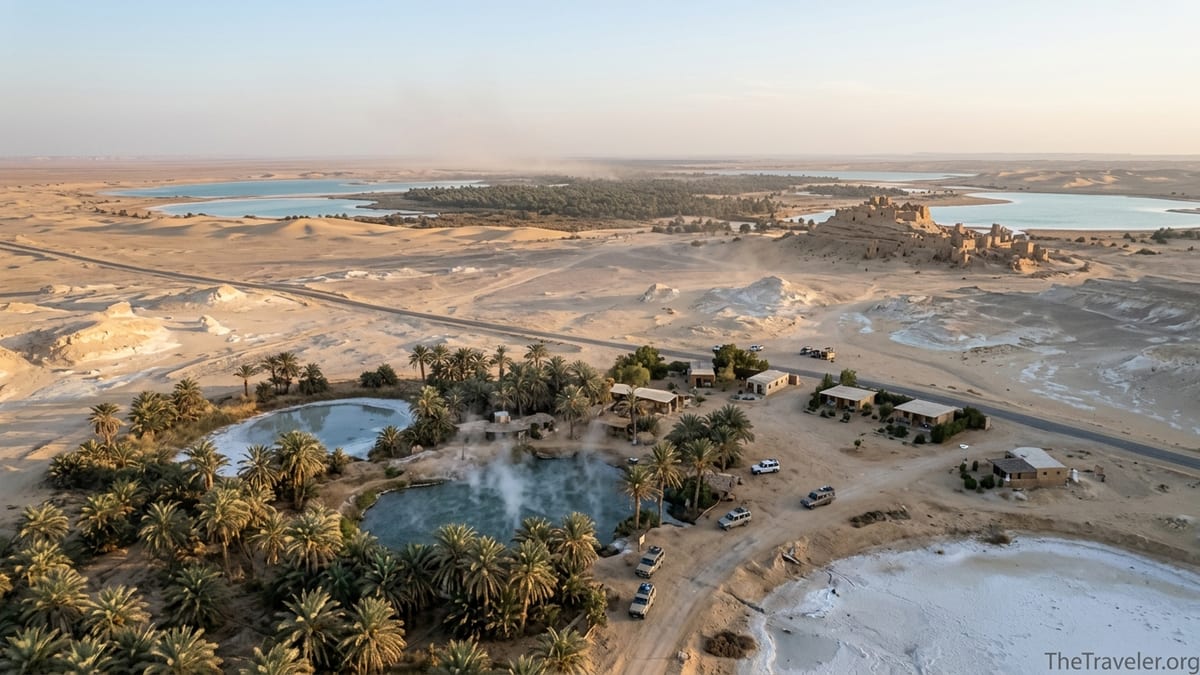
Siwa, by contrast, is famous for its distinct Amazigh (Berber) heritage and language, which locals still speak alongside Arabic. The crumbling mudbrick fortress-village of Shali rises above the palm groves, a honey-colored mass of organic architecture that glows at sunset. Nearby, the so-called Mountain of the Dead houses rock-cut tombs with painted decorations, and the Temple of the Oracle of Amun evokes the ancient visit of Alexander the Great, who reportedly sought confirmation of his divine status there.
This strong cultural identity infuses daily life. Traditional dress, Siwan handicrafts, local olive and date production, and a slower rhythm all make Siwa feel markedly different from Cairo and the Nile. The combination of ruins, palm gardens, donkey carts and salt-lake horizons creates an atmosphere that many travelers describe as stepping into a separate world. For culturally curious first-timers willing to undertake the longer journey, Siwa offers a richer sense of place, while Bahariya provides a more straightforward, functional base for nature-focused safaris.
Ecolodges, Accommodation Styles and Trip Budgets
Accommodation choices are central to the commercial decision of which oasis to visit first, because they shape both your budget and the style of your stay. In Bahariya, the core offering is a mix of modest hotels, safari camps and a growing number of ecolodges. Rooms in standard guesthouses or simple hotels can be relatively affordable by Egyptian standards, often appealing to budget and midrange desert travelers. Ecolodges and desert camps outside Bawiti sit in gardens or near small salt lakes, with adobe-style rooms, rooftop terraces and access to nearby hot or cold springs.
These Bahariya ecolodges often bundle accommodation with activities. A typical two-night package might include transfer from Cairo, a night in the oasis, an overnight White Desert safari with all meals, camping gear and national park fees, plus a return to Cairo. Pricing varies widely by comfort level and operator, but many first-time visitors appreciate that the package model simplifies logistics, particularly when they have just a few spare days at the end of a Nile-focused itinerary.
Siwa has seen a distinct wave of boutique and eco-conscious accommodation. At the upper end, famous desert lodges built from local kershef (a salt-and-mud mixture) are lit by candlelight at night and emphasize sustainability, local food and digital detox. Rates here can rival or exceed luxury hotels in Cairo, which positions them squarely in the splurge category. Alongside these icons, Siwa also offers midrange hotels near the center, family-run guesthouses, palm-garden chalets and basic hostels where backpackers share mattresses and blankets on rooftop terraces under the stars.
For a first Western Desert trip, your choice of oasis will likely track closely with your budget and what kind of lodging experience you want. If you need straightforward, good-value accommodation tied to a White Desert safari, Bahariya is practical and usually cheaper for the overall package. If you are ready to invest in a slow, design-forward desert retreat with days spent between salt lakes and candlelit dinners, Siwa’s ecolodges make a compelling argument for choosing it first, provided you can allocate enough nights to make the journey worthwhile.
Safari Styles, Activities and Ideal Trip Length
In Bahariya, the flagship activity is the classic White Desert safari. Typical itineraries from Cairo run for one or two nights. A two-day, one-night version might look like this in practice: early morning pickup in Cairo, midday arrival in Bahariya, jeep transfer through the Black Desert and Crystal Mountain, sunset in the White Desert, a night camping, then a leisurely breakfast and return to Bahariya, with an evening drive back to Cairo. For many travelers, this compact format fits neatly around other Egypt highlights and still provides a genuine sense of being out in the wilderness.
Beyond the White Desert circuit, Bahariya offers modest hiking in surrounding hills, visits to palm and olive groves, and short bike rides or walks around Bawiti. However, most itineraries remain two to three days long. Only dedicated desert enthusiasts tend to linger longer, often pairing Bahariya with onward journeys to Farafra, Dakhla and Kharga on multi-day expeditions.
Siwa invites a slower rhythm. Because of the long journey to reach it, most travelers aim for at least three days and two nights in the oasis, with four or five nights being more comfortable if time allows. A typical Siwa program might include walking or cycling between Shali, the Mountain of the Dead and the Oracle Temple, an afternoon soaking at Cleopatra’s Spring, a full day exploring several salt pools, and a dune safari into the Great Sand Sea with sandboarding and a sunset at Bir Wahed. Many visitors also include an evening up Jebel Dakrour or a stroll among the palm groves at golden hour.
Activity-wise, Siwa’s menu is more varied for those who like to explore at their own pace. It is easy to rent a bicycle, hire a tuk-tuk or negotiate with a donkey cart driver for short rides between sights, then punctuate the day with swims and café stops. That makes Siwa attractive to independent travelers and repeat visitors to Egypt who want more than a single marquee desert overnight. For a first-timer on a tight schedule, however, the shorter, more guided nature of Bahariya safaris may be less intimidating and easier to fit into a classic Cairo and Nile circuit.
Which Oasis Is Better First? Matching Destinations to Travelers
When you weigh accessibility, cost, activities and the feel of each place, a pattern emerges that helps answer the question of which oasis to visit first. For most first-time visitors to Egypt who want a taste of the Western Desert without re-organizing their entire itinerary, Bahariya is usually the more practical starting point. It is closer to Cairo, better integrated into conventional tour circuits and tightly linked to the White Desert experience that many travelers have at the top of their wish list.
Bahariya works especially well if you have only two or three spare days, are traveling with children or older relatives, or feel wary of very long road journeys. The ability to book a single package that includes round-trip transport from Cairo, a night or two in the oasis, a full White Desert safari and basic comforts upon return simplifies planning. The oasis town itself, with its modest hot springs and small-town atmosphere, gives you a digestible introduction to life in the Western Desert.
Siwa, by contrast, comes into its own for travelers who have more time and want a destination that feels self-contained. If you can spare at least three full days in the oasis and handle 8 to 10 hours on the road each way, Siwa rewards you with salt lakes, distinctive culture, atmospheric ruins and a stronger emphasis on wellness and contemplative slow travel. It is particularly appealing as a stand-alone escape at the beginning or end of an Egypt trip, or combined with days on the Mediterranean coast in Marsa Matrouh.
In commercial terms, the most robust strategy for many travelers is to start with Bahariya for a fast, high-impact first Western Desert encounter, then return to Egypt another year for a deeper, more immersive stay in Siwa. That progression mirrors the learning curve of desert travel: you begin with a guided White Desert overnight from Bahariya, gain confidence with the logistics and climate, and eventually graduate to a multi-day immersion in Siwa’s salt lakes, palm gardens and Amazigh heritage.
The Takeaway
Bahariya Oasis and Siwa Oasis both deliver on the promise of the Egyptian Western Desert, yet they serve different needs. Bahariya is the accessible gateway: four to five hours from Cairo, closely tied to the iconic White Desert and ideal for one- or two-night safaris that can be packaged seamlessly into a broader Egypt itinerary. Its hot springs, modest ecolodges and small-town setting give first-time visitors a manageable, rewarding taste of oasis life without demanding extensive planning.
Siwa, much further from Cairo, is a destination for travelers ready to commit more time, money and attention to a single place. Salt lakes where you float as if in the Dead Sea, famed springs like Cleopatra’s Bath, dune safaris in the Great Sand Sea and a strong Amazigh cultural identity combine into a slower, more immersive experience. It is less about ticking off a single landmark and more about settling into a rhythm of swimming, cycling and wandering through palm groves and mudbrick ruins.
If your first Western Desert priority is to see the White Desert and you have only a few days, choose Bahariya first and treat Siwa as a future trip. If you are able to dedicate close to a week to the desert and want an oasis that feels like a world apart, Siwa can justify being your first choice. Either way, starting with realistic expectations about distances, transport, and what each oasis does best will help you design a trip that fits both your calendar and your appetite for adventure.
FAQ
Q1. Is Bahariya or Siwa easier to reach from Cairo?
Bahariya is significantly easier, typically four to five hours by road, while Siwa usually requires an eight to ten hour journey and often an overnight bus.
Q2. Which oasis is better for seeing the White Desert?
Bahariya is the better base for the White Desert, with most classic overnight safaris starting there and combining the Black Desert, Crystal Mountain and chalk formations.
Q3. How many days do I need in Bahariya for a first visit?
Most first-time visitors are satisfied with two or three days, which allows for travel from Cairo, a White Desert overnight and a little time in the oasis itself.
Q4. How long should I plan for Siwa Oasis?
Because of the long journey, plan at least three full days and two nights in Siwa, with four or five nights preferable if you want time for salt lakes, springs and dune safaris.
Q5. Are there hot springs in both Bahariya and Siwa?
Yes. Bahariya has several hot and mineral springs, some attached to hotels and ecolodges, while Siwa offers well-known springs like Cleopatra’s Bath and Bir Wahed.
Q6. What is special about Siwa’s salt lakes?
Siwa’s salt lakes and small salt pools are extremely saline, so you float effortlessly. Many are managed by local families who charge a modest entrance fee and provide basic facilities.
Q7. Which oasis has more ecolodge-style accommodation?
Both have ecolodges, but Siwa is better known for high-end, design-focused eco properties built from traditional materials, alongside midrange hotels and guesthouses.
Q8. Is it safe to travel overland to Bahariya and Siwa?
Most trips run without incident, but conditions and permit rules can change. It is wise to check current travel advisories and use reputable local operators for transfers and safaris.
Q9. Can I visit both Bahariya and Siwa in one trip?
Yes, but combining them requires ample time and long desert drives. Many travelers focus on Bahariya plus the White Desert on a short trip, then plan a separate journey for Siwa.
Q10. For a first Western Desert trip, which oasis offers better value?
For short, high-impact trips that include the White Desert, Bahariya usually offers better value. Siwa becomes worthwhile value when you can stay longer and fully experience its lakes and culture.