


Few trips in Egypt capture the imagination quite like heading deep into the Western Desert. For many travelers, the real choice is not whether to go, but where: the remote palm-fringed Siwa Oasis near the Libyan border, or the otherworldly White Desert of chalk pinnacles and mushroom-shaped rocks near Bahariya and Farafra. Both promise big skies, sand dunes and stargazing, but the experiences could not be more different. This guide compares Siwa and the White Desert on culture, landscapes, camping, safaris, travel time from Cairo and accommodation, so you can decide which trip is better for you.
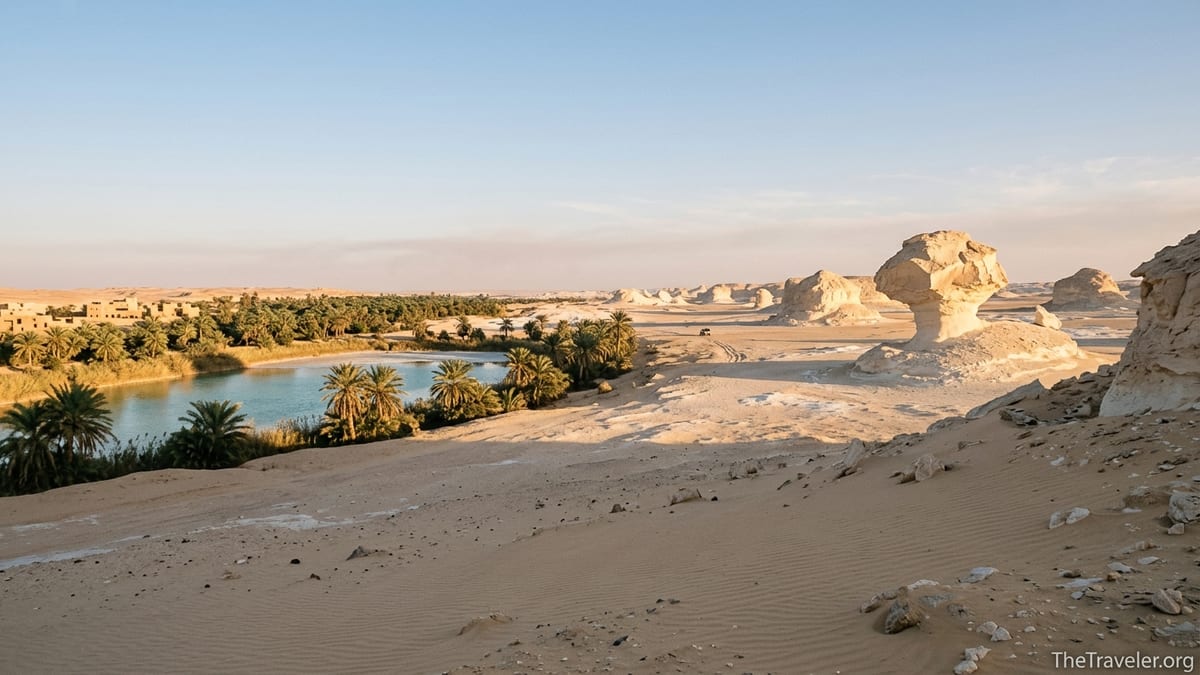
Western Desert Overview: Two Very Different Adventures
Siwa Oasis and the White Desert both lie in Egypt’s Western Desert, yet they offer almost opposite styles of travel. Siwa is a lived-in oasis town and surrounding palm groves, famous for its Berber-speaking community, ancient oracle temple and shimmering salt lakes. Days here are about slow wandering through mud-brick lanes, cycling to springs and joining 4x4 trips into the Great Sand Sea. By contrast, the White Desert is an empty national park of wind-sculpted chalk formations near Farafra and Bahariya where there is no permanent settlement inside the park. You sleep in basic desert camps, watch the sky blaze with stars, then return to an oasis base the next day.
Because of this contrast, many travelers use Siwa as a multi-day destination and the White Desert as a shorter camping safari. From Cairo, the White Desert region around Bahariya is typically 4 to 5 hours by road, making it realistic for one- or two-night trips that slot between Nile Valley sightseeing. Reaching Siwa from Cairo usually means a 9 to 12 hour road journey, sometimes split with an overnight on the North Coast or at Marsa Matruh, and most visitors stay at least three nights to justify the distance.
Choosing between them depends on what you want from your time in Egypt. If your priority is meeting local communities, soaking in hot springs and exploring archaeological sites, Siwa usually wins. If you dream of camping on soft sand under a bowl of stars, surrounded by surreal white rock formations and total silence, the White Desert is hard to beat. Time, budget, comfort level and season will all influence which of these Western Desert heavyweights comes out on top for you.
Getting There From Cairo: Distance, Time and Logistics
Travel time is one of the biggest practical differences. To reach Siwa from Cairo, you are looking at roughly 560 kilometers by road. In practice, direct overland journeys usually take 9 to 12 hours depending on route, traffic, rest stops and whether you go via Alexandria and Marsa Matruh or take a more direct desert highway. Some specialized operators package this into multi-day itineraries that include an overnight in Matruh and several days of guided touring around Siwa’s springs and dunes, which softens the long haul but adds to the overall cost.
By contrast, the gateway to the White Desert is Bahariya Oasis, roughly 365 kilometers from Cairo. Most private cars and tour jeeps cover this in about 4 to 5 hours on paved road. From Bahariya, it is another stretch into the White Desert National Park and nearby Black Desert and Crystal Mountain, usually as part of a licensed 4x4 safari. Because the driving time is shorter, a common pattern is to leave Cairo early one morning, arrive in Bahariya by midday, head out into the desert in the afternoon, camp overnight, and be back in Cairo by the following evening.
In practical terms, Siwa is best for travelers who can spare at least four to five days in their itinerary, including travel days. The White Desert can work even if you only have two or three days spare. There are local buses between Cairo and both Bahariya and Siwa, which remain the cheapest options, but almost all White Desert campers book a package that bundles transport, permits, camp gear and meals. For Siwa, some visitors use a mixture of public bus or shared minivan to Marsa Matruh then private transfer onward, while others book door-to-door transfers directly with their Siwa lodge.
Landscapes & Atmosphere: Oasis Culture vs Surreal Chalk Formations
Siwa’s appeal rests on its combination of lush oasis scenery and surrounding dunes. The town and its satellite villages sit in a depression ringed by escarpments and the Great Sand Sea, with a central salt lake and pockets of palm groves fed by natural springs. Climbing the crumbled mud-brick citadel of Shali gives you a panorama of green date palms, olive trees and water glinting between them. A short drive away, the desert quickly takes over, with golden sand ridges where 4x4s carve tracks and travelers try sandboarding before watching sunset over the dunes.
The White Desert is visually starker and more abstract. Just north of Farafra, the pale chalk surface suddenly erupts into thousands of formations shaped by millennia of wind. Some resemble giant mushrooms, others look like chickens or camels depending on your imagination, all glowing cream or bright white against orange desert light. Nearby, the Black Desert is a low landscape of volcanic-looking hills topped with dark basalt, while Crystal Mountain is known for glittering quartz embedded in its rocky arch. This is not a lived-in landscape but a sculptural one that feels closer to walking through a gigantic open-air gallery.
Atmosphere also differs. Siwa is calm but lived in, with donkey carts rattling along dusty lanes, men in long galabeyas gathering in small cafes, and children cycling between palm trees. You might hear Amazigh music at a local event or watch women selling embroidered Siwan dresses. In the White Desert, the only lights after sunset are your campfire and the stars. The silence at night is so complete that even the sound of your own footsteps on sand feels amplified. Many travelers describe their first sight of the chalk formations at dusk as one of the most otherworldly moments of their time in Egypt.
Culture, History and Everyday Life in Siwa vs the White Desert
Siwa is one of Egypt’s most distinctive cultural enclaves. The majority of residents are Siwan Berbers who have their own language and traditions alongside Arabic and wider Egyptian culture. Walking through the remains of the old Shali fortress or visiting the small traditional houses around it, you see architecture built from kershef, a mixture of salt and mud that naturally keeps interiors cool. Women’s festivals, local marriage customs and the continued use of ancient olive presses give Siwa a sense of continuity that appeals to travelers interested in human stories as much as landscapes.
Historically, Siwa was famous in the ancient world for the Temple of the Oracle of Amun, where rulers including Alexander the Great are believed to have sought divine approval. Visitors today can explore the ruins on a low hill outside town, as well as Gebel al Mawta, the “Mountain of the Dead,” with rock-cut tombs dating back to the late Pharaonic and Greco-Roman periods. Even simple experiences like soaking in “Cleopatra’s Bath” spring or watching the evening crowd gather in the main square underline that Siwa is a living community rather than a museum.
By comparison, the White Desert has almost no permanent inhabitants inside the protected area itself. Its cultural layer is experienced mostly through the Bedouin guides and oasis communities of Bahariya and Farafra who run safaris, cook meals and share stories around the fire. In Bahariya, you may notice more contemporary history, such as references to the “Valley of the Golden Mummies” discovered near Bawiti, or small local museums. Yet most visitors who book a one- or two-night White Desert camping trip spend limited time in the town and focus on the natural spectacle of the park instead.
This means that if you are drawn to Egypt for temples, tombs and everyday life, Siwa offers far more content. You could spend a full day moving between archaeological sites, then another day visiting craft workshops or family-run date farms. In the White Desert, cultural interaction is more concentrated in your guide and crew, and the focus tilts overwhelmingly toward the physical environment.
Salt Lakes, Springs and Desert Activities
One of Siwa’s signatures is its saline landscape. The oasis is ringed by salt lakes and pools, some developed into photogenic swimming spots by local entrepreneurs. Travelers often spend a late morning floating in turquoise salt pools in reclaimed salt pans, their bodies buoyed effortlessly by the dense water. These pools are simple but atmospheric settings, sometimes with basic shaded seating and tea service, making them a favorite for photographers. Many lodges also arrange visits to hot and cold springs such as Cleopatra’s Bath or more secluded pools on the edges of the Great Sand Sea.
Desert activities around Siwa typically revolve around the Great Sand Sea. A standard afternoon 4x4 excursion might include dune bashing over roller-coaster sand ridges, sandboarding on tall slopes, a visit to a cold spring hidden in the dunes, and sunset tea at a high vantage point before returning to town. Some operators and ecolodges arrange overnight camping in the dunes with simple tents, campfires and traditional dinners. Prices vary widely: short 4x4 trips with sandboarding can start in the low hundreds of Egyptian pounds per person in a group, while private, fully catered overnight safaris with a reputable lodge often cost significantly more.
In the White Desert, activities are centered entirely on the national park and adjacent attractions. Classic overnight safaris from Bahariya typically combine several stops: the Black Desert with its dark volcanic caps, Crystal Mountain with translucent mineral veins, and various viewpoints in the White Desert where you walk among chalk pinnacles at sunset and sunrise. Camping is usually “wild,” meaning your crew sets up a simple camp directly on the sand with windbreaks, sleeping mats, blankets and sometimes low tents. As of 2026, many operators quote prices for a one-night White Desert trip in the rough range of about 120 to 220 US dollars per person from Cairo depending on group size and level of comfort, often including transport, meals, permits and camping equipment.
While you can sandboard in both regions, the feeling is different. Around Siwa, the dunes are warmer in tone and framed by occasional palm groves and lakes. In the White Desert, you are sliding near eerie white outcrops and darker volcanic hills. Snorkeling or water-based activities are not a major feature in either destination, but the combination of springs and salt pools makes Siwa more suitable if you like to punctuate desert days with swims.
Accommodation Styles and Comfort Levels
Accommodation is another key distinction. In Siwa, you have a growing range of ecolodges and guesthouses built in traditional styles using local materials. At the high end, places such as Adrere Amellal near Gebel Dakrur have drawn international attention for their candlelit mud-brick rooms, views over salt lakes and a deliberate absence of modern distractions like televisions. These properties can be priced on par with boutique hotels in Cairo and are aimed at travelers seeking “desert chic” rather than budget simplicity.
Mid-range travelers can choose from numerous smaller ecolodges and retreats scattered around the oasis, some positioning themselves as wellness stays with yoga terraces and salt-based spa treatments. Recent listings on major booking platforms show well-reviewed lodges with pools and palm gardens typically starting from moderate nightly rates by international standards, though prices fluctuate by season and demand. At the lower end, basic family-run guesthouses in or near the town center offer simple en-suite rooms and home-cooked meals that appeal to backpackers and independent travelers.
In the White Desert, there are no permanent hotels inside the park, so your “room” is usually a sleeping bag on mattresses under a canvas or open sky. Bahariya and Farafra do have small hotels and camps where you might spend a night before or after your safari, but most visitors rate the highlight as the night in the desert itself. Comfort levels vary by operator: some provide thicker mattresses, windbreaks, private chemical toilets and plentiful blankets, while ultra-budget trips can feel quite basic. If you need a proper bed every night, the White Desert may be more challenging unless you arrange a trip that bases you at a lodge and only enters the park for day visits.
For families with young children or travelers who sleep lightly, Siwa’s fixed accommodations with reliable bathrooms and electricity are generally more relaxing. Couples seeking romance often gravitate to atmospheric ecolodges around Siwa’s salt lakes. On the other hand, adventure travelers who do not mind roughing it are often willing to trade hotel comfort for one unforgettable, if chilly, night on the sands of the White Desert.
Camping, Safety and Regulations
Camping set-ups differ significantly. Around Siwa, overnight trips into the dunes are typically run by local guides and lodges who set up small camps in the Great Sand Sea or by remote springs. Regulations are looser than in a national park, and groups tend to be smaller and more improvisational, though responsible operators still pay attention to weather, navigation and leaving minimal trace. Nights are usually spent around a campfire eating simple grilled meals, with opportunities to listen to local music or stories under the stars.
The White Desert is a protected national park, and camping is regulated by the park authorities. Travelers enter with licensed 4x4 drivers who know designated camping zones and rules about fires, waste and off-road driving. Recent management plans emphasize minimizing impact, which is why most foreign visitors are encouraged to go with recognized operators rather than trying to arrange independent trips. For safety, guides monitor weather conditions such as strong wind or sandstorms and choose camp spots accordingly, usually in natural hollows or behind formations that break the wind.
In terms of perceived safety, both destinations are well established on Egypt’s tourist circuit, but conditions can change and travelers should always check current advice from their governments and local contacts before booking. Long desert highway drives, particularly at night, can be tiring, so many visitors prefer arrangements where a professional driver handles the journey. For solo travelers, joining a group White Desert safari from Cairo or Bahariya can be a convenient way to experience camping while spreading costs and ensuring there are multiple people around in case of minor issues.
Equipment-wise, the White Desert typically requires warmer clothing and better wind protection at night, especially in winter, since you are exposed on open terrain. In Siwa’s dunes, nights can also be cold, but those who do not wish to camp can simply base themselves in a lodge and venture out only for afternoon and sunset activities, making the overall experience feel more controlled.
Who Should Choose Siwa, Who Should Choose the White Desert?
Not every Western Desert destination suits every type of traveler. Siwa tends to suit people who prefer slower travel and are willing to invest time to reach a unique place. It works particularly well for couples, photographers, wellness-focused travelers and culture seekers who value the mix of springs, salt lakes, traditional architecture and gentle desert adventures. Families with children often appreciate having a stable base with a pool, shaded gardens and regular meal times, alongside short, tailored excursions into the dunes that can be adjusted to energy levels.
The White Desert, meanwhile, is ideal for those chasing an intense but relatively short desert immersion. Adventure travelers, backpackers on limited time, and people building a varied Egypt itinerary often add a one-night or two-night White Desert safari between classic sites such as Cairo and Luxor. If you love hiking on strange terrain, photographing naturally sculpted rocks, and watching the sky change color over an unbroken horizon, this is likely to be your pick. It can also be a memorable highlight for small groups of friends who do not mind sharing basic camp conditions and early starts.
From a budget perspective, both destinations cover a wide range, but the cost structures differ. Siwa can be kept fairly affordable if you choose simple guesthouses and public transport, though longer stays and remote ecolodges will raise daily costs. The White Desert, by contrast, often consolidates expenses into one fixed safari price that includes almost everything for the duration of the trip. Travelers who like clear, all-inclusive pricing may find that more straightforward, while those who prefer to fine-tune each element might gravitate toward Siwa’s a la carte style of planning.
If you have a week or more and want to go deep into oasis life, Siwa usually offers more layers to peel back. If you only have a couple of spare days around Cairo but want a story to tell that feels far removed from the city, the White Desert delivers high impact for relatively little time investment. Some travelers with flexible schedules ultimately choose to combine both, visiting Siwa on one trip to Egypt and keeping the White Desert in reserve for a future visit, or vice versa.
The Takeaway
Deciding between Siwa Oasis and the White Desert is less about which is “better” in absolute terms and more about which experience fits your travel style, timeframe and expectations for Egypt. Siwa offers a rare blend of Berber-influenced culture, ancient ruins, salt lakes and springs, framed by the rolling dunes of the Great Sand Sea. It requires a long journey from Cairo and rewards those who slow down, linger in ecolodges, and let the rhythms of oasis life sink in.
The White Desert, on the other hand, is a compact, high-impact adventure focused on surreal landscapes and nights under the stars. Its proximity to Cairo via Bahariya makes it a realistic two-day escape from the city, and most of your budget goes into a single safari package that covers transport, meals and camping. You will come home with photographs of chalk formations and night skies that look almost unreal, even though the experience itself is entirely grounded in the rawness of the Sahara.
If you crave cultural immersion, varied day trips and a comfortable base with options to camp or not, Siwa is probably your Western Desert match. If you dream of stripped-back wilderness, simple camps and waking up surrounded by white rock towers and silence, the White Desert is likely to leave the deeper imprint. Whichever you choose, planning with reputable guides, realistic expectations about comfort and climate, and respect for fragile desert environments will turn your Western Desert side trip into one of the most memorable chapters of your time in Egypt.
FAQ
Q1. Is Siwa Oasis or the White Desert easier to visit from Cairo on a short trip?
The White Desert is generally easier for short trips from Cairo, as Bahariya Oasis is usually about 4 to 5 hours by road, making one- or two-night safaris realistic. Siwa typically requires 9 to 12 hours of travel each way, so it suits travelers with at least four or five days to spare.
Q2. Which destination is better if I want to meet local communities?
Siwa is better for cultural immersion. It is a living oasis with Siwan Berber communities, traditional architecture, markets and historic sites, so you naturally interact with local life. In the White Desert, cultural contact is mostly through your guides and the small oasis towns of Bahariya or Farafra.
Q3. Where will I find more comfortable accommodation options?
Siwa offers a wider range of fixed accommodation, from high-end ecolodges and wellness retreats to mid-range guesthouses and basic family hotels. In the White Desert itself, you sleep in simple desert camps and rely on more conventional lodgings only before or after the safari in nearby oases.
Q4. Can I camp in both Siwa and the White Desert?
Yes, you can camp in both. Around Siwa, local guides organize camping in the Great Sand Sea with simple tents and campfires. In the White Desert National Park, overnight camping is usually part of an organized safari that follows park regulations and uses designated areas.
Q5. Which is better for photography, especially landscapes?
Both are excellent but in different ways. Siwa is photogenic for its combination of palm groves, mud-brick ruins, salt lakes and golden dunes. The White Desert stands out for dramatic chalk formations, stark contrasts between white rock and blue sky, and spectacular night skies for astrophotography.
Q6. How much does a typical White Desert overnight safari cost?
Prices vary by operator and comfort level, but many one-night White Desert safaris from Cairo fall in a broad range that might be around 120 to 220 US dollars per person, often including transport, meals, permits and basic camping gear. Trips starting from Bahariya alone can be somewhat cheaper.
Q7. Is Siwa significantly more expensive than the White Desert?
Siwa can be either modest or expensive depending on your choices. Simple guesthouses and local cafes keep costs reasonable, but long transfers and high-end ecolodges can raise the budget. The White Desert often concentrates spending in a single safari package, which may feel straightforward even if the nightly cost is relatively high compared with budget stays in Siwa.
Q8. Which destination is better for families with children?
Families usually find Siwa easier because it offers stable accommodation, more flexible daily schedules and options to mix short dune trips with time by pools or springs. The White Desert can be magical for older children who enjoy camping and do not mind basic facilities, but very young kids or those who sleep lightly may struggle with cold nights and limited amenities.
Q9. Are there any special permits needed to visit either place?
Permits for the White Desert National Park are typically handled by your safari operator and included in the package price. Siwa itself does not usually require special permits for standard tourist visits, though security checks are common on desert roads and regulations can change, so it is wise to confirm current requirements with your accommodation or agency.
Q10. If I have time for only one Western Desert destination, which should I choose?
If you prioritize culture, history, springs and a comfortable base, Siwa is likely the better choice. If you want a concise, high-impact wilderness experience with one or two nights of camping under extraordinary rock formations, the White Desert is more suitable. Your decision should reflect your time frame, comfort preferences and whether you are more drawn to people and places or to pure desert scenery.