


For many travelers, Middle Egypt is the most tempting gap on the map between Cairo and Luxor. Names like Beni Hassan, Tell el-Amarna and Tuna el-Gebel evoke some of Egypt’s most fascinating but least-visited ancient landscapes. The challenge is how to see them without committing to a full-on overland or cruise itinerary. Today, a handful of operators sell private Cairo–Minya runs that package Beni Hassan and Amarna into a single day, while most two-day products add Tuna el-Gebel and a night in Minya. This guide breaks down the trade-offs so you can decide whether a very long same-day trip or an overnight in Minya fits your style, stamina and schedule.
Understanding the Route from Cairo to Minya
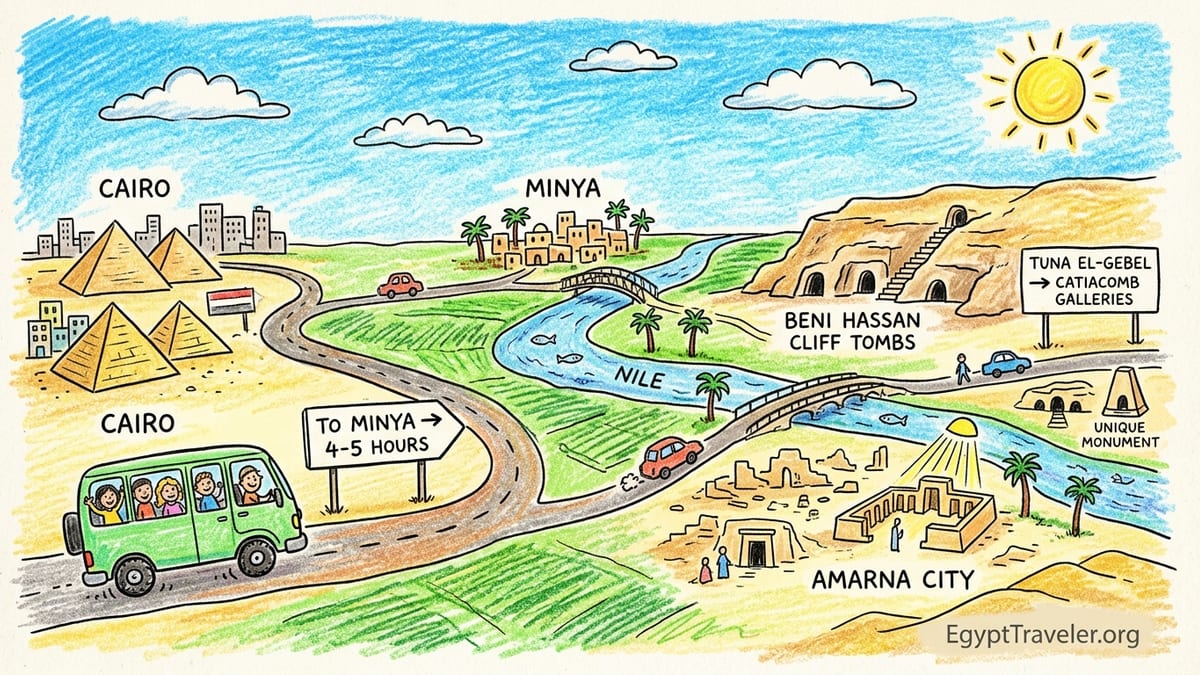
Middle Egypt begins roughly where the fertile Nile Valley narrows south of Cairo, with Minya as its main urban hub. From a traveler’s perspective, almost every modern itinerary to Beni Hassan and Tell el-Amarna is anchored on the road between Cairo and Minya. The drive is usually via the main desert highway that parallels the Nile, then cuts across to the river and the archaeological sites.
Driving time is the first major factor in your planning. Most reputable tour companies currently quote about 4 to 5 hours each way between Cairo and Minya in a private air-conditioned vehicle, depending on traffic leaving Cairo, rest stops and security checkpoints. In practice, travelers commonly report a real-world one-way time of around 4.5 to 5 hours, which means you should assume 9 to 10 hours of road time for a same-day return.
The sites themselves are scattered along both banks of the Nile. Beni Hassan lies on the east bank roughly 20 kilometers south of Minya, high on a limestone cliff that looks back across the river. Tell el-Amarna is further south again, still within Minya governorate, on a broad desert bay that once cradled Akhenaten’s experimental capital. Tuna el-Gebel sits on the opposite, west bank closer to Minya, forming a triangle of sites that are simply too spread out to tick off casually.
Because of the distances and security formalities, independent self-drive is rare. Most visitors either book a private tour from Cairo that includes all permits and a licensed Egyptologist, or they base themselves in Minya for one or two nights and have a local operator arrange the day’s circuits with police notifications handled in the background.
The Very Long Same-Day Private Tour from Cairo
A handful of Cairo-based agencies will quote a “Beni Hassan and Amarna in one day” private excursion. In promotional copy it can sound deceptively straightforward: early pickup in Cairo, drive to Minya, visit Beni Hassan and Tell el-Amarna, then drive back to Cairo in the evening. On paper this often appears as a 16 to 18-hour door-to-door day, with first pickup around 4:00 or 5:00 in the morning.
Once you strip out road time, the margins are tight. With 9 to 10 hours spent in the vehicle, plus at least an hour for lunch and basic breaks, you are left with perhaps 5 to 6 hours on the ground for both sites and any mandatory security checks. Many same-day itineraries respond by trimming Amarna to a quick look at the northern tombs and a drive-by or brief stop at the Royal Tomb route, plus a compressed visit to one or two key tombs at Beni Hassan.
Travelers who have done this route in one day describe arriving back in Cairo somewhere between 9:00 pm and close to midnight, depending on their starting neighborhood. The return leg after dark can feel long, especially if you are not used to intensive road trips. Jet-lagged visitors or those traveling in hotter months may find the combination of a pre-dawn start, high-sun tomb climbs and nighttime highway driving particularly draining.
This format still suits a narrow slice of travelers. If you are short on days in Egypt, comfortable with long road journeys and primarily want the “I have been” checkmark for both Beni Hassan and Amarna, a same-day tour delivers fast access. It can also make sense for repeat visitors who know exactly what they want to prioritize on site and are willing to sacrifice depth for efficiency.
Minya Overnight: How a Two-Day Route Changes the Experience
Most current tour products that market Beni Hassan and Amarna together recommend a two-day structure with an overnight in Minya. Several well-known Egyptian agencies now sell nearly identical private itineraries: morning departure from Cairo, visits to Tuna el-Gebel and sometimes a local museum on day one, overnight at a three or four-star hotel in Minya, then a full day around Beni Hassan and Tell el-Amarna on day two before returning to Cairo in the evening.
The key advantage is how this reorganizes your time. Instead of trying to accomplish everything in a single 16-hour push, you spread both the drive and the sightseeing over roughly 36 hours. Day one becomes a gentler run down from Cairo with a major stop at Tuna el-Gebel. You check into your Minya hotel by late afternoon or early evening, have dinner at a normal hour and sleep in a proper bed rather than napping upright in a car.
On day two you can leave Minya after breakfast, reach Beni Hassan in around an hour and give the cliff tombs a reasonable amount of time before continuing to Amarna. Many itineraries advertise visits to multiple rock-cut tombs at Beni Hassan along with the painted scenes of wrestling, desert hunts and daily life that the site is famous for. With an overnight schedule, guides have more flexibility to tailor the sequence based on weather, your energy level and whether security escorts require adjustments.
The quality of the Minya stay varies by operator and budget. A typical midrange package might include a local four-star Nile-side hotel, breakfast buffet, two lunches at local restaurants and a private vehicle throughout. Prices displayed by several operators for a full two-day Cairo–Minya–Cairo loop, including Beni Hassan, Amarna and Tuna el-Gebel, commonly fall in the mid hundreds of US dollars per person in a private party, with decreasing per-person rates for small groups. Exact pricing shifts seasonally and by room standard, but the overnight format consistently carries a smaller time cost for a much larger gain in comfort and depth.
Sightseeing Time on the Ground: What You Actually See
For most travelers, the real question is not the clock but what those hours let you experience. At Beni Hassan, the main draw is the row of Middle Kingdom tombs carved into the cliff. Even a short visit involves a steep walk up steps from the parking area to the tomb terrace, where several of the best-preserved tombs line the face of the hill. A rushed tour might only step into one or two, giving you a glimpse of the wrestling scenes and desert hunts. With more time, your Egyptologist can linger over scenes of labor, warfare and daily life that are rarely this well preserved elsewhere in Egypt.
Tell el-Amarna is more spread out. The core visitor circuit usually includes a cluster of northern tombs with their early Atenist art, the remains of Akhenaten’s city on the desert floor and, when practical, the route into the wadi that holds the Royal Tomb. Even in a private vehicle with a driver waiting, moving between these zones takes time on rougher desert roads. Under a same-day schedule, guides often have to make hard choices about which stops to prioritize, especially if the local antiquities office sets fixed closing times or security teams impose a back-to-Minya deadline.
Tuna el-Gebel, added on many overnight routes, contributes a different atmosphere again. Here you walk down into long catacomb galleries and visit monuments like the Tomb of Petosiris, combining late Pharaonic and early Hellenistic artistic styles. The experience is less about cliff views and more about the quiet interior spaces and the cumulative effect of thousands of ibis and baboon burials. While you could technically skim this stop in an hour, its value grows if you can slow down and let your guide unpack the layers of cult, burial and reuse.
In practice, a two-day itinerary from Cairo via Minya allows roughly double the on-site time compared with a very long single day, without multiplying your road hours. You are still spending around 9 to 10 hours in the vehicle overall, but you are no longer cramming your entire encounter with three complex archaeological zones into the exhausted middle of the day.
Guides, Security Permits and Practical Requirements
Because Beni Hassan, Amarna and Tuna el-Gebel sit in a region with more formal security oversight than the Giza plateau or central Luxor, most travel companies insist on pre-arranged, private or small-group tours rather than fully independent arrangements. When you book through a Cairo or Minya-based operator, they typically handle the required notifications to local police and antiquities authorities, and they make sure a licensed Egyptologist is assigned to your party.
You can expect your Egyptologist-guide to stay with you from departure in Cairo through to your return, especially on private tours sold through larger agencies. In some cases, particularly with overnight trips, the company may use a Cairo driver and then work with additional local escorts or police convoys as required by the governorate. This usually happens behind the scenes: from the traveler’s side, you simply see an extra police vehicle at certain stretches of road or an officer joining your car for portions of the route.
Passport and information requirements vary slightly by operator but are generally straightforward. Many companies ask for passport scans in advance, sometimes at least 24 to 48 hours before your tour date, so they can submit details for permits or security paperwork. Others will simply photocopy your passport at pickup and handle notifications en route. In all cases you should carry your physical passport with you on the day, as checkpoints may request to see it. Travelers staying overnight in Minya are also required to provide passport details to their hotel for registration, just as in Cairo.
Meals are commonly bundled into tour prices. A typical same-day Cairo–Minya–Cairo product includes at least one lunch at a simple local restaurant in or near Minya, plus bottled water in the vehicle. Overnight packages usually add a second lunch and hotel breakfast, and may or may not include dinner, depending on the price level. If dinner is not included, you can generally eat in the hotel or at a nearby Nile-side restaurant, but options will be simpler than in Cairo or Luxor. Dietary needs are usually accommodated if you inform the operator ahead of time.
When a One-Day Tour Becomes Too Rushed
The tipping point between “long but worthwhile” and “simply too rushed” depends on your priorities. For many travelers, the decisive factor is how much time they are prepared to spend in a vehicle relative to how much time they want at the sites themselves. Once road time exceeds on-the-ground time by more than two to one, the experience begins to feel compressed rather than exploratory.
A practical rule of thumb is this: if your schedule allows even a single night away from Cairo, moving to an overnight Minya itinerary usually provides a better balance. By adding 12 to 16 hours of calendar time, you transform an exhausting there-and-back dash into a trip where each of the three main sites can receive at least a solid half-day of attention. This is particularly important for Amarna, whose power lies in the sense of moving through an entire former cityscape rather than just checking a tomb off your list.
A one-day tour starts to make less sense if you are traveling in the heat of late spring or summer, if you know you struggle with early starts or if you have a strong academic or personal interest in the Amarna period. Under those conditions, trying to combine Beni Hassan and Amarna in a single day from Cairo almost guarantees that you will have to abandon sections of the sites or skim through them without context. Families with younger children and older travelers often find the stair climbs at Beni Hassan and the desert exposure at Amarna particularly punishing after hours in the car.
On the other hand, if you are in Egypt on a very tight business schedule, are already acclimatized to long overland days, and primarily want a visual introduction rather than deep study, a same-day trip can still be justified. The crucial step is to acknowledge the trade-offs frankly and discuss them with the operator in advance: ask exactly how long you will spend at each site, what time they realistically expect to return to Cairo, and which tombs or zones the guide typically includes or omits.
Is Tuna el-Gebel Worth Adding on a Two-Day Itinerary?
Many of the two-day Middle Egypt products now on offer explicitly highlight Tuna el-Gebel as a third pillar alongside Beni Hassan and Amarna. On a map it might look like an optional extra, but in practice it rounds out the narrative of the region in a way that most visitors find rewarding. Where Beni Hassan speaks to Middle Kingdom provincial elites and Amarna to a brief, radical religious experiment, Tuna el-Gebel brings in the later, more cosmopolitan world of animal cults, Greek influence and shifting funerary practices.
The most common visitor route at Tuna el-Gebel includes the catacombs associated with the cult of Thoth and the Tomb of Petosiris. Even with a brisk pace, this site is difficult to appreciate properly in less than 60 to 90 minutes. Catacomb galleries require careful walking, and guides often pause to explain how literally millions of mummified ibis and baboons ended up in this remote stretch of desert. The Petosiris tomb itself rewards time in front of its unusual reliefs and paintings, which blend Egyptian and Greek artistic conventions.
Because Tuna el-Gebel lies closer to Minya than Amarna, it fits naturally into day one of an overnight circuit. You drive down from Cairo, have lunch, explore Tuna el-Gebel at a human pace and then continue on to your Minya hotel. From a purely logistical point of view, adding this stop on a two-day route costs relatively little additional road time yet dramatically expands the range of periods and religious practices you encounter.
From a traveler’s perspective, Tuna el-Gebel is often the unexpected highlight. People arrive with high expectations for Amarna, given its association with Akhenaten and Nefertiti, but they leave talking about the eerie catacombs and the hybrid art of Petosiris. For that reason, if you are debating whether to stretch your budget or timetable to accommodate a two-day route, the presence of Tuna el-Gebel is a strong argument in favor. It turns a demanding but focused historical excursion into something closer to a miniature Middle Egypt survey course.
Choosing the Right Format for Your Trip
To decide between a very long day trip and an overnight in Minya, start by clarifying your non-negotiables. If you absolutely must sleep in Cairo every night, and you only have a single free day, then your choice is effectively between a one-day private Cairo–Minya circuit or postponing Middle Egypt for a future journey. In that scenario, it makes sense to look carefully at recent traveler feedback about specific operators, ask pointed questions about realistic return times and confirm which parts of Amarna and Beni Hassan they routinely include.
If you can spare one night away from Cairo, an overnight becomes the more rational choice for most travelers. You will still experience a long drive, but you are buying real time among the tombs and ruins rather than extra hours on the highway. You also gain the softer benefits of waking up in a Nile-side provincial city, seeing a different slice of Egyptian daily life and having the flexibility to adjust your on-site schedule if the weather or security protocols shift unexpectedly.
Budget is another consideration. Because the vehicle, guide and entry fees are major fixed costs, many operators price a private two-day Middle Egypt tour only moderately higher than an intensive one-day version, especially for two or more people traveling together. Hotel rates in Minya are also generally lower than in central Cairo. When you factor in the additional meals included on overnight packages, the price difference per person may be smaller than it appears at first glance.
Finally, think ahead to the rest of your Egyptian itinerary. If you are already devoting several days to the classic Cairo and Luxor highlights on this trip, the overnight Middle Egypt route becomes a unique add-on that exposes you to different periods and landscapes. If, on the other hand, you are using this visit primarily to sample Egypt for the first time, you may prefer to keep logistics simpler and concentrate on the better-served sites closer to the major tourist centers, saving Middle Egypt for a later, more specialized journey.
The Takeaway
Visiting Beni Hassan and Tell el-Amarna from Cairo is entirely feasible without a longer regional odyssey, but how you approach it will shape your experience. A very long same-day private tour offers speed and the satisfaction of checking both sites off your list, at the cost of compressed visits and a heavy ratio of bus time to exploration. For travelers on tight schedules, used to long road days and content with a high-level overview, this can still be an acceptable, if intense, choice.
For most visitors, though, the overnight Minya route delivers better value. By spending one night in Minya, you transform a draining marathon into a two-day journey that allows meaningful time at Beni Hassan, Tell el-Amarna and Tuna el-Gebel. You still return to Cairo without committing to a full Nile cruise or an extended overland itinerary, but you gain a much deeper understanding of Middle Egypt’s role in the broader story of the Nile Valley.
If you have the option, treat Middle Egypt as a compact expedition rather than a hurried side trip. Ask your operator detailed questions about driving times, exact sightseeing schedules, guide qualifications and permit handling before you book. With realistic expectations and the right format, a short foray to Minya can become one of the most memorable and revealing segments of your time in Egypt.
FAQ
Q1. How long does the drive from Cairo to Minya take in real conditions?
Most travelers should plan on about 4.5 to 5 hours each way in a private vehicle, including traffic, rest stops and possible security checkpoints, so around 9 to 10 hours of total road time for a round trip.
Q2. Is a one-day Cairo–Minya–Cairo tour to Beni Hassan and Amarna realistic?
It is realistic but very demanding. Expect a pre-dawn departure, a late return to Cairo and only limited time at each site. It suits travelers comfortable with long road days who accept that their visits will be more of an overview than an in-depth exploration.
Q3. What extra value does staying overnight in Minya provide?
An overnight in Minya spreads the driving over two days, allows more relaxed and detailed visits to Beni Hassan and Amarna, and usually adds Tuna el-Gebel, giving you a much broader picture of Middle Egypt’s archaeology.
Q4. Do I need to provide my passport details in advance for these tours?
Many operators ask for passport scans 24 to 48 hours in advance to handle security notifications and permits, and you must carry your physical passport on the tour for hotel registration and possible checkpoints.
Q5. Are meals generally included on Middle Egypt tours from Cairo?
Yes, at least one lunch is usually included on a one-day tour, while overnight packages commonly include hotel breakfast and two lunches, with dinner either included or easily arranged at your Minya hotel or a nearby restaurant.
Q6. How demanding is the walking at Beni Hassan and Tell el-Amarna?
Beni Hassan involves a fairly steep climb up steps to the cliff tombs, which can be strenuous in hot weather. Tell el-Amarna is more spread out, with short walks at multiple stops, often in exposed desert conditions without much shade.
Q7. Is Tuna el-Gebel worth the extra time on a two-day tour?
Most travelers find Tuna el-Gebel very worthwhile, especially for its catacombs and the Tomb of Petosiris. It adds distinctive late Pharaonic and Hellenistic layers that you will not see at Beni Hassan or Amarna, and it fits naturally into a two-day itinerary.
Q8. Can I arrange this trip independently using trains or public transport?
While it is technically possible to reach Minya by train and hire local guides, most visitors rely on organized tours because of security notifications, scattered sites and limited local transport options between Minya and the archaeological zones.
Q9. What kind of guide should I expect on these tours?
Reputable operators provide a licensed Egyptologist who travels with you from Cairo, explains the history on site and coordinates with local authorities. On overnight trips you usually have the same guide throughout the two days.
Q10. When does the one-day option become too rushed to recommend?
For most travelers, if you have even one night free to spend away from Cairo, the one-day option becomes unnecessarily rushed. The overnight Minya route offers a far better balance of road time, comfort and meaningful sightseeing.