


The overnight sleeper train from Cairo to Luxor and Aswan remains one of Egypt’s classic journeys and, for many visitors, a practical way to combine transport and accommodation in a single night. With the opening of Cairo’s new Upper Egypt (Bashtil) station and evolving train timetables, planning this route in 2026 is slightly more complex than it used to be. This guide walks you through cabins, tickets, meals, luggage, Bashtil station arrangements and how the sleeper compares with daytime trains and domestic flights, so you can choose the best option for your itinerary.
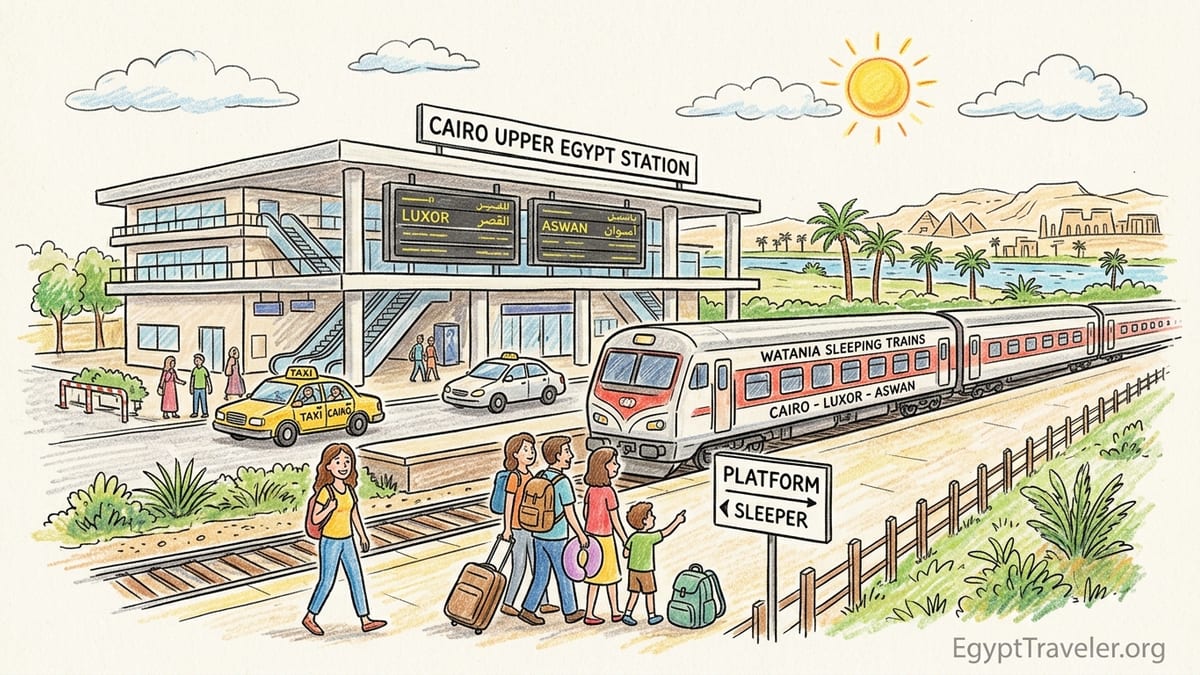
Bashtil / Upper Egypt Station: Your New Cairo Departure Point
Since October 2024, Cairo’s overnight sleeper trains to Luxor and Aswan have been departing from the new Upper Egypt Railway Station in Bashtil, usually called Cairo Upper Egypt or simply Bashtil. Located in Giza around 7 kilometres west of Ramses Station, this large, modern hub was built specifically to handle Upper Egypt traffic and relieve congestion in central Cairo. If you last visited Egypt before 2024, you should consider Bashtil a completely new station and plan your transfers accordingly.
Bashtil is designed more like a small airport than an old-style station. The main building spans several floors with escalators, wide concourses, electronic departure boards and airport-style security screening at the entrance. You put your bags through an X‑ray machine and walk through a metal detector, which usually takes only a few minutes but can slow down at peak evening times when multiple long-distance trains are boarding.
There is currently no metro station at Bashtil, so most travellers reach it by taxi or ride-hailing services from central Cairo. In normal evening traffic, the drive from downtown or Zamalek often takes 25 to 45 minutes, but it can stretch longer in rush hour. In practice, many visitors aim to leave their hotel around 17:45 to 18:15 for a 19:45 sleeper departure, building in a generous buffer for traffic and security. Hotels and guesthouses in central Cairo are now familiar with Bashtil and can usually estimate realistic travel times on the day.
Inside the station, you will find basic services such as snack kiosks, small cafés, ATMs and clean, modern bathrooms. There are usually plenty of seats in the waiting areas, but the concourses can feel busy when several Upper Egypt trains depart within the same hour. Expect announcements mainly in Arabic, supported by electronic screens that display train numbers and destinations in Arabic and English. If you are unsure, showing your ticket to a uniformed station staff member is still the most reliable way to confirm your platform.
Cabin Types, Layout and What to Expect On Board
Egypt’s overnight sleeper service on the Cairo–Luxor–Aswan route is operated by Watania (often still called Abela by travellers), using modern air‑conditioned sleeping cars. A typical sleeper train consists mainly of sleeping cars plus a club or restaurant car near the middle. Each sleeping car is split into small, hotel-style cabins arranged along a side corridor, with lockable doors, large windows and shared bathrooms at each end of the carriage.
The standard cabin layout is for two people. In daytime mode, the cabin has two comfortable seats facing each other, a small fold‑out table, a large window and a washbasin with mirror. After departure, the attendant converts the seats into lower and upper bunks with bedding, similar to a compact twin hotel room on rails. Bedding usually includes a sheet, blanket or duvet and a pillow for each bunk. Décor is simple and slightly dated in places, but most recent travellers report that cabins are clean and functional, with working air‑conditioning and lockable doors.
Lighting options usually include a main ceiling light, wall lamps and individual reading lights for each bunk. There are power sockets in the cabin, generally one or two per compartment, but you should not rely on them for heavy charging; bring a small extension or power bank if you need to charge multiple phones or cameras overnight. Windows do not open fully for safety reasons, but blinds or curtains help block light from station platforms along the way. Noise levels are typical for older overnight trains: you will hear track noises, horn blasts and some movement from neighbouring cabins, so light sleepers may prefer earplugs.
At each end of the car, there are shared toilets and basic washrooms. These are roughly equivalent to airline lavatories, with a toilet, sink and mirror. They are cleaned periodically by staff, but standards can vary over the course of a long night. It is sensible to pack hand sanitiser, tissues and any personal toiletries you might need for an early-morning wash before arrival in Luxor or Aswan.
Single vs Double Cabins, Families and Solo Travellers
The default product sold for the Cairo to Luxor and Aswan sleeper is the two-berth cabin, which can be booked either as a shared compartment or for sole use. Couples or friends commonly book a double cabin for two, which is usually the best-value configuration: each person has their own bunk in the same private space, and the price typically includes an evening meal and a simple breakfast.
Solo travellers have two main options. The first is to pay the single-supplement price for a “single cabin,” which essentially means you are booking both berths but using only one. This costs more, sometimes approaching the price of two people sharing, but buys privacy and control over your space. Some solo travellers consider this worthwhile, especially women who want to lock the door and sleep without a stranger in the room. The second option is to accept a shared two-berth cabin with a same‑sex stranger if the operator offers mixed booking in that season; in practice, many travellers now prefer to pay for sole use when booking online.
Families typically have to split across two adjacent cabins. For example, two parents might book one double cabin and one child could share with an adult, or teenagers could share a second cabin with the door between them kept open while awake. There are no dedicated family suites or interconnecting doors, so talk through the sleeping arrangements before boarding. When availability is tight in high season, it can be difficult to secure multiple cabins in the same car at the last minute, which is one reason families are advised to book as early as practical.
Prices for sleeper cabins are quoted in US dollars, euros, or Egyptian pounds depending on how and where you book. In mid‑2026, many travellers report paying the equivalent of a mid‑range hotel night in Cairo for a berth between Cairo and Luxor, and a small premium for the longer Cairo to Aswan route. Currency fluctuations in Egypt can be significant, so treat any specific fare you hear about as a guideline only. Always confirm the latest fare directly with the operator or a reputable ticketing agent at the time you plan to travel.
Tickets, Booking Methods and Check‑in Routine
There are three main ways to book sleeper train tickets on the Cairo–Luxor–Aswan route in 2026: via the official Watania / Al Wataniya sleeping trains website or app, through Egyptian National Railways ticket offices and counters in Egypt, or by using a reputable third‑party travel agent or booking service that specialises in Egyptian trains. Online booking has become more reliable in recent years and is often the most convenient option for visitors planning from abroad.
When booking online, you usually select your route (for example, Cairo Upper Egypt to Luxor, or Cairo Upper Egypt to Aswan), choose your travel date, then pick from the available sleeper trains and cabin types. Departure times vary, but one popular pattern has a sleeper leaving Cairo Upper Egypt around 19:20 to 19:45 and arriving in Luxor around 05:30 to 06:10, or in Aswan between about 08:30 and 11:00 depending on the specific train. Once you pay, you typically receive an e‑ticket or booking confirmation which you can present on your phone or as a printout when boarding.
If you prefer to buy in person, you can purchase sleeper tickets at certain ticket windows in Bashtil or other large stations such as Luxor and Aswan, usually marked separately from regular daytime train counters. Lines can be long at busy times, and for popular dates such as public holidays, Egyptian school breaks and winter tourist high season, the most convenient cabins often sell out days in advance. For that reason, most travellers planning a once‑in‑a‑lifetime Nile trip now secure sleeper tickets before they arrive in Egypt whenever possible.
On the day of travel, aim to arrive at Bashtil at least 45 to 60 minutes before departure. This allows time for the security check, finding your platform and car, and sorting out any misunderstandings with carriage or berth numbers. Once on board, an attendant will check your ticket again, collect or confirm passport details if needed, and usually ask what time you would like breakfast. Shortly after departure, the attendant begins converting the cabin to night mode, distributing bedding and, on many services, serving the included evening meal.
Meals, Drinks, Luggage and Onboard Comfort
Sleeper train tickets usually include a simple hot dinner and a basic breakfast tray. Dinner is often served not long after departure and tends to be a set menu, for example a portion of grilled or stewed chicken with rice or potatoes, a bread roll, salad, and a small dessert or piece of fruit. Vegetarian options are limited and may need to be requested in advance; do not assume that a full plant‑based meal will be available without prior notice. Breakfast commonly consists of bread, a packaged pastry or cake, cheese, jam, and tea or instant coffee.
A club or restaurant car is typically attached to the sleeper, offering additional drinks and light snacks. However, the range can be modest and prices higher than in the city, so many travellers bring their own water, soft drinks and snacks from Cairo. Alcohol is generally not served on board. Bottled water is essential, especially given the air‑conditioning and Egypt’s dry climate. As a rule of thumb, bringing at least 1.5 to 2 litres of water per person for the night is a sensible minimum.
Luggage arrangements on the sleeper are straightforward. There are no formal weight limits for tourist passengers, and you take your bags into the cabin rather than checking them in. Most travellers place large suitcases either under the lower bunk or in the rack above the door, while smaller backpacks fit next to the washbasin or on the floor. Because cabin space is compact, it is easier to manage with one medium suitcase and a daypack per person rather than multiple large bags. As always on overnight trains, keep passports, money, phones and cameras in a small bag you can keep within arm’s reach while you sleep.
For comfort, treat the sleeper like a budget hotel on rails. Room temperature is centrally controlled, so packing light layers can help you stay comfortable if the air‑conditioning feels too cold at night. Some travellers bring a travel pillow or thin sleeping bag liner for extra comfort, though the provided bedding is normally sufficient. Noise and motion are part of the experience; if these might disturb you, earplugs and a sleep mask make a noticeable difference to how rested you feel on arrival.
Luxor vs Aswan: Routes, Arrival Times and Sightseeing Impact
The core sleeper route runs from Cairo Upper Egypt to Luxor and on to Aswan, with several trains each night following roughly similar patterns. The main practical difference for travellers is the total journey time and what that means for your first day of sightseeing. Cairo to Luxor is around 10 hours overnight, while Cairo to Aswan typically takes 12 to 14 hours depending on the specific train and intermediate stops.
If you disembark at Luxor, you often arrive around dawn or shortly after, commonly between about 05:30 and 06:10 on current timetables. This can be ideal for travellers who want to maximise their first day: it is realistic to transfer to a Nile‑side hotel, drop bags and be on the West Bank by mid‑morning to explore the Valley of the Kings or Hatshepsut’s Temple before midday heat. Some visitors even schedule a sunrise hot‑air balloon flight over Luxor’s west bank on the same morning they arrive by sleeper, though this requires careful coordination with a local operator.
Continuing all the way to Aswan gives you more uninterrupted sleep and a very different arrival context. Many sleepers reach Aswan in late morning, typically between about 08:30 and 11:00. You will wake up to views of the Nile Valley and desert landscapes south of Luxor, eat breakfast as the train passes Esna, Edfu and Kom Ombo, and then arrive in Aswan with most of the day still ahead of you. Realistically, your first afternoon is usually better suited to low‑intensity activities such as a felucca sail, a stroll through the souq, or a visit to the Nubian Museum, leaving more ambitious excursions such as Abu Simbel for another day.
One common strategy is to take the sleeper from Cairo to Luxor, spend several days exploring, then make the shorter daytime hop from Luxor to Aswan on a morning or afternoon train. This breaks the journey into more manageable segments and gives you daylight views along one of Egypt’s most scenic rail corridors. Others prefer to ride the sleeper straight through to Aswan, especially if their itinerary is tight and they want to save as many hotel nights as possible. Both approaches work; the better choice depends on how many days you have and whether Luxor or Aswan is your main priority.
In all cases, it is essential to treat current schedules and calling patterns as indicative rather than fixed. Egyptian trains are prone to delays, and while sleepers usually keep reasonably close to timetable, 30 to 60 minute shifts are not unusual. Each time this guide is updated, the writer should verify the latest schedules and calling stations against up‑to‑date timetables or a reputable rail‑travel resource before publishing specific times.
Sleeper vs Daytime Train vs Domestic Flight
From a planning perspective, the Cairo–Luxor–Aswan corridor now offers three main options: the overnight sleeper, daytime intercity trains, and domestic flights operated by EgyptAir and other carriers. Each presents a different balance of price, convenience and usable sightseeing time, and your ideal choice may change between the Cairo–Luxor and Luxor–Aswan segments of your journey.
The sleeper is typically priced as a mid‑range option. It is usually more expensive than a simple second‑class seat on a daytime train but cheaper than a last‑minute domestic flight bought close to departure. Its main financial advantage is that it combines transport and accommodation in one, potentially saving the cost of a Cairo hotel night. For example, many travellers in 2026 report that the price of a Cairo–Luxor sleeper berth for one night is similar to a night in a mid‑range Cairo hotel, whereas a Cairo–Luxor domestic flight purchased at short notice can be considerably more.
Daytime trains are the budget workhorse of the route. Egyptian National Railways operates multiple air‑conditioned express services from Cairo Ramses to Luxor and Aswan each day, with a mixture of “VIP,” “Special” and “Russian” air‑conditioned stock. These trains are generally cheaper than the sleeper, especially in second class, and give you daylight views of the Nile Valley. However, they consume a full day of travel: Cairo to Luxor typically takes around 9 to 10 hours, and Cairo to Aswan 13 to 14 hours. For travellers with limited time, losing a full daytime run on a long‑distance train can be a significant drawback.
Domestic flights are by far the fastest. Non‑stop flights from Cairo to Luxor or Aswan often take around one hour of air time, plus airport transfers and security. In practice, door‑to‑door travel still takes half a day once you factor in getting to Cairo International Airport, arriving early for check‑in and security, and transferring from Luxor or Aswan airports into town. Prices fluctuate widely depending on season, how early you book and whether there are sales or promotions running. For some itineraries, especially those with tight connections to international flights, a domestic flight can be the most logical choice despite higher average cost.
In terms of practical sightseeing time, the sleeper often hits a sweet spot. You board after dinner in Cairo, sleep while the train moves, then step off close to the heart of Luxor or Aswan with almost a full day ahead. A daytime train gives you rural Nile scenery but uses up your daylight hours, while a flight preserves daylight but introduces the extra layers of airport logistics and potential schedule changes. The best approach is to sketch your ideal sightseeing days first, then match the transport mode that leaves you with the most time on the ground where you actually want to be.
Current Bashtil Arrangements and Practical Tips for 2026
As of 2026, Bashtil’s role as Cairo’s gateway to Upper Egypt continues to evolve. Overnight sleeper trains to Luxor and Aswan now start from Cairo Upper Egypt / Bashtil rather than Ramses, and most travellers should plan to use Bashtil for any journey involving the Watania sleeping cars. Many daytime trains to Upper Egypt still originate at Ramses but stop at Bashtil shortly afterwards, which can be useful if you are staying in Giza or western Cairo and want to avoid crossing the city centre.
Because Bashtil is relatively new, some map apps and printed guidebooks still label it inconsistently, using names such as Cairo Upper Egypt, Upper Egypt Station, or Bashtil station. When ordering a taxi or ride‑hail, it helps to show the driver the name in Arabic or a pin on a digital map, and to specify clearly that you are taking a train to Luxor or Aswan. Drivers in central Cairo are increasingly familiar with Bashtil, but you may still encounter occasional confusion from those who default to Ramses.
Facilities continue to improve, but travellers should not expect the polished retail environment of a major international airport. Snack options are mainly small kiosks, coffee stands and simple eateries rather than big international chains, and they may close earlier at night outside peak times. For a smoother departure, buy water and snacks earlier in the day and arrive at the station with a printed or clearly saved digital ticket, some small Egyptian pound notes for porters or snacks, and an understanding that last‑minute platform changes can occur.
Most importantly, Egyptian rail schedules and fares are subject to change. New trains are added, numbers change, and departure times are adjusted several times a year. Each time this article is updated, the writer should individually verify all sample times, relative journey lengths, and approximate fares against current Egyptian National Railways data, the Watania sleeper booking system, or a reliable and recently updated rail‑travel reference before publication.
The Takeaway
Choosing between the Cairo–Luxor–Aswan sleeper, daytime trains and domestic flights is less about finding a single “best” mode and more about aligning your transport with your priorities. The overnight sleeper remains the most atmospheric and time‑efficient choice for many visitors, folding a hotel night into the journey and delivering you to Luxor or Aswan with most of a day ahead. Daytime trains offer savings and rural scenery at the cost of lost daylight hours, while flights trade money and some logistical complexity for raw speed.
With the opening of Bashtil / Upper Egypt station, anyone planning this journey in 2026 must add a new layer of logistics: reaching a modern but still bedding‑in transport hub west of central Cairo in time for evening departures. Once on board, though, the essentials are unchanged. You have a compact private cabin, a hot meal, a made‑up bed and the rhythmic clatter of rails carrying you south through the night toward some of Egypt’s most remarkable ancient sites.
For many travellers, the sleeper is as much part of the experience as the temples and tombs that follow. Whether you step off at Luxor for sunrise over the West Bank or continue all the way to Aswan to watch the Nile widen among granite boulders and palm trees, the journey itself becomes a highlight. With realistic expectations, a bit of advance booking, and up‑to‑date schedule checks, Egypt’s overnight sleeper remains one of the most rewarding ways to connect Cairo with Upper Egypt.
FAQ
Q1. Do all Cairo to Luxor and Aswan sleeper trains now depart from Bashtil / Upper Egypt Station?
Most overnight sleeper services to Luxor and Aswan now start from Cairo Upper Egypt (Bashtil) rather than Ramses, but you should always confirm your exact departure station on your ticket or booking confirmation, as arrangements can change.
Q2. How early should I arrive at Bashtil station before my sleeper train?
Arriving 45 to 60 minutes before departure is usually sufficient, giving you time for security checks, finding your platform and car, and settling into your cabin without rushing.
Q3. Is the sleeper train from Cairo to Luxor or Aswan safe for solo travellers?
Many solo travellers use the sleeper safely each year. Booking a single‑use cabin, locking the door from the inside, and keeping valuables in a small bag within reach are common-sense precautions that help most people feel comfortable.
Q4. Can I choose between a shared and private cabin on the sleeper?
Yes. The standard cabins are two‑berth and can be booked either for two people traveling together or for sole use by one person paying a single supplement; some booking systems also offer shared cabins with same‑sex strangers, though availability varies.
Q5. Are meals included in the sleeper ticket price?
Sleeper tickets usually include a simple hot dinner and a basic breakfast, but the exact offering can vary by season and operator policy, so check what is included at the time of booking and bring extra snacks if you have dietary restrictions.
Q6. How does the cost of the sleeper compare to a daytime train ticket?
The sleeper is generally more expensive than a daytime seat on the same route, but since it replaces a hotel night in Cairo, overall trip costs can still be competitive, especially for travellers who value time and comfort.
Q7. Is it better to take the sleeper to Luxor and then a daytime train to Aswan, or go straight through to Aswan?
Both options work. Many travellers take the sleeper to Luxor to maximise their first sightseeing day there, then continue to Aswan by daytime train for the scenery; others go straight through to Aswan to save a hotel night and simplify logistics.
Q8. How far in advance should I book sleeper train tickets?
Availability varies, but for peak travel periods such as winter, major holidays and school breaks, booking several weeks in advance is advisable; outside peak times, you may find berths closer to departure, though specific cabin types can still sell out.
Q9. What should I pack specifically for an overnight sleeper journey?
In addition to your usual luggage, pack earplugs, a sleep mask, hand sanitiser, tissues, a refillable water bottle, light layers for variable air‑conditioning, and any medications or toiletries you might need overnight or on early arrival.
Q10. How reliable are sleeper train schedules, and should I plan tight connections?
Sleeper trains generally keep roughly to timetable but can run 30 to 60 minutes late, so you should avoid tight same‑day connections with flights or time‑sensitive tours and instead allow generous buffers in your planning.