


To travel the Nile Valley from Cairo toward Luxor and Aswan is to follow the spine of Egypt itself. The river is a narrow, fertile corridor hemmed in by desert on both sides, a green ribbon of fields, palm groves and villages that has supported continuous settlement for thousands of years. Modern trains and highways now follow the same route that pharaohs once sailed, and the great periods of Egyptian history appear almost in sequence along the banks. For first-time visitors, this guide introduces the whole valley while shining a spotlight on the often overlooked middle stretch around Minya and Sohag, where crowd-free tombs and remote temples can feel like a private audience with the past.
Understanding the Nile Valley Corridor
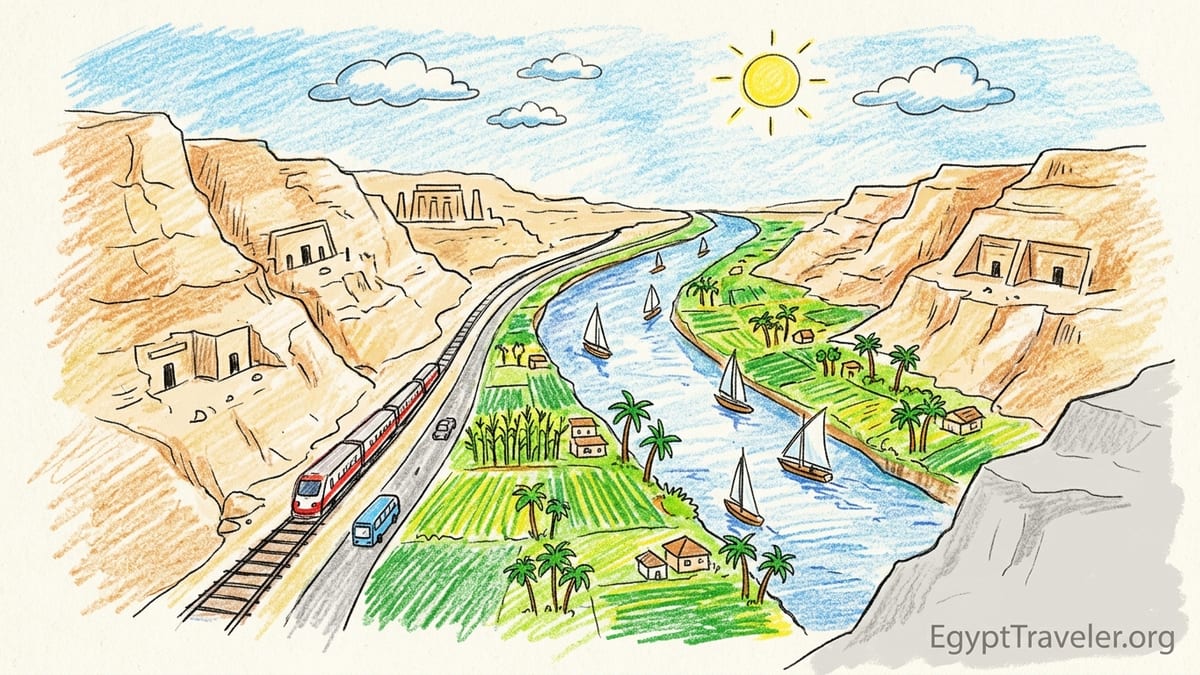
The Nile Valley that most travelers experience begins at Greater Cairo and runs south past Luxor to Aswan, roughly 900 kilometers of river. For almost this entire distance, the contrast between land and desert is abrupt. On the east and west banks you see a band of sugarcane, wheat and vegetable fields rarely more than a few kilometers wide, then suddenly beige cliffs and open desert. Flying in, the pattern looks like a green thread sewn through a bolt of sand. This geography shaped everything from settlement patterns to the location of tombs, which are often cut into the first line of desert cliffs overlooking irrigated fields.
Today’s transport network mirrors this river corridor. The main Cairo–Aswan railway line runs close to the water for most of its length, with air-conditioned express trains connecting Cairo, Minya, Sohag, Qena, Luxor and Aswan. Private drivers and long-distance buses use a modern highway that largely parallels the tracks. In practice, this means you can step off a morning train in Minya or Sohag, visit tombs and temples during the day, and be back on the move in the evening, stitching together a route that feels like a continuous narrative of Egyptian history rather than isolated day trips.
That historical narrative unfolds almost chronologically as you head upstream. Around Cairo and Giza you encounter the Old Kingdom and its great pyramids. In Middle Egypt around Minya and Beni Hassan you find cliff tombs and the short-lived Amarna period. Further south at Abydos and Dendera, the Middle and New Kingdoms are memorialized in some of the most beautifully preserved reliefs in Egypt. By the time you reach Luxor, Edfu, Kom Ombo and Aswan, you are deep in the grand temples of the New Kingdom and the later Ptolemaic and Roman eras. Seen in this way, the Nile Valley is less a string of individual sights and more a timeline carved into rock and painted on stone.
For first-time visitors, this corridor also offers a practical advantage. Because nearly all towns of interest line the river and railway, you can explore with a mix of train journeys, car transfers and, if you wish, short cruise segments. You might, for example, take an evening sleeper train from Cairo to Minya, spend two or three nights exploring Beni Hassan and Amarna, continue south by day train to Sohag and Abydos, then finish with a more classic combination of Luxor, Edfu, Kom Ombo and Aswan, flying back from Aswan to Cairo at the end. The same infrastructure that moves millions of Egyptians up and down the valley every year is what makes a linear, historically rich itinerary possible.
Cairo to Minya: Entering Middle Egypt
Most journeys begin in Cairo, but this guide assumes you have already explored the capital and Giza’s pyramids, which represent the Old Kingdom’s high point. From Cairo to Minya is roughly a four to five hour journey by train, depending on the service. Air-conditioned second-class seats on Egyptian National Railways are usually modestly priced compared with internal flights, and you share the carriages with Egyptian families, students and workers heading south. Booking a morning departure allows you to watch the city thin out into fields, canals and palm groves.
Minya, sometimes called the “Bride of Upper Egypt,” is the administrative hub of Middle Egypt and an excellent base for exploring the region. The city hugs the east bank of the Nile, with a corniche lined by cafes and simple hotels that cater mainly to Egyptian business travelers. A few larger properties, including long-established local hotels and newer mid-range chains, offer amenities like river-view rooms, small pools and on-site restaurants serving grilled meats, ful medames and freshly baked baladi bread. Prices for double rooms vary widely but are typically much lower than in Cairo or Luxor, which makes Minya a cost-effective place to pause for several nights.
Middle Egypt historically saw fewer foreign visitors than Luxor or Aswan, partly because many standard Nile cruises sail straight between those cities without stopping. In recent years, however, both the Egyptian Ministry of Tourism and specialist tour operators have been promoting Minya and its surroundings as “hidden gems” for travelers who are comfortable with a bit of independent logistics. Security regulations sometimes require that foreign visitors move with a police escort between major sites, especially when driving out to Beni Hassan or Amarna. In practice, this often means a police pickup quietly joining your car convoy at the city limits, something your hotel or tour operator can arrange while you focus on the archaeology.
Everyday Minya offers a refreshing contrast to tourist-saturated resort towns. In the evenings, locals stroll along the Nile corniche, buy ice cream from street vendors and shop in crowded clothing stores off the main square. For visitors, simple experiences like drinking a sweet mint tea at a busy cafe or visiting the small but engaging Mallawi Museum, which showcases artifacts from the surrounding region, help root the famous ancient sites in a modern, lived-in context. This sense of a working Egyptian city is one of Middle Egypt’s subtle pleasures.
Beni Hassan, Amarna and Tuna el-Gebel: Heart of Middle Egypt
North of Minya, the limestone cliffs at Beni Hassan hold some of the finest Middle Kingdom tombs open to visitors. Reached by a short drive and a climb up a stone stairway, the rock-cut tombs overlook irrigated fields and the Nile beyond, a view that immediately connects the elaborate tomb scenes with the farming life below. Inside, painted reliefs show wrestling matches, hunting scenes, boat-building and daily activities in surprisingly fresh colors. Because Beni Hassan sees far fewer tour buses than sites in Luxor, you might share a tomb with only a caretaker and perhaps another small group, which allows time to study details like the wrestling holds or the carefully rendered clothing of visiting foreigners depicted in the wall scenes.
Further south lies Amarna, site of Akhenaten’s short-lived capital Akhetaten. Today it is a wide archaeological zone on both sides of a desert road, reached by crossing the Nile near the village of El-Till and driving into a shallow desert basin. Many visitors begin at the modern visitor center, which explains the radical religious and artistic changes of the Amarna period, before continuing by car to scattered sites: the remains of palaces and temples on the valley floor, as well as the northern and southern tombs carved into the surrounding cliffs. The route can take most of a day, and in the hotter months, starting early is essential. Practical touches like carrying several liters of water per person, a hat, and snacks from Minya’s bakeries make the difference between a rewarding visit and an exhausting one, as on-site services are minimal.
West of the Nile, Tuna el-Gebel represents a different chapter of Egyptian history. This extensive necropolis was in use from the Late Period through the Ptolemaic and Roman eras and is associated with the ancient city of Hermopolis, sacred to the god Thoth. Visitors walk through desert sand to reach rock-cut catacombs that once held thousands of mummified ibis and baboons, animals sacred to Thoth, as well as human burials in painted coffins and stone sarcophagi. Above ground, the well-preserved tomb of Petosiris combines Egyptian and Greek styles in its architecture and decoration, a vivid example of cultural blending in the late first millennium BCE.
Putting these three sites together in an itinerary shows how Middle Egypt compresses centuries of history into a relatively compact area. A common pattern is to base in Minya for three nights: use one full day for Beni Hassan and Tuna el-Gebel, another for Amarna, and a half day for Minya’s museums and riverfront before moving on. Some travelers book private day tours with local agencies that include transport, guide, site tickets and a simple lunch stop, while others commission a car and driver through their hotel and hire local guides at each site gate. Either way, the quieter atmosphere, limited signage and sparse infrastructure reward visitors who prepare with a good guidebook and approach the area as a more exploratory extension of a classic Nile itinerary.
Sohag, Abydos and Dendera: Bridges Between Eras
Continuing south from Minya by rail, many trains pass through Asyut and Sohag on the way to Luxor. Sohag itself, on the west bank of the Nile, is a regional capital with a riverside corniche, a modern museum and a cluster of simple hotels catering mostly to domestic travelers. While many foreign visitors still pass through without stopping, Sohag is a logical pause if you plan to visit Abydos, one of Egypt’s most important sacred sites, situated further north in Sohag Governorate near the town of El-Balyana.
Abydos, dominated by the Temple of Seti I, is a place where the quiet can be as striking as the art. The temple stands at the edge of the desert, with its famous reliefs carved in crisp, low relief on limestone walls. Inside, chapels dedicated to various deities are roofed and relatively dim, so the carved figures and hieroglyphs retain a clarity that is rare in other temples. One chamber holds the so-called Abydos King List, a chronological list of pharaohs from earlier dynasties, which has been crucial for historians reconstructing Egypt’s royal sequence. A visit typically involves hiring a local guide at the gate, wandering through the main halls, then walking or driving a short distance to the more ruined but atmospheric temple of Ramesses II nearby.
South of Abydos and just north of Luxor, on the west bank opposite the modern town of Qena, the Temple of Hathor at Dendera forms another key bridge between historical eras. Although much of what visitors see today dates from the Ptolemaic and Roman periods, the temple stands on a site with a cult history reaching back to the Old Kingdom. The complex is renowned for its richly decorated hypostyle hall, where massive stone columns are carved with the face of Hathor and the ceiling is painted with astronomical scenes. In some areas, decades of soot have been carefully cleaned, revealing original blues and greens that feel startlingly fresh. For travelers, a practical detail is that Dendera is often combined with Abydos in a long day trip from Luxor, but those who are following the valley by land may visit from either the Qena or Sohag side.
Logistically, independent travelers can reach Abydos by taking a train to El-Balyana and hiring local transport for the short drive to the temple area, or by arranging a private vehicle from Sohag or Luxor. Security checkpoints along the road sometimes register foreign visitors and may assign a police escort vehicle, which can add a sense of formality to what is otherwise a fairly straightforward rural drive past sugarcane fields and brick villages. Dendera is typically reached via the modern bridge at Qena, then a short drive through fields to the temple car park, where local guides and a small cluster of souvenir stalls await. Together, Abydos and Dendera reward those who build extra days into their Nile Valley plans instead of rushing directly between Cairo and the big-name sites of Luxor and Aswan.
Luxor to Aswan: Classic Upper Egypt with New Context
By the time you reach Luxor, the Nile Valley has opened into one of its most dramatic cultural landscapes. On the east bank lie the temples of Karnak and Luxor, aligned roughly along an ancient processional route, while on the west bank the green fields give way to desert hills that hide the Valley of the Kings, the Valley of the Queens and the mortuary temples of the New Kingdom. For first-time visitors, spending at least three full days in Luxor allows you to balance major monuments with quieter experiences like evening walks along the corniche, felucca sails at sunset or a visit to the Luxor Museum.
South of Luxor, the river narrows again between cultivated banks and desert, and this stretch is where many standard Nile cruises operate. Even if you choose not to commit to a full four-night cruise, it is helpful to understand the places you will pass. Edfu, roughly halfway between Luxor and Aswan, holds the Temple of Horus, one of the best-preserved major temples in Egypt, largely from the Ptolemaic period. The imposing pylon gateway, intact courtyard and roofed inner halls give a vivid sense of what temple complexes elsewhere would once have looked like. A common practical scene is disembarking from a cruise boat, walking or taking a short carriage ride through the modern town, and then stepping through the gates into a world of hieroglyphs and reliefs.
Further south, Kom Ombo stands uniquely on a curve of the river where the Nile pulls close to the desert cliffs. Its temple is dedicated jointly to Sobek, the crocodile god, and Horus the Elder, a duality reflected in the duplication of sanctuaries and relief scenes. The adjacent museum displays crocodile mummies found in the area, a tangible echo of the wild animals that once inhabited the river. For travelers on cruises, Kom Ombo is often visited around sunset, when shifting light emphasizes the raised carvings. Those following the valley by road can stop during a long Luxor–Aswan transfer, breaking the journey into manageable segments.
Aswan, at the southern end of this guide’s route, has a different feel from the rest of the valley. The river widens around boulder-strewn islands, sail-powered feluccas tack between rocky outcrops, and the city’s markets reflect strong Nubian influences in textiles, spices and music. Many visitors use Aswan as a base for side trips to the Philae Temple, relocated to an island after the construction of the Aswan High Dam, or for early-morning excursions further south to Abu Simbel near the Sudanese border. Practical details include a wider range of accommodation than in Middle Egypt, from simple guesthouses in Nubian villages on the west bank to polished riverfront hotels with pools overlooking the First Cataract.
Experiencing Luxor and Aswan after traveling through Minya, Sohag, Abydos and Dendera adds layers of context that a direct flight cannot provide. By the time you stand in Karnak’s hypostyle hall or gaze over the granite boulders of Aswan, you have seen how the Nile’s fertile strip continues unbroken from Cairo, and how different periods of Egyptian history left their marks in different stretches of the valley. Instead of isolated highlights, Luxor and Aswan become chapters in a longer story you have physically traced along the river’s course.
Travel Logistics, Seasons and Safety Along the Nile
Practically, the Nile Valley is one of Egypt’s better-connected regions. The Cairo–Luxor–Aswan rail line is the backbone, with a mix of day trains and, on some segments, overnight sleeper services. Schedules and comfort levels vary, but in general, first- and second-class carriages on intercity services offer assigned seating, air conditioning and basic refreshments. Tickets can usually be purchased in advance at major stations such as Cairo’s Ramses Station, Luxor and Aswan, or through local travel agencies. For routes where foreign travelers cannot book certain trains directly, agencies or hotel concierge desks often act as intermediaries.
Road travel fills in the gaps between rail heads and archaeological sites. In Middle Egypt especially, hiring a private car and driver through your hotel or a reputable local operator is often the most efficient way to reach Beni Hassan, Amarna, Tuna el-Gebel and Abydos within a limited time frame. Daily rates for a car with driver are generally lower than equivalent private hire in Western Europe or North America, though fuel prices, distances and the requirement for a police escort can influence costs. When comparing quotes, ask whether all permits, checkpoints and waiting time at sites are included, so that the final bill matches expectations.
Seasonal considerations are crucial. From June through early September, daytime temperatures along the Nile can be extremely hot, especially at desert-edge sites like Amarna or Beni Hassan where shade is scarce. Many guides recommend that first-time visitors aim for the cooler months from roughly late October to April, when midday heat is more manageable and evenings along the river are pleasantly cool. Even in winter, however, carrying water, sun protection and light breathable clothing is essential, as you may spend several hours walking through exposed temple courtyards or climbing stairways to tomb entrances.
Security is a natural concern for travelers considering less-visited regions. Along the main Nile Valley route, the Egyptian authorities maintain a visible security presence at stations, hotel entrances and major archaeological sites. In Middle Egypt, foreign visitors may find that their movements between cities or to certain sites are recorded at checkpoints and sometimes accompanied by police escort vehicles. While procedures can change, recent practice has focused on making such measures as unobtrusive as possible. For travelers, the most practical steps remain the standard ones: stay informed through your country’s travel advisories, work with reputable local operators, and allow a bit of flexibility in itineraries in case road timings or routes are adjusted by the authorities.
Planning Your Nile Valley Journey and Next Steps
When planning a first trip, it is helpful to think of the Nile Valley not as a single monolithic route but as a set of overlapping segments. One common pattern is to begin with two or three nights in Cairo for the pyramids, Egyptian Museum and Islamic and Coptic quarters, then travel by train to Minya for three nights, focusing on Beni Hassan, Amarna and Tuna el-Gebel. From there, you might continue to Sohag or El-Balyana for a visit to Abydos, then reach Luxor by either train or a private car transfer that stops at Dendera along the way. After three or more nights in Luxor and a stop in Edfu and Kom Ombo, you can finish with several days in Aswan before flying back to Cairo.
Within this framework, smaller choices personalize the journey. Those who enjoy slow travel might add extra nights in Minya to explore lesser-known Middle Egypt sites or simply to spend more time in a modern Egyptian city with few foreign tourists. Photography enthusiasts may time visits to Beni Hassan or Amarna for early morning or late afternoon light that rakes across desert cliffs. Families with children might prioritize sites where carved scenes of daily life, animals and boats are more engaging than long lines of hieroglyphic text, using Luxor and Aswan’s comfortable hotels as bases with pools for afternoon breaks.
To delve deeper into particular stretches of the valley, you can pair this regional overview with more detailed planning resources. Dedicated guides to Minya and Middle Egypt will help with up-to-date information on accommodations, local museums and smaller sites not covered here. Separate child guides to Luxor, Aswan and the Nile cruise segment between them can provide more granular advice on ticketing systems, which tombs are currently open, and how to structure multi-day sightseeing passes. Another specialized guide might focus entirely on Amarna, with maps of scattered ruins and practical advice for navigating the desert tracks.
However you structure it, allowing the historical sequence of the Nile Valley to guide your movements transforms a first trip to Egypt into more than a checklist of famous temples. Starting in Cairo’s Old Kingdom pyramids, pausing in Middle Egypt around Minya to explore the Middle Kingdom tombs of Beni Hassan and the revolutionary city of Akhetaten at Amarna, visiting the late-period necropolis at Tuna el-Gebel, and then moving on to Abydos, Dendera, Luxor, Edfu, Kom Ombo and Aswan creates a satisfying arc. At journey’s end, watching the sun set over the Nile at Aswan, you will have not only seen Egypt but followed, in order, many of the civilizations that rose and fell along its banks.
FAQ
Q1. Is it realistic for a first-time visitor to include Minya and Middle Egypt on a Nile Valley trip?
Yes, it is realistic if you have at least 10 to 14 days in Egypt and are comfortable with some overland travel. With that amount of time you can spend a few nights in Minya to see Beni Hassan, Amarna and Tuna el-Gebel before continuing to Abydos, Dendera, Luxor and Aswan, using trains and private transfers arranged through hotels or local operators.
Q2. How many days should I plan for Minya and the surrounding sites?
Most travelers find that two full days, plus arrival and departure time, is a good minimum. That usually allows one long day for Beni Hassan and Tuna el-Gebel and another for Amarna. If you are particularly interested in the Amarna period or prefer a slower pace, adding an extra night in Minya gives you more flexibility for weather, site opening hours and rest.
Q3. Are trains along the Nile Valley comfortable and safe for tourists?
Intercity trains between Cairo, Minya, Sohag, Luxor and Aswan are widely used by local passengers and generally considered safe, with assigned seating in the higher classes and air conditioning. Comfort is basic but adequate for journeys of several hours, and many first-time visitors use daytime trains to experience the landscape. As with any rail travel, keep valuables close, use common-sense precautions and confirm schedules locally, as timetables can change.
Q4. When is the best time of year to travel the Nile Valley?
The most comfortable period for sightseeing is typically from late October through April, when daytime temperatures are cooler and evenings can be pleasantly cool along the river. Summer months can be extremely hot, especially at exposed sites like Amarna or Beni Hassan. If you must travel in warmer months, plan early-morning visits, carry plenty of water and schedule midday breaks in shaded or air-conditioned spaces.
Q5. Do I need guided tours at sites like Beni Hassan, Amarna and Abydos?
Guides are not mandatory but are highly recommended at less-frequented sites where signage can be limited and the layout is not obvious. Many travelers hire local guides at the site entrances for a set fee or book a full-day tour from Minya or Luxor that includes guiding, transport and tickets. A good guide can explain scenes in the tombs, point out details you might miss and help with practicalities such as navigating checkpoints and coordinating with site staff.
Q6. How does security work for visiting Middle Egypt destinations?
Security procedures can change, but visitors to Middle Egypt often register with local authorities through their hotels or tour operators and may be accompanied by a police escort vehicle on some road journeys. Checkpoints along highways record vehicle details and routes, and site entrances are staffed with guards. While this can sound intimidating, for most travelers it is simply part of the background and does not interfere significantly with sightseeing, though it can influence departure times and route choices.
Q7. Can I combine a Nile cruise with overland visits to Minya and Sohag?
Yes, many travelers combine a short Nile cruise between Luxor and Aswan with overland segments that cover Cairo, Minya, Sohag, Abydos and Dendera. One approach is to travel overland from Cairo through Middle Egypt to Luxor, then board a three or four-night cruise to Aswan at the end of the itinerary. This gives you both the quieter, more exploratory feel of Middle Egypt and the convenience of a cruise for the classic Upper Egypt stretch.
Q8. What kind of accommodation can I expect outside Cairo, Luxor and Aswan?
In cities like Minya and Sohag you will mostly find mid-range local hotels and a few properties aimed at business travelers rather than international tourists. Rooms are generally simple, with private bathrooms, air conditioning and basic Wi-Fi, but fewer resort-style amenities. In Luxor and Aswan there is a broader range, from guesthouses and family-run hotels to high-end riverfront properties. Booking in advance is advisable if you are traveling during peak winter months or major holidays.
Q9. How should I dress when visiting towns and archaeological sites in the Nile Valley?
Loose, breathable clothing that covers shoulders and knees is both practical for the sun and respectful of local norms, especially in Middle Egypt where foreign visitors are less common. A wide-brimmed hat or scarf, sunglasses and comfortable closed-toe walking shoes are important for tomb stairways and uneven ground. At religious sites that are still in use, such as mosques or churches in city centers, more conservative dress is appreciated.
Q10. Where can I find more detailed planning information for specific Nile Valley regions?
Use this article as a regional overview, then consult more focused child guides dedicated to particular areas. Detailed guides to Minya and Middle Egypt can offer up-to-date information on hotels, local museums and smaller archaeological sites. Separate guides to Luxor, Aswan, the Luxor–Aswan cruise stretch and specialized topics like Amarna will help with exact opening times, ticket systems and recommended daily itineraries tailored to your interests.