


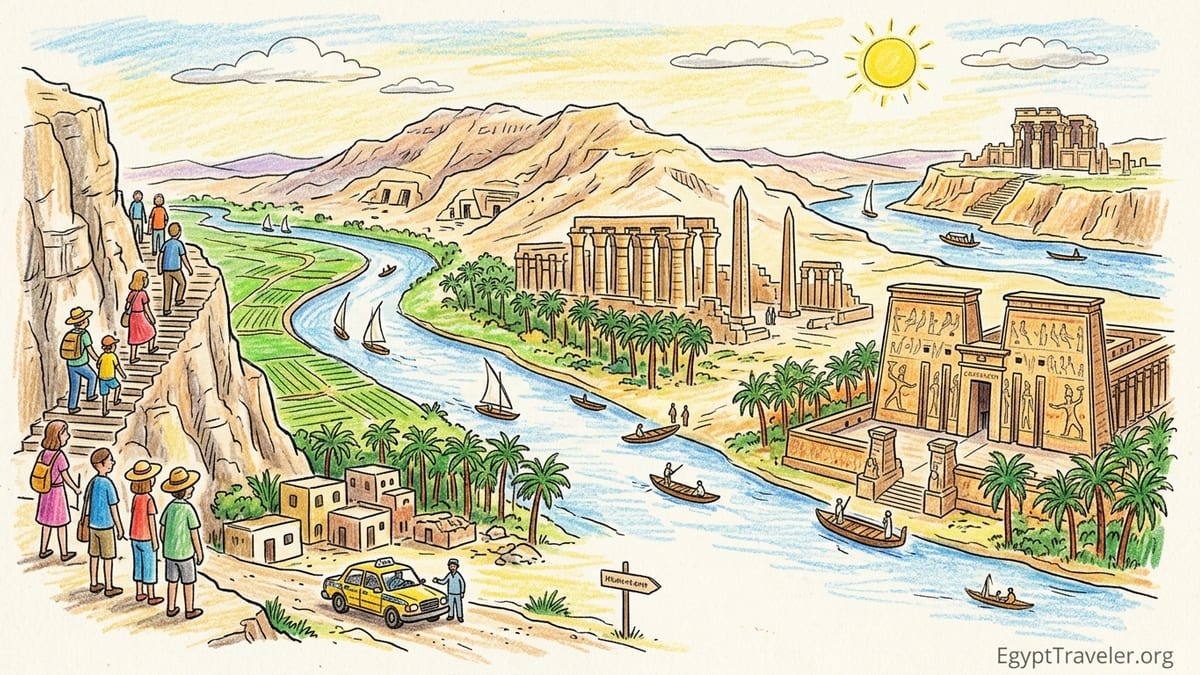
The Nile Valley remains one of the most rewarding places on earth for travelers who like old stones with real stories attached. Yet many itineraries still focus only on Cairo, Aswan and a whistle‑stop tour of Luxor. The stretch between Cairo and Luxor, and even parts of Luxor itself, offers a series of very different archaeological experiences, from remote Middle Kingdom tombs to intimate Ptolemaic chapels painted in deep blues and golds. This guide compares key sites along the Nile Valley and asks a practical question for modern travelers: what does each actually add to your trip, and which are worth going out of your way to see?
How to Think About the Nile Valley’s Archaeological Sites
Planning a Nile trip can feel like choosing between variations of the same theme: more temples, more tombs, more hieroglyphs. In reality, Beni Hassan, Tell el Amarna, Tuna el Gebel, Abydos, Dendera, Luxor, Edfu and Kom Ombo each represent different periods and ideas in Egyptian history. Some focus on provincial life in the Middle Kingdom, others on experimental religion in the New Kingdom, or on Greek and Roman reinterpretations of Egyptian faith. Understanding this can help you avoid “temple fatigue” and instead build an itinerary that progresses through time and theme.
From a practical angle, access and atmosphere differ wildly. You might stand almost alone in the wind above the fields at Beni Hassan, hiring a local taxi from Minya for the day, then later find yourself in a crowd beneath the columns of Karnak on a standard Luxor tour. A traveler who has three or four extra days between Cairo and Luxor can thread these sites into a loose overland route, while a first timer on a tight schedule might only add one or two beyond Luxor. What follows is not a list of “must sees,” but a selection guide that spells out what is distinctive about each place and how much effort it takes to experience it.
Beni Hassan: Vivid Middle Kingdom Life on a Cliff
Beni Hassan in Middle Egypt is the place to go if you want to see how Egypt’s provincial elites imagined their lives around 2000 to 1900 BCE. The rock cut tombs high in the cliffs above the green fields date mostly to the Eleventh and Twelfth Dynasties, a core period of the Middle Kingdom. Inside, you find long painted walls showing wrestling bouts, caravan traders with brightly patterned clothes, craftsmen at work and river scenes that feel closer to documentary than royal propaganda. These are not grand pharaonic monuments but the tomb chapels of local governors, and that perspective makes the art unusually human.
Reaching Beni Hassan takes more effort than most classic sights. It lies near Minya, roughly midway between Cairo and Luxor. Independent travelers typically take a morning train from Cairo to Minya, then hire a private taxi through their hotel for a half day visit, with rates often quoted in the region of what you might pay for a city tour in Cairo. At the base of the cliffs, expect a ticket office, basic facilities and then a climb up stone steps to the upper cemetery. The payoff for the effort is that crowds are light; outside local groups and a few tour vans, you may share the main tombs with only a handful of people.
What Beni Hassan adds to an itinerary is a concentrated look at Middle Kingdom painting and provincial life, something you will not get from Luxor alone. If you are already visiting Luxor’s royal tombs, Beni Hassan is not redundant; the style and subject matter are different. For travelers who like art history, it is worth shaping an overland journey around, perhaps linking it with Amarna or Tuna el Gebel. For a first timer flying directly between Cairo and Luxor on a five or six day trip, it is a rewarding extra rather than an essential stop.
Tell el Amarna: Akhenaten’s Radical Capital, Mostly for Specialists
Tell el Amarna, in the same broad region as Minya, sits in a different mental category. This was the short lived capital of Akhenaten in the Eighteenth Dynasty, around the mid 1300s BCE, when the king promoted the worship of the Aten and briefly upended Egypt’s traditional religious system. On the ground today, the appeal for most visitors lies in the atmosphere of a wide desert plain dotted with low ruins, boundary stelae and rock cut tombs, rather than in towering architecture. The site evokes the feeling of a vanished city more than a conventional temple visit.
In practical terms, Amarna is harder work than most places in this guide. It remains relatively remote, with limited facilities in the immediate area. Travelers usually base themselves in Minya or Mallawi, arrange transport with a tour operator or local driver familiar with police check points, and commit most of a day to the visit. Expect rough desert tracks, intense sun and simple shade structures at best. For many non specialists, the reward is a sense of stepping into a chapter of history they may have only seen in documentaries about Akhenaten and Nefertiti.
What Amarna adds, if you make the effort, is insight into a specific and unusual historical moment: urban planning on a grand scale for a brand new capital, the politics of religious change, and the lives of courtiers whose tombs still preserve parts of the so called Amarna style of art. Visitors with a background in Egyptology or a deep personal interest in Akhenaten often find the site unforgettable. For a first or even second trip, though, Amarna is best thought of as an optional specialist add on rather than a core recommendation.
Tuna el Gebel: Greco Egyptian Funerary World on the Desert Edge
Southwest of Minya, Tuna el Gebel is the necropolis of ancient Hermopolis Magna and helps bridge the gap between pharaonic Egypt and the Hellenistic and Roman worlds. The site was used for centuries, but many of the surviving monuments date from the Ptolemaic and Roman periods, after Alexander’s conquest. Here you can walk from long underground galleries that once held millions of mummified ibises and baboons, sacred to the god Thoth, to stone built tombs that mix Egyptian imagery with Greek architectural details and inscriptions.
Getting to Tuna el Gebel typically involves the same logistics as Beni Hassan or Amarna: a base in Minya, a private car for the day and coordination with local tourism police through your hotel or guide. Compared with Amarna, the core visitor area is more compact and manageable, with a clear path between the catacombs, the famous tomb of Petosiris and other key points. Travelers often combine Beni Hassan and Tuna el Gebel in a long day, or pair Tuna el Gebel with Amarna on a separate outing, depending on opening times and security arrangements.
Tuna el Gebel adds something genuinely different to an itinerary anchored around Old and New Kingdom sites. It shows how Egyptian religious practice evolved in conversation with Greek culture, and how elites in the Ptolemaic and Roman periods commissioned tombs that were both Egyptian and cosmopolitan. If you are interested in how cultures blend, or if you want at least one experience of Greco Egyptian necropolis architecture beyond Alexandria, Tuna el Gebel is a strong candidate. Without that curiosity, it may feel like a niche diversion compared to Abydos or Dendera.
Abydos: Seti I, Osiris and Pilgrimage to the Afterlife
Further south, closer to Sohag, Abydos occupies an important place in both ancient religion and modern itineraries. The Temple of Seti I, begun by the Nineteenth Dynasty king and finished by Ramesses II, dates to the New Kingdom around the thirteenth century BCE. Inside, the reliefs are some of the most refined in Egypt, carved in crisp raised relief and still retaining areas of delicate color. Beyond its craftsmanship, Abydos was a major cult center of Osiris, and many Egyptians from across the country dreamed of being buried there or at least having a cenotaph in the region.
Reaching Abydos is easier than it used to be but still requires planning. Many travelers visit on a long day trip from Luxor by private car with a driver and guide, leaving around dawn and returning in the evening. Others come from Sohag, using a hired taxi or pre arranged transfer, especially if they are exploring the less visited central Nile Valley. The temple complex itself is straightforward to navigate, with a visitor ticket, a processional way between mudbrick walls and the main temple with multiple chapels aligned side by side. Time permitting, some visitors also explore the nearby Osireion, a mysterious subterranean structure behind the main temple.
What Abydos adds that you will not get even in Luxor is an intense focus on Osiris and a temple interior where the reliefs are unusually well preserved and intimate. The so called Abydos King List, carved along one corridor, offers a sequence of royal names that has been vital for reconstructing Egyptian chronology. For travelers who are already seeing Karnak and the Valley of the Kings, Abydos complements those sites with a quieter, more contemplative atmosphere and a sense of pilgrimage. If you can spare a day from Luxor, Abydos is one of the most worthwhile excursions in all of Upper Egypt.
Dendera: Painted Ceilings and a Compact Ptolemaic Gem
North of Luxor near modern Qena, the Temple of Hathor at Dendera often surprises visitors who think they have already seen “enough” temples. The main structure is largely Ptolemaic and Roman, mainly built between the first century BCE and the first century CE, but follows traditional Egyptian temple layout dedicated to the goddess Hathor. What makes Dendera famous among travelers is its preservation: the stone roof remains intact, so the interior has been sheltered from centuries of weathering. Many columns and ceilings still carry deep blue backgrounds spangled with stars and zodiac figures, while carved capitals show the sistrum headed face of Hathor.
In practical terms Dendera is one of the easier extra sites to visit from Luxor. Many local agencies sell half day trips, either by road in a minibus or occasionally as a longer cruise excursion from Nile boats that dock near Qena. Expect a drive of around an hour and a half each way and a relatively modest ticket price compared with the blockbuster sites in Luxor itself. On arrival, the complex feels compact: you move from the first courtyard into a forest of columns, then up stairways to the roof where chapels and open terraces look across the surrounding fields.
Dendera adds a striking visual contrast to earlier temples: intense color, a feeling of enclosure under the painted ceilings and a different time slice, when Greek speaking rulers still commissioned traditional Egyptian religious art. If your schedule is tight and you can only add one non Luxor temple, many repeat visitors would choose Dendera over Edfu or Kom Ombo because of this combination of preservation, manageable scale and ease of access. For photography, the interplay of light shafts, incense smoke and painted ceilings can make Dendera one of the most atmospheric stops on the Nile.
Luxor: New Kingdom Heartland and Essential Classics
Luxor, built on the site of ancient Thebes, remains the centerpiece of most Nile Valley trips for good reason. Here you find the densest cluster of New Kingdom monuments from roughly the sixteenth to eleventh centuries BCE, including the temple complexes of Karnak and Luxor on the east bank and the royal necropoleis of the Valley of the Kings and Valley of the Queens on the west. This is where pharaohs such as Hatshepsut, Thutmose III, Seti I and Ramesses II built at a monumental scale, using colossal pylons, obelisks and hypostyle halls with more than a hundred columns.
Access to Luxor’s main sites is straightforward, with frequent domestic flights from Cairo, an established range of hotels from simple guesthouses to large resorts and a constant flow of Nile cruise boats. On a typical day, visitors might join a small group tour to Karnak and Luxor Temple in the morning, then cross the river by motor launch in the afternoon to see the Colossi of Memnon and a selection of tombs in the Valley of the Kings. Ticket prices are higher than at Middle Egypt sites, especially for premium tombs that require separate entry, but infrastructure is also better: shaded paths, rest areas, electric carts at some sites and a broad choice of guides.
What Luxor adds, if it is your first trip, is non negotiable: it anchors your understanding of New Kingdom power, religion and art. The scale is almost overwhelming, and that is part of the point. Even if you later visit Beni Hassan or Tuna el Gebel, those experiences will be filtered through what you saw in Luxor. For travelers on a tight time frame of five or six days in Egypt, Luxor plus Cairo might be the core, with everything else in this guide as optional extensions. For those returning, Luxor also hides less visited gems such as the workers’ village of Deir el Medina or tombs in the Valley of the Nobles that echo the narrative paintings at Beni Hassan.
Edfu and Kom Ombo: Ptolemaic Temples on the Cruise Circuit
South of Luxor on the usual cruise route to Aswan, the temples of Edfu and Kom Ombo represent Ptolemaic Egypt at its most monumental. Edfu is dedicated to the falcon god Horus and is one of the best preserved large temples in the country, mostly constructed between the third and first centuries BCE. Kom Ombo, closer to Aswan, is unusual in being dedicated to two gods, Sobek and Horus the Elder, with a roughly symmetrical layout that once corresponded to twin cults. Travelers who choose a standard three or four night Nile cruise between Luxor and Aswan are almost guaranteed stops at both sites.
Logistically, Edfu and Kom Ombo are among the easiest temples to visit because transport is integrated into the cruise experience. Boats moor at the riverbank, and travelers disembark with a guide at set times. At Edfu, many tours still use traditional horse drawn carriages from the dock to the temple, something some visitors enjoy for the atmosphere, while others prefer to ask for a minivan transfer if available. At Kom Ombo, the temple rises directly above the river, and you step off the boat and walk up the slope. Facilities are basic but adequate: ticket desks, small visitor services and vendors where you can buy water and simple snacks.
What these temples add to a broader Nile itinerary is a sense of how late Egyptian religious architecture continued to flourish under Greek rule. At Edfu, the pylons tower over visitors and the reliefs include long columns of hieroglyphs that read like theological treatises. At Kom Ombo, medical reliefs on one wall depict surgical instruments and birthing chairs, popular with guides who use them to show how science and religion overlapped. If your trip already includes Dendera, you may find some stylistic overlap; in that case, Edfu’s scale and Kom Ombo’s riverfront drama become the main reasons to visit. For travelers tightly focused on earlier periods, these temples are a welcome bonus that come packaged with the cruise rather than essential detours.
Choosing What to Prioritize: Sample Traveler Profiles
With limited days, most people cannot see every site between Cairo and Aswan. Thinking in terms of traveler profiles can help. A first time visitor with one week in Egypt might focus on Cairo and Luxor, then choose just one or two extras: perhaps Dendera for its painted ceilings and Abydos for its Osiris cult if they have a strong interest in religion, or a Nile cruise that includes Edfu and Kom Ombo if they prefer to unpack once and watch the riverbanks drift by. In this scenario, Beni Hassan, Amarna and Tuna el Gebel become second trip material.
A repeat visitor or archaeology enthusiast with ten to twelve days, by contrast, might deliberately add Middle Egypt. After Cairo, they could travel overland to Minya, spending two nights there to visit Beni Hassan and Tuna el Gebel, with an optional long day at Amarna, before continuing south to Sohag and Abydos and finally Luxor. This route involves more logistics and hours in cars and trains, but in exchange it delivers a chronological arc from Middle Kingdom provincial life through experimental New Kingdom religion to the later Ptolemaic temples. The extra cost comes mainly from private drivers, additional nights in regional hotels and multiple mid range site tickets rather than from any one large expense.
If you are traveling as a family or with companions who are less passionate about archaeology, it may be wise to limit the number of stone sites per day. Combining Luxor and Karnak in one morning, a west bank site in the afternoon and then Dendera the next day can keep interest high, while trying to see every tomb in one go can exhaust even the most enthusiastic teenager. In this context, Beni Hassan’s climb, Amarna’s heat and Tuna el Gebel’s tunnels are best reserved for those in the group who explicitly want to chase more specialized experiences rather than for a mixed first time party.
The Takeaway
The Nile Valley rewards curiosity with layers: Middle Kingdom governors hunting in painted registers at Beni Hassan, a revolutionary but fragile capital at Amarna, Greco Egyptian catacombs at Tuna el Gebel, Osirian pilgrimage at Abydos, jewel like Ptolemaic color at Dendera, and the sweeping New Kingdom stage set of Luxor, with Edfu and Kom Ombo as late flourishing statements in stone. No single itinerary can do justice to every site, and you do not need to see them all to have a rich sense of ancient Egypt.
When choosing where to go, think less about ticking off “all the temples” and more about what stories interest you. If you care about how ordinary elites lived, Beni Hassan and the tombs around Luxor’s west bank will speak to you. If you are drawn to questions of belief and heresy, Amarna and Abydos will matter more. For art and color, Dendera and select tombs in the Valley of the Kings or at Deir el Medina may be the highlights. By being selective and honest about your interests and energy, you can build a Nile journey that feels coherent rather than repetitive, and come away with memories rooted not just in stone, but in the very different worlds those stones once framed.
FAQ
Q1. Can I visit Beni Hassan, Amarna and Tuna el Gebel without joining a group tour?
Yes, independent visits are possible, but you will usually need to base yourself in Minya or Mallawi and arrange a private car and driver through your hotel or a local agency. Authorities sometimes require that visitors travel in daylight and pass through police check points, so it is important to confirm current procedures and opening hours a day or two in advance.
Q2. Is Abydos worth the long day trip from Luxor?
For travelers interested in temple art and religion, Abydos is often one of the most rewarding excursions in Upper Egypt. The raised reliefs of Seti I, the focus on Osiris and the relative quiet compared with Luxor’s main sights give the temple a distinctive atmosphere. The drive takes several hours each way, so it works best if you have at least three nights in Luxor and are comfortable committing a full day.
Q3. How difficult is the climb at Beni Hassan?
The main Middle Kingdom tombs at Beni Hassan sit high on a cliff, reached by a long but steady staircase from the ticket area. Most reasonably fit visitors manage the climb with short breaks, but in hot weather it can feel demanding. There is little shade on the steps, so bringing water, a hat and starting early in the morning are practical ways to make the ascent more comfortable.
Q4. What makes Dendera different from other temples around Luxor?
Dendera’s Temple of Hathor stands out because its stone roof has survived, sheltering vivid painted ceilings and column capitals that still retain strong blues and greens. The complex is compact and easy to navigate, with much of the decoration preserved above head height. Compared with the vast scale of Karnak or the crowded corridors of the Valley of the Kings, Dendera offers a more intimate, color rich experience that many travelers remember vividly.
Q5. Are Edfu and Kom Ombo necessary if I am short on time?
If you are not taking a Nile cruise and your schedule is tight, it can be reasonable to prioritize Luxor’s main sites and perhaps Dendera or Abydos over Edfu and Kom Ombo. Both Ptolemaic temples are impressive, but they are most convenient as built in stops on a cruise between Luxor and Aswan. If you do cruise, visiting them rarely requires extra planning or cost beyond the standard excursion package.
Q6. How does Tell el Amarna compare to Luxor in terms of what you actually see?
Tell el Amarna feels very different from Luxor. Where Luxor offers towering temples and richly decorated royal tombs, Amarna presents low ruins, wide open desert and rock cut tombs with partially preserved reliefs. The rewards are more intellectual and atmospheric than visual, centered on Akhenaten’s short lived capital and its religious experiment. For most first time visitors, Amarna is a specialist side trip rather than a substitute for Luxor.
Q7. Is Tuna el Gebel suitable for travelers who are not archaeology experts?
Yes, as long as you have some curiosity about how cultures blend. Tuna el Gebel’s animal catacombs and Greco Egyptian tombs are striking even without deep background knowledge, and guides can explain the basics of Thoth’s cult and how Greek and Egyptian styles interact. It is still a more niche site than Luxor or Dendera, so it works best as an addition for travelers who enjoy exploring beyond the main tourist circuit.
Q8. How should I budget for tickets to these sites?
Ticket prices across Egypt vary, but Middle Egypt sites like Beni Hassan and some Amarna tombs tend to be significantly cheaper than headline attractions such as the Valley of the Kings or premier tombs in Luxor. The larger expense often comes from private transport rather than the entry fees themselves. It is sensible to set aside a flexible amount in your budget for site tickets, then expect to spend more per day on days that involve long private transfers.
Q9. When is the best time of year to explore the Nile Valley’s archaeological sites?
October to April is generally the most comfortable period, with cooler daytime temperatures that make climbing to tombs and walking exposed temple courtyards more manageable. The peak winter months can be busy in Luxor and on the cruise route, but Middle Egypt sites such as Beni Hassan and Tuna el Gebel remain relatively quiet even in high season. In summer, early starts and plenty of water are essential, and some travelers choose to limit long desert excursions.
Q10. Do I need a guide at every site, or can I explore on my own?
You can explore most of these sites independently after buying a ticket, and basic signage usually points the way through the main monuments. However, hiring a licensed guide in Luxor, Dendera or Abydos can greatly enrich the experience by decoding scenes, explaining historical context and managing time. In more remote areas like Amarna or Tuna el Gebel, traveling with a guide or agency that understands local logistics and security arrangements can also make the visit smoother and safer.