


Tuna el-Gebel is one of Middle Egypt’s most atmospheric archaeological sites, a desert necropolis where painted tomb chapels, underground animal catacombs and traces of ancient Hermopolis Magna all converge. Unlike the better known pharaonic cemeteries of nearby Beni Hassan and Amarna, this is a place where Egyptian and Greek worlds visibly overlap in stone, paint and mummified animals. For travelers basing themselves in Minya, Tuna el-Gebel offers a full, rewarding excursion that combines history, art and a tangible sense of place.
Why Tuna el-Gebel Matters
Tuna el-Gebel was the necropolis of Hermopolis Magna, the great cult center of the god Thoth in Middle Egypt. Used extensively from the Late Period through the Ptolemaic and Roman eras, it preserves a cross-section of religious life at a time when Egypt was under first native, then Persian, and finally Greek and Roman rule. Rather than colossal pyramids or New Kingdom royal tombs, you find painted chapels, mudbrick houses and vast underground galleries filled with animal mummies.
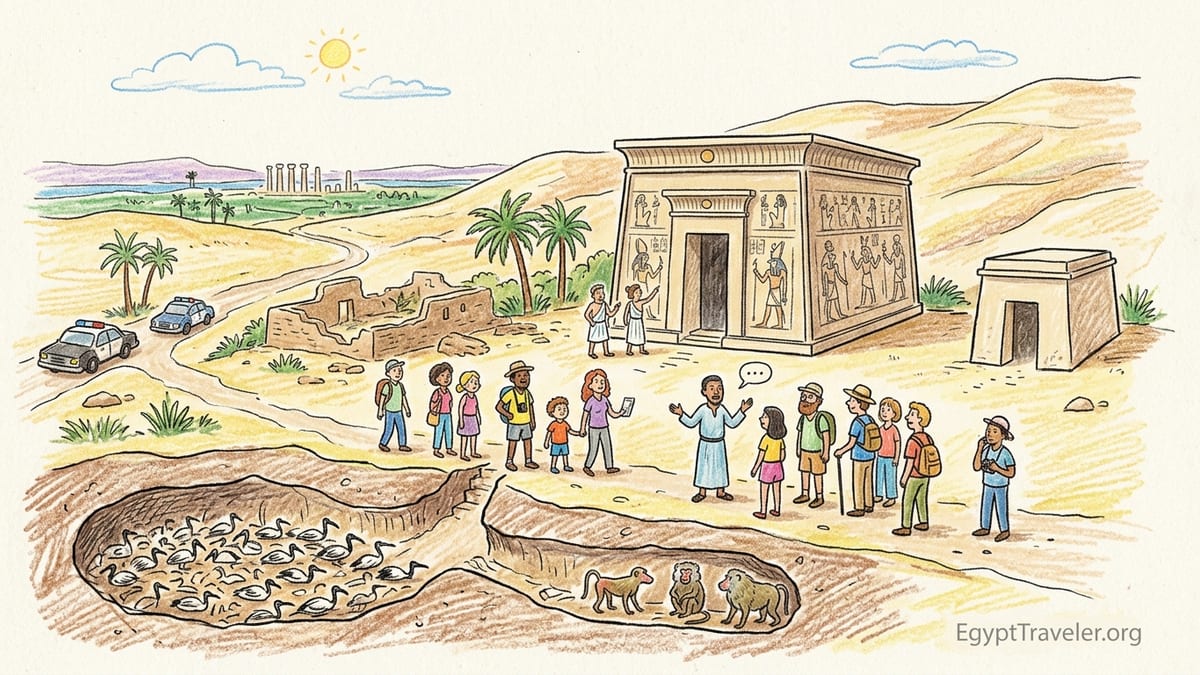
The site is best known for three experiences: the painted Tomb of Petosiris, the poignant Tomb of Isadora, and the extensive underground catacombs where millions of sacred ibises and numerous baboons were buried as offerings to Thoth. Together they tell the story of an Egyptian priestly community adapting to a Hellenistic world, where Greek language and artistic styles were fashionable but older Egyptian religious ideas still provided the framework of daily life.
For travelers who have already visited Luxor or Giza, Tuna el-Gebel feels different in mood and scale. There are fewer visitors, less commercial pressure and more room to absorb the details. You may share the tombs with just a handful of other people, or sometimes have them entirely to yourself, which makes hiring a good local guide particularly worthwhile to unlock the layers of history.
From Minya to Tuna el-Gebel and El Ashmunein
Most visitors reach Tuna el-Gebel from the city of Minya, which sits on the east bank of the Nile about 270 kilometers south of Cairo. The archaeological zone lies on the west bank roughly 40 to 50 kilometers southwest of central Minya by road, depending on your exact starting point and route. In practice, the drive typically takes about one hour in light traffic, a little longer if you are crossing the river on the main bridge north of Minya.
Independent travelers usually arrange a private car through their hotel or a local agency in Minya. As of mid-2026, a full-day car with driver for Tuna el-Gebel and nearby El Ashmunein (Hermopolis Magna) is often quoted in the region of 1,500 to 2,500 Egyptian pounds, varying with vehicle size, negotiation skills and whether your hotel takes a commission. The trip requires a registered driver and, in many cases, police notification or an escort arranged by your hotel or guide, so it is not something you simply hail from the street at the last minute.
Tuna el-Gebel pairs naturally with El Ashmunein, whose ruins lie only a short drive to the north. Many itineraries from Minya visit Beni Hassan in the morning, cross back to the west bank for Tuna el-Gebel around midday, and finish at El Ashmunein in the late afternoon before returning to the city. This makes for a long but realistic 9 to 10 hour day, with perhaps 2 to 3 hours at Tuna el-Gebel itself if you are reasonably efficient and have pre-arranged transport.
Tickets, Opening Hours and How Long to Spend
Official ticket prices in Egypt can change with relatively short notice, so it is worth checking with your hotel or a local agent in Minya just before you travel. In recent years, foreign adult tickets for provincial archaeological sites like Tuna el-Gebel have generally fallen in the range of a few hundred Egyptian pounds, with reduced rates for students carrying valid international ID. There may be a separate ticket or small supplement to access specific tombs or the catacombs with an attendant unlocking doors.
The site is typically open during standard daylight hours, roughly from early morning until late afternoon, though exact opening times can shift seasonally and around public holidays. Because Tuna el-Gebel lies exposed in the desert fringe, it is prudent to arrive either early in the day or in mid to late afternoon outside of the hottest hours, especially in summer when midday temperatures can be intense and shade sparse away from the tomb interiors.
A focused visitor can see the headline sights of Tuna el-Gebel in 2 to 3 hours: the Tomb of Petosiris, the Tomb of Isadora, one of the sacred animal catacomb entrances, and a quick walk around some of the priestly settlement remains and boundary stela area. Travelers combining the site with El Ashmunein or Beni Hassan should budget a full day including driving and lunch. Those with a deeper interest in archaeology, or photographers drawn to subtle desert light, can easily spend half a day exploring the above-ground chapels, ruined structures and landscape.
The Tomb of Petosiris: A Greco-Egyptian Masterpiece
The Tomb of Petosiris is the star of Tuna el-Gebel, and a key reason many archaeologists describe the site as a textbook for cultural fusion. Petosiris was a high priest of Thoth during the early Ptolemaic period. His family tomb, built as a free-standing limestone chapel, looks at first glance almost like a small Egyptian temple. Step inside, however, and you are surrounded by wall scenes that borrow heavily from Greek art, while still depicting recognizably Egyptian rituals.
On the outer walls and in the broad hall, you will see agricultural and craft scenes painted with people in short Greek-style tunics, cloaks and curly hairstyles. The proportions, gestures and even the shading of some figures reflect Hellenistic taste, reminiscent of what you might see on a Greek funerary stele. Yet the activities they perform are Egyptian: ploughing fields, tending vines, and preparing offerings in a format familiar from older tombs in the Nile Valley.
Closer to the sanctuary, the decoration reverts to more conventional Egyptian religious iconography. Gods are shown as they would be in any late temple, with Petosiris himself receiving life and protection in the traditional manner. This juxtaposition makes the tomb a compelling example to compare with sites like Beni Hassan, whose Middle Kingdom tombs feature purely Egyptian styles, or with the Amarna tombs, where Akhenaten’s artistic revolution produced distinctive elongated figures and intimate family scenes rooted in a very different ideology.
Contemporary guides at the site often point out specific hybrid details, such as a scene of metalworking where artisans stand in Greek poses but use Egyptian tools, or funerary banquets that mix Greek couch-dining conventions with Egyptian offering tables. When visiting, give yourself time for your eyes to adjust to the dim interior and move slowly along the walls; the longer you look, the more small cross-cultural details you will notice.
The Tomb of Isadora: A Roman-Era Love Story
A short walk from Petosiris brings you to the Tomb of Isadora, a modest chamber that owes its fame less to scale or decoration than to the touching story it preserves. Isadora was a young woman from Hermopolis who died tragically when her boat capsized on the Nile, probably in the second century AD during the Roman period. Her grieving father, a wealthy local official, had her embalmed and buried at Tuna el-Gebel and composed an elegiac Greek inscription that can still be read today.
Inside the tomb, you encounter a far more Hellenized world than in Petosiris’s chapel. The decoration is simpler, and the focus falls on the Greek text and the sarcophagus, which once contained Isadora’s mummified body. The inscription, written in ancient Greek, laments her untimely death and asks the traveler to pause and remember her, echoing conventions from classical epitaphs in places like Athens or Alexandria. Even if you cannot read Greek, your guide can summarize the sense of the poem, which adds an emotional layer to the visit.
From a historical perspective, Isadora’s tomb illustrates how, by the Roman era, elite families in Hermopolis were living in a cultural milieu thoroughly steeped in Greek language and forms, even while continuing the Egyptian practice of mummification and burial in a desert necropolis. This is a world away in time and tone from Amarna, which flourished more than a thousand years earlier under Akhenaten’s radical religious reforms, or from Beni Hassan’s Middle Kingdom nobles, yet all three sites lie within a few hours’ drive of each other along the same stretch of Nile.
Many visitors find the contrast between the grandeur of Petosiris and the intimacy of Isadora particularly striking. It underscores how Tuna el-Gebel is not just about institutions like temples and animal cults, but also about individual stories that bridge cultures and centuries.
Sacred Ibis and Baboon Catacombs
The subterranean catacombs dedicated to the sacred ibis and baboon remain one of Tuna el-Gebel’s most distinctive and memorable features. Here, in a honeycomb of rock-cut galleries stretching under the desert, the priests of Thoth deposited millions of mummified birds and countless primates over several centuries. Many were votive offerings made by pilgrims, others part of regular temple rituals linking Hermopolis Magna to its necropolis.
Access for visitors is usually limited to a defined portion of the catacombs for safety and conservation reasons. After descending a flight of steps, you walk into cool, dimly lit corridors lined with niches where stone sarcophagi and pottery jars once held neatly wrapped animal mummies. In some areas you may see partial remains, bundled wrappings or explanatory displays, while in others only the architecture hints at the incredible numbers that once filled the chambers.
Guides often explain that the ibis and baboon were both sacred to Thoth, who could appear as either bird or primate. Ancient texts and modern research suggest that local breeding facilities around Tuna el-Gebel supplied a steady stream of animals for mummification, with occasional shipments from more distant regions. The sheer volume of burials has made the catacombs important for studies of ancient animal cults, trade and even early attempts at controlled breeding.
For travelers, the experience is as much about atmosphere as about specific artifacts. The muffled sound of your footsteps, the scent of stone and dust, and the thought of countless ancient offerings surrounding you create a contemplative mood. It is wise to bring a small flashlight or use your phone torch respectfully, even if the attendants provide basic lighting, so you can appreciate the textures of the walls and the niches without straining your eyes.
Hermopolis Magna and the Wider Sacred Landscape
To fully appreciate Tuna el-Gebel, it helps to understand its relationship to Hermopolis Magna, whose ruins lie at modern El Ashmunein a short distance to the north. Hermopolis was the capital of the 15th Upper Egyptian nome and the principal center of Thoth’s worship. The city contained large temples, administrative buildings and residential quarters, of which columns, basalt blocks and scattered architectural fragments can still be seen.
Tuna el-Gebel functioned as Hermopolis’s necropolis and animal cemetery, linked to the city by processional routes used during festivals and funerary rituals. Archaeologists have identified remains of priestly houses and cult complexes at Tuna that housed the communities responsible for breeding, mummifying and depositing the sacred animals, as well as overseeing human burials like those of Petosiris and Isadora. Walking among these low mudbrick ruins, you can imagine a small, specialized settlement living in close rhythm with the larger, more urban Hermopolis across the fields.
Visiting El Ashmunein after Tuna el-Gebel underscores the complementary nature of the two sites. At El Ashmunein you stand among fragments of monumental temples and see inscriptions that speak to civic and royal life; at Tuna you encounter the practical and devotional side of the same religious system in the necropolis and catacombs. Many day trips from Minya include a short stop at the archaeological storehouse or open-air display area at El Ashmunein, where large statues and relief blocks give a sense of the city’s former grandeur.
While the ruins at El Ashmunein are less immediately photogenic than the painted tombs at Tuna el-Gebel, combining the two rewards travelers with a more complete picture of how a provincial capital and its sacred landscape functioned in the Late Period and Greco-Roman world.
How Tuna el-Gebel Differs from Amarna and Beni Hassan
Travelers often visit Tuna el-Gebel as part of a broader Minya region circuit that includes the rock-cut tombs of Beni Hassan and the archaeological zone of Amarna (Tell el-Amarna). It is tempting to see them as variations on a theme, but in reality they represent very different historical moments and artistic outlooks. Recognizing these differences makes each site more rewarding.
Beni Hassan belongs mostly to the Middle Kingdom, roughly 4,000 years ago. Its tombs are carved into limestone cliffs directly above the Nile’s east bank and decorated with painted scenes firmly within the classic pharaonic tradition: wrestlers, hunters, caravans, and processions rendered in the strict profile style familiar from Old and Middle Kingdom art. Greek influence is absent, and the social world depicted is that of provincial governors under a centralized Egyptian monarchy.
Amarna, by contrast, was Akhenaten’s short-lived capital in the 14th century BC, more than a millennium before the Ptolemies. Its tombs were carved for courtiers of a revolutionary king who abandoned many traditional gods in favor of the Aten, the sun disk. The art is distinctive: elongated figures, intimate family scenes of the royal couple with their daughters, and a focus on sun rays and offerings that speaks to a very specific theological experiment. Although the tombs are also cut into cliffs, the worldview they present could hardly be more removed from that of Petosiris or Isadora.
Tuna el-Gebel, in contrast to both, flourished in the first millennium BC and the early centuries AD. By then, centuries of foreign contact and the arrival of Greek settlers had transformed Egypt’s cultural landscape. In Petosiris’s tomb, Greek dress and artistic techniques exist side by side with traditional Egyptian religion. In Isadora’s tomb, Greek language and literary forms dominate a burial that still uses mummification and a desert necropolis. The animal catacombs reflect large-scale devotional practices and priestly economies that were largely unknown in the earlier periods represented at Beni Hassan and Amarna.
For the visitor, this means that a day at Tuna el-Gebel feels less like stepping into the world of the pharaohs at their height and more like entering a layered frontier between Greek and Egyptian identities. It is a valuable counterpoint to the more familiar images of ancient Egypt and helps place the country’s long history into a broader Mediterranean context.
Guides, On-Site Practicalities and When to Go
Because signage at Tuna el-Gebel and El Ashmunein can be sparse or limited to basic labels, hiring a knowledgeable guide significantly enriches the experience. Many travelers arrange an Egyptologist guide through a Minya-based agency or their hotel. Daily guide fees for a licensed English-speaking guide on a full-day excursion in Middle Egypt often fall into the broad range of 1,500 to 3,000 Egyptian pounds, depending on experience, language and whether guiding is bundled with transport and lunch.
At the site itself, attendants are usually responsible for opening and closing tomb doors and controlling access to the catacombs. It is common for them to accompany you briefly inside and point out notable scenes, sometimes expecting a modest tip in return. Bringing small denominations of local currency makes these informal interactions smoother. Modest, respectful clothing is advisable, especially as you may pass through conservative rural villages en route to the site.
Tuna el-Gebel lies at the edge of the desert, so conditions can be hot, dry and dusty. Pack water, sun protection and sturdy shoes suitable for walking on uneven ground and descending into underground spaces. Photography is usually permitted in open areas and often inside the tombs for personal, non-flash use, but rules and camera fees can change. If you plan to bring larger photographic equipment, confirm current regulations before you travel.
The best seasons to visit are generally from October to April, when daytime temperatures are more comfortable and the light is softer for photography. Summer visits are still possible but require an early start or late-afternoon timing and extra attention to hydration and heat management.
The Takeaway
A visit to Tuna el-Gebel offers far more than a simple detour from Minya. It opens a window onto Egypt’s Late Period and Greco-Roman centuries, when traditional religious practices persisted even as Greek language, art and social customs took root. In the Tomb of Petosiris, you can literally watch these traditions intertwine on the walls; in the Tomb of Isadora, you meet a Greek-speaking young woman memorialized with both Egyptian and Hellenistic sensibilities; in the ibis and baboon catacombs, you confront the scale and complexity of animal cults that bound Hermopolis Magna to its desert necropolis.
Combined with the ruins of El Ashmunein, Tuna el-Gebel also helps complete the picture of how a provincial capital functioned across time, linking temples, priestly communities and specialized burial grounds. For travelers willing to go beyond Egypt’s headline sites, a day among these tombs and catacombs is one of the most evocative experiences Middle Egypt has to offer, and a powerful reminder that the story of ancient Egypt did not end with the last of the pharaohs.
FAQ
Q1. Where is Tuna el-Gebel and how far is it from Minya?
Tuna el-Gebel lies on the west bank of the Nile in Middle Egypt, roughly 40 to 50 kilometers southwest of central Minya by road, usually about an hour’s drive each way depending on traffic and checkpoints.
Q2. How much time do I need to visit Tuna el-Gebel properly?
Most travelers should allow 2 to 3 hours on site to see the Tomb of Petosiris, the Tomb of Isadora, one entrance to the animal catacombs and the surrounding ruins at a comfortable pace.
Q3. Can I combine Tuna el-Gebel with other nearby sites in one day?
Yes, many itineraries from Minya combine Tuna el-Gebel with El Ashmunein, and sometimes also Beni Hassan or Amarna, creating a full-day excursion of 9 to 10 hours including driving and breaks.
Q4. Do I need a guide to visit Tuna el-Gebel?
A guide is not strictly required, but hiring a knowledgeable Egyptologist or local guide greatly enhances the visit, especially for interpreting the Greco-Egyptian art in Petosiris and the function of the animal catacombs.
Q5. What makes the Tomb of Petosiris special compared to other tombs in Egypt?
The Tomb of Petosiris uniquely blends Greek artistic styles, such as figures in tunics with naturalistic poses, with traditional Egyptian religious scenes, making it a key example of cultural fusion in Ptolemaic Egypt.
Q6. Who was Isadora and why is her tomb famous?
Isadora was a young woman from Hermopolis who drowned in the Nile during the Roman period; her small tomb at Tuna el-Gebel is renowned for its moving Greek inscription that preserves her personal story.
Q7. What are the sacred ibis and baboon catacombs?
They are extensive underground galleries where priests of Thoth buried millions of mummified sacred ibises and numerous baboons as votive offerings and temple cult animals over several centuries.
Q8. How does Tuna el-Gebel differ from Beni Hassan and Amarna?
Beni Hassan and Amarna preserve earlier, purely pharaonic artistic traditions, while Tuna el-Gebel reflects a much later era when Greek language and art mingled with enduring Egyptian religious practices.
Q9. Are there facilities like cafes or shops at Tuna el-Gebel?
Facilities are limited, usually to basic ticket offices and small kiosks, so it is wise to bring water, snacks and any personal supplies you might need for a few hours on site.
Q10. Is it safe to visit Tuna el-Gebel as an independent traveler?
Conditions can change, but many travelers visit safely by arranging transport and, if required, security through reputable hotels or agencies in Minya and following local advice on timing and routes.