


Tell el-Amarna is one of Egypt’s most important archaeological landscapes, yet it can also be one of the most confusing to visit. Akhenaten’s short-lived capital of Akhetaten survives today not as towering temples but as foundations, rock-cut tombs and boundary stelae scattered across a wide desert bay on the east bank of the Nile. With planning, the right expectations and a good local guide, it becomes one of the most thought-provoking stops in Middle Egypt.
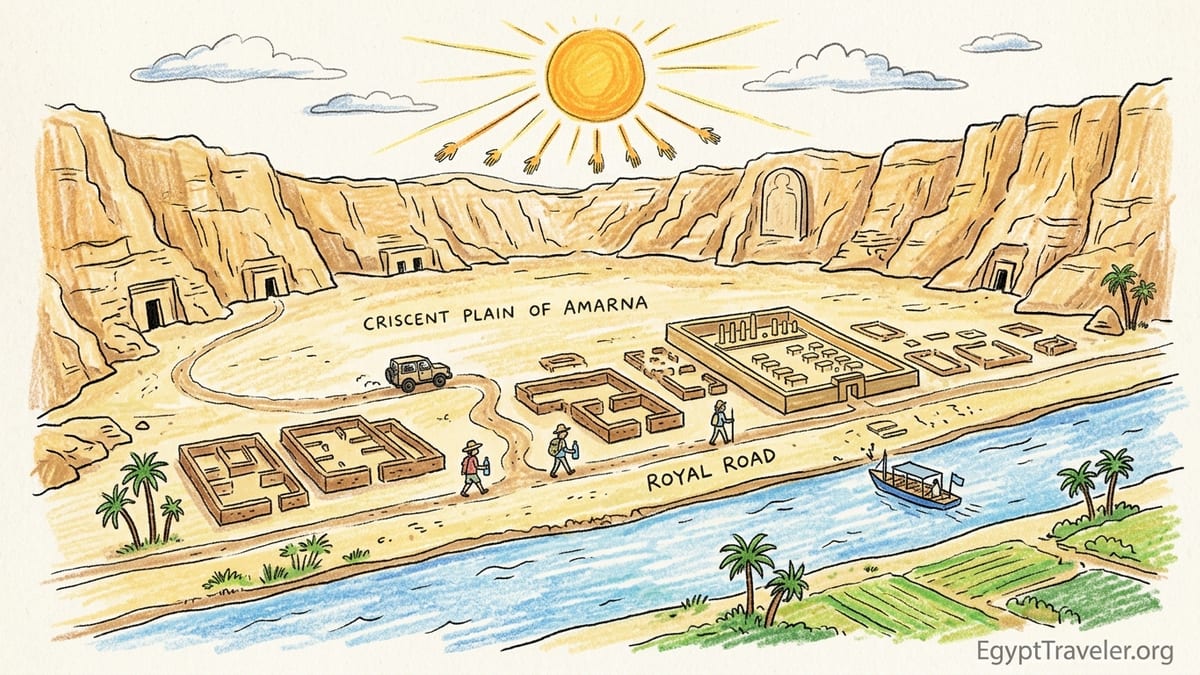
Akhetaten in Context: A Radical City in a Quiet Bend of the Nile
Akhetaten, the city we now call Tell el-Amarna, sits on the east bank of the Nile roughly 58 kilometers south of the modern city of Minya and opposite the west-bank town of Deir Mawas. From the river it appears as a broad crescent of low desert framed by limestone cliffs, very different from the tight Nile valleys around Luxor. When Akhenaten chose this location in the 14th century BC, he was deliberately stepping away from the great religious centers of Thebes and Memphis to build something new.
For modern travelers, that decision still shapes the experience. There is no large town on the east bank at Amarna, no corniche lined with hotels and cafés. Instead you move between isolated clusters of ruins by car along asphalt tracks and gravel roads, with the cliffs on one side and fields or desert on the other. It feels far from the busy circuits of Cairo, Luxor and Aswan, even though a train between Cairo and Minya can take as little as four to five hours and Minya itself is a substantial provincial capital.
Because of this isolation, Amarna rewards visitors who arrive with historical context. Reading a concise overview of the Amarna Period on the way down on the train, or visiting the Egyptian Museum in Cairo or the Grand Egyptian Museum to see Akhenaten’s elongated statues and Amarna art beforehand, will make the low mudbrick walls and rock-cut chapels far easier to imagine as a living city. Think of Tell el-Amarna not as a standalone monument but as one chapter in a broader Middle Egypt itinerary including Beni Hassan, Tuna el-Gebel and the planned Aten Museum in Minya.
From Minya to the Plain: Access, Ferries and On-the-Ground Logistics
Most visitors base themselves in Minya, which has a range of mid-range business hotels and a few Nile-view options. From Minya city to the Amarna visitor center is typically around 1.5 hours by road, depending on checkpoints and traffic through towns like Mallawi. An early departure, around 6.30 or 7.00 in the morning, allows you to reach the site in time for the coolest hours and to spread the visit comfortably across the day.
Road and rail links run on the west bank of the Nile. To reach the site on the east bank you either cross by road bridge between Mallawi and Deir Mawas, then turn south along the east-bank road, or use a local ferry from the west bank opposite the northern part of the site. Many private tour operators and hotel-arranged drivers prefer the bridge route because it avoids lining up at the public ferry and offers more control over timing. However, independent travelers coming by train to stations such as Mallawi or El-Minya often negotiate directly with a taxi driver who knows the ferry schedule and can escort them across.
At Amarna itself, a private vehicle is practically essential. Distances between the main clusters are significant: from the ferry landing near the village of el-Till to the North Tombs is around 3 kilometers, to the Central City another 2 kilometers, and from the North Tombs down to the South Tombs about 5 to 6 kilometers across exposed desert. The Royal Tomb road heads even farther into the cliffs. Walking between all these in Middle Egypt heat, often over soft sand and gravel, would turn a rewarding visit into an ordeal. A standard air-conditioned sedan arranged in Minya for a full-day excursion is a common choice; some travelers opt for a four-wheel drive, especially if they plan to push beyond the main asphalt roads to outlying boundary stelae.
In practice, most visitors engage a local guide in addition to a driver, either through a Minya-based agency or with the help of hotel staff. Licensed Egyptologists familiar with the site are used to requests such as “focus on the tomb scenes” or “I care most about Akhenaten’s religious ideas,” and they can adjust the routing accordingly. A guide will also handle required permissions at police checkpoints, coordinate with site guardians to open specific tombs, and help you judge when sun and heat are becoming unsafe. Expect to pay a reasonable day rate for a guide plus car and driver, comparable to hiring a private guide for a day trip to Beni Hassan from Minya.
Planning Your Time: How Many Days and What Order to See the Site
It is technically possible to rush Tell el-Amarna in half a day, stopping at a selection of tombs and driving quickly past the Central City. For most independent travelers, however, that would be a missed opportunity. A full day on site from roughly 9.00 to 16.00 allows time to see the North Tombs, parts of the Central City including the Great Temple of Aten, and at least one boundary stela or the Royal Tomb without feeling hurried. You can then return to Minya for the evening and dinner along the Nile corniche.
Travelers with a deep interest in archaeology or in the Amarna religious revolution often plan two days. A typical two-day schedule might combine the North Tombs and Central City on day one with the South Tombs, Royal Tomb road and a boundary stela on day two. This pacing gives you time to linger in individual tombs, re-read the wall scenes, and absorb how the city is laid out across the plain. It also provides flexibility if a checkpoint, sandstorm or unexpected closure forces you to swap the order of visits.
Whatever your timeframe, it is wise to start with an elevated view. Many guides like to begin at the North Tombs, where a short but steep climb leads to a cliff-side terrace with wide views over the plain. From here your guide can point out the straight line of the ancient Royal Road, the low mounds marking temple platforms, and the gentle curve of the cliffs where boundary stelae are cut. Once you have this bird’s-eye sense of the site, later stops at foundations on the plain feel more connected.
Heat and light shape the day. The rock-cut tombs are cooler in the morning, and the Central City is shadeless by midday. If you are traveling in hotter months, consider an early start, a break in the shade or at the visitor center around lunchtime, and a return to more strenuous climbs only in late afternoon. Carry more water than you think you need, along with a hat, sunscreen and closed shoes suitable for gravel and loose rock.
Walking the Royal Road: Palaces, Temples and a Vanished City
The heart of Akhetaten was a linear spine of official and religious buildings often called the Royal Road, running roughly north–south parallel to the Nile. Today, the central stretch of this axis is known as the Central City, and although its standing walls are low, the outlines of individual complexes are still easy to trace. Your driver will typically drop you near the modern visitor facilities, from which you can walk with your guide through doorways and along the routes once used by priests and officials.
Key among these ruins is the Great Temple of Aten, an expansive enclosure that once contained multiple courts, offering tables and open-air colonnades. Visitors today see lines of low stone platforms marking the arrangement of altars and the processional path. A guide may explain how the Aten cult favored open roofs and direct sunlight over dark inner sanctuaries, so the absence of towering pylons and roofed halls here is very much the point. Nearby stood administrative complexes and smaller sanctuaries aligned along the road, their functions partially reconstructed thanks to excavation plans and foundation remains.
Farther north along the line of the Royal Road lay the Great Palace and North Riverside Palace, which served as royal residences and ceremonial spaces. Little stands above ground beyond foundation traces and occasional stair bases, but with the help of site maps and a knowledgeable guide you can imagine the movement of royal chariots and courtiers under painted colonnades. This experience is fundamentally different from visiting Karnak or Edfu, where monumental stone architecture survives to its full height. At Tell el-Amarna you are walking floor plans etched into the earth, so a willingness to “see through” the flatness is essential.
The reward is a rare sense of urban scale. Because Akhetaten was abandoned and never rebuilt as a major city, its street grid, house blocks and industrial areas are unusually intact at ground level. When your guide points out the footprint of a workmen’s village or the layout of a house with reception hall, side rooms and backyard, you are looking at the raw plan of a pharaonic city without later overbuilding. This makes Amarna a favorite teaching site for archaeologists, even if it can feel visually understated for casual visitors.
North and South Tombs: Courtiers in the Cliffs
The rock-cut tombs that line the eastern cliffs are the most immediately impressive monuments at Tell el-Amarna. Carved for Akhenaten’s officials rather than the king himself, they line two main clusters: the North Tombs above the village of el-Till and the South Tombs farther along the arc of cliffs. Many visitors focus on the North Tombs, both for their relatively easy access and for the quality of the reliefs.
At the North Tombs, expect a short but steep walk up stone steps from the parking area to a terrace. From here individual tombs open off the cliff face. Inside, the best-preserved examples display scenes of the royal family under the Aten’s radiant disk, processions of officials, and texts that include hymns to the sun god. A site guardian usually accompanies your group, unlocking metal doors and turning on electric lighting where available. It is customary to leave a modest tip for this service, offered through your guide or driver.
The South Tombs are more scattered and require a longer drive along the base of the cliffs. The road surface can vary; after heavy winter rains, some stretches may be rough or partially washed, another reason why a sturdy vehicle and an experienced local driver are valuable. Several tombs here preserve different aspects of Amarna art and administration, though some travelers find the additional effort less rewarding than the North Tombs if time is short. A realistic expectation is to focus on a curated selection of two to four tombs in each cluster rather than trying to see every numbered chapel.
Beyond these elite tombs, archaeological work has revealed cemetery areas for more ordinary residents, including the South Tombs Cemetery above a narrow wadi. These are not generally part of standard tourist routes but they underscore an important point: Akhetaten was a living city with social depth, not just a royal stage. Guides who have followed recent research may weave this story into your visit, helping you understand the strain that Akhenaten’s religious project placed on everyday life.
Boundary Stelae and the Royal Tomb: Edges of a Sacred Landscape
One of the most distinctive features of Akhetaten is its ring of boundary stelae, large rock tablets carved into the cliffs to mark the sacred limits of the city. Sixteen are known, on both east and west banks of the Nile, though not all are accessible today. The most frequently visited examples are on the east bank where asphalt or graded tracks approach the base of the cliffs. Reaching them usually requires a specific request to your guide when planning the day, as they lie away from the main North and South Tombs circuits.
Standing beneath a boundary stela is a highlight for many visitors. Even when the carved figures of Akhenaten, Nefertiti and their daughters are weathered, the sheer scale of the niche in the cliff and the sense of enclosure between desert and river make the king’s proclamation tangible. You may find crumbling remnants of modern protective shelters and low stone steps added by past expeditions, reminders that Amarna has been a focus of study since the nineteenth century. Allow for the heat here: the approach from the car to the cliff can involve crossing open gravel in full sun, so a hat, scarf and plenty of water are essential.
Another evocative excursion is the road to the Royal Tomb. This track runs east into a wadi that cuts deep into the desert hills. Vehicles can drive a good portion of the way, after which a short walk brings you to the main tomb entrance cut into the rock. The Royal Tomb’s decoration is fragmentary and parts may be closed for conservation, so manage your expectations regarding vivid wall art. The power of the place lies more in its isolation and the knowledge that Akhenaten chose this valley, away from traditional royal cemeteries like the Valley of the Kings, as his own eternal resting place.
Not every itinerary includes both a boundary stela and the Royal Tomb, especially on a one-day visit. Discuss your priorities with your guide: if you are fascinated by texts and proclamations, a boundary stela might come first. If royal funerary architecture interests you more, the Royal Tomb may be the better use of time. In either case, these outlying sites emphasize that Akhetaten was conceived as an entire sacred landscape, not just as rows of palaces along the river.
Art, Religion and the Amarna Revolution in Practice
Akhenaten’s decision to elevate the Aten, represented as the sun’s disk, reshaped both religion and art during his reign. At Amarna this is not just an abstract story in history books; it appears in the details of the reliefs you see in tombs and in the very layout of temples. Instead of enclosed sanctuaries with hidden statues, the Aten’s temples were open to the sky, lined with offering tables to catch the sunlight. Sacrifices and rituals took place under the gaze of the blazing sun rather than in dark inner chambers.
In the North Tombs you may stand before a scene where Akhenaten and Nefertiti, with their daughters, raise offerings while rays of the Aten end in small hands extending ankhs toward their faces. The royal family occupies the center of devotion, mediating between god and people. Your guide might contrast this with traditional scenes from Thebes, where Amun or other deities receive offerings directly. These differences are subtle when you see only one place; they become vivid when your wider itinerary pairs Amarna with more conventional sites such as Luxor Temple or Abydos.
Amarna art also famously altered royal portraiture. Statues and reliefs from the city show Akhenaten with elongated skull, narrow chest and distended belly, and the royal daughters in playful, intimate poses. While many of the finest pieces now reside in museums in Cairo, London and Berlin, echoes of this style survive in the rock tombs. Look for the fluid, almost casual way figures interact, and for details of daily life, from chariots and storehouses to banquet scenes. Guides familiar with the latest scholarship can point out where damage later pharaohs inflicted on Akhenaten’s name and image is still visible, reminding you that this revolution was controversial even in antiquity.
For travelers, engaging with this artistic and religious experiment adds depth to the long drives and hot climbs. One practical approach is to bring or purchase a compact site guide that reproduces key scenes, then match them in situ during your visit. Another is to schedule a stop at the Aten Museum in Minya when it is open, where artifacts and models from the Amarna Period help bridge the gap between the low ruins on the plain and the vibrant world that once filled them.
Practical Tips, Safety and Setting Expectations
Tell el-Amarna is a working archaeological zone, a rural community landscape and a tourist site all at once. Respectful behavior and realistic expectations go a long way. Security procedures can include police escorts for foreign visitors on certain routes, passport checks at checkpoints and requirements to register your itinerary. These measures may lengthen transfer times but are routine for Middle Egypt and are generally described by travelers as courteous rather than intrusive. Using a reputable local agency or guide familiar with current regulations helps ensure a smooth day.
Facilities at the site are basic compared with major centers like Giza or Luxor. There are toilets and shade at the visitor center, but you should not count on cafés or shops once you leave Minya or Mallawi. Packing snacks, plenty of bottled water and simple electrolyte powders is a sensible precaution, particularly if you are traveling with children or older visitors. Mobile coverage can be patchy in the wadis, so do not rely on ride-hailing apps; your pre-arranged driver remains your lifeline.
Photography is usually permitted in open areas, though inside tombs policies can change and sometimes require the purchase of a ticket supplement or the use of a phone rather than a DSLR. Ask your guide about current rules before entering, and avoid using flash on delicate paintings or reliefs. Drones are generally prohibited at Egyptian archaeological sites and should not be brought without explicit prior permission from authorities.
Most importantly, shape your expectations. If this is your first trip to Egypt and you dream of towering obelisks and colored hypostyle halls, Amarna may feel stark, a scattering of low stone lines in a sea of sand. Its power is slower and more cerebral: piecing together a short-lived experiment in belief and power from fragmentary clues. Many seasoned travelers say that this reflective, imaginative aspect is precisely what makes a day in Akhetaten stay with them long after more visually dramatic sites blur together.
FAQ
Q1. How long do I really need to visit Tell el-Amarna from Minya?
Most travelers find that one full day on site, framed by an early departure and a late afternoon return to Minya, is enough for the North Tombs, Central City and either the Royal Tomb or a boundary stela. Serious archaeology enthusiasts often add a second day to explore both North and South Tombs in depth and to visit more remote stelae at a relaxed pace.
Q2. Do I need a guide, or can I visit Tell el-Amarna independently?
In theory you can hire a taxi and visit independently, but in practice a licensed guide is highly recommended. Distances are large, site signage can be limited, and local knowledge is useful for negotiating checkpoints, ferries and tomb access. A guide also helps you interpret low foundation walls and eroded reliefs, which otherwise can be difficult to appreciate.
Q3. Is Tell el-Amarna safe to visit today?
Tell el-Amarna lies in a part of Middle Egypt that receives fewer tourists than Luxor or Aswan, but it is routinely visited on organized trips. Authorities may require police escorts or route notifications, which your guide or agency will arrange. As with any destination, travelers should check current travel advice, but on the ground most visitors report feeling secure and well looked after.
Q4. What is the best time of year and time of day to visit?
The most comfortable months are typically from late autumn through early spring, when daytime highs are milder and walking in the open desert is more pleasant. Within a given day, mornings are cooler and well suited to climbing to the tombs, while midday can be reserved for the Central City or a break at the visitor center. Afternoons, when the sun lowers, are often ideal for wide views and photography.
Q5. Can I combine Tell el-Amarna with other sites in the same trip?
Yes. Many itineraries pair Amarna with Beni Hassan, Tuna el-Gebel or other Middle Egypt sites, using Minya as a base for several nights. Travelers coming from Cairo sometimes include Minya and Amarna as a slower overland segment between Cairo and Luxor instead of flying. With careful planning, you can visit Beni Hassan one day, Amarna the next and continue south by train or private vehicle.
Q6. What should I wear and bring for a day at the site?
Light, breathable clothing that covers shoulders and knees, a wide-brimmed hat or scarf, sturdy closed shoes and sunglasses are practical choices. Bring more water than you think you will need, high-SPF sunscreen, snacks and perhaps a lightweight scarf against wind or sand. A small flashlight or phone torch is helpful in more dimly lit tombs, and a paper map or downloaded site plan can aid orientation.
Q7. Are there toilets, cafés or shops at Tell el-Amarna?
There are basic facilities at or near the visitor center, including toilets and some shaded areas, but you should not rely on cafés or shops once you leave the towns on the west bank. It is wise to eat breakfast in Minya, bring provisions for lunch and carry any medicines you might need, as there are no pharmacies at the site itself.
Q8. How does visiting Amarna compare with famous temples like Karnak or Edfu?
Karnak and Edfu impress with towering stone architecture, intact columns and extensive reliefs. Tell el-Amarna, by contrast, is mostly foundations, low walls and rock-cut tombs. The visual impact is subtler, but the sense of walking through the footprint of a purpose-built capital, with its palaces, royal road and experimental temples, offers a different kind of immersion that many repeat visitors to Egypt particularly value.
Q9. Is it possible to reach Tell el-Amarna by public transport?
Trains and long-distance buses run along the west bank of the Nile to cities like Minya and Mallawi, but from there you still need a private car or taxi to reach the site and to move between its widely spaced monuments. Some experienced travelers arrange a taxi for the day at Mallawi station, but most find it easier and ultimately better value to book a car and guide in advance from Minya.
Q10. Can I visit the boundary stelae and Royal Tomb on a short visit?
On a single day you can usually include either a boundary stela or the Royal Tomb in addition to the North Tombs and Central City, but doing all of them risks making the day rushed and tiring. If these outlying sites are high priorities, discuss this early with your guide so they can design a route that minimizes backtracking and accounts for road conditions and checkpoint timings.