


On a low rise above the Nile floodplain in Middle Egypt, the scattered ruins of Hermopolis Magna and the vast necropolis of nearby Tuna el-Gebel preserve one of the longest, richest religious stories in the country: from Pharaonic cult center of Thoth to bustling Greco-Roman metropolis and later Christian stronghold. This is not a site of towering complete temples, but of fragments, layers and atmosphere, best appreciated by travelers willing to look past rubble and read the clues in broken columns, reused blocks and colossal baboon statues turned golden in the late-afternoon light.
Understanding Khmun, Hermopolis and El Ashmunein
Modern El Ashmunein, in Minya Governorate on the west bank of the Nile, sits atop the ancient city the Egyptians called Khmun, the “City of the Eight,” later known to Greeks as Hermopolis Magna, the great city of Hermes. For more than two millennia this was the principal cult center of Thoth, the ibis- and baboon-headed god of writing, wisdom and cosmic order. Greek settlers identified Thoth with their own Hermes, and the city flourished in the Ptolemaic and Roman periods as a proud metropolis, described in papyri as “the Great, Ancient, Illustrious and Most August City of Hermopolis.” Today, almost all that grandeur has vanished, leaving a compact archaeological zone hemmed in by villages and fields.
The surviving remains at El Ashmunein are modest in size but unusually rich in chronological depth. Within a short walk you can move from the scattered blocks of New Kingdom temples through column stumps and baths of the Greco-Roman city to the foundations of a large late antique basilica that marks Hermopolis as an early Christian center. Archaeologists have shown that a substantial Christian community existed here by the 4th century, building churches literally on top of earlier pagan institutions. The result is a rare, layered cross-section of Egyptian religious history that is best understood not as isolated ruins, but as a continuous story that also extends into the surrounding necropolis at Tuna el-Gebel.
For travelers, this means that Hermopolis is less about isolated photo opportunities and more about context. You will not find a single intact temple like at Dendera or Edfu. Instead you walk across gentle mounds and fenced enclosures, picking out column drums reused as building material, Greek inscriptions carved into limestone blocks, and the faint outlines of public squares. Going with a guide who can “translate” these traces into narratives about festivals, processions and theological debates can make the difference between seeing a pile of stone and glimpsing a once-vibrant regional capital.
The Temple Precinct and Colossal Baboons of Thoth
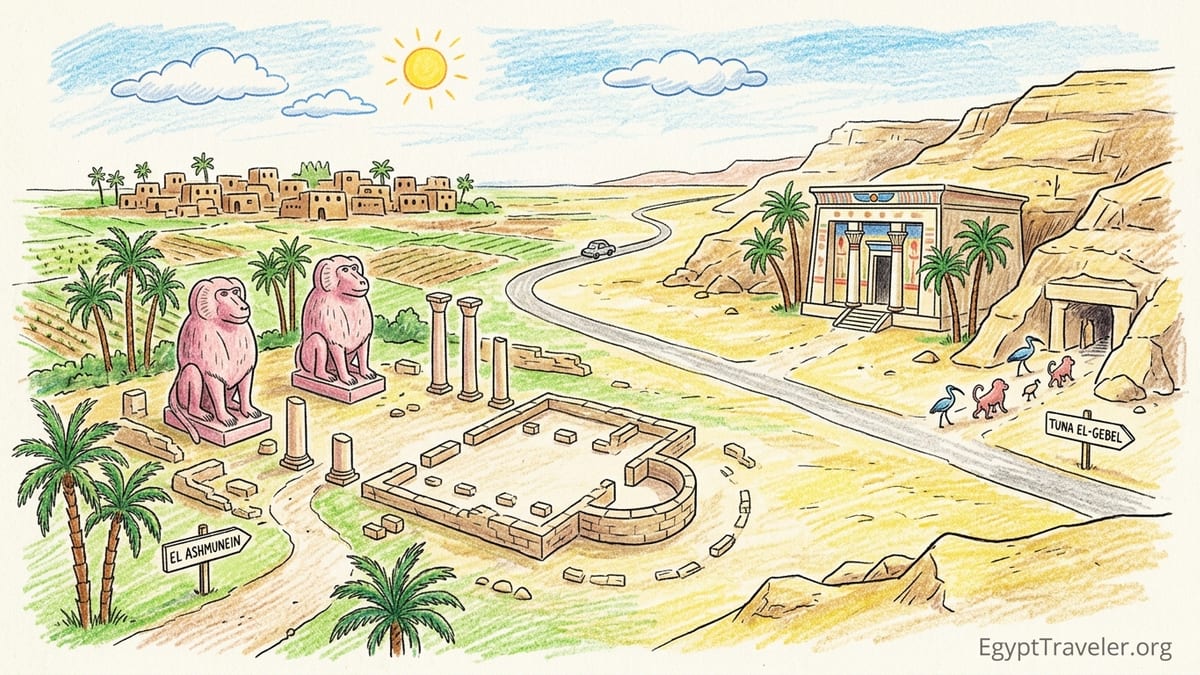
The visual highlight of El Ashmunein is the compact open-air museum that preserves the most impressive pieces from the temple of Thoth and related monuments. Here you stand face to face with colossal granite baboons, each several meters high and weighing tens of tons, originally set up by Amenhotep III in the New Kingdom. Their stylized, upright bodies and solemn, forward-facing gaze recall their role in Egyptian religion as “solar baboons,” howling at sunrise and linked to Thoth’s control of the sun’s daily cycle. Two of these giants now stand in the open air, their surfaces weathered but their power unmistakable, providing one of the few chances in Egypt to stand so close to such monumental representations of Thoth in baboon form.
Around the baboons are scattered architectural blocks from the great temple complex, including fragments with hieroglyphic inscriptions praising Thoth and naming pharaohs from the New Kingdom and later. Archaeological studies have shown that some of the foundations in the sanctuary were built of reused blocks from the short-lived capital of Akhetaten (Tell el-Amarna), across the river, underlining how intimately linked Hermopolis was to the political experiments of the Amarna period. Travelers who have visited the Amarna ruins will recognize similar pale limestone and relief styles, now uprooted and reassembled in Thoth’s city after Akhenaten’s fall.
Beyond the museum, traces of the larger temple precinct are still visible in low walls, mudbrick platforms and stretches of stone pavement. With a guide, you can trace the likely processional routes from the main sanctuary out toward the edge of the city, imagining statues of Thoth carried in barques during festivals while priests chanted hymns. Do not expect towering pylons or full hypostyle halls; instead, expect fragments, some only knee-high. The reward is the chance to see how temple stonework was dismantled, reused and folded into later phases, from Roman civic architecture to Christian churches.
Greco-Roman City: Agora, Baths and Civic Life
By the Hellenistic and Roman periods, Hermopolis had become a typical Egyptian metropolis with a distinctly Mediterranean flavor. Excavations have uncovered the remains of an agora, or central square, that once served as the administrative and commercial heart of the city. Today, travelers see mainly stone foundations and column bases outlining an open rectangular space, but archaeological reports describe stoas and colonnades where local elites might have debated civic matters and merchants from the surrounding countryside brought produce for sale. Standing among the stubby columns with fields and village houses in the distance, it takes only a little imagination to hear the murmur of Greek and Demotic conversations that once filled the square.
Nearby, archaeologists working with the Egypt Exploration Society have documented a substantial Roman public bath complex. Much of the superstructure has disappeared, but you can still pick out hypocaust pillars that once supported heated floors, as well as channels where hot water circulated. For travelers familiar with better-preserved baths in places like Ephesus or Ostia, Hermopolis offers a stripped-down, almost diagrammatic version: the same sequence of cold, warm and hot rooms, but reduced to foundations in the dust. This is precisely what makes the site valuable. It shows how Roman urban amenities extended deep into provincial Egypt, right alongside older temples dedicated to Thoth.
Scattered across the site you may notice fragments of fluted columns, Corinthian capitals and inscribed bases that once carried bronze statues of emperors or local benefactors. Many of these were recorded in detail by scholars working from the 19th century onward, but on the ground today they sit quietly in the sun, half-buried in coarse sand and grass. A good guide will often pull out a folded photocopy of a site plan or old publication, pointing from a worn capital in front of you to a small black dot on the page. This kind of low-tech field interpretation is typical of Hermopolis and should be part of your expectations.
From Temples to Basilicas: Early Christianity at Hermopolis
One of Hermopolis Magna’s most significant stories is its transformation into a Christian center in late antiquity. Archaeological and textual evidence suggests that a Christian community was present here by the 3rd century, and by the 4th century the city was a recognized episcopal seat. On the ground, this history is visible in the remains of a large basilica uncovered within the ancient city. From a traveler’s perspective, the basilica appears as a broad, rectangular outline of stone walls articulated into nave and side aisles, with the curve of an apse at one end and traces of ancillary rooms flanking it.
What makes this basilica particularly important is its location within the former pagan urban core. Researchers have noted that parts of its masonry include reused blocks from earlier temples and civic buildings, some still bearing pagan iconography on faces that were turned inward or downward. As you walk along the line of the nave, you might be stepping over stones that once formed a threshold for worshippers of Thoth or supported a statue base honoring a Roman emperor. This palpable reuse of sacred space illustrates a broader pattern in Egypt: old sanctuaries being reoriented, both physically and spiritually, toward new forms of worship.
For visitors, the basilica is also a reminder of how quickly monumental Christianity spread beyond the more famous centers like Alexandria. Standing here, with the outlines of the basilica blending into surrounding mudbrick, you are in one of the earliest Christian architectural spaces preserved in Middle Egypt. Yet, as with the rest of Hermopolis, you see it in an almost skeletal state. The absence of walls and roofs invites you to imagine processions, incense and hymn-singing in what is now open sky. Travelers interested in late antique and Coptic history will find Hermopolis, in combination with nearby monastic sites and churches in Minya, an evocative stop.
Tuna el-Gebel: Necropolis of Hermopolis Magna
To understand Hermopolis fully, you need to leave the city mound and drive west into the desert to Tuna el-Gebel, the sprawling necropolis that served the metropolis from the Late Period through the Roman era. The distance between El Ashmunein and Tuna el-Gebel is roughly 7 to 10 kilometers depending on the route, usually covered in 15 to 25 minutes by car along local roads that leave the cultivated land and climb gently into the low limestone escarpment. Most visitors arrange a private car and driver from Minya that includes both sites on a single day, with Tuna el-Gebel often visited second, in the lower, warmer light of afternoon.
Tuna el-Gebel is best known for its animal catacombs dedicated to Thoth. In long underground galleries cut into the rock, priests and pilgrims deposited thousands of mummified ibises and baboons as votive offerings. Today, only selected sections of these catacombs are open, and security staff typically accompany small groups with flashlights. You walk along rock-cut corridors lined with niches, some still containing limestone or wooden boxes that once held animal mummies. Interpretation is basic, often a short explanation from a guard or your guide rather than museum-style panels, but the experience of moving through these dim, incense-scented tunnels gives a powerful sense of the cultic machinery that underpinned Thoth’s fame.
Above ground, Tuna el-Gebel also preserves monumental tombs of high officials and priests from the Ptolemaic and early Roman periods. The most famous is the tomb of Petosiris, a high priest of Thoth, whose finely decorated chapel blends traditional Egyptian scenes with Greek stylistic elements. Here you can see reliefs of banquets, agricultural work and religious rituals, all labeled with bilingual inscriptions that reflect a culturally mixed society. Nearby, later tombs take the form of small “house facades” with painted plaster interiors in which the deceased appear in Greek dress but with Egyptian religious motifs. For travelers, these tombs offer some of the clearest, most accessible evidence of how Greek, Egyptian and Roman identities were negotiated in daily life and death.
Practical Itinerary: Combining Hermopolis and Tuna el-Gebel from Minya
Most international travelers base themselves in Minya city to visit Hermopolis and Tuna el-Gebel. Minya has a cluster of midrange hotels where double rooms typically cost the equivalent of 40 to 80 US dollars per night, along with a handful of simpler guesthouses. From Minya, the drive to El Ashmunein is roughly 45 to 60 minutes, depending on traffic and police checkpoints, following the main west-bank road and then smaller agricultural roads that wind through villages. Because security procedures can change, particularly for foreign visitors, it is advisable to check with your hotel or a reputable local agency the day before your trip about any current requirements for police escorts or travel permissions.
A common day itinerary starts with an early breakfast in Minya, a departure around 8:00, and arrival at El Ashmunein by mid-morning. You spend about 60 to 90 minutes at Hermopolis, enough time to walk the open-air museum, explore the temple precinct, agora and basilica remains at a measured pace, and allow for questions with your guide. Afterward, your driver continues on to Tuna el-Gebel, where you can have a simple packed lunch or eat at a basic local café near the site entrance. Expect another 2 to 3 hours in the necropolis, especially if you want to visit the Petosiris tomb, other notable tombs and a section of the animal catacombs. Most visitors are back in Minya by late afternoon or early evening.
Hiring a private car with driver and licensed guide for the full-day loop from Minya to Hermopolis and Tuna el-Gebel typically costs the equivalent of 80 to 150 US dollars for two people, depending on vehicle quality, guide experience and whether arrangements are made directly or through a Cairo-based operator. Entrance fees at each site are relatively modest by Egyptian standards but can change seasonally; your hotel reception in Minya can usually quote up-to-date prices in Egyptian pounds. Travelers on tighter budgets sometimes negotiate a taxi just for transport and rely on local site guides paid separately in cash, but for sites as fragmentary and lightly signposted as Hermopolis, investing in a knowledgeable guide is recommended.
Guides, Permissions and Honest Expectations
Hermopolis Magna and Tuna el-Gebel lie outside the main tourist corridors of Luxor and Aswan, and their on-site infrastructure reflects this. There are usually a few guards and an inspector from the Ministry of Tourism and Antiquities present, but facilities beyond basic restrooms and a small ticket office can be minimal. English-language signage at Hermopolis is limited, and at Tuna el-Gebel most interpretation depends on your guide or the custodians who accompany you through the tombs and catacombs. Because of this, organizing a licensed Egyptologist or experienced local guide either from Minya or through a Cairo agency is the single best investment you can make in your visit.
Security procedures in Middle Egypt have tightened and relaxed in cycles over the past decade, and arrangements can vary by nationality. At times, foreign visitors have been required to travel with a police escort or register their movements in advance, while at other periods a simple passport check at a checkpoint has been sufficient. As of mid-2026, reports from travelers suggest that independent travel with a private car and guide from Minya is generally possible, but you should still build in flexibility for roadside checks and possible delays. Carry your passport, a copy of your hotel booking and contact details for your local organizer in case police wish to confirm your plans.
Perhaps the most important expectation to set is about the fragmentary nature of the ruins. If your mental image of Egyptian archaeology is shaped by the intact hypostyle hall of Karnak or the near-complete temples along the Nile cruise routes, Hermopolis will feel sparse by comparison. Much of the stone of the ancient city was quarried for later building projects or ground into lime, and what remains often sits no higher than your waist. Tuna el-Gebel is more visually striking thanks to its decorated tombs and catacombs, but even here many corridors are closed or unstable, and the experience is one of glimpses rather than exhaustive exploration. Go prepared to piece together the story from scattered clues rather than expecting monumental spectacle.
Why Hermopolis and Tuna el-Gebel Matter
Despite, or perhaps because of, their fragmentary state, Hermopolis Magna and Tuna el-Gebel form one of the most intellectually rewarding day trips in Middle Egypt. Nowhere else along the Nile is it so easy to trace, in a single landscape, the full arc of religious change from Pharaonic temple cult through Greco-Roman civic religion to organized Christianity. At El Ashmunein, you encounter Thoth in the guise of colossal baboon statues and temple inscriptions, walk through a classical-style agora and Roman baths, and then stand in the footprint of a basilica that anchored the Christian community. At Tuna el-Gebel, you descend into catacombs lined with animal mummies dedicated to the same Thoth, then emerge to study tomb facades whose Greek styling and Egyptian symbolism speak to a multi-layered cultural identity.
For travelers who have already seen the “greatest hits” of Egyptian archaeology, this combination offers a more nuanced perspective. It challenges a simplistic view of ancient Egypt as static and unchanging and instead reveals a landscape of continual adaptation. Thoth, patron of scribes and record-keepers, remained central even as the scripts changed from hieroglyphic and Demotic to Greek and eventually Coptic. Civic spaces like the agora articulated new forms of public life, while Christian basilicas repurposed pagan stones for new liturgies. By walking these sites in a single day, you witness this long, overlapping sequence in situ rather than as separate galleries in a museum.
In practical terms, Hermopolis and Tuna el-Gebel also exemplify a different kind of Egyptian travel, one less about ticking off iconic images and more about engaging slowly with landscapes that require explanation and imagination. Conversation with your guide, with site guards proud to point out a favorite inscription, and with Minya residents who see these ruins as part of their local identity is as important as any single photo. If you approach the day with patience, curiosity and realistic expectations about what is visible on the ground, you are likely to come away with a deeper appreciation of Egypt’s layered past.
FAQ
Q1. How do I get to Hermopolis Magna and Tuna el-Gebel from Minya?
Most travelers hire a private car with driver from Minya, often arranged through their hotel or a local agency, which covers the 45 to 60 minute drive to El Ashmunein and the shorter hop onward to Tuna el-Gebel before returning to Minya the same afternoon.
Q2. Do I need a guide, or can I visit the sites on my own?
You can technically visit with only a driver, but because Hermopolis in particular has very limited signage and fragmentary remains, a licensed guide or experienced local Egyptologist greatly enhances the experience by explaining the temple precinct, agora and basilica layout.
Q3. Are any special permits or police escorts required for foreign visitors?
Requirements change over time, but as of mid-2026 most foreign visitors can travel with a private car and guide after routine passport checks at roadblocks, although in some cases local police may decide to accompany you between Minya and the sites for security reasons.
Q4. How much time should I plan for Hermopolis and Tuna el-Gebel in one day?
A full-day trip works well, with around 60 to 90 minutes at Hermopolis and 2 to 3 hours at Tuna el-Gebel, plus driving time and a simple lunch stop, allowing you to return to Minya by late afternoon.
Q5. What are the entrance fees like at these sites?
Ticket prices are moderate compared to major sites like the Pyramids or Karnak and are usually paid in Egyptian pounds at small on-site ticket offices, but they change periodically so it is best to ask your hotel or guide for current figures shortly before you travel.
Q6. How fragmentary are the ruins, and will I be disappointed compared to sites like Luxor?
Hermopolis is much more ruined than the major temple complexes in Upper Egypt, with many remains only at foundation level, so travelers who value intact monuments may find it visually modest, but those interested in layered history usually consider it a rewarding visit.
Q7. Is it safe to visit Minya, Hermopolis and Tuna el-Gebel now?
Security in Middle Egypt is generally stable, and the authorities monitor movement along main roads, but you should still check recent advice, follow local guidance, carry your passport and be prepared for routine police checkpoints on the way to the sites.
Q8. What should I wear and bring for a day trip to these sites?
Loose, breathable clothing, a wide-brimmed hat, sturdy closed shoes, sunscreen, plenty of water and some snacks are advisable, as shade can be limited at both sites and services around them are basic.
Q9. Can I combine Hermopolis and Tuna el-Gebel with other nearby archaeological sites?
Some visitors pair this day trip with a separate excursion to Amarna on another day from Minya, but combining all three in a single day is usually too rushed, especially given security checks and the need to respect closing hours.
Q10. Are photography and video allowed at Hermopolis and Tuna el-Gebel?
Photography is generally allowed in open-air areas, though using drones is prohibited and some tomb interiors or catacomb sections at Tuna el-Gebel may have restrictions or require a small additional fee, which your guide can confirm on the spot.