


For many travelers, Middle Egypt is the blank stretch of map between Cairo and Luxor. Yet around the provincial city of Minya lies one of the densest clusters of archaeological sites in the Nile Valley: the painted cliff tombs of Beni Hassan, the revolutionary capital of Tell el-Amarna, the vast necropolis of Tuna el-Gebel and the remains of Hermopolis at El Ashmunein. The question is not whether these sites are worth the effort. It is whether you should attempt punishing day trips from Cairo or slow down and use Minya as a proper base. This guide takes a practical, on-the-ground approach to answering that question.
Why Minya Works as a Base for Middle Egypt
Minya sits roughly 245 kilometers south of Cairo on the west bank of the Nile, a midpoint between the capital and Upper Egypt. The city is large enough to have reliable train links, decent midrange hotels and a pool of licensed drivers and guides, but it still feels distinctly local. You will see vegetable boats unloading at the riverfront, students crowding the corniche in the evening, and family-run cafes serving strong coffee late into the night. For most visitors, the city itself is a pleasant backdrop rather than the main attraction, and that is precisely what makes it a practical staging post.
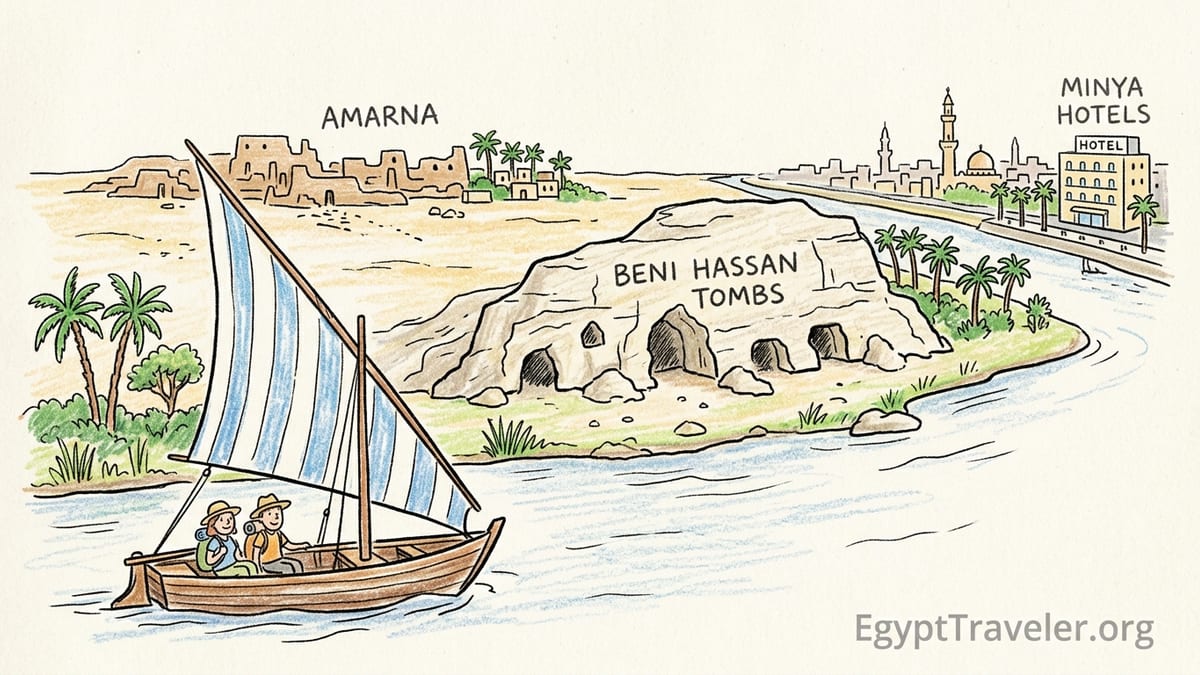
The key advantage of Minya is logistics. Beni Hassan lies about 20 kilometers south of the city, while Tell el-Amarna and Tuna el-Gebel / El Ashmunein form a broader arc to the south and west within roughly 60 to 80 kilometers’ reach. That clustering means you can set out after breakfast, reach each site comfortably by car, explore in cooler morning hours and return without the bone-deep fatigue that comes from a 10 to 12 hour day on the highway from Cairo. Multi-day archaeological tours increasingly schedule two or three nights in Minya for exactly this reason.
Staying in Minya also spreads your time across sites that reward unhurried visits. At Beni Hassan, painted Middle Kingdom tombs reveal wrestling scenes and desert hunts that are easy to rush past if you are watching the clock. At Amarna, the scale of Akhenaten’s short-lived capital only really makes sense when you allow time to move between distant clusters of ruins. Using Minya as a base lets you allocate days by theme or geography instead of by the demands of a long-distance transfer.
In practical terms, Minya is the only place in Middle Egypt where you can reliably combine rail access, a choice of hotels and reasonably straightforward arrangements for private drivers. Smaller towns closer to individual sites rarely have accommodation to match even basic international expectations, which makes Minya the default hub if you want to explore Beni Hassan, Amarna, Tuna el-Gebel and Hermopolis in a focused but comfortable way.
Getting to Minya from Cairo: Train and Road
The Cairo–Aswan rail line is the backbone of travel to Minya. Trains from Cairo’s Ramses Station typically take about 3 to 4 hours to reach Minya, depending on the service. Air-conditioned express trains offer reserved seating in first and second class, and online schedule aggregators and local booking offices usually show several departures spread through the day and evening. As of mid-2026, typical one-way fares for non-luxury services are often in the low hundreds of Egyptian pounds, with first class still relatively inexpensive by European standards, though prices can fluctuate.
For most independent travelers, the train is the most comfortable and predictable choice. The ride follows the Nile and irrigated fields, and you step off in central Minya within a short taxi ride of the main hotels along or near the corniche. It is worth arriving with your train number and departure time written out in Arabic or on your phone screenshot, as ticket clerks may not always speak English. Buying a day or two in advance in Cairo is wise in high season or around public holidays.
Travel by road from Cairo is possible on the main Upper Egypt desert highway. Private transfers can be arranged through Cairo-based agencies or Minya drivers, usually with a modern sedan or minivan. As an approximate guide, quotes in 2025–2026 for a one-way private transfer from Cairo to Minya in an air-conditioned car have ranged from around 6,000 to 10,000 Egyptian pounds depending on vehicle size and whether the car is returning empty. The drive time is typically 4 to 5 hours, depending on traffic leaving Cairo and police checkpoints along the way.
Long day trips from Cairo that attempt a loop of Minya-area sites in one push exist, mainly as custom tours for travelers who are very short on time. These can involve a pre-dawn departure, a 4 to 5 hour drive south, a compressed visit to Beni Hassan and Amarna or Beni Hassan and a church or monastery, then the same drive back in the evening. Even in a comfortable vehicle, you are looking at 8 to 10 hours of road time. That is why most archaeologically minded travelers and many specialist tour operators now favor at least one overnight stay in Minya rather than racing back the same day.
First Impressions of Minya: Nile Waterfront, Hotels and Safety
Minya’s Nile corniche is the city’s most attractive face. In the late afternoon, families stroll the riverfront promenade, felucca-style sailing boats and river barges pass slowly on the water, and the light softens over the fields on the east bank. A handful of hotels and cafes overlook this stretch, and larger tour groups often book into simple but functional properties near the river. Expect tiled lobbies, basic but air-conditioned rooms, and hearty Egyptian breakfasts rather than luxury finishes.
Although options change year to year, you can typically find at least one upper-midrange hotel that caters regularly to foreign tour groups plus a scattering of budget local hotels. Names and standards evolve, so it is sensible to check recent traveler reports and, where possible, confirm that the property is accustomed to international visitors. Many independent travelers also coordinate with a Minya-based guide, who can suggest lodging that works well with current security procedures.
On safety, Minya and Middle Egypt have had periods of tighter security in the past, and some formalities remain. It is common for foreign visitors to register with tourism police, either through their hotel or guide, and to encounter occasional checkpoints on roads to archaeological sites. In practical terms, these usually amount to showing a passport photocopy and having the driver’s itinerary noted. While security protocols can slow travel slightly, they are part of why organized excursions and pre-arranged cars are strongly preferred to ad hoc hitchhiking or experimental backroads travel in this region.
Within the city, Minya feels like a busy provincial capital rather than a tourist resort. Dress codes are conservative by coastal Egypt standards but not restrictive; long trousers or skirts and covered shoulders are appreciated, especially away from the hotel and riverfront. Alcohol is available in some hotels and a few licensed premises but not widely served in local street cafes. Travelers who approach the city as a working Egyptian community that happens to sit beside extraordinary archaeology, rather than a resort, tend to enjoy it most.
Planning Your Stay: How Many Nights in Minya?
For travelers focused on archaeology, a minimum of two nights in Minya is advisable, with three nights ideal if you want to see all four major sites without rushing. Two nights gives you a full day between arrival and departure, which is just enough to cover Beni Hassan plus either Amarna or Tuna el-Gebel if you accept a long but manageable touring day. Three nights allows for two full days of site visits, which in practice means you can group the sites logically by geography and spend more time on the ground rather than in the car.
A typical three-night plan might see you arrive from Cairo by afternoon train on Day 1, settle into your hotel and perhaps take a sunset stroll along the Nile. Day 2 could then focus on Beni Hassan and nearby sites, with an early start and a relaxed return. Day 3 would be devoted to Amarna and Tuna el-Gebel and, if time allows, a short stop at the Hermopolis ruins at El Ashmunein. On Day 4, you would continue south to Abydos or Luxor, or return to Cairo by train. Specialist archaeology tours often adopt a similar rhythm, using Minya as a pivot between Cairo and Upper Egypt.
Attempting to see all four sites in just one full day from Minya is theoretically possible if you are very focused, but it quickly becomes a box-ticking exercise, especially in warmer months. Beni Hassan alone can absorb several hours if you pause at different tombs, appreciate the wall paintings and climb to viewpoints over the Nile. Amarna covers a large area on the east bank and is usually visited by road circuits rather than on foot. Tuna el-Gebel, with its catacombs and Ptolemaic-era tombs, is more compact but still deserves unhurried time, especially if you are interested in the transitional period between Pharaonic and Greco-Roman Egypt.
For travelers who are less specialized but still curious, two nights can be a good compromise: one full day that takes in Beni Hassan and either Amarna or Tuna el-Gebel, then a relaxed evening back in Minya and onward travel next day. In contrast, trying to do the same as a single enormous day trip from Cairo means trading hours inside tombs for hours in traffic. Unless you absolutely cannot spare a night away from the capital, Minya is the more humane option.
Organizing Drivers and Guides in Minya
Because public transport to the archaeological sites is patchy and often involves multiple local microbuses and informal connections, most visitors rely on private cars arranged through hotels or local agencies. A common scenario is to arrive in Minya by train, then meet a pre-booked driver at the station for transfer to your hotel and onward touring in the following days. Cars are typically late-model sedans or small vans with air conditioning, and the driver waits while you explore each site.
Daily rates vary widely, but as a very rough guide, travelers in recent seasons have reported paying the equivalent of around 2,500 to 4,000 Egyptian pounds per day for a full-day car and driver covering Beni Hassan or one of the longer circuits to Amarna and Tuna el-Gebel. Prices scale with distance, fuel costs and whether you book through a Cairo-based tour operator or a local Minya contact. It is standard to pay a deposit or full payment in cash and to clarify whether entrance fees, parking and the driver’s meals are included.
Guiding is a separate question. At major sites like Beni Hassan and Amarna, local site guardians may offer informal explanations, but for structured interpretation many travelers either bring an Egyptologist guide from Cairo or Luxor or hire a Minya-based licensed guide. Several Egypt-focused tour companies now contract regularly with guides who know Middle Egypt well and can accompany you over multiple days, often combining Minya with Abydos and Dendera further south.
A practical approach for independent travelers is to email a few reputable Egypt-focused agencies or guides in advance and ask specifically about a Minya-based program that includes Beni Hassan, Amarna, Tuna el-Gebel and El Ashmunein. Ask for sample daily itineraries and what is realistically covered in a day. A good operator will be candid about travel times, security procedures and seasonal heat, and will schedule earlier starts for the more exposed desert sites. If you prefer more flexibility, you can arrange drivers day by day via your hotel, but in that case it is even more important to carry a written list of sites and to allow extra time.
Grouping the Sites Geographically: Smart Day Itineraries
Looking at a map, the main sites around Minya fall into two logical clusters. Beni Hassan lies on the east bank of the Nile, roughly 20 kilometers south of Minya. Tell el-Amarna stretches along the east bank further south, while Tuna el-Gebel and the remains of Hermopolis at El Ashmunein sit west of the river, near the town of Mallawi. Grouping them with geography in mind helps minimize zigzagging across the Nile and reduces time lost to ferry crossings and checkpoints.
A sensible first day from Minya focuses on Beni Hassan and its surroundings. After driving south along the Nile and up into limestone cliffs, you reach the rock-cut tombs carved for Middle Kingdom provincial governors. The painted scenes inside include wrestling matches, desert hunts, and everyday life in the Oryx Nome. Because these tombs are relatively compact and clustered, many visitors combine them with a nearby village visit or a short stop at a lesser-known site recommended by their guide before returning to Minya by mid-afternoon.
The second main day combines Amarna with Tuna el-Gebel and, if time allows, El Ashmunein. One common pattern is to drive south to the vicinity of Deir Mawas, cross to the east bank by road and ferry or bridge depending on current routing, then follow the local road into the plain of Amarna. There you can visit selected tombs of officials, the remains of the Great Temple of the Aten and the palace area, as well as one of the boundary stelae that marked the city’s sacred limits. After several hours, your driver brings you back across to the west bank and on to Tuna el-Gebel.
Tuna el-Gebel presents a different atmosphere. This is a vast necropolis of the late Pharaonic and early Greco-Roman periods, with catacombs for sacred ibis and baboon burials, the painted tomb of Petosiris, and a scattering of temple and residential remains surrounded by desert. The site lies about 270 kilometers south of Cairo overall, but from Minya it is a feasible drive, especially when combined with Amarna. Nearby El Ashmunein, preserving traces of ancient Hermopolis, adds another layer with its association with the god Thoth and later Christian remains. Because this cluster involves more driving and the sites are spread out, many guides recommend an early start from Minya and a flexible schedule that allows you to linger where your interests are strongest.
Comparing Minya Stays with Long Day Trips from Cairo
The attraction of a long day trip from Cairo is obvious: you keep your city hotel base, you avoid checking in and out, and you return to familiar surroundings at night. A typical private day tour advertised from Cairo to Minya might promise a 6 a.m. pick-up, a 4 to 5 hour drive south, a quick circuit of Amarna and Beni Hassan or Beni Hassan and a Holy Family church, lunch on the road and a late-night return. For travelers who only have a handful of days in Egypt and are unlikely ever to come back, that can sound tempting.
In practice, such days are extremely tiring. You can easily spend more time sitting in the vehicle than on the ground at the sites. The long drives also make you more vulnerable to delays from traffic leaving Cairo, roadworks or additional security checks, any of which can compress your already tight time at the tombs. In hot months, you may arrive at exposed desert sites such as Amarna when temperatures are at their peak rather than in the relative cool of morning.
By contrast, basing yourself in Minya multiplies your options. With two or three nights in the city, you can spread your visit over two full days of exploration, reach sites earlier, and adjust your schedule if heat or fatigue demands a slower pace. The overall cost difference between one ultra-long day trip from Cairo and a pair of train tickets plus two hotel nights and local drivers is often smaller than you might expect, especially if you are sharing the car with another traveler. You also gain a richer sense of Middle Egypt’s everyday life by spending evenings in Minya rather than spending dawn and dusk on the highway.
From a safety and logistics perspective, authorities are also accustomed to visitors staying overnight in Minya for precisely these itineraries. Local tourism officials have repeatedly highlighted the trio of Beni Hassan, Amarna and Tuna el-Gebel as the governorate’s principal archaeological circuit, and multi-national tour groups now move steadily along that route. That infrastructure of expectations works in your favor when you plan a stay that aligns with it, rather than pushing for an extreme same-day return to Cairo.
The Takeaway
For travelers who care deeply about ancient Egypt, the area around Minya is not a footnote between Cairo and Luxor but a destination in its own right. The painted cliff tombs of Beni Hassan, the revolutionary urban experiment of Tell el-Amarna, the sprawling necropolis of Tuna el-Gebel and the remains of Hermopolis at El Ashmunein together tell a story that bridges the Middle Kingdom, the Amarna period and the Greco-Roman era. Experiencing that story properly requires more than a rushed stop on the highway.
Using Minya as a base allows you to approach these sites with the time and attention they deserve. Practical rail links from Cairo, workable road distances to each site and a growing ecosystem of drivers and guides make it possible to organize two or three days of focused exploration without punishing travel days. The city itself, with its Nile corniche and lived-in Egyptian character, becomes a calm anchor between desert excursions.
Compared with extremely long day trips from Cairo, a stay in Minya is almost always the more worthwhile choice if your schedule allows. You gain fuller days at the sites, greater flexibility in the face of weather and logistics, and a more nuanced sense of Middle Egypt’s landscape and communities. For many visitors, the memories that endure are not only of famous names like Akhenaten or Nefertiti, but of quiet evenings watching the Nile glide past Minya’s waterfront, knowing that the cliffs and plains beyond hold some of the most evocative chapters in Egypt’s long history.
FAQ
Q1. Is Minya safe for foreign travelers right now?
Minya is regularly visited by organized tour groups and independent travelers, and authorities maintain a visible security presence, especially on roads to archaeological sites. Procedures such as police checkpoints and visitor registration can feel formal but are part of routine precautions. Conditions can change, so it is wise to check recent government travel advisories and consult your hotel or tour operator shortly before your trip.
Q2. How many nights should I stay in Minya to see the main sites?
Two nights is the minimum sensible stay if you want one full day of sightseeing without excessive rushing. Three nights is ideal for most travelers, as it allows one day focused on Beni Hassan and a second on Amarna, Tuna el-Gebel and, if time permits, Hermopolis at El Ashmunein. Enthusiasts who enjoy slow, detailed exploration sometimes stretch to four nights.
Q3. Can I visit Beni Hassan, Amarna and Tuna el-Gebel in one day from Minya?
It is theoretically possible but not recommended for most visitors. Distances and site sizes mean you would have limited time at each location, especially in warmer months. A more comfortable approach is to dedicate one day to Beni Hassan and another full day to a combination of Amarna and Tuna el-Gebel, possibly adding a brief stop at El Ashmunein if your energy and daylight allow.
Q4. Is a long day trip from Cairo to Minya worth it?
A long day trip from Cairo may suit travelers with very tight schedules, but it usually involves 8 to 10 hours of driving and relatively short visits at the sites. If you can spare even one or two nights away from Cairo, basing yourself in Minya gives you far more time on the ground at Beni Hassan, Amarna and Tuna el-Gebel with much less fatigue.
Q5. Do I need a guide, or can I visit the sites on my own?
You can visit Beni Hassan, Amarna, Tuna el-Gebel and El Ashmunein without an official guide, using a private driver and guidebooks or audio resources for context. However, many travelers find that hiring a licensed Egyptologist or experienced local guide significantly enriches the experience, especially at Amarna where the ruins are sprawling and interpretation is complex. A guide can also smooth security formalities and help coordinate with site staff.
Q6. How do I arrange a driver in Minya?
The most reliable options are to pre-book through an Egypt-focused tour operator, work with a guide who includes a driver, or ask your Minya hotel to arrange a trusted car and driver. Expect to agree a day rate that covers fuel and waiting time, and confirm your route in advance. Because informal local transport to the sites is slow and confusing for newcomers, private cars are strongly preferred.
Q7. What is the best season to visit Minya and these sites?
The most comfortable months are typically from late autumn through early spring, roughly November to March, when daytime temperatures are milder and exploring exposed desert sites is less taxing. Shoulder seasons such as October and April can also work with early starts. In high summer, midday heat on the cliffs at Beni Hassan and the open plains of Amarna can be intense, so itineraries shift toward very early departures and shorter midday visits.
Q8. Are there good hotel options in Minya?
Minya offers a small but evolving selection of hotels, including at least one upper-midrange property that regularly hosts tour groups and several simpler local hotels. You should not expect luxury on the level of Cairo or Luxor, but you can usually find clean, air-conditioned rooms, private bathrooms and straightforward breakfasts. Checking recent guest feedback and booking through an operator or guide who knows current conditions is helpful.
Q9. Can vegetarians and vegans eat comfortably in Minya?
Vegetarians generally do well in Minya, thanks to common Egyptian dishes such as falafel, ful medames, koshari, salads and vegetable stews. Strict vegans need to communicate more carefully, as dairy and eggs are common in some preparations. Hotels that work regularly with foreign guests are usually familiar with basic dietary requests, but it is still useful to learn a few simple phrases in Arabic or carry them written down.
Q10. How should I dress when visiting these Middle Egypt sites?
Lightweight, breathable clothing that covers shoulders and knees is recommended both for cultural sensitivity and sun protection. Long trousers or a long skirt, a loose shirt or blouse, a hat, sunglasses and sturdy walking shoes work well. Even in cooler months, the sun can be strong on exposed cliffs and desert plains, so carrying water and sunscreen is essential.