


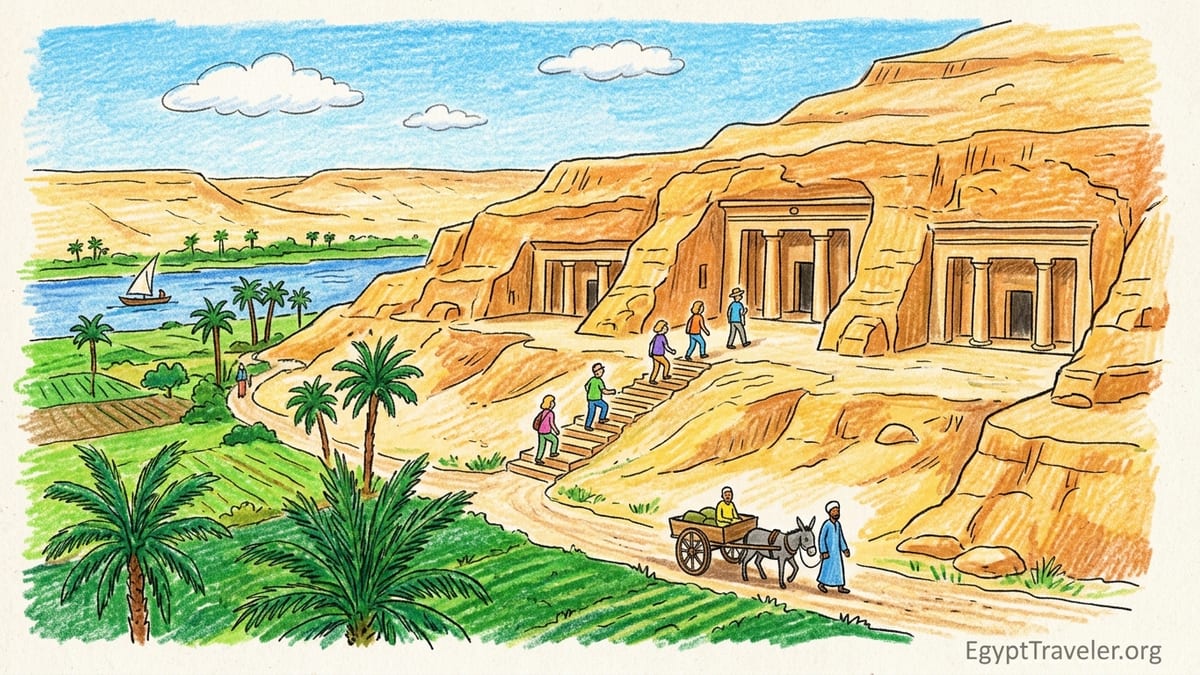
High above the green fields of Middle Egypt, the rock-cut tombs of Beni Hassan hold some of the most vivid Middle Kingdom paintings in the country. Far from the crowded circuits of Luxor and Giza, this cliffside cemetery near Minya preserves colorful scenes of wrestling, hunting, craftsmanship and everyday life that tell a very different story from the royal tombs in the south. For travelers willing to make the detour and climb, Beni Hassan offers one of the most atmospheric and revealing stops on the Nile.
Why Beni Hassan Matters in Middle Kingdom Egypt
Beni Hassan is a provincial cemetery cut into the cliffs on the east bank of the Nile about 20 kilometers south of Minya. Most of the tombs date to the 11th and 12th Dynasties of the Middle Kingdom, roughly 2000 to 1900 BCE, when regional governors ruled Egypt’s nomes on behalf of the pharaoh. Unlike the grand royal monuments at Thebes and the pyramids further north, Beni Hassan preserves the perspective of local power: nomarchs who controlled agricultural production, security and justice in their districts. Their tombs combine impressive rock-cut architecture with painted scenes that read almost like illustrated biographies.
The necropolis contains around 39 tombs, but only a handful are usually open to visitors at any one time. These include the chapels of Amenemhat (Tomb 2), Khnumhotep II (Tomb 3), Baqet III (Tomb 15) and Khety (Tomb 17). All were powerful provincial governors of the Oryx Nome, a fertile region in Middle Egypt. Their careers span from the late 11th Dynasty, when Egypt was reuniting after a period of division, into the more centralized 12th Dynasty when pharaohs such as Amenemhat I and Senusret I reorganized the administration. Walking from tomb to tomb, you effectively move through several generations of one elite family and its successors.
Official descriptions from Egypt’s antiquities authorities highlight Beni Hassan as one of the best-preserved Middle Kingdom cemeteries in the country, particularly for its painting. The dry desert air and the tombs’ high position above the river have helped protect pigments that elsewhere have faded or disappeared. For travelers this means that scenes of daily life retain a surprising freshness: you can still distinguish fabrics, tools, animal species and even the gestures of individual wrestlers and workers. It is this immediacy that makes the site so compelling even if you are not an Egyptology specialist.
Historically, Beni Hassan also marks an important moment when provincial elites expressed their status quite boldly. The columns, large halls and elaborate painting cycles show nomarchs borrowing royal styles and adapting them to local concerns. Later in the Middle Kingdom the central government reined in this independent power and provincial tombs became more modest. In that sense, Beni Hassan captures a short-lived flourishing of regional identity that is difficult to see at royal sites focused on the king alone.
The Nomarchs Behind the Tombs
The four tombs most often open to visitors belonged to men who effectively ran this stretch of the Nile Valley. Their titles usually include “Great Chief of the Oryx Nome” along with priestly and military roles. Baqet III, whose tomb is numbered 15, governed during the late 11th Dynasty when Theban rulers were pushing north to reunite Egypt. He appears as a local strongman whose loyalty to the victorious dynasty was later rewarded with the continuation of his family’s authority. His tomb shows him inspecting troops, presiding over offering rituals and enjoying rural pastimes such as hunting and fishing in the marshes.
Baqet’s son Khety, buried in Tomb 17, inherited both the office and the artistic ambition. His chapel continues the themes of military preparedness and sports, including sequences that look like ball games or training exercises, along with more formal processions and offering scenes. For visitors, Khety’s tomb is a vivid reminder that nomarchs were expected to secure their borders and maintain a personal militia as much as to administer justice and taxation. It feels closer to the life of a frontier governor than a remote courtier.
By the early 12th Dynasty the governorship had passed to a different family. Amenemhat (often called Ameny), owner of Tomb 2, served under King Senusret I. His tomb, with its three-aisled hall decorated with registers of farmers, artisans, boatmen and wrestlers, suggests a governor who wanted to show his control over every aspect of economic life. Khnumhotep II, in Tomb 3, ruled in the reigns of Amenemhat II and Senusret II. His chapel is famous for the scene of a caravan of Asiatic traders bringing eye-catching goods and animals from the Levant, a rare Middle Kingdom depiction of foreigners visiting Egypt under peaceful circumstances.
Together these governors’ tombs chart a shift from the turbulent reunification of Egypt to a more stable, centrally managed state. When you stand in front of their façades and look down at the green fields and palm groves, it is easy to imagine what their authority meant in practice: commanding irrigation works, collecting grain taxes, organizing hunting expeditions and overseeing craftsmen in nearby villages. The tombs’ location directly above the cultivated land they controlled is no accident; they were meant to dominate the landscape in life and in memory.
What Makes the Paintings Different from Luxor’s Royal Tombs
Travelers who have already visited the royal tombs in the Valley of the Kings around Luxor are often surprised at how different Beni Hassan feels. In royal tombs the decoration focuses on the king’s journey through the underworld, filled with gods, protective spells and complex religious texts. At Beni Hassan the emphasis is on the visible realities of life in the province: work, sport, family, soldiers, animals and trade. It is still religious art intended to secure a good afterlife, but the logic is that by showing a prosperous, well-governed life the tomb owner will continue to enjoy those benefits eternally.
Perhaps the most striking difference is the sequences of wrestling scenes, especially in the tomb of Baqet III where dozens of pairs of athletes are shown locked in different holds, throws and counters. The sequence runs almost like frames from a slow-motion video, preserving techniques that modern wrestling coaches sometimes recognize. Nearby are other physical activities such as stick fighting, acrobatics and hunting with throwsticks. Instead of gods judging the dead, you see strength, training and fair competition, suggesting that physical prowess was a valued elite quality in this region.
Other walls show crafts and industries in unusual detail. In Amenemhat’s tomb, for example, you can pick out carpenters shaping wooden planks, boat builders assembling hulls, and weavers working at looms. Herdsmen drive cattle and goats, fowlers trap birds in netted enclosures, and scribes record deliveries of grain. In Khnumhotep II’s chapel, the scene of the foreign caravan features donkeys laden with goods, women and children in patterned garments and a leader who appears to introduce the delegation. Compared with the more formal and symbolic processions in royal tombs, these scenes feel crowded and almost documentary.
Even the architecture of the painted halls is distinctive. Many Beni Hassan tombs have porticoes with proto-Doric or fluted columns carved directly from the cliff, leading into broad chambers where rows of internal columns support the roof. Ceilings are often painted with geometric patterns such as zigzags or diamond designs in red, blue and green. The effect is more like entering a provincial palace than a narrow underground passageway. The scale and brightness overturn the idea that Middle Kingdom art is only a prelude to the better known New Kingdom masterpieces.
Access from Minya and On-the-Ground Logistics
Beni Hassan lies in Middle Egypt, well off the standard Luxor to Aswan cruise route. Most visitors base themselves in Minya, a city roughly 4 to 5 hours by road south of Cairo, and then arrange a day trip by car. Hotels in Minya usually work with licensed drivers familiar with the security procedures; for example, a midrange Nile-side hotel might quote around the equivalent of 60 to 100 US dollars for a private round trip including waiting time, depending on fuel prices and negotiation. Because security rules can change, particularly for foreign visitors, it is wise to confirm current requirements with your hotel or a local agency a day or two before traveling.
The drive from central Minya to Beni Hassan typically takes 30 to 45 minutes, passing through villages and cultivated fields before reaching the desert edge. There is a ticket office and parking area near the base of the cliffs. Official prices are published by the Ministry of Tourism and Antiquities and are usually listed in Egyptian pounds, with a standard adult foreign ticket and reduced rates for students holding valid international ID. Because official schedules and prices can be updated, you should check them through your hotel or a reputable local operator close to your travel date rather than relying on older guidebooks.
Public transportation in the strict sense does not really serve Beni Hassan in a practical way for overseas visitors. Microbuses and local trains run along the Nile corridor, but they do not directly connect to the tomb site and still leave you with several kilometers to cover on foot or by informal taxi. Given the security checkpoints and the need to coordinate with the site guards, most travelers find that arranging a private car with driver, either through a Minya hotel or a Cairo-based tour company experienced in Middle Egypt itineraries, is the most efficient option. It also makes it easier to combine Beni Hassan with another stop such as the Speos Artemidos or further north at Tuna el Gebel if time and permissions allow.
Opening hours generally follow a daylight schedule, often from early morning until late afternoon, similar to many archaeological sites around the country. In practice, visiting in the morning from Minya works best: traffic is lighter, temperatures are cooler for the climb, and you are less likely to run up against closing time. During Ramadan or on public holidays, hours can shift slightly and some agencies build in extra buffer time to allow for slower procedures at checkpoints.
Climbing, Walking Demands and On-Site Experience
Beni Hassan is physically more demanding than most temple visits on the flat Nile plain. From the parking area at the foot of the cliffs, you follow a stepped path cut into the slope to reach the main terrace of tombs. The ascent is gradual rather than vertical, but there are many steps and little shade. In the cooler months from roughly November to March, most reasonably fit visitors manage the climb without difficulty, but in summer the combination of heat and reflected light from the rock can feel intense. Plan on at least 10 to 15 minutes of steady walking uphill to reach the upper row of tombs.
Good footwear makes a real difference. The steps and paths are uneven, sometimes covered with sand and small stones. Closed shoes or sturdy sandals with grip are strongly recommended over flip-flops. Because there is no café or shop at the terrace itself, bring water from Minya or buy it at a roadside stall before reaching the site. An insulated bottle is handy in hotter months. Many travelers also bring a light scarf or hat; there are resting spots along the climb but little natural shade once you leave the car park.
Once on the terrace, the tomb entrances line up along the cliff face, separated by short stretches of gravel path. Inside, floors can be irregular and lighting is usually provided by electric fixtures controlled by the site guards. In some tombs the light is intentionally kept low to protect the paint, so your eyes may need a moment to adjust from the bright desert outside. Simple handheld flashlights are often discouraged or banned if they risk shining directly on the walls, but some guides carry small lights and use them carefully to point out details without lingering on a single spot.
The climb back down is easier on the lungs but harder on knees and ankles. Take your time, especially if the steps are dusty. Families with children often find that older kids enjoy the sense of exploration while very young children may tire quickly. If mobility is a concern, you might discuss with your guide in advance whether a slower pace or partial visit will still feel rewarding; even two tombs, approached unhurriedly, can give a powerful impression of the site.
Guides, Photography Rules and Time Needed
At Beni Hassan you will usually be accompanied on the terrace by a resident guardian or guard attached to the antiquities service. This person unlocks tomb gates, turns on and off the lighting and ensures visitors respect the rules. Their English may be limited, but many know the basic names and highlights of each tomb and will point out wrestling scenes or the caravan of foreigners with obvious pride. Tipping is customary; travelers commonly offer a modest gratuity at the end of the visit, in addition to any tip you give a professional guide or driver.
Many visitors choose to hire an Egyptologist guide based in Minya or traveling from Cairo. A knowledgeable guide can interpret the scenes in a narrative way, explaining, for example, how the wrestling sequences may symbolize controlled strength, why the depiction of Asiatic traders in Khnumhotep II’s tomb hints at long-distance trade or diplomacy, or how specific tools in the craft scenes match finds from Middle Kingdom settlements. For a private English-speaking guide accompanying you from Minya, agencies often quote a fee in the range of 40 to 80 US dollars for a half-day excursion, varying with experience and language skills.
Photography rules at Beni Hassan can be stricter than at famous tourist hubs. Recent reports indicate that photography inside the tombs is often restricted or completely prohibited, even without flash, in order to protect the paintings and manage visitor behavior. Outside, on the terrace and looking down over the Nile floodplain, photography is generally allowed and the views are superb: lines of tomb façades backed by desert plateau with the green valley and river below. Because enforcement can change with new regulations, you should ask your guide and the site guardian clearly what is allowed on the day of your visit and be prepared to accept a no-photography policy inside.
In terms of timing, most travelers spend around 1.5 to 2 hours on the terrace itself, not including driving to and from Minya. That allows you to visit the four principal tombs, pause to study key scenes, and enjoy the panorama. If you move quickly, you could see the essentials in just over an hour, but part of Beni Hassan’s appeal lies in slowing down enough to notice small details: the way a wrestler’s foot hooks behind an opponent’s leg, the knots on a donkey’s harness, or the different hairstyles of foreign visitors in Khnumhotep II’s caravan. For those particularly interested in Middle Kingdom art, arranging a slightly longer window so that you are not rushed by midday heat or a tight driving schedule is well worth it.
Adding the Speos Artemidos and Other Nearby Sites
About 2 kilometers south of the main Beni Hassan terrace lies the Speos Artemidos, a rock-cut temple best known from the reign of Queen Hatshepsut in the 18th Dynasty. Later Greeks associated it with Artemis, hence the name, but its ancient dedication focused on the lioness goddess Pakhet. The temple consists of a façade cut into the cliff with an interior hall and shrines, including inscriptions that once praised Hatshepsut’s achievements before some were altered in favor of Thutmose III. Although less vividly colored than the Middle Kingdom tombs, it adds variety to a day in the area by showing a different period and function: a temple sanctuary rather than an elite burial.
In practice, whether you can include the Speos Artemidos during a visit to Beni Hassan depends on current access rules and your transport arrangements. Some tour operators in Minya advertise combined visits, sending a vehicle that can drive the short distance along the desert edge between the two sites. Others recommend focusing on Beni Hassan if you have limited time and then adding another destination such as Tuna el Gebel or the ruins at Hermopolis on a separate day. Because official priorities and security considerations can shift, especially for quieter sites, it is best to treat the Speos Artemidos as a flexible extra rather than a guaranteed component of your plan.
Travelers who do manage to visit both sites often comment on the contrast between the busy narrative walls of the tombs and the more formal, text-heavy surfaces of the speos. One moment you are looking at wrestlers and cattle herders; the next you are standing in front of royal inscriptions that speak in the voice of a New Kingdom queen. Together they underline how Middle Egypt remained important across different eras even when most modern itineraries focus on Cairo and southern Upper Egypt.
If you have a strong interest in ancient Egyptian religion or the reign of Hatshepsut, mentioning this in advance when booking a local guide can help ensure they schedule time at the speos and are prepared to interpret its more worn reliefs. The combination of Beni Hassan and Speos Artemidos turns what might otherwise be a single stop into a fuller exploration of life and belief along this stretch of the Nile.
Making the Most of the Art Without Getting Lost in Theory
Because Beni Hassan is often praised in academic circles for its historical value, there is a risk that casual visitors approach it expecting something dry or technical. In reality, the scenes are highly readable once you know what to look for. Before entering a tomb, take a moment to think of it as a story in pictures. One wall may show the governor overseeing his domain; another presents his troops; another the produce and crafts that sustain his household; another sports or entertainment. Simply walking around the chamber clockwise, wall by wall, often reveals a structure that makes intuitive sense.
Concrete details help the images come alive. In Baqet III’s wrestling registers, for instance, notice how the painter differentiates individual bodies through slight variations in posture and grip rather than repeating a single template. In Amenemhat’s agricultural scenes, look at the way plow blades cut into stylized furrows or how harvested grain is measured and recorded by scribes. In Khnumhotep II’s procession of foreigners, focus on clothing and hairstyles; the newcomers’ striped garments and beards contrast with the clean-shaven Egyptian officials who meet them. Asking your guide to point out two or three of these specifics in each tomb is often more rewarding than trying to memorize dynastic dates.
It can also help to connect what you see in the paintings with modern life in the valley below. On the drive from Minya you will pass farmers tending fields with irrigation equipment, herding animals along canal banks and ferrying goods in small pickup trucks. Once you have seen the painted boat builders, imagine how their wooden vessels once filled the role that trucks and trains do today. The wrestlers echo modern sports clubs; the weavers standing at looms evoke today’s textile workshops. By linking scenes in the tombs to real-world counterparts, Beni Hassan feels less like a static museum and more like a layered landscape.
Above all, do not worry if you cannot absorb every detail. Even seasoned researchers return repeatedly to these tombs and still notice something new. If you leave with a sense of how a Middle Kingdom governor projected his power through imagery of work, sport and abundance, and with a few mental snapshots of your favorite scenes, you have already gained more from the visit than many standard itineraries allow.
The Takeaway
For travelers looking beyond Egypt’s classic highlights, Beni Hassan offers a rare chance to step into the world of Middle Kingdom provincial elites. The climb to the rock-cut tombs above the Nile rewards you with sweeping views, cool pillared halls and paintings that capture the energy of daily life in a way royal tombs seldom do. Wrestling matches, siege drills, craft workshops and foreign caravans coexist on the walls, turning stone surfaces into a window onto a 4,000 year old society.
Reaching the site from Minya requires a little planning, a private car and a willingness to tackle a flight of steps in the sun, but the logistics are far from insurmountable. Hiring a knowledgeable guide, respecting photography rules that prioritize preservation and allowing enough time to absorb the art all help transform the excursion into a highlight of a Middle Egypt journey. If access allows, adding the nearby Speos Artemidos deepens the story with a glimpse of New Kingdom religious architecture.
Ultimately, what sets Beni Hassan apart is its blend of accessibility and depth. You do not need to be an expert to find the scenes engaging; the humanity of the figures is immediate, from grappling wrestlers to caravan families on the move. Yet the tombs also anchor larger historical questions about power, administration and regional identity. For visitors who make the effort to get here, Beni Hassan often becomes one of the most memorable and personal encounters with ancient Egypt.
FAQ
Q1. How long do I need to visit the Beni Hassan tombs from Minya?
Most visitors allow half a day from Minya, including 30 to 45 minutes driving each way and 1.5 to 2 hours on the terrace exploring the main tombs.
Q2. Which Beni Hassan tombs are usually open to visitors?
Access can change, but travelers typically find four decorated tombs open: Amenemhat (Tomb 2), Khnumhotep II (Tomb 3), Baqet III (Tomb 15) and Khety (Tomb 17).
Q3. How difficult is the climb up to the tombs?
The ascent follows a stepped path with many uneven steps but a gradual slope. Most reasonably fit visitors manage it, though summer heat makes it more demanding.
Q4. Can I take photos inside the Beni Hassan tombs?
Photography rules are strict and can change. Recent reports suggest that photos inside are often prohibited, while outdoor shots of the façades and view are usually allowed.
Q5. Do I need a guide, or can I visit Beni Hassan independently?
You can technically visit with just a driver and the on-site guardian, but hiring an Egyptologist guide greatly enriches the experience by explaining the scenes and historical context.
Q6. How do I get from Minya to Beni Hassan?
Most travelers arrange a private car and driver through their Minya hotel or a tour agency. The drive takes about 30 to 45 minutes each way along the Nile corridor.
Q7. What should I wear and bring for a visit?
Wear comfortable closed shoes, sun protection and light breathable clothing. Bring water, as there are no cafés on the terrace, and consider a small daypack for camera and essentials.
Q8. How is Beni Hassan different from the royal tombs in Luxor?
Royal tombs emphasize gods and the king’s afterlife journey, while Beni Hassan focuses on everyday life, wrestling, hunting and crafts that reflect provincial society.
Q9. Can I combine Beni Hassan with other nearby sites?
Yes, some itineraries add the nearby rock-cut temple of Speos Artemidos or sites like Tuna el Gebel, depending on time, security rules and transport arrangements.
Q10. Is Beni Hassan suitable for children or older travelers?
Children who enjoy climbing and exploring usually like the site, but the steps can tire very young kids. Older travelers with mobility issues should allow extra time and use walking aids if needed.