


Between the headline sights of Cairo and Luxor stretches a quieter reach of the Nile that many visitors simply speed past. Middle Egypt, anchored by Minya and running south through Mallawi, Sohag and Abydos, is where the story of ancient Egypt knits together between the Old Kingdom pyramids and the New Kingdom temples. For repeat visitors and serious archaeology travelers, this region offers important Middle Kingdom tombs, the short-lived capital at Amarna, vast Greco-Roman necropoleis and atmospheric provincial towns that see only a fraction of the tourist traffic farther south.
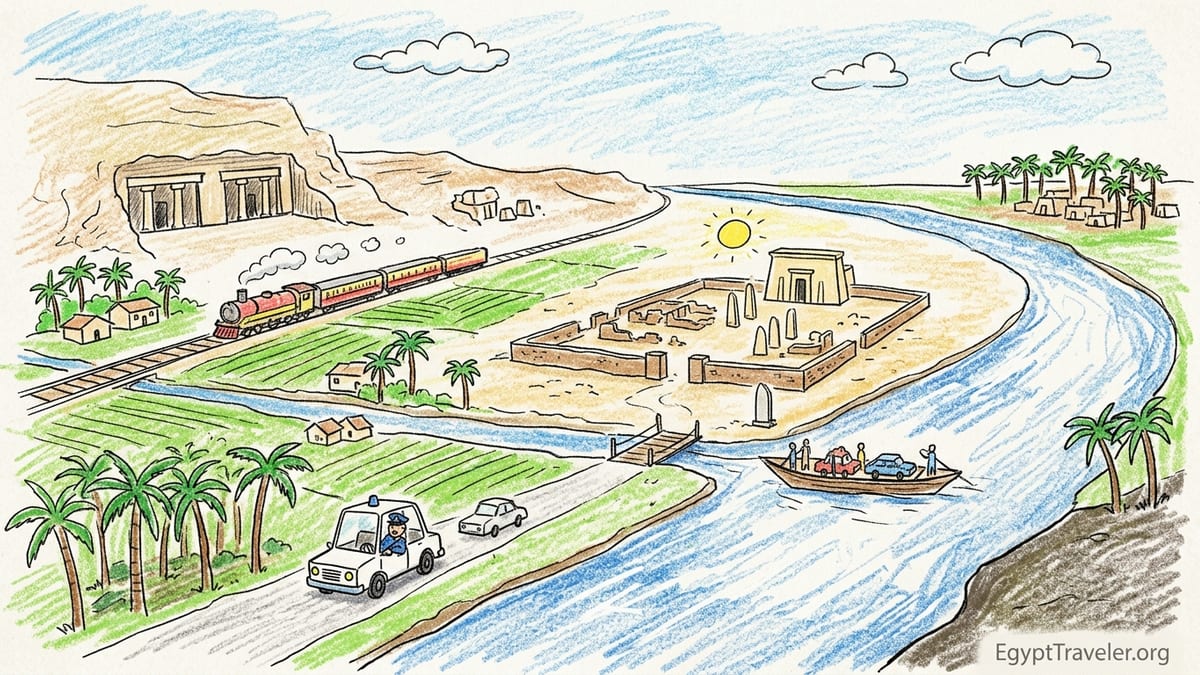
Why Middle Egypt Matters Historically
Most first-time itineraries in Egypt jump from the pyramids and Sakkara to Luxor and Aswan, leaving an apparent gap of a thousand years in the country’s history. Middle Egypt is where that gap closes. Sites like Beni Hassan preserve brightly painted rock-cut tombs of Middle Kingdom governors, while Abydos and Hermopolis Magna document religious developments and regional power that flourished long before the monumental New Kingdom temples at Luxor and Karnak. Walking these sites helps explain how a pyramid-building society evolved into the imperial Egypt that carved out the Valley of the Kings.
Nowhere is that transition more vivid than at Tell el-Amarna, Akhenaten’s short-lived capital on the east bank of the Nile. Here, amid lightly visited desert plateaus, you meet the radical experiment in Aten worship that briefly upended Egypt’s religious and artistic traditions. Because the city was abandoned and quarried for stone, what you see today is low walls, boundary stelae and rock tombs rather than soaring pylons. Yet much of what is known about Amarna-period art, daily life and royal ideology comes from this valley, filling in the narrative between traditional temples at Abydos and the later complexes at Luxor.
Tuna el-Gebel and Hermopolis Magna add a Greco-Roman layer that bridges Pharaonic religion and the Hellenistic and Roman worlds. Tuna el-Gebel, necropolis of Hermopolis, stretches along the desert edge in a belt of catacombs, animal galleries and tombs that remained active into late antiquity. At nearby Hermopolis Magna (modern el-Ashmunein), fragments of a temple to Thoth and a later pylon of Ramses II reveal how stones from Amarna were recycled once Akhenaten’s revolution was unwound. Taken together, these sites turn a Cairo–Luxor transfer into a coherent historical journey rather than a blank stretch of railway.
Planning Your Route: How to Reach and Move Through Middle Egypt
The spine of any Middle Egypt itinerary is the main Nile corridor between Cairo and Luxor. Trains on the Cairo–Luxor–Aswan line are the most practical public transport for independent travelers. Daytime second-class seats are usually sufficient for the 4 to 5 hour run from Cairo to Minya and the roughly 6 to 7 hour journey from Cairo to Sohag. As of 2026, fares are typically modest by international standards, often comparable to a mid-range intercity bus ticket elsewhere in the region, and can be bought at stations shortly before departure unless you are traveling around major holidays.
For time-pressed travelers or those integrating Middle Egypt into a longer cruise-based trip, domestic flights are another option. Sohag has an airport with periodic services from Cairo, and Luxor is well connected to both Cairo and some European hubs. One practical pattern is to travel overland from Cairo to Minya and on to Sohag and Abydos by train and road, then continue south to Luxor by train or private transfer. Several specialist tour operators also run occasional Nile cruises that slow down through Middle Egypt, stopping at sites like Tell el-Amarna, Tuna el-Gebel and Hermopolis Magna, but these departures often run only a few times per year and sell out early.
On the ground, most archaeological sites in Middle Egypt lie a short drive from the Nile towns on either bank. In Minya governorate, Beni Hassan and Tell el-Amarna are typically reached from Minya, Mallawi or Deir Mawas by private car or licensed taxi. Tuna el-Gebel and Hermopolis Magna sit west of the river and are usually combined in a single half-day outing. Around Sohag, the small but worthwhile Sohag National Museum and nearby monasteries can be toured by local taxi, while Abydos is reached from either Sohag or Luxor by train to al-Balyana followed by a taxi, or by private car directly along the Nile road.
Security, Police Escorts and Practicalities
Travel through Middle Egypt remains closely monitored by Egypt’s Tourist Police, but the experience is much more relaxed than during the tightly controlled convoy era of the early 2000s. In Minya itself, recent independent reports and guidebook updates describe visitors being allowed to walk around town unescorted and to use regular microbuses and taxis to nearby sites without difficulty, provided they register passport details at hotels and follow local advice. Around particularly sensitive archaeological zones such as Beni Hassan and Tell el-Amarna, you may still be accompanied by a Tourist Police officer or escort vehicle, especially if you are visibly foreign and traveling in a private car.
This security presence generally feels more protective than intrusive. At Tell el-Amarna, for instance, it is common to be met at the riverside ferry by Tourist Police who then accompany your vehicle as you work through the north tombs, central city, royal wadi and south tombs. Distances are several kilometers between points, so the escort does not significantly slow you down and may help with on-the-spot site logistics. At Beni Hassan, a checkpoint above the village often notes visitors as they arrive and depart; your driver or guide will usually handle any paperwork while you explore the tombs.
Travelers should expect occasional changes to the rules. During sensitive political moments or local incidents, authorities sometimes restrict night road travel for foreign visitors or insist on specific routes. It is wise to ask your Minya or Sohag hotel reception the evening before an excursion whether any new instructions have been issued for Beni Hassan, Tuna el-Gebel, Hermopolis Magna or visits farther south. Organized archaeology-focused tours typically coordinate detailed police permissions in advance, which can be a major advantage if your time is short or you plan to string several remote sites together in a single long day.
Minya: Base for Beni Hassan, Amarna and Tuna el-Gebel
Minya city, roughly midway between Cairo and Sohag, is the best base for exploring the cluster of major Middle Egypt sites. It is a substantial provincial capital with riverside corniche, banks, ATMs, pharmacies and a small range of modern hotels. Mid-range options that appeal to foreign visitors tend to cluster along or near the Nile and offer air conditioning, reliable hot water and on-site restaurants. Room rates are generally lower than in Cairo or Luxor, so it is realistic to secure comfortable doubles for a price similar to a budget city hotel in Europe, especially outside peak winter season.
From Minya, Beni Hassan lies about 20 kilometers south on the east bank. Most travelers hire a car and driver for a half-day, either through their hotel or a local agency. The drive passes fields and small villages before climbing to a car park near the cliff. From here, a staircase leads up to the Middle Kingdom tombs, where scenes of wrestling, desert hunts and Asiatic visitors are still strikingly clear in the desert light. Starting early helps avoid the midday heat and increases your chances of having the rock-cut portico almost to yourself.
Tuna el-Gebel and Hermopolis Magna can be done as another focused excursion. You drive southwest from Minya or Mallawi to the modern village of Tuna el-Gebel, then continue to the desert edge, where the tomb of Petosiris, the so-called tomb of Isadora and long catacombs dedicated to sacred ibis and baboons line the escarpment. A short onward hop brings you to Hermopolis Magna, whose tumbled colossi and temple fragments stand among fields and modern houses. Many visitors pair Tuna el-Gebel and Hermopolis with a brief stop at one of the nearby Holy Family pilgrimage churches, which anchor Christian heritage routes through the governorate.
Tell el-Amarna demands a full day. The classic pattern is to drive south along the west bank from Minya or Mallawi to the ferry opposite the site, cross with your vehicle, then work your way around the circuit of tombs and temples under police supervision. Distances between the North Tombs, North Palace, Central City, Small and Great Aten Temples and the South Tombs run across a broad desert amphitheatre, so having a private car with a patient driver is far more efficient than trying to cobble together local transport. Many archaeology enthusiasts budget two nights in Minya specifically to give themselves an unhurried day at Amarna after a warm-up at Beni Hassan.
Sohag and Abydos: Southern Anchors of Middle Egypt
South of Minya, Sohag is less visually dramatic than Luxor but makes a useful overnight stop if you are connecting Middle Egypt with Upper Egypt by land. The compact city sits on the west bank with a pleasant Nile frontage and a handful of business-class hotels that cater to government delegations and domestic travelers. The standout attraction is the Sohag National Museum, a modern riverside institution holding several thousand artifacts from the surrounding governorate. Its displays trace local history from Predynastic times through the Pharaonic, Coptic and Islamic periods, giving helpful context before you continue to Abydos.
Abydos itself lies near the town of al-Balyana, around 90 kilometers north of Luxor. Independent travelers typically reach it by train from either Sohag or Luxor, alighting at al-Balyana station and hiring a taxi for the short drive inland to the temples. Services along this stretch of the line are frequent but can be busy; it pays to arrive at the station early and to accept that you may be directed into whichever class has seats available. Alternatively, many repeat visitors arrange a private car from Luxor for a long day that combines Abydos with Dendera, returning to Luxor in the evening after roughly four hours on the road.
The Temple of Seti I at Abydos, with its exquisitely carved reliefs and well-preserved colors, repays slow, detailed exploration. Many seasoned Egypt hands consider it one of the finest surviving temples in the country, and its smaller crowds make it easier to study scenes without interruption. Beyond Seti’s temple, the later temple of Ramses II and the desert edge necropolis at Umm el-Qaab recall Abydos’s deeper role as a cult center of Osiris and burial place of early dynastic kings. Allow at least three hours on site, more if you like to work systematically through every chapel and hypostyle hall.
Where to Stay and How Long to Allocate
Because Middle Egypt remains lightly touristed compared with Cairo and Luxor, hotel choice is narrower, but there is enough variety for archaeology-focused travelers who prioritize location and practicality over resort-style amenities. In Minya, riverside business hotels with secure parking and in-house restaurants make the most convenient bases; expect simple, functional rooms, often with Nile views. In Mallawi, accommodation is more basic, so most visitors prefer to base in Minya and treat Mallawi purely as a transit point for Tuna el-Gebel and Tell el-Amarna.
In Sohag, a small cluster of modern hotels near the Nile and the city center cater mainly to domestic business and official traffic. Rooms tend to be clean and air conditioned, with reliable Wi-Fi and buffet breakfasts, but facilities beyond a restaurant and maybe a modest pool are limited. Abydos itself has traditionally offered a handful of very simple guesthouses close to the temple; conditions vary from year to year, so many visitors still opt to overnight in Sohag or Luxor and visit Abydos as a day trip, especially in the hotter months when solid air conditioning and dependable power are priorities.
For a serious archaeology-focused circuit, a common pattern is to spend 3 nights in Minya and 1 night in Sohag. This allows one travel day Cairo to Minya, plus two full site days out of Minya, followed by an easy transfer to Sohag with time for the museum and onward travel to Abydos and Luxor. Repeat visitors who have already explored Luxor in depth may want to rebalance that equation, spending an extra night in Minya to fit in lesser-known monasteries, rock-cut cemeteries or Holy Family sites that rarely appear in mainstream itineraries.
Guides, Site Logistics and Costs on the Ground
Hiring a knowledgeable guide significantly enhances Middle Egypt, where labeling at sites can be sparse and the historical context is complex. In practice, there are three main options. Some travelers engage a licensed Egyptologist guide from Cairo or Luxor who accompanies them throughout the Cairo–Minya–Sohag–Luxor leg, arranging vehicles and hotel logistics. Others hire local guides in Minya or Sohag for specific days at Beni Hassan, Amarna, Tuna el-Gebel or Abydos. A third option, for experienced repeat visitors comfortable reading site plans and academic guides, is to travel largely independently and use local guardians on site for orientation and keys to locked chapels.
Costs depend on how bespoke your arrangements are. A full-day private excursion from Minya to Beni Hassan, for example, with car, driver, fuel and a licensed local guide, is typically priced in line with a private full-day tour in Cairo, though the exact figure varies with fuel prices and demand. A day at Tell el-Amarna is usually more expensive than Beni Hassan because of the greater distances involved and the time taken to process any required police notifications. Meanwhile, site entrance tickets in Middle Egypt remain modest: most tombs and temples cost significantly less to enter than major Cairo or Luxor monuments, though fees for photography rights may be charged separately.
At the sites themselves, facilities are basic but improving. Beni Hassan and Tuna el-Gebel generally have small ticket offices, shade shelters and rudimentary restrooms but no cafés, so bringing water, snacks and sun protection is essential. Tell el-Amarna has very limited services once you leave the ferry area, so plan to carry everything you need for the day. At Abydos, a cluster of small shops and simple eateries near the temple caters to visiting groups, offering cold drinks, light meals and souvenirs. Tipping guardians who open locked tombs or chapels, while never mandatory, is expected and should be handled discreetly and in small local currency notes.
Integrating Middle Egypt into a Longer Cairo–Luxor Trip
For repeat visitors, the most rewarding way to experience Middle Egypt is to weave it into the classic Cairo–Luxor axis rather than treat it as a separate detour. A practical 10 to 12 day second-visit itinerary might begin with 3 nights in Cairo to revisit the Egyptian Museum or its successor institutions, explore lesser-known pyramids at Dahshur and Meidum, then take a daytime train to Minya. After 3 nights in Minya with excursions to Beni Hassan, Tell el-Amarna, Tuna el-Gebel and Hermopolis Magna, you continue by train or car to Sohag for a night, visit the Sohag National Museum, then press on to Abydos and ultimately Luxor.
If your first trip only skimmed Luxor, you could instead reverse the emphasis. Fly from Cairo to Luxor, spend several nights returning to the west-bank tombs and east-bank temples with fresh eyes, then dedicate two long days to Abydos and Dendera before riding the train north through Sohag and Minya back to Cairo. In either direction, building Middle Egypt into the spine of your journey allows you to see thematic continuities: solar theology linking Amarna, Abydos and Luxor; the persistence of provincial cult centers; and the evolution of tomb art from Beni Hassan to the Valley of the Kings.
Time of year matters. Winter and early spring are the most comfortable periods for extended desert walking at Amarna and the cliff paths around Beni Hassan. In high summer, midday temperatures on these exposed plateaus can be severe, and long overland connections on trains or in private cars become more tiring. Shoulder seasons, especially late autumn, often combine quieter major sites with manageable heat in Middle Egypt, though dust and occasional sand-laden winds can reduce visibility. Whatever the season, building rest time into Minya and Sohag stays prevents your Cairo–Luxor journey from becoming a relentless series of early starts.
FAQ
Q1. Is Middle Egypt safe for independent travelers right now?
Independent travel through Middle Egypt is possible and many experienced visitors report feeling safe, but the region is closely monitored by Tourist Police. Expect routine checkpoints, occasional escorts on certain routes and possible last-minute changes in which roads foreigners can use. Check current advisories from your government and confirm arrangements with your Minya or Sohag hotel before travel.
Q2. Do I need a police escort to visit Beni Hassan and Tell el-Amarna?
Rules change, but recent visitors to Minya have reported being able to move around town and reach nearby sites like Beni Hassan without constant escort, while Tell el-Amarna commonly involves a Tourist Police presence once you cross the river. Often an officer or escort vehicle simply accompanies your car between sectors of the site. Your driver and guide will coordinate whatever permissions are required on the day.
Q3. How many days should I budget for Minya and its surroundings?
For archaeology-focused travel, two full days and three nights in Minya is a good minimum. This lets you spend one day at Beni Hassan and nearby sites and one long day at Tell el-Amarna, with time for Tuna el-Gebel, Hermopolis Magna or a stroll along Minya’s Nile corniche. Adding an extra night allows for slower starts, unforeseen delays or additional monasteries and Holy Family locations.
Q4. Can I visit Abydos as a day trip from Luxor or should I stay overnight?
Abydos is commonly visited as a long day trip from Luxor by private car, often combined with Dendera. This suits travelers who prefer to keep a single base and return to familiar accommodations at night. However, staying in Sohag or simple local lodgings near Abydos gives you more time on site and allows for quieter early or late visits, which serious photography and epigraphy enthusiasts often appreciate.
Q5. Are there decent mid-range hotels in Minya and Sohag?
Yes. Both cities have a small selection of business-style hotels that offer clean, air-conditioned rooms, private bathrooms, breakfast and Wi-Fi. They are simpler than large resort hotels in Luxor or Sharm el-Sheikh but entirely adequate for a few nights. Booking ahead is wise in peak winter months or when local conferences and official delegations increase demand.
Q6. Do I need a specialist guide, or can I visit the sites on my own?
Experienced repeat visitors with good background reading can visit most sites independently, especially with a detailed guidebook or site plans. That said, a specialist guide can deepen your understanding of Beni Hassan scenes, Amarna’s low walls and Abydos reliefs, and can also help streamline police formalities and transport logistics. Many travelers choose a hybrid approach, hiring guides for key days and exploring smaller sites on their own.
Q7. What is the best time of year to travel through Middle Egypt?
The most comfortable months are generally from late October to early April, when daytime temperatures are milder and desert sites like Beni Hassan and Tell el-Amarna are more pleasant to explore. In the peak of summer, heat on exposed cliffs and plateaus can be intense, so early starts, long midday breaks and air-conditioned transport become essential.
Q8. How do ticket prices and on-site costs compare with Cairo and Luxor?
Entrance fees for Middle Egypt sites are usually lower than for headline monuments such as the Giza Plateau or the major temples of Luxor. However, costs for private cars, fuel and guiding can feel similar once you factor in distances and the extra time required for security formalities. On the ground, day-to-day expenses for meals, snacks and taxis in Minya and Sohag are generally modest by international standards.
Q9. Can I use public transport to reach all the major sites?
Public trains are excellent for moving between Cairo, Minya, Sohag and Luxor, and they get you close to Abydos via al-Balyana station. For Beni Hassan, Tell el-Amarna, Tuna el-Gebel and Hermopolis Magna, however, private cars or taxis arranged through hotels or local agents are far more practical. The sites are scattered in the desert and local microbuses rarely run convenient routes or schedules for visitors.
Q10. Is Middle Egypt suitable for a first-time trip to Egypt?
It can be, but Middle Egypt is best appreciated by travelers who have already seen Cairo and Luxor and want to explore the “missing chapters” in between. Facilities and tourist infrastructure are less developed, English is less widely spoken outside hotels, and days can be long and logistically complex. For a first trip, most people focus on Cairo, Luxor and Aswan, then return to delve into Minya, Sohag and Abydos with more context and confidence.