


The words “Nile Valley tour” now appear on everything from short Luxor–Aswan cruises to multi-week archaeological expeditions that push deep into Middle and Upper Egypt. For travelers who are serious about ancient history, separating a standard sightseeing package from a genuinely in-depth Nile Valley itinerary is essential. This guide looks at how major marketplaces and specialist operators use the term, compares classic Cairo–Luxor–Aswan routes with deeper circuits that include Minya and lesser-visited sites, and explains how to evaluate guides, transport, cruises and hotels in real-world terms.
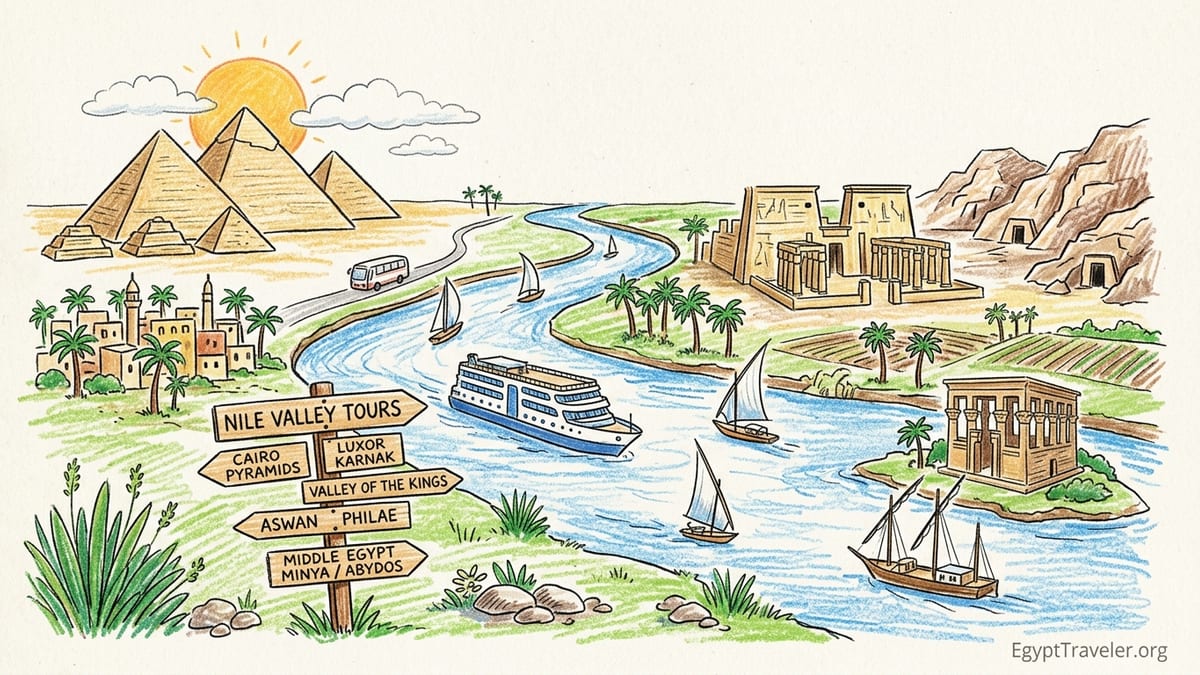
What “Nile Valley” Really Means in Today’s Tour Market
In current tour marketplaces, the phrase “Nile Valley” is often used as a marketing label rather than a precise geographic or archaeological description. Many packages under this banner are essentially classic one-week trips that pair Cairo with a Luxor–Aswan cruise, visiting the Pyramids of Giza, the Egyptian Museum, Karnak, the Valley of the Kings, and Philae Temple. These itineraries absolutely follow the Nile, but they rarely go north of Cairo into the Delta or south of Aswan toward Abu Simbel, and almost never detour into Middle Egypt around Minya, where sites like Beni Hassan and Amarna sit above a quieter stretch of the river.
At the same time, there is a growing niche of tours that use “Nile Valley” in a more literal way, traveling nearly the full length of Egypt’s river corridor. A 19-day Alexandria-to-Abu Simbel archaeology-focused itinerary, for example, might include Cairo, Minya, Abydos, Luxor and a multi-day dahabiya cruise before continuing to Aswan and Abu Simbel. These trips deliberately knit together both headline monuments and lesser-visited sites, and they usually involve an Egyptologist tour leader and groups capped at around 16 travelers rather than large buses.
For an archaeology-oriented traveler, the key is to read beyond the label. If a supposed Nile Valley tour only lists Cairo, Luxor and Aswan, with a 3- or 4-night cruise and no mention of Minya, Beni Hassan, Amarna or Abydos, then it is better understood as a classic highlights itinerary. That can still be worthwhile, but it will not provide the same depth of engagement with the full Nile landscape as an itinerary that lingers in Middle Egypt and includes more complex overland segments.
Classic Cairo–Luxor–Aswan Packages: What You Actually Get
Most first-time itineraries sold on platforms such as Viator or GetYourGuide follow a similar pattern: two or three nights in Cairo, a flight to Luxor, a 3- or 4-night cruise to Aswan, and a final night in Cairo before departure. A typical “8-day Nile Valley tour” in this mold might advertise the Giza pyramids and Saqqara, the Egyptian Museum or Grand Egyptian Museum, Karnak and Luxor Temples, the Valley of the Kings, Edfu and Kom Ombo temples, and Philae Temple near Aswan. Prices vary widely but mid-range group tours often fall in the region of 1,200 to 2,000 US dollars per person excluding international flights, depending on hotel class and season.
These tours rely on domestic flights between Cairo and Luxor or Aswan rather than trains, keeping logistics simple and journey times short. Most include a standard 4- or 5-star Nile cruise ship with around 60 to 120 cabins, buffet meals and a fixed schedule of shore excursions in bus groups. Travelers are commonly assigned local Egyptologist guides in each city, or they may have one guide traveling with the group on the cruise sector, with city-based guides in Cairo. The focus is on headline monuments; any mention of the “Nile Valley” tends to be about scenery viewed from the deck, not about visiting lesser-known archaeological zones.
Even within the classic pattern, there are ways to tilt toward a more serious archaeology experience. Some cruise-based itineraries add a half-day to the rarely visited temples at Dendera near Qena, or a day trip by road from Luxor to Abydos, where Seti I’s temple preserves exceptional reliefs. However, these additions usually appear as optional excursions with extra cost and long driving days of six hours or more in total. If your goal is a deep-dive Nile Valley trip, relying on optional add-ons inside a mainstream package can leave you dependent on minimum numbers and time pressures from broader group schedules.
Beyond the Basics: Cairo–Minya–Upper Egypt Archaeology Circuits
The real dividing line between a standard highlights journey and a Nile Valley archaeology tour is often the inclusion of Middle Egypt, especially Minya and its satellite sites. Specialist operators now run 2-day private trips from Cairo to Minya that focus on Beni Hassan’s rock-cut Middle Kingdom tombs, the Amarna plain at Tell el Amarna, and the catacombs and tombs at Tuna el-Gebel. These short excursions typically use private air-conditioned vehicles, include one night in a mid-range hotel in Minya with breakfast, and come with a dedicated Egyptologist who travels from Cairo or is based locally.
Longer multi-stop tours sometimes weave Minya into extended itineraries that also feature Abydos and Dendera. For example, an 11- to 14-day archaeology-focused program might start with several nights in Cairo, drive south to Minya for Beni Hassan and Amarna, stop at Tuna el-Gebel, then continue to Abydos for the Seti I temple before reaching Luxor for several days of West Bank and East Bank exploration. From there, travelers might board a smaller dahabiya cruise to Aswan rather than a standard ship, allowing for slower travel and flexible stops at lesser-known sites along the way.
Academic or specialist cultural tour companies also feature these circuits. Some itineraries branded as “Egypt Revisited” or “Alexandria to Abu Simbel” explicitly include Minya, Beni Hassan, Amarna and Tuna el-Gebel in their day-by-day descriptions. Group sizes are often limited to around 16, prices can exceed 6,000 or 7,000 US dollars per person for 15 to 19 days, and tours are led by named Egyptologists or archaeologists who lecture in the evenings. These journeys are where Nile Valley begins to mean a continuous historical landscape rather than a list of famous temples.
Key Sites That Distinguish Serious Nile Valley Archaeology Tours
Several specific sites act as a shorthand for how deep a tour goes into the Nile Valley’s archaeology. In Middle Egypt, Beni Hassan’s hillside necropolis provides tomb paintings that document daily life, wrestling scenes and foreign delegations during the Middle Kingdom. Amarna, the short-lived capital of Akhenaten, lies on the east bank near modern el-Amarna and preserves a broad archaeological zone of palace remains, tombs and temples. Tuna el-Gebel, west of Minya, holds catacombs, a famous pet cemetery and Ptolemaic tombs, including the tomb of Petosiris, that are still much quieter than the tombs of Luxor.
Further south, Abydos and Dendera are important markers of a more serious Nile Valley itinerary. Abydos, around 160 kilometers north of Luxor, is home to the temple of Seti I and a long history of royal cults and burials. Dendera, about 60 kilometers from Luxor, features the well-preserved Temple of Hathor with its astronomical ceiling and crypts. Day tours from Luxor to Abydos and Dendera are now widely offered on a private basis, but they are still absent from many large-group cruise programs. When an operator includes both sites as a standard feature rather than an optional excursion, it usually signals a stronger archaeological focus.
Even within Luxor and Aswan, tour descriptions reveal priorities. Itineraries that build in Deir el-Medina, the workers’ village, and Medinet Habu alongside the Valley of the Kings are taking a more holistic approach to ancient society than tours that confine the West Bank to three or four royal tombs. Around Aswan, time in the Nubian Museum or visits to lesser-visited rock-cut tombs show similar intent. Reading for these telltale inclusions is one of the simplest ways to gauge whether a “Nile Valley” route is structured for history enthusiasts or general sightseeing.
Private vs Group: Choosing the Right Style for Nile Valley Travel
For travelers intent on Minya, Amarna or Abydos, the choice between private and group travel has practical and financial consequences. Private touring is almost always the default for Middle Egypt segments, especially around Minya, where large mainstream groups are still relatively rare. A private 2-day Cairo–Minya–Amarna circuit for two people typically costs more per person than joining a large coach in Luxor or Aswan, but it buys flexibility with timings, the opportunity to linger at specific tombs, and the ability to adjust the pace for note-taking or photography without pressure from a big group.
Small specialist groups offer a middle ground. A 15- to 19-day archaeology tour limited to 12 or 16 participants might cost several times more than an 8-day mainstream package, but pricing usually bundles domestic flights, overland transport, entrance fees, tips and lectures from the tour leader. Because the itinerary is designed entirely around archaeology, there is little dilution with shopping stops or souvenir detours. The trade-off is less day-to-day flexibility; the group has to keep to a schedule to meet security, transport and opening time constraints.
Large-group tours, especially those sold through big online marketplaces, are ideal for travelers who want to see the headline sites with a predictable structure and a lower per-person price. However, these groups are the least likely to include Minya or more complex overland sections, because coordinating overland security approvals, accommodation and local permits is simpler with smaller numbers. If a tour with 20 to 30 guests advertises a “Nile Valley adventure,” read carefully to see if that means Cairo plus a cruise, rather than a full stretch of the river.
Guides, Transport and Logistics: How Deeper Tours Actually Work
On nearly all serious archaeology-oriented itineraries, guiding is provided by licensed Egyptologists rather than generalist tour escorts. In practice, this may mean one Egyptologist leading the entire journey or a combination of a tour leader plus local Egyptologists contracted in Cairo, Minya, Luxor and Aswan. Private Minya and Abydos excursions usually advertise a professional Egyptologist guide and driver, with transport via modern air-conditioned minivan or sedan and hotel pick-up in Cairo or Luxor. For deeper trips, having the same guide across multiple destinations helps knit together the historical narrative as you move from Old and Middle Kingdom tombs to New Kingdom temples and Ptolemaic sites.
Transport choices also shape the feel of a Nile Valley tour. Classic routes rely on short domestic flights between Cairo and either Luxor or Aswan, cutting travel time to around one hour and avoiding overnight trains. Deeper itineraries often choose daylight road journeys between Cairo and Minya, or Minya and Abydos, partly to comply with local security arrangements and partly to allow scenic stops. Road distances between Luxor and Abydos or Dendera mean that day trips can involve two to three hours in each direction, which is why these sites are typically arranged as private or small-group excursions rather than mass bus outings.
Rail travel remains an option along the Nile corridor, with seated day trains and overnight sleeper services connecting Cairo, Luxor and Aswan. Some budget-conscious archaeology travelers use day trains independently, booking local guides at each destination while reserving hotels and day tours from marketplaces or local agencies. This approach suits travelers happy to manage their own logistics and accept some timetable unpredictability, while those preferring a curated experience usually opt for tours that bundle transport and guiding throughout.
Cruises, Dahabiyas and Hotels: Understanding Standards Along the River
Most mainstream Nile Valley packages include a 3- or 4-night cruise between Luxor and Aswan on large ships rated as 4- or 5-star by local standards. Cabins are compact but comfortable, with private bathrooms, air conditioning and upper-deck pools. Shore excursions to Edfu and Kom Ombo are conducted in groups, and fixed meal times structure the day. For many travelers, this cruise is the highlight of a first trip; for archaeology-focused visitors, it can feel rushed, especially when multiple temple visits are compressed into a morning or afternoon window.
Specialist operators often favor smaller vessels such as dahabiyas, traditional sailing boats with far fewer cabins. A 4- or 5-night dahabiya trip from Luxor to Aswan typically carries around 10 to 20 passengers, allows for quieter moorings and off-schedule stops, and creates more chances for on-deck lectures and informal discussion. Prices are higher than large-ship cruises on a per-night basis, but the experience is more aligned with slow, observational travel. Some high-end archaeology tours include both a dahabiya segment and stays in historic or boutique hotels in Cairo and Luxor, framing the cruise as one part of a broader Nile Valley journey.
Hotel standards in Minya and other Middle Egypt cities are improving but remain more limited than in Cairo or Luxor. Many private Cairo–Minya packages use mid-range business-style hotels with basic amenities, clean rooms and breakfast included, but without the resort-style facilities common in Luxor. In Luxor and Aswan themselves, options range from small guesthouses on the West Bank to international-brand 5-star hotels with Nile views. When comparing Nile Valley tours, check whether the operator clearly specifies hotel categories and sample properties; vague phrases like “good tourist-class hotel” can hide big differences in comfort levels, particularly outside the main tourist centers.
How to Tell If a Tour Truly Explores the Nile Valley
For a history-focused traveler, the central question is whether a tour uses the Nile Valley as a geographic framework or simply as a poetic label. A genuine Nile Valley archaeology route will describe substantial overland segments, list towns such as Minya or Sohag, and include sites like Beni Hassan, Amarna, Tuna el-Gebel, Abydos or Dendera in the core itinerary rather than as optional extras. There will often be explicit mention of traveling the “length of the Nile Valley” or tracing three thousand years of history from the Old Kingdom to the Roman era, with attention to both temples and settlements.
By contrast, a package using “Nile Valley” primarily as a marketing term will focus on Giza plus a cruise, may not mention Middle Egypt at all, and will frame the river mostly in scenic terms. Look closely at how many days are spent in Luxor and whether there is time for secondary sites like Deir el-Medina and Medinet Habu. In Minya, check if the tour allows full days for Beni Hassan and Amarna rather than short roadside stops. Serious archaeology itineraries often publish detailed day-by-day descriptions naming individual tombs and temples, while generic tours lean on phrases such as “explore ancient wonders” without specifics.
Another indicator is how the tour handles free time and optional experiences. On a deeper Nile Valley itinerary, free time might be structured around museum research, independent exploration of Luxor’s souqs, or optional visits to academic institutions. Shopping is usually de-emphasized. On more standard tours, spare hours are frequently paired with visits to papyrus galleries, perfume factories or alabaster workshops, sometimes on a commission basis. For travelers evaluating where to invest limited vacation time and budget, these subtle cues can help distinguish an itinerary built for archaeological curiosity from one designed mainly around general sightseeing.
The Takeaway
Navigating the expanding universe of “Nile Valley” tours means reading beyond evocative titles to the actual route, pacing and guiding. Classic Cairo–Luxor–Aswan packages remain an efficient and often affordable way to see Egypt’s best-known sites, especially when they include strong local Egyptologist guides and, where possible, day trips to additional temples such as Dendera or Abydos. For travelers whose primary goal is to understand the Nile as a continuous historical landscape, however, these mainstream trips are usually only the beginning.
Serious archaeology-focused itineraries now reach far deeper into Middle Egypt, building Minya, Beni Hassan, Amarna and Tuna el-Gebel into the backbone of the journey and often continuing south through Abydos, Luxor and Aswan with a mix of road travel, trains and cruises. They are more expensive and logistically demanding, but they reward the investment with quieter sites, richer context and a more nuanced sense of how ancient Egyptians lived along the river. By paying close attention to which sites are included, how transport is handled, and who is doing the guiding, history-minded travelers can ensure that a Nile Valley tour does more than follow the river’s banks. It can also trace the deep cultural currents that have flowed along them for millennia.
FAQ
Q1. What is the main difference between a classic Nile tour and a deeper Nile Valley archaeology itinerary?
The classic tour usually focuses on Cairo plus a Luxor–Aswan cruise, while a deeper itinerary adds Middle Egypt stops such as Minya, Beni Hassan, Amarna, Tuna el-Gebel and often Abydos or Dendera as standard inclusions.
Q2. Do I need to visit Minya to claim I have explored the Nile Valley properly?
You can certainly enjoy Egypt without visiting Minya, but including Minya and nearby sites gives a much fuller picture of Nile Valley history beyond the most famous temples.
Q3. Are Middle Egypt sites like Beni Hassan and Amarna safe and practical to visit?
These sites are regularly included on specialist tours using private vehicles and local security procedures, and most archaeology-focused operators treat them as logistically routine, though always subject to local regulations.
Q4. How much more expensive are specialist Nile Valley archaeology tours compared with standard packages?
Extended archaeology itineraries that include Minya and smaller groups often cost several times more than an 8-day highlights package, reflecting added road travel, guiding and longer durations.
Q5. Should I choose a private tour or a small group trip for serious Nile Valley archaeology?
Private tours give maximum flexibility and are common for Minya or Abydos segments, while small specialist groups balance cost, expert leadership and a ready-made community of fellow history enthusiasts.
Q6. Are domestic flights or trains better for an archaeology-focused Nile Valley trip?
Domestic flights are faster between Cairo and Luxor or Aswan, but trains and road journeys can better connect Middle Egypt stops; many deeper tours use a mix of these options.
Q7. How can I tell if a “Nile Valley” tour is just a standard Luxor–Aswan cruise?
Check the itinerary for specific mentions of Minya, Beni Hassan, Amarna, Tuna el-Gebel, Abydos or Dendera; if these are missing or only optional, it is likely a standard cruise-based package.
Q8. What level of hotel should I expect in Minya compared with Cairo or Luxor?
Minya generally offers solid mid-range business-style hotels, without the resort-level choice found in Cairo or Luxor, so expect comfortable but simpler accommodation during Middle Egypt segments.
Q9. Is a dahabiya cruise worthwhile for archaeology-focused travelers?
A dahabiya’s slower pace and small passenger numbers suit travelers who value quiet stops, flexible timing and on-deck discussions, even though it is usually pricier than standard cruise ships.
Q10. How important is having a qualified Egyptologist guide on a Nile Valley tour?
A licensed Egyptologist adds significant value by interpreting inscriptions, connecting sites across periods and answering detailed questions, which is especially important on deeper archaeology-focused itineraries.