


Riding the rails down the Nile Valley is one of the most atmospheric ways to cross Egypt. Trains connect Cairo with Minya, Luxor, Aswan and many smaller cities along the river, giving independent travellers a practical alternative to internal flights and tour buses. With a bit of planning around schedules, ticket classes and local drivers for off‑line archaeological sites, you can stitch together a flexible journey that feels both authentic and efficient.
Understanding the Nile Valley Rail Route
The main passenger line through the Nile Valley runs from Cairo south through Beni Suef and Minya, continuing via Asyut and Sohag to Luxor and finally Aswan. This is a long, busy corridor used by commuters, students and pilgrims as much as by tourists. For visitors, the most relevant segments are Cairo to Minya for middle Egypt sites, Cairo or Minya to Luxor for the great temples and tombs, and Luxor to Aswan for the deep south and Lake Nasser gateways.
Trains are operated by Egyptian National Railways, with separate overnight sleeper services on the Cairo–Luxor–Aswan route managed under a dedicated sleeper brand. The core tourist experience is either an overnight sleeper between Cairo and Luxor or Aswan, or a daytime air‑conditioned express where modern Spanish‑built Talgo sets and other AC trains now handle many long‑distance runs. Locals also rely heavily on slower, non‑AC trains, but these are rarely worth considering for visitors because of comfort and security concerns.
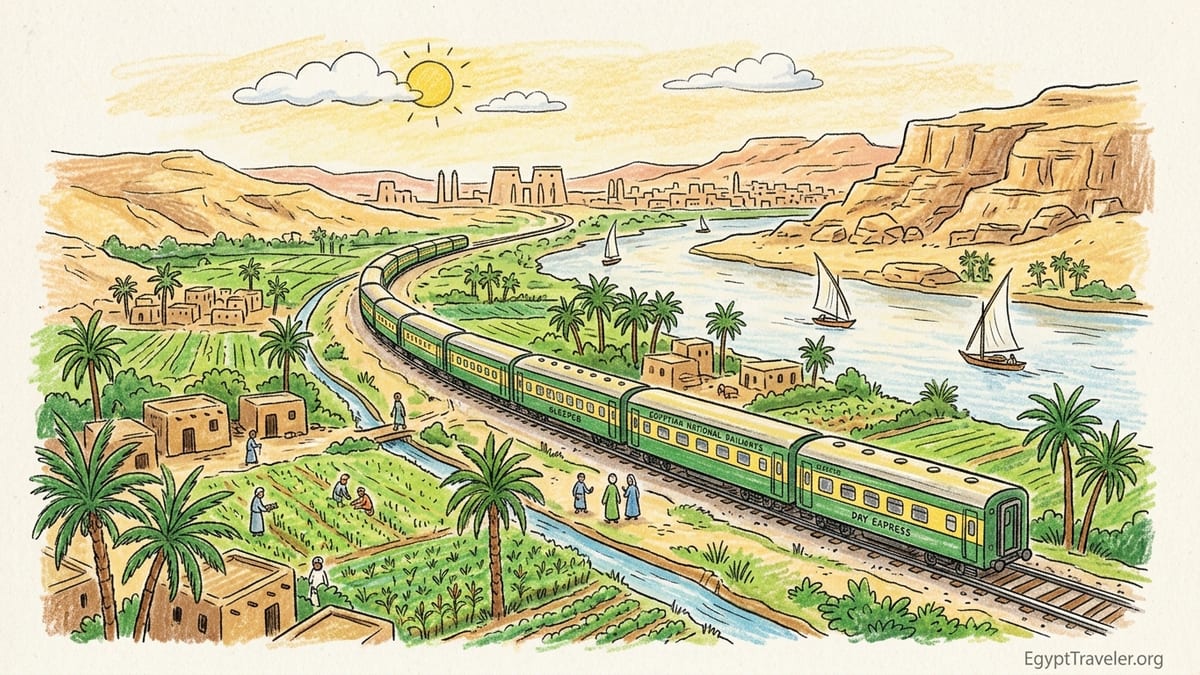
Most trains follow the west bank of the Nile for much of the journey, occasionally crossing bridges and irrigated farmland. You will not see every major temple from your window, but you do get repeated glimpses of palm groves, canals and village life that are invisible from a plane. If you plan your timing so that at least one direction is in daylight, the journey itself becomes part of the attraction rather than just a way to get from one hotel to another.
Keep in mind that rail operations and rolling stock in Egypt are in the middle of a long modernization program. New daytime express services are being added and older coaches retired. Schedules and train numbers can change from one season to the next, so always double‑check times a few weeks before you travel using the official railway app or at a ticket office instead of relying on information that is years out of date.
Daytime Express vs Overnight Sleeper
For most tourists in the Nile Valley the key decision is between a daytime express train and the classic overnight sleeper. Day trains are usually cheaper and let you watch the countryside unroll in daylight. On key routes such as Cairo to Luxor or Aswan, the fastest AC express services with compulsory seat reservations typically cost somewhere in the range of what a midrange hotel room might cost for a night. Exact fares change frequently with inflation, so think in relative rather than absolute numbers and check just before travel.
Overnight sleeper trains between Cairo, Luxor and Aswan operate with private two‑berth cabins that convert from seats to beds, plus basic washbasins in each compartment. Tickets include an evening meal and simple breakfast. Recent pricing changes mean that for foreign travellers a one‑way fare in a shared two‑berth cabin on the Cairo–Luxor or Cairo–Aswan route is now often quoted in hard currency or higher‑tier Egyptian pound rates, making it a premium experience rather than a budget one. At peak holiday periods, a Cairo–Aswan single‑occupancy cabin can be priced similarly to or higher than a discounted domestic flight.
To decide between day and night trains, think about your itinerary. If you are short on time and want to avoid “wasting” a day in transit, an overnight sleeper from Cairo to Luxor works well: you leave in the evening and arrive early next morning, checking directly into a West Bank guesthouse or East Bank hotel. On the other hand, if you are planning a stop in Minya or Asyut, a daytime AC express lets you get a feel for middle Egypt while arriving mid‑afternoon, which is more practical for finding your hotel and organizing a driver to sites like Beni Hassan.
A useful compromise is to take one leg of your journey as a sleeper and the other as a day train. For example, you might ride the Cairo–Minya–Luxor stretch by day, with a break in Minya, then continue from Luxor to Aswan on a morning or midday AC express that reaches Aswan in time for sunset over the First Cataract. This way you experience both the social, scenic side of Egyptian trains and the restful privacy of a sleeper cabin without repeating the same type of journey twice.
Planning Routes: Cairo, Minya, Luxor and Aswan
Many guides assume you will travel straight from Cairo to Luxor or Aswan, but stopping in Minya or other middle Egypt cities makes for a richer route. A common pattern is to travel Cairo to Minya on a mid‑morning AC express, spend two or three nights using Minya as a base for surrounding tombs and rock‑cut sites, then continue onward by train to Luxor. From there you might spend four or five nights exploring both banks of the river before a final hop south to Aswan by rail or cruise boat.
When planning legs, consider departure and arrival times. For example, a daytime express from Cairo’s main Ramses or Bashtil Upper Egypt station to Minya typically takes around four to five hours, depending on the service. Leaving Cairo around 9:00 or 10:00 means you step off in Minya mid‑afternoon, with enough daylight to walk or grab a taxi to a Corniche‑side hotel. Two days later you can catch an early afternoon train from Minya toward Luxor, arriving later in the evening to check into your hotel and rest before visiting Karnak or the Valley of the Kings the following morning.
Luxor to Aswan is a shorter run, usually about three hours on the fastest AC express services and a bit longer on slower trains. Many travellers choose to leave Luxor around mid‑morning, reach Aswan around lunchtime and then take a felucca sail or stroll the Corniche before dinner. Others do the reverse, catching a morning train from Aswan after an early visit to Philae Temple, arriving in Luxor mid‑day in time for a later‑afternoon run out to Luxor Temple or Luxor Museum.
If your time is very limited, you might fly one way and use the train the other. For instance, flying from Cairo to Luxor allows you to start sightseeing the same day, then after your Luxor and Aswan stay you could board a sleeper train back to Cairo, freeing up daytime hours. Because flight and rail pricing fluctuate, check both a few weeks before your trip and be prepared to adjust plans if, for example, an airline launches a temporary promotion that significantly undercuts the sleeper fare.
Booking Tickets and Understanding Classes
Egyptian National Railways sells tickets through station counters, travel agencies and a mobile app that, at the time of writing, primarily accepts Egyptian IDs and local payment methods. Foreign travellers typically buy daytime AC tickets either in person at major stations or through local travel agents and hotel concierges, who can often secure seats on specific trains in advance for a service fee. For the sleeper trains, booking is handled by the dedicated sleeper operator, with online reservations in English and sales desks at big stations like Cairo and Aswan; however the website can be temperamental and it is wise to build in extra time or use an agent if you are on a tight schedule.
On daytime trains the main classes relevant to tourists are first‑class AC and second‑class AC. Both are air‑conditioned and reserved‑seat; first class usually has a 2+1 seating layout with slightly wider seats and a quieter atmosphere, while second class has a 2+2 layout and is more crowded but still comfortable for the relatively short Luxor–Aswan run. Non‑AC second and third‑class coaches also exist on many services, but they are typically very busy and can be overwhelming for first‑time visitors, especially in the hotter months.
As a rough guide, a first‑class AC daytime ticket from Cairo to Luxor will cost more than a standard intercity bus but less than a last‑minute domestic flight on a full service carrier. Luxor to Aswan tickets are significantly cheaper because of the shorter distance. Within Egypt, prices are frequently revised to keep pace with inflation and fuel costs, and foreigner pricing on some premium services is periodically adjusted, so think of ranges rather than fixed numbers and avoid planning a budget around old price lists you find in archived forums.
For the sleeper trains, fares are structured by route, cabin type and whether you occupy the whole cabin or share. For example, a foreign traveller booking a two‑berth shared cabin from Cairo to Luxor might pay the equivalent of a mid‑range hotel night, including the basic dinner and breakfast. Opting to have the cabin to yourself can raise the price substantially, especially on the longer Cairo–Aswan stretch or during holiday peaks such as Eid and the winter high season. If you are traveling in February or over Christmas and New Year, specialists often advise booking the sleeper at least a few weeks in advance to secure your preferred date.
Key Stations and On‑the‑Ground Logistics
In Cairo, long‑distance Upper Egypt trains use either the historic Ramses station downtown or the newer Bashtil Upper Egypt station in Giza, depending on the service. Sleeper trains to Luxor and Aswan have increasingly been routed from Bashtil or from Giza station itself, while some daytime expresses still depart Ramses. Confirm your departure station carefully as the three are in different parts of Greater Cairo. Many travellers staying in downtown hotels prefer Ramses because it is a short taxi or metro ride away; those staying near the pyramids may find Giza or Bashtil simpler.
Minya’s station sits close to the city center, a short taxi ride from most riverside hotels. On arrival you exit through a busy forecourt where local taxis and tuk‑tuks wait. There is no elaborate tourist infrastructure here, so it helps to have your hotel name written in Arabic or saved on your phone. Luxor and Aswan stations, by contrast, are firmly on the tourist circuit. Luxor station lies on the East Bank within easy reach of the Nile Corniche; most mid‑range hotels can be reached in 5 to 10 minutes by taxi. Aswan station is similarly central, a few blocks from the riverfront, and many guesthouses offer to arrange a driver to meet your train if you provide the arrival time in advance.
At major stations you will usually find a basic left‑luggage room or lockers, but opening hours and procedures can vary. In Luxor, for example, travellers sometimes prefer to leave bags at their hotel after early check‑out and return later to pick them up before an evening train, rather than relying on station facilities. Cairo’s big stations have more formal left‑luggage services, but security checks are stricter: allow extra time to pass your suitcase through scanners at the station entrance, especially during busy holiday periods when queues lengthen.
On board, expect air‑conditioned coaches but variable catering. Some daytime expresses have trolley service with tea, instant coffee, soft drinks and simple snacks; others may have very little for sale. Most seasoned travellers bring bottled water, fruit and bakery items purchased near the station. Sleeper trains serve tray dinners of rice, vegetables and a protein, plus bread and dessert, as well as a light breakfast. These meals are adequate but not gourmet; if you have dietary restrictions or simply prefer something else, bring packaged snacks as a backup.
Combining Trains with Local Drivers for Archaeological Sites
Although trains carry you efficiently along the Nile Valley spine, very few major archaeological sites sit directly at station doors. In practice, you will almost always combine rail travel with local drivers, taxis or rides arranged through your accommodation. This is particularly true in Minya, where the real draw for tourists is not the city itself but the rock‑cut tombs and desert‑edge sites scattered along both sides of the river.
For example, a classic middle Egypt outing from Minya is a day trip to Beni Hassan, Tuna el‑Gebel and the ancient city mound of Hermopolis. None of these are walkable from a station in any meaningful way. A practical approach is to arrive in Minya by midday train, check into a Corniche hotel, then ask the reception to arrange a licensed driver for the following morning. You might agree a flat rate in Egyptian pounds that covers a full day, fuel and waiting time, then set out at 8:00 to reach Beni Hassan before the heat builds, continuing on to the other sites and returning to Minya by late afternoon.
In Luxor and Aswan, the pattern is similar but more familiar to tourists. From Luxor station you will normally take a taxi to your hotel and then rely on hotel‑arranged cars, local taxis or rideshares to reach the West Bank necropolis, Karnak Temple or the road out to Dendera if you plan that excursion. While there is a small station near the town of Qena for Dendera, the temple itself lies several kilometres away and is most easily visited on a day tour from Luxor or as part of a private transfer that combines multiple stops.
South of Luxor, the same principle applies to famous sites like Kom Ombo and Edfu. Although there are railway stops in these towns, tourists typically visit them by Nile cruise boat or road transfer rather than hopping on and off trains with luggage. If you are determined to use rail, it is theoretically possible to ride a morning train from Luxor to Kom Ombo, visit the temple with a local taxi, then continue to Aswan later in the day, but in practice this can be stressful because of limited taxi availability, potential schedule slippage and the need to align temple opening hours with train times.
The most extreme example is Abu Simbel, which sits far to the south near the Sudanese border with no rail connection. Almost everyone visits via early‑morning road convoy from Aswan or by short‑haul flight. In this case the train still plays a role by getting you comfortably to Aswan, where you join a pre‑arranged tour or hire a private vehicle. Thinking of the train as your backbone and local drivers as the ribs that take you out to sites prevents unrealistic expectations about walking from station platforms straight into temple forecourts.
Luggage, Safety and Comfort on Board
Egyptian trains do not have the strict baggage rules you see on budget airlines, but you still want to travel light enough to handle your own luggage on stairs and crowded platforms. Most AC coaches have open overhead racks suitable for daypacks and soft duffels and there is usually space at the end of the carriage for bulkier suitcases. In sleeper cabins, luggage slides under the lower berth or stands upright in the corner. Travellers with compact rolling suitcases and one small day bag tend to be the most comfortable.
Security on mainline trains is generally reassuring, with visible police presence at major stations and on certain trains, plus routine metal‑detector checks at station entrances. Normal urban common sense still applies: keep valuables in a money belt or under‑clothes pouch, avoid leaving phones or cameras on the table unattended and if you are a solo traveller, consider sharing a sleeper cabin with a friend or partner rather than with a stranger if that makes you more relaxed. In first‑ and second‑class AC coaches you will often find family groups, business travellers and students; the atmosphere is typically calm and social.
Dress for air‑conditioning rather than outdoor heat. Many visitors are surprised at how cool AC can feel after time in the sun, especially on the newer express sets, so a light fleece or shawl is useful even at the height of summer. On overnight services, the bedding provided is generally clean but may show signs of wear; some travellers like to bring a lightweight sleep sheet or pillowcase for extra comfort. Earplugs and an eye mask also help if you are sensitive to noise or corridor lights.
For families, rail can be a pleasant way to move between cities because children can stretch their legs and watch villages pass by. Bringing simple snacks, card games and downloaded shows on a tablet makes longer journeys easier, especially on the nine to ten hour overnight run between Cairo and Luxor or the longer Cairo–Aswan leg. Think of the train as a moving living room rather than a sealed‑off aircraft cabin and you will adjust quickly to its rhythms.
The Takeaway
Using trains to travel the Nile Valley gives you a grounded sense of how Egypt fits together: the continuous strip of green along the river, the desert beyond and the chain of cities from Cairo to Aswan. Whether you choose a daytime AC express or a classic overnight sleeper, rail works best when combined thoughtfully with local drivers and flexible hotel arrangements instead of treated as a self‑contained package.
If you are drawn to lesser‑visited sites and slower travel, weaving Minya and middle Egypt into your route will reward you with quieter tombs and a more everyday slice of Egyptian life. If your focus is primarily Luxor and Aswan, trains still offer a characterful alternative to flying, especially when you factor in airport transfers and security checks.
Most of all, remember that the system is functional but not always polished. Schedules change, booking websites misbehave and trains occasionally depart late. Approach the Nile Valley railway as part of the adventure rather than a hurdle, pad your plans with extra time where it matters and you will likely step off each train with both a story to tell and a new appreciation for how Egyptians themselves move along their great river.
FAQ
Q1. Can foreign tourists still use regular daytime trains between Cairo, Luxor and Aswan?
Yes. Foreigners can ride regular daytime AC trains on these routes, usually in first or second class with reserved seats, purchased at major stations or through local agents.
Q2. Do I need to book the sleeper train from Cairo to Luxor or Aswan in advance?
Advance booking is strongly recommended, especially between October and April and around major holidays, because cabins are limited and can sell out days or weeks ahead.
Q3. Is Minya safe and practical as an overnight stop for independent travellers?
Minya is a working Nile city that sees far fewer tourists than Luxor or Aswan, but many independent travellers use it as a base with no problems by sticking to licensed hotels and organized site trips.
Q4. How early should I arrive at the station before my train departs?
Plan to be at major stations 45 to 60 minutes before departure to allow time for security checks, finding your platform and boarding without rushing, especially if you have heavy luggage.
Q5. Can I see major sites like Beni Hassan or Dendera directly from the train?
No. These sites lie several kilometres from their nearest stations or in areas without convenient stops, so you will need a local driver or organized excursion from cities like Minya or Luxor.
Q6. Are there food and drinks available on board Egyptian trains?
Many AC day trains have trolley service with simple snacks and drinks, and sleeper fares include basic dinner and breakfast, but it is wise to bring your own water and extra snacks.
Q7. What is the best direction to travel if I want daylight views of the Nile Valley?
For scenery, it is ideal to take at least one leg in daylight, such as a morning or midday train between Luxor and Aswan or a mid‑morning departure from Cairo to Minya.
Q8. Can I store luggage at stations if I arrive early or leave late?
Major stations like Cairo, Luxor and Aswan usually have left‑luggage facilities, but opening hours vary, so many travellers prefer to leave bags with their hotel when possible.
Q9. Is it better to book train tickets online or in person?
Online booking for sleepers is possible but can be unreliable; many visitors rely on station ticket counters, hotel concierges or local agencies, particularly for daytime AC trains.
Q10. How does taking the train compare with flying between Cairo, Luxor and Aswan?
Flying is faster but involves airport transfers and security checks, while trains offer a slower, more atmospheric journey that can double as a night’s accommodation on sleeper services.