


The Sinai Peninsula can feel like several different trips layered into one: polished Red Sea resorts, barefoot beach camps, high granite mountains and remote desert canyons. The challenge is not whether to go, but how to connect the dots. This guide compares the main bases for travelers in South Sinai and helps you decide where to spend your precious days between Sharm El Sheikh, Dahab, Nuweiba, St Catherine, Ras Mohammed and nearby protected areas such as Ras Abu Galum and the Colored Canyon.
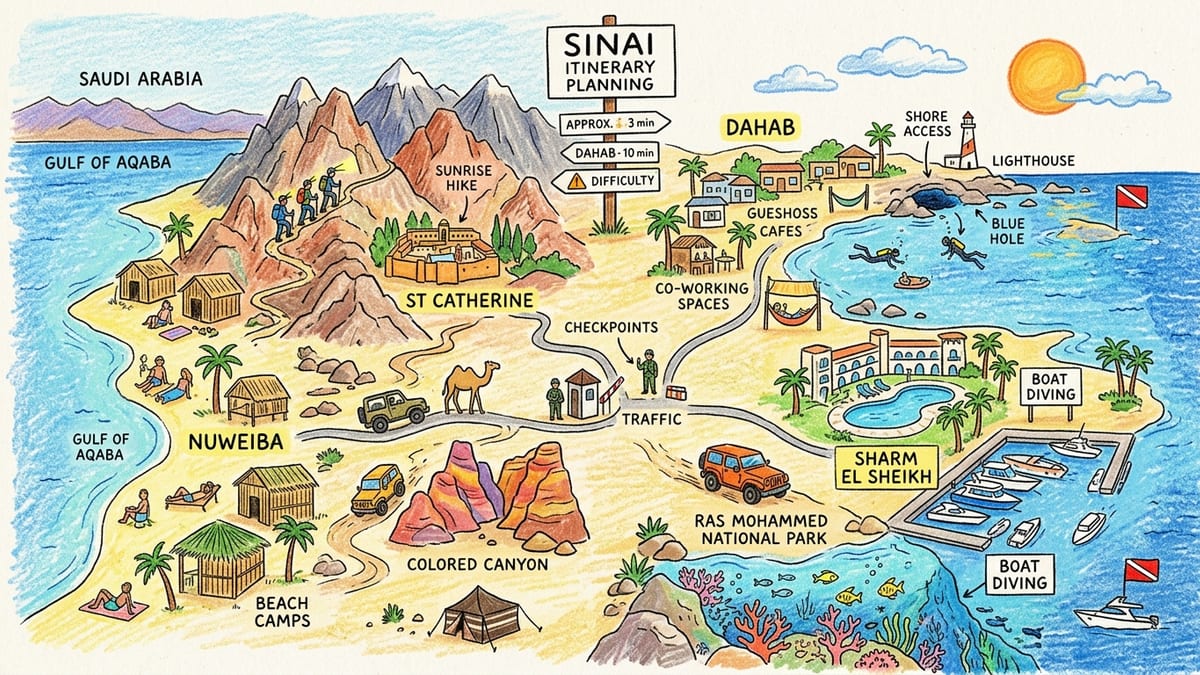
How to Think About Planning a Sinai Itinerary
Before choosing specific towns, it helps to understand how Sinai is laid out. Most visitors stick to a triangle formed by Sharm El Sheikh on the southern tip, Dahab and Nuweiba along the Gulf of Aqaba coast, and St Catherine in the central mountains. Ras Mohammed National Park lies just south of Sharm, while Ras Abu Galum and the Blue Lagoon sit north of Dahab. The Colored Canyon lies inland of Nuweiba. Distances are not huge but security checkpoints, heat and indirect routes mean that a two-hour line on the map can feel like a much longer travel day in reality.
At the time of writing in August 2026, several foreign ministries advise against non-essential travel to parts of Sinai away from the main resort areas, citing a risk of terrorism and limited infrastructure. Sharm El Sheikh and the established coastal resorts along the Gulf of Aqaba generally have more permissive advisories, but roads across central Sinai, including some routes to St Catherine and Nuweiba, may be subject to restrictions. Always check your government’s latest Egypt advisory and confirm with local operators before finalizing inland excursions, and expect that regulations can change with little notice.
Practically, that means most first-time visitors anchor their trip in Sharm El Sheikh or Dahab, then layer on carefully chosen forays: a boat trip to Ras Mohammed, a shore-diving day in Dahab, an overnight at St Catherine, or a guided jeep excursion from Nuweiba to the Colored Canyon. Trying to do everything in four or five days usually leads to more time at checkpoints than in the water or on the trail. A better strategy is to pick one main base and one or two complementary side trips that match your priorities.
Costs within Sinai are moderate by global standards, but there is a wide spread between an all-inclusive resort in Sharm, a mid-range dive guesthouse in Dahab and a no-frills bamboo hut in Nuweiba. As a rough guide, a private transfer between Sharm and Dahab often falls in the range of 30 to 40 euros one way, while shared coach or microbus services can be under 10 euros equivalent for the same route, at the expense of comfort and flexibility. Day tours into the desert can range from simple half-day jeep trips at budget-friendly prices to higher-end private expeditions with fewer crowds.
Sharm El Sheikh: Resorts, Boat Diving and Easy Logistics
If you want a straightforward Red Sea holiday with strong infrastructure, flights that arrive late at night and the widest choice of organized excursions, Sharm El Sheikh is still the most practical gateway to Sinai. The town sits on the southern tip of the peninsula and has been developed as a full-service resort destination, with everything from large all-inclusive hotels in Sharks Bay and Nabq to smaller dive-focused hotels around Hadaba and the Old Market. For many European travelers, packages bundle nonstop flights, airport transfers and a week at a resort for less than the cost of flights alone to other regions.
Sharm’s big advantage for divers and snorkelers is boat access. The marina at Travco and other jetties see a daily armada of dive boats heading for Ras Mohammed and the Straits of Tiran. A typical full-day boat dive trip, with two or three dives, tanks and lunch, might cost a mid-range traveler somewhere in the region of 80 to 120 euros per person, depending on operator, equipment rental and season. Non-divers can book cheaper snorkel boats visiting the same reefs. It is a convenient, relatively low-effort way to experience some of the Red Sea’s famous walls and pinnacles.
Reaching Sharm is usually the easiest step in any Sinai trip. Sharm El Sheikh International Airport has frequent flights from Cairo and seasonal or year-round routes from many European cities. From the airport, hotel-arranged transfers or local taxis take 15 to 25 minutes to most tourist areas, with typical taxi fares in recent reports in the ballpark of a few hundred Egyptian pounds for a ride from Naama Bay to the airport, depending on haggling and time of day. Buses and private cars connect Sharm with Dahab and Nuweiba along the coastal highway, though schedules can be irregular and subject to checks.
Sharm works both as a standalone base and as a jumping-off point. It combines naturally with Ras Mohammed, either by boat or by road, and with St Catherine for an overnight trip into the mountains, conditions and advisories permitting. Travelers who want a softer landing often spend the first few days unwinding at a resort in Sharm, then transfer to Dahab for a more independent, low-key atmosphere. Day trips from Sharm to Dahab technically exist, but in practice the 90-kilometer drive, security stops and the sheer amount to do in Dahab make an overnight stay more rewarding if time allows.
Dahab: Independent Travel and World-Class Shore Diving
Dahab started life as a laid-back Bedouin settlement and backpacker hub. Today it still feels far less polished than Sharm, with a long seafront promenade lined by small dive centers, simple guesthouses, cafes and co-working spaces. Independent travelers, digital nomads and repeat visitors often base themselves here for weeks or months, drawn by lower prices than Sharm and a more casual vibe. Instead of resort buffets, you are more likely to eat grilled fish at a table on the sand or falafel from a street stall near the Lighthouse area.
The great appeal for divers in Dahab is shore access. Many of the area’s best-known sites, including the Lighthouse, Eel Garden and the famous Blue Hole, are reached by pickup truck or jeep in less than 20 minutes from town, then entered right off the rocky shore. This keeps costs down. A fun-dive package of 10 shore dives with a reputable shop can often come in significantly cheaper than the equivalent number of boat dives in Sharm, and you lose less time to long boat rides. Freedivers and tech divers also gravitate to Dahab because they can return to the same deep walls and sinkholes repeatedly without chartering boats.
Getting to Dahab usually involves arriving through Sharm airport and continuing by road. The coastal highway distance is roughly 90 to 100 kilometers, and a private taxi transfer typically takes around 1.5 hours in light traffic. Shared buses and microbuses, including services such as Go Bus or Super Jet, take longer once you factor in security checks, loading and intermediate stops, but are considerably cheaper than a private car. Many visitors ask their Dahab hotel or dive center to arrange an airport pick-up to avoid haggling at the arrivals curb.
Dahab combines naturally with more remote parts of the Gulf of Aqaba coast. North of town lies the Ras Abu Galum protectorate and the Blue Lagoon, reached either by boat, camel or guided hike. Inland desert canyons are typically accessed from Nuweiba rather than Dahab, but many local operators in Dahab can arrange joint trips that include transport up the coast and into the interior for one or more nights. Dahab also works as a base for a long day or overnight trip to St Catherine, though in practice travelers often prefer to do that segment with a local Bedouin guide and pre-arranged vehicle due to early-morning summit hikes and security procedures.
Nuweiba and the Gulf of Aqaba’s Quieter Beaches
North of Dahab, Nuweiba stretches as a low-key port town with clusters of beach camps spreading along the coast in both directions. Compared with both Sharm and Dahab, Nuweiba feels quieter and more spaced out. Most accommodation consists of simple huts or small lodges right on the sand, with a mix of Egyptian families, independent travelers and long-stay guests reading in hammocks under shade cloth. If your priority is to unplug, gaze at the mountains of Saudi Arabia across the Gulf and listen to the water, Nuweiba can be more appealing than busier resorts.
Practically, Nuweiba is also a useful gateway. The ferry port here connects Sinai with Aqaba in Jordan, which makes it a handy node for itineraries that combine Sinai with Petra and Wadi Rum. Inland, Nuweiba is the usual launch point for jeep trips into the Colored Canyon and other sandstone formations. Day excursions often bundle several sites, for example a morning hike through the Colored Canyon followed by lunch at a Bedouin oasis such as Ain Khudra and a late-afternoon return to the coast. Prices vary with group size and negotiation, but visitors commonly pay the equivalent of a modest day-tour rate per person that includes transport, guiding and simple meals.
Nuweiba is reachable by bus and private car from both Sharm and Dahab, following the same Gulf of Aqaba highway. The road distance to Sharm is roughly 180 kilometers, with travel times of around three hours by coach depending on checks and fuel stops. To Dahab it is shorter, roughly 75 to 90 kilometers. Infrastructure is more limited than in Sharm or Dahab: ATMs can be unreliable, medical facilities basic and mobile coverage patchy in some stretches of the coast. For that reason, many travelers use Nuweiba as a multi-night base to unwind rather than as a place to rush through; arriving with some cash in Egyptian pounds and confirming your camp’s power and water setup in advance is wise.
Nuweiba combines well with both Dahab and St Catherine. A common pattern is to spend several days in Dahab diving, transfer to a beach camp near Nuweiba to slow down and explore the Colored Canyon, then continue inland to the mountains if security conditions permit. Some travelers also string together laid-back stays at smaller spots like Ras Shaitan or other Bedouin-run camps between Nuweiba and Taba, but as with all independent movement in Sinai, it is important to understand current travel advisories and to work with trusted local hosts who are informed about road conditions and checkpoint rules.
St Catherine: Mountains, Monastery and Sunrise Hikes
In the rocky interior of Sinai, the small town of St Catherine sits at around 1,500 meters above sea level. It is the main access point for St Catherine’s Monastery and the summit of Mount Sinai, which many religious traditions associate with the giving of the Ten Commandments. The granite peaks here feel like a different world from the coast, with cooler temperatures, terraced gardens and valleys used by Bedouin families for centuries. For hikers and those interested in religious history, St Catherine offers a side of Sinai that you do not see from a deckchair on the beach.
Most visitors experience St Catherine as a night-time or very early-morning visit. A typical itinerary from the coast involves leaving Sharm or Dahab in the evening, arriving at the trailhead near the monastery around midnight and hiking for two to three hours by headlamp to reach the summit of Mount Sinai for sunrise, before descending and visiting the monastery when it opens. Others prefer to stay one or two nights at a guesthouse in St Catherine or in nearby Bedouin-run camps so they can explore quieter trails in daylight, including higher peaks such as Mount Catherine, the highest mountain in Egypt, and shaded wadis with ancient orchards.
Reaching St Catherine involves traveling inland on mountain roads that pass through sparsely populated areas, which is why many foreign governments treat this region differently in their advisories compared with Sharm, Dahab or Nuweiba. In practice, travelers who make the trip usually do so with licensed local operators that coordinate route permissions with the tourist police and, where needed, military authorities. Group tours from Sharm or Dahab can be competitively priced because transport, guiding and permits are shared. Private trips cost more but allow more flexible timing and the option to add longer hikes.
St Catherine combines most naturally with coastal bases. Many visitors build their Sinai itinerary around several days in Sharm or Dahab, with an overnight or two in St Catherine as a contrasting interlude. It is not usually efficient to treat St Catherine as a day trip if you are also interested in inland canyon hikes from Nuweiba, because the drives involve different roads that may not intersect conveniently. Instead, think of the high mountain region as its own mini-destination worth at least one night, both for acclimatization and for the chance to experience Bedouin hospitality outside the busy summit trail.
Ras Mohammed: Iconic Reefs Within Easy Reach of Sharm
Ras Mohammed National Park occupies the southern tip of the Sinai Peninsula, just west and south of Sharm. Its waters protect some of the richest coral reefs in the region, with steep drop-offs, schooling fish and, in the right season, passing pelagics such as barracuda and jacks. For many visitors to Sharm, a day at Ras Mohammed is the highlight of their entire Red Sea stay, whether they experience it by snorkel or on scuba.
From Sharm, Ras Mohammed is an archetypal day trip. The distance by road is roughly a dozen kilometers from the city limits, and organized tours typically pick up guests from hotels around 8 in the morning and return by mid to late afternoon. Boat trips may visit multiple sites in the park, often including popular spots such as Shark Reef and Yolanda Reef, with lunch on board. Prices vary by operator and inclusions, but a shared snorkel boat can cost a modest amount per person, while a full dive package including equipment and park fees will cost more. Independent travelers can also hire a taxi or rental car and enter the park by road, paying the conservation fee at the gate, though arranging your own boat within the park is less common.
Because Ras Mohammed is so close to Sharm, it rarely justifies moving your base. It works best as a day or two folded into a broader Sharm stay, with rests or alternative activities in between if you are diving repeatedly. Some visitors prefer to book two separate Ras Mohammed days with different dive centers, both to sample different sites and as a form of informal safety hedge, since conditions like currents and visibility can vary. The national park also combines naturally with trips further afield, such as St Catherine or Dahab, but these links are usually logistical rather than geographic: you dive Ras Mohammed while based in Sharm, then move on.
One thing to bear in mind is that Ras Mohammed is a protected area with rules on anchoring, fishing and behavior on the reefs. Operators that specialize in the park will brief you on not touching coral, avoiding standing on shallow patches and keeping distance from nesting birds or other wildlife. Choosing a dive center or boat company with a strong environmental track record and smaller group sizes will not only improve your experience but also help reduce pressure on some of the Red Sea’s most famous sites.
Ras Abu Galum, Blue Lagoon and the Colored Canyon
Beyond the main resort towns, a handful of protected natural areas showcase Sinai’s quieter side. North of Dahab, the Ras Abu Galum protectorate combines mountains that tumble into the sea with sparse, clear water reefs and a handful of simple Bedouin camps. Just beyond, the Blue Lagoon is a shallow turquoise bay that has become popular with kitesurfers. There is no direct road; visitors usually reach the area by taking a taxi or jeep from Dahab to the Blue Hole, then continuing by small boat or camel along the coast. The boat ride can be bumpy and basic, reflecting the local, informal nature of the transport, so this is best for relatively flexible travelers rather than those expecting cruise-ship comforts.
Stays in Ras Abu Galum or the Blue Lagoon are typically minimalist. Camp accommodations may be simple huts or rooms with shared bathrooms, solar-powered electricity for a few hours a day and menus based on what the supply boat brings from Dahab. Prices can be very reasonable by international standards, sometimes including half-board meals in a nightly rate that remains accessible even for budget travelers. On longer stays, guests often negotiate lower rates in exchange for staying a week or more. The payoff is a near-silent beach, clear night skies and direct contact with local Bedouin host families.
Inland from Nuweiba, the Colored Canyon offers a different type of natural spectacle. Here, narrow sandstone walls wind through a dry wash, displaying swirls of red, yellow and purple minerals. It is usually visited as part of a guided jeep excursion starting on the coast, with a local Bedouin guide leading small groups through the most photogenic sections. As of recent visitor reports, entrance fees are modest, with a portion going to local communities that manage access. The hike is not technically difficult for most reasonably fit people, though there are short scrambles and tight squeezes that may challenge those with limited mobility or claustrophobia.
Both Ras Abu Galum and the Colored Canyon work best as one- or multi-night add-ons to stays in Dahab or Nuweiba rather than as standalone bases. From Dahab, a popular pattern is to spend a few days diving in town, then go by boat to Ras Abu Galum or the Blue Lagoon for one or two nights, returning in time to catch a bus onward or connect with a domestic flight in Sharm. From Nuweiba, you can organize Colored Canyon trips that return the same day, or combine the canyon with overnight camping in the desert. Because all these excursions rely on local knowledge of tracks, weather and checkpoints, booking through well-regarded local guides or through your accommodation is usually more reliable than trying to arrange everything independently on arrival.
Putting It Together: Sample Combinations by Travel Style
Once you understand what each place is best at, building an itinerary becomes an exercise in matching them to your style, budget and risk tolerance. For a classic first-time Sinai trip centered on comfort and diving, you might spend five or six nights based in Sharm, with two or three boat days to Ras Mohammed or the Straits of Tiran, a rest day wandering Naama Bay or the Old Market and a one-night excursion to St Catherine for the sunrise hike, provided that road conditions and advisories support it. This approach minimizes hotel changes and keeps you within the better-served southern tip for most of your stay.
For a more independent, slower-paced trip, Dahab makes a strong primary base. A traveler with 10 days could spend a week in Dahab mixing shore diving, snorkeling and desert walks, then move north to Nuweiba for three nights of quiet beach time and a jeep trip to the Colored Canyon. If you are comfortable with simple conditions and informal local transport, you might insert two nights in Ras Abu Galum or the Blue Lagoon between Dahab and Nuweiba, traveling up the coast by boat and back by road. Throughout, you would lean on local Bedouin guides to navigate both the landscape and any security-related bureaucracy.
Budget-conscious travelers often blend coastal stays with carefully chosen inland highlights. For example, a shoestring itinerary might involve arriving via Sharm, immediately transferring to Dahab by shared bus, spending most of the time in a guesthouse there, then allocating a modest additional sum to a single high-impact excursion such as a combined St Catherine and Mount Sinai overnight or a Colored Canyon and oasis day from Nuweiba. Because long-distance buses within Egypt are relatively affordable compared with private taxis, shifts between main towns do not have to dominate the budget as long as you plan for some waiting time and changing schedules.
Whatever your style, keep two principles in mind. First, try to build your route in a logical line rather than doubling back unnecessarily. Sharm to Dahab to Nuweiba to the Taba border or ferry to Jordan makes more sense than repeatedly bouncing between Sharm and Dahab. Second, accept that conditions in Sinai can change. Speak with your accommodation hosts, dive centers and guides a few weeks before travel and again on arrival about which routes are currently open, which require special permissions and which are unwise. A flexible plan that can drop or substitute destinations is safer and ultimately more relaxing than one that tries to tick every box on a fixed checklist.
FAQ
Q1. Is it safe to travel around the Sinai Peninsula as an independent visitor?
Safety conditions in Sinai change over time. As of 2026, coastal resorts such as Sharm El Sheikh, Dahab and Nuweiba are widely visited, while many governments advise against non-essential travel in parts of inland Sinai. Independent travelers should check their own government’s Egypt travel advisory, stick to main resort areas and well-known routes, and use licensed local guides for inland trips.
Q2. Do I need a full Egyptian visa to visit Dahab, Nuweiba or St Catherine?
Visa rules can depend on your nationality and how far you plan to travel beyond the Red Sea coastal strip. Many visitors on short stays in Sharm can enter with a Sinai-only permission stamp, but trips to Dahab, Nuweiba or St Catherine often require a full Egyptian visa, which is usually obtainable on arrival at major airports. Check current requirements for your passport before travel and confirm with your airline or embassy.
Q3. How much time should I spend in Dahab compared with Sharm El Sheikh?
If you are mainly interested in resort comfort and organized boat diving, three to seven nights in Sharm may be sufficient, with one or two day trips to Ras Mohammed. If you prefer independent travel and shore diving or freediving, many travelers find that a week or more in Dahab passes quickly, especially if they add side trips to Ras Abu Galum or the Blue Lagoon.
Q4. Is Nuweiba worth visiting if I am not planning to go to Jordan?
Yes, Nuweiba is worth a stop even if you are not taking the ferry to Jordan. Its quiet beach camps, relaxed pace and access to desert sites like the Colored Canyon make it attractive for travelers seeking downtime after busier days in Sharm or Dahab. It is particularly appealing if you enjoy simple, low-key accommodations on the sand.
Q5. Can I visit St Catherine and Mount Sinai as a day trip from Sharm or Dahab?
Day trips are technically possible but can be long and tiring, often involving several hours of driving each way plus a night-time hike. Many travelers prefer to stay at least one night near St Catherine to rest, adjust to the cooler mountain climate and explore beyond the main summit trail. Always confirm that current security conditions and road access allow the trip.
Q6. What is the best way to reach Ras Mohammed National Park?
From Sharm El Sheikh, the most common way to reach Ras Mohammed is on an organized boat or road tour booked through a dive center or excursion office. These typically include hotel pick-up, park fees and lunch. Taxis or rental cars can also take you to the park entrance by road, but you will need to pay the conservation fee and arrange any boat activities separately.
Q7. How basic are the facilities in Ras Abu Galum and the Blue Lagoon?
Facilities in Ras Abu Galum and the Blue Lagoon are generally simple. Expect rustic huts or small rooms, limited electricity, basic shared bathrooms and menus that depend on supplies brought from Dahab. Mobile coverage may be weak or absent. The experience suits travelers comfortable with camping-style conditions who value quiet and nature over amenities.
Q8. Do I need a guide to visit the Colored Canyon?
In practice, most visitors join guided jeep tours to the Colored Canyon, both for navigation and for safety. The approach tracks are not always well marked, and local Bedouin guides know the best routes, entry points and escape paths if weather changes. Joining a small guided group arranged through your accommodation is recommended rather than attempting to go alone.
Q9. How expensive is getting around between Sharm, Dahab and Nuweiba?
Prices vary with fuel costs and negotiation, but as a rough guide a private taxi transfer between Sharm and Dahab is often quoted in the range of 30 to 40 euros one way. Shared buses and microbuses are much cheaper, usually costing the equivalent of only a few euros, but can take longer and be less comfortable. Travel between Dahab and Nuweiba is shorter and often slightly cheaper.
Q10. When is the best time of year to visit Sinai for outdoor activities?
Spring and autumn are generally the most comfortable times, with warm but not extreme temperatures and good underwater visibility. Summer brings intense heat, especially inland and on mountain trails, which can make midday hiking risky, while winter can be surprisingly cold at night in St Catherine, with occasional frost. For diving and snorkeling, conditions are usually good year-round, but surface temperatures and wind can affect comfort.