


The Sinai Peninsula can feel like several different worlds packed into one corner of Egypt. For first-time visitors, the contrast between glossy Red Sea resorts, low-key backpacker towns, stark Bedouin deserts and cool high mountains is striking, and a little confusing. This guide focuses on South Sinai, the main tourist region, and explains how to experience its three very different faces while staying on the right side of current entry rules and regional travel advisories.
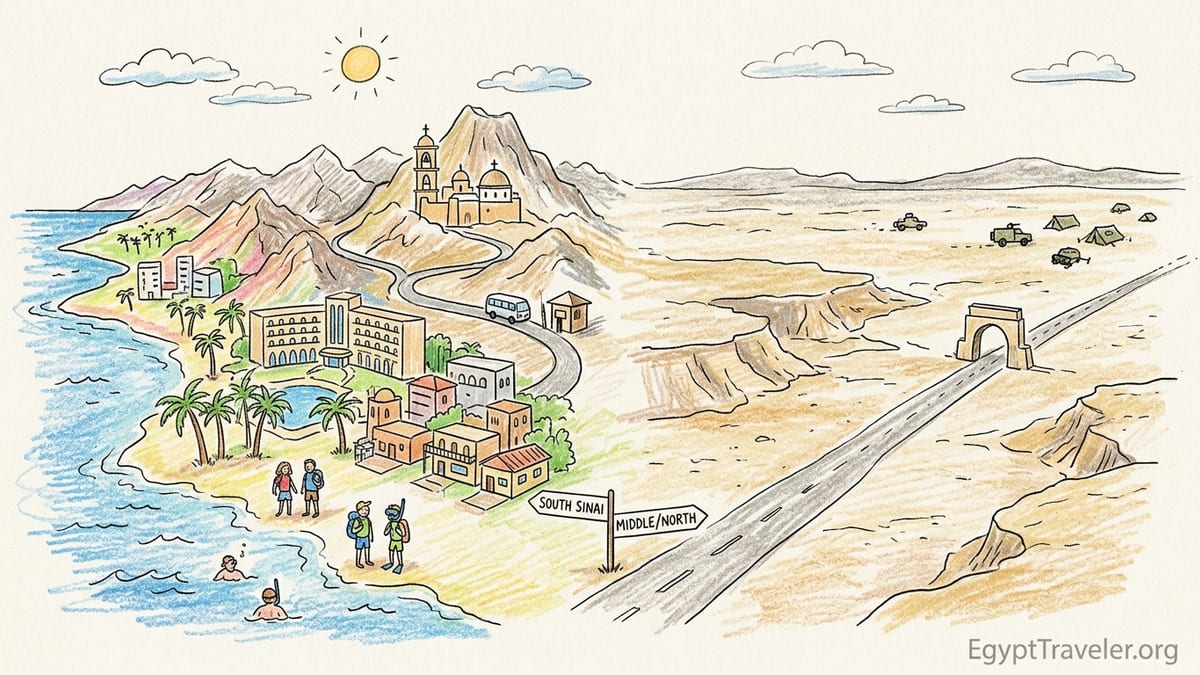
Understanding South Sinai vs the Rest of the Peninsula
On a map, Sinai looks like a triangle wedged between Africa and Asia, but in travel terms it is divided into three very different zones: South Sinai, Middle Sinai and North Sinai. First-time leisure visitors overwhelmingly stay in South Sinai, the governorate that wraps around the Red Sea and Gulf of Aqaba coasts from Sharm El Sheikh up to Taba, including Dahab, Nuweiba and the St Catherine mountains. This corridor is heavily policed, packed with hotels and tour operators, and is treated by Egyptian authorities as a distinct tourist bubble.
Middle Sinai and North Sinai, by contrast, are sparsely populated, dominated by desert plateaus and towns along the highway to the Suez Canal and Gaza border. These regions have seen periodic militant activity and ongoing military operations in recent years. Western and other governments currently advise against all travel or all but essential travel to most of North Sinai, and discourage independent overland crossings of Middle Sinai except on specific permitted roads with strict conditions. Those security advisories are updated frequently and should be checked close to departure.
For practical purposes, first-time visitors should think of South Sinai as the accessible, touristed part of the peninsula, reached mainly by air to Sharm El Sheikh or by road along the Gulf of Aqaba from Taba. If you fly into Cairo and dream of an overland desert journey across the middle of Sinai, that usually requires special permits, a 4x4 and a local operator, and even then may be restricted at short notice. Most people instead either stay entirely in South Sinai or combine it with mainland Egypt by domestic flight.
Within South Sinai itself, you can move relatively freely between the main resorts and towns through a web of checkpoints on the coastal highways and the mountain road up to St Catherine. Buses and shared minibuses ply the Sharm–Dahab–Nuweiba–Taba route, while private transfers are easily arranged through hotels. Expect your passport and entry stamp to be checked several times on any intercity journey; this is routine and usually quick, but having a clear photo of your passport ID page on your phone can be useful if you are asked to hand the physical passport to your driver for checkpoint formalities.
The Three Faces of Sinai: Resorts, Desert and High Mountains
Most first-timers encounter Sinai through its Red Sea resorts, where palm-lined promenades meet coral-fringed bays. Sharm El Sheikh is the best-known, with large all-inclusive hotels in areas such as Naama Bay, Hadaba and Nabq that feel closer in style to Mediterranean package destinations than to the rest of Egypt. Just up the Gulf of Aqaba, Dahab offers a more relaxed, village-scale experience with low-rise guesthouses and beach cafés facing Saudi Arabia’s mountains. Continuing north, Nuweiba and Taba are quieter still, with small camps and older resorts strung along the coast.
Step inland, and a different Sinai emerges: long gravel wadis, sandstone canyons and granite ridges broken only by acacia trees and Bedouin gardens. Many visitors get their first taste of this desert world on a half-day jeep trip from Sharm or Dahab to places such as the Colored Canyon or the dunes of Wadi Ghazala. More immersive experiences include overnight trips that sleep in simple Bedouin camps, with dinner cooked over open fires and the Milky Way as the main attraction.
In the far south, Ras Mohammed National Park protects a wild headland of cliffs, mangroves and shallow lagoons where the desert meets some of the Red Sea’s richest reefs. Boat trips run daily from Sharm’s jetty for snorkeling and diving. Even above the waterline, Ras Mohammed feels very different from the tamed resort strips: there are few buildings, almost no shade and a sense of being right on the edge of the peninsula.
The third face of Sinai lies around St Catherine and Mount Sinai in the high interior, more than 1500 meters above sea level. Here the granite mountains are cooler, drier and more subdued in color, dotted with orchards tended by Bedouin families. The ancient St Catherine’s Monastery and the sunrise climb up Mount Sinai draw pilgrims and hikers rather than beachgoers. Many people are surprised to find that in winter, night-time temperatures can drop close to freezing, and snow is not unheard of on the highest peaks.
Key Destinations: Sharm El Sheikh, Dahab, Nuweiba and Taba
Sharm El Sheikh is South Sinai’s main entry point and a destination in its own right. Its international airport receives direct flights from parts of Europe and the Middle East, as well as domestic services from Cairo, Luxor and Hurghada. Sharm’s appeal is straightforward: warm seas, dependable sunshine, large resorts with pools and kids’ clubs, and some of the world’s most accessible coral reefs. A family might spend a week without leaving their hotel complex except for a day boat trip to Tiran Island or Ras Mohammed.
Dahab, about 90 minutes’ drive north of Sharm, has a very different feel. Once a backpacker hangout of simple beach camps, it now mixes budget hostels, midrange boutique hotels and a few upscale resorts. Life is centered on the pedestrian seafront in the Lighthouse and Mashraba areas, where dive shops, falafel stalls and cafés line the promenade. Prices are typically lower than Sharm: a midrange guesthouse might charge the equivalent of 40 to 70 US dollars per night, while simple seafood dinners along the water can come in at 10 to 15 dollars per person depending on what you order.
Further north, Nuweiba is spread out along a wide bay, with a modest town center and several separate clusters of accommodation. These range from older concrete resorts to rustic “eco-camps” of reed huts or simple chalets, some still popular with long-stay visitors and digital nomads looking for low costs and quiet. Expect more basic infrastructure than in Sharm or Dahab, and limited nightlife, but big skies and a slower pace. Nuweiba is also a staging point for ferries to Aqaba in Jordan, though schedules can be erratic and are best confirmed locally.
Taba, near the Israeli border opposite Eilat, combines a small Egyptian town with a handful of waterfront resorts, some with their own jetties on the Gulf of Aqaba. The scenery here is dramatic, with steep ochre mountains dropping almost straight into the sea and views across to Israel, Jordan and Saudi Arabia. Many visitors arrive overland from Israel at the Taba border crossing and stay in one of the nearby hotels or continue south along the coast. It is important to understand that the visa and tax rules at this crossing are quite specific: there is usually a fee to travel beyond the immediate Taba area, and the free Sinai-only entry stamp does not permit travel to mainland Egypt.
St Catherine, Mount Sinai and the Mountain Interior
The highland basin of St Catherine is the spiritual and hiking heart of Sinai. The town of St Catherine sits at around 1600 meters, surrounded by jagged granite peaks that rise to over 2600 meters. The Greek Orthodox St Catherine’s Monastery, one of the oldest working Christian monasteries in the world, nestles at the foot of Mount Sinai and is the main cultural attraction. Most visitors base themselves in a small hotel or guesthouse on the edge of town and visit the monastery during its limited opening hours in the morning.
Climbing Mount Sinai, traditionally associated with the biblical story of Moses, is usually done as a night hike to catch the sunrise. Typical tours from Sharm and Dahab depart late evening, reaching the trailhead after midnight. From there, local Bedouin guides lead groups up a broad path, known as the Camel Path, followed by a steep flight of stone steps to the summit. The ascent is not technically difficult but is sustained, and in peak season you may find yourself in a line of headlamps snaking up the mountain. Basic blankets and hot drinks are sold at simple huts along the way.
Independent travelers can also base themselves in St Catherine town for several days of hiking. Local Bedouin cooperatives run guided treks into surrounding wadis such as Wadi El Arbain, or up less-frequented peaks including Mount Katherine, Sinai’s highest summit. These walks range from easy half-day rambles between Bedouin gardens to challenging multi-day circuits that involve scrambling over boulders and camping under the stars. Facilities are minimal, so guides usually provide simple meals cooked over small fires, and you will need warm layers even in late spring.
Because of the security sensitivity of the interior and the monastery’s importance, access rules can change. There are frequent checkpoints on the road between the coast and St Catherine, and organized tours typically coordinate their passenger lists with the authorities in advance. If you are arranging your own transport, it is sensible to book through an accommodation provider in St Catherine who is up to date on current opening times, ticket prices and any restrictions on visiting the summit at night.
Red Sea Reefs: Diving and Snorkeling in South Sinai
South Sinai’s reefs are a primary reason many visitors choose the region over mainland Egypt. The area around Sharm El Sheikh offers dozens of dive sites, from the steep walls of Ras Mohammed to the sheltered coral gardens off Tiran Island. Day boats typically leave from Sharm’s harbor around 8 am and include two or three dives with lunch on board. Prices vary with the operator and season but as a ballpark, a two-dive day trip with gear rental might run between 70 and 120 US dollars per person.
Dahab’s diving scene is more shore-based, with sites such as the Lighthouse, Eel Garden and the famous Blue Hole accessed from simple entries off the rocky shoreline. This setup suits both beginners and repeat visitors who prefer a more relaxed schedule over the regimented rhythm of boat dives. Open Water certification courses in Dahab, including four to five days of instruction and equipment, are commonly priced in the range seen in other global dive hubs, sometimes slightly lower than Sharm due to lower overheads.
Snorkelers are also well catered for. In Sharm, house reefs in front of many hotels provide drop-off walls just meters from the beach, accessed via jetties. Popular spots like Ras Um Sid and Shark’s Bay have shallow coral gardens where you can see clownfish, butterflyfish and, with luck, turtles in just a few meters of water. In Dahab, the narrow strip of reef along the seafront is often too shallow for comfortable snorkeling at low tide, but places like the Blue Hole, Canyon and Three Pools offer easy entry points combined with beach cafés that rent masks, fins and wetsuits.
Many liveaboard dive cruises running itineraries such as “Deep North” or “Sinai Wrecks and Reefs” begin or end in Sharm. These usually require a full Egyptian tourist visa rather than a Sinai-only stamp, because the vessels often call at ports or dive sites considered outside the limited South Sinai entry permission. If you are planning any diving that includes famous wrecks, remote reefs or crossings to mainland ports, it is safer to obtain a full visa on arrival or via the official e-visa system before travel.
Desert and Bedouin Experiences
Beyond the reefs, South Sinai’s interior offers a chance to experience Bedouin culture and desert landscapes. In Sharm El Sheikh, hotels and street agencies advertise “desert safaris” that might include a short 4x4 ride over gravel plains, a camel ride of 20 to 30 minutes, a quick stop in a canyon and dinner in a mock Bedouin camp complete with buffet and music. These are easy introductions, though often quite commercial and standardized from one operator to another.
From Dahab and Nuweiba, it is easier to access more authentic Bedouin-run trips into the interior. For example, you might book a one-night excursion into the canyons and dunes north of Dahab with a local guide, sleeping in a simple shelter of palm branches or under a rock overhang. Costs vary widely depending on group size and level of comfort but are often comparable to a midrange hotel stay once you factor in meals and transport. The emphasis on these trips is usually on walking, storytelling and shared meals rather than adrenaline activities.
It is important to understand that many Bedouin in Sinai have a semi-nomadic lifestyle woven around small gardens, goat herds and seasonal tourism work. Buying handicrafts directly from women’s cooperatives, paying fair rates for guiding and camel services, and respecting requests not to photograph people without permission are concrete ways to support local communities. Cash is still king in remote areas; while Sharm has ATMs and card-accepting supermarkets, small desert camps often rely entirely on cash payments.
Security-wise, reputable desert operators coordinate their routes with local police and military authorities and carry phones that work on the limited network coverage in the interior. You may pass through temporary checkpoints even on short desert trips. For longer treks, guides will usually register your itinerary in advance. This is both a safety measure in case of breakdowns or injuries and a reflection of the state’s close management of movement in the interior following years of insurgency elsewhere on the peninsula.
Getting In and Around: Airports, Roads and Checkpoints
For most first-time visitors, Sharm El Sheikh International Airport is the main gateway to South Sinai. It handles a mix of scheduled and charter flights from European and Gulf cities as well as domestic flights from Cairo and other Egyptian hubs. On arrival, you will encounter two distinct entry options: a free Sinai-only stamp for eligible nationalities who plan to stay within the South Sinai resort corridor for up to around two weeks, and a paid tourist visa that allows travel throughout Egypt. The exact list of eligible passports and current fees can change, so it is essential to verify details via official channels before you fly.
Some travelers arrive overland via the Taba border crossing from Israel. Here, procedures include an exit fee on the Israeli side and, if you travel further than the immediate Taba resort area, an Egyptian border tax and the same choice between a limited Sinai-only entry permission and a full visa. Reports in 2026 indicate that crossing at Taba and later trying to “upgrade” to a full visa from within Sinai can be difficult and may involve high fines if you overstay your initial allowance, so if you think you may continue to Cairo or beyond, it is usually wiser to secure a full Egyptian visa in advance or at first entry.
Once in South Sinai, movement is primarily along two paved corridors: the coastal highway that links Taba, Nuweiba, Dahab and Sharm, and the mountain road from the coast up to St Catherine. Public buses operate some of these routes, though schedules can change with little notice. Shared minibuses and private taxis or hotel transfers are more common in practice. For example, a private car transfer from Sharm to Dahab typically takes about 90 minutes, with at least one significant checkpoint along the way where passports are checked and passengers may be briefly questioned about their destination.
Renting a car is possible but not especially common for foreign tourists, partly because of the checkpoint system and partly because local driving styles and road conditions can be challenging for the uninitiated. If you do choose to self-drive, expect to show your passport and registration at multiple points and to be turned back from certain roads that are reserved for residents, security convoys or vehicles with special permits. Night driving on the coastal highway can also involve unexpected speed bumps and occasional wandering camels, so many operators prefer to travel during daylight hours.
Visas, Sinai-only Entry Rules and Safety Considerations
Egypt’s entry rules for Sinai fall into three broad categories: full tourist visas, limited Sinai-only permissions and various special cases for residents, dual nationals and certain organized tours. For most tourists, the relevant decision is whether to rely on the free Sinai-only stamp, which typically allows around 14 to 15 days in designated South Sinai areas, or to pay for a full tourist visa, usually valid for a longer period and for travel across Egypt. While the Sinai-only option is attractive for simple beach holidays, it comes with important limitations.
A Sinai-only stamp generally restricts you to the Gulf of Aqaba coast and adjacent areas of South Sinai. Traveling to Cairo, crossing the Suez Canal, boarding certain domestic flights, or joining liveaboard cruises that stop at mainland ports normally requires a full visa. Travelers who accidentally stray outside their permitted area or overstay their Sinai allowance have reported significant fines at exit points in 2026, sometimes running to the equivalent of a substantial hotel bill even for a one-day overstay. Immigration rules are also applied unevenly at times, so leaning toward the conservative option of a full visa can reduce stress if your plans are at all flexible.
Security advisories from various governments draw a sharp distinction between the main South Sinai coastal resorts and the rest of the peninsula. At the time of writing in late August 2026, there is typically guidance to exercise increased caution in South Sinai while avoiding non-essential travel in much of North Sinai and some interior routes. These advisories reflect both the wider regional situation and specific incidents in recent years. For the average visitor who sticks to Sharm, Dahab, Nuweiba, Taba and the carefully managed route to St Catherine, the day-to-day experience is more about checkpoints and bag scans than about any visible unrest.
Common sense precautions still apply. Petty theft can occur in busy resort areas, so hotel safes are worth using for passports and cash. In desert and mountain areas, the bigger risks are environmental: dehydration, sun exposure and, in winter at altitude, the cold. Tap water quality varies; many visitors drink bottled or filtered water, and reef-safe sunscreen is recommended to minimize damage to the corals. Respecting local dress norms away from the beach, especially in St Catherine and smaller towns, also goes a long way toward avoiding unwanted attention.
The Takeaway
For first-time visitors, South Sinai offers a rare combination: world-class reefs and beaches, accessible desert adventures and a compact mountain region steeped in religious and cultural significance. Understanding the peninsula’s internal divisions helps you make sense of travel advisories and entry stamps that treat Sharm, Dahab and Taba as one controlled tourism zone, separate from the more sensitive areas of North and Middle Sinai.
In practical terms, most newcomers will choose between a straightforward resort stay focused on snorkeling, boat trips and perhaps a one-night pilgrimage to Mount Sinai, and a more varied itinerary that mixes Sharm or Dahab with desert camps and a couple of days in St Catherine. Being realistic about your comfort level with checkpoints, night hiking and simple desert facilities will help you pick the right balance.
Whichever path you take, giving some thought in advance to visas, transport and the seasonal climate will pay dividends. A full visa rather than a Sinai-only stamp can keep options open if you decide on a spur-of-the-moment detour, while booking reputable local operators for diving and desert trips will deepen your experience and support communities who have lived with Sinai’s landscapes for generations.
Arrive with a flexible mindset, a respect for both the fragile reefs and the people who call this peninsula home, and an awareness of the broader security context, and South Sinai is likely to reward you with some of the most vivid memories you can bring home from Egypt.
FAQ
Q1. Is South Sinai safe to visit right now for a first-time traveler?
South Sinai’s main resort areas such as Sharm El Sheikh, Dahab and Taba are open to tourism and heavily policed, though many governments advise increased caution. The situation in North Sinai is very different, which is why first-time visitors are usually advised to stay within the established South Sinai tourist corridor and to keep an eye on their own government’s travel advisories before departure.
Q2. Should I get the free Sinai-only stamp or pay for a full Egyptian visa?
If you are absolutely sure you will stay only in South Sinai for under about two weeks and will not take liveaboard cruises or travel to mainland Egypt, the Sinai-only stamp can be sufficient. If you might visit Cairo, Luxor or other regions, or join trips that technically leave the limited Sinai zone, a full visa is usually safer and avoids potential fines or complications if plans change.
Q3. How do I reach Dahab, Nuweiba and Taba from Sharm El Sheikh Airport?
From Sharm Airport you can book private transfers through your accommodation, use tour operator buses or, less commonly, public buses from Sharm’s main station. The drive to Dahab is around 90 minutes along the coastal highway with at least one passport checkpoint, while Nuweiba and Taba are progressively farther north. Many first-time visitors arrange transfers in advance rather than negotiating on arrival.
Q4. Can I visit St Catherine and climb Mount Sinai on my own?
It is possible to travel independently to St Catherine and stay in local guesthouses, but you will still need to use licensed Bedouin guides for the main summit routes and respect any current access rules. Most first-timers find it easier to join an organized excursion from Sharm or Dahab, which includes transport through the checkpoints, a guide and coordination with the monastery’s opening hours.
Q5. Do I need to be an experienced diver to enjoy South Sinai’s reefs?
No. Many visitors experience the reefs purely through snorkeling on hotel house reefs or guided boat trips. Dive centers in Sharm and Dahab run beginner-friendly introductory dives and full certification courses, while also offering advanced sites for experienced divers. If you do not dive, you can still see abundant marine life from the surface in shallow areas such as Ras Um Sid or Dahab’s Three Pools.
Q6. What is the best time of year to visit South Sinai?
Spring and autumn are generally the most comfortable, with warm seas and daytime temperatures that are hot but more manageable than mid-summer. July and August can be extremely hot on the coast, especially for desert excursions, while winter brings cooler air and, in the St Catherine mountains, potentially freezing nights and occasional frost or snow.
Q7. Are desert and Bedouin camp excursions suitable for children?
Short evening trips that combine a 4x4 ride, a simple camel ride and dinner in a Bedouin camp are popular with families and generally suitable for school-age children. Longer treks with basic facilities, rough tracks and cold nights are better suited to older children and teenagers who are comfortable with camping and limited comfort. Always check with the operator about minimum ages and specific conditions.
Q8. Can I drive my own rental car around South Sinai?
Self-driving is possible but involves dealing with multiple checkpoints, variable road conditions and local driving habits that can feel aggressive to newcomers. Most first-time visitors find it less stressful to rely on licensed transfers, taxis and organized tours. If you do rent a car, make sure your paperwork is in order and be prepared to show your passport and registration at checkpoints.
Q9. What should I wear in beach resorts and in St Catherine?
In resort areas and on hotel beaches, swimwear and casual summer clothes are widely accepted. Away from the immediate beachfront and especially in towns, villages and St Catherine, it is respectful to dress more conservatively: shoulders and knees covered, and loose, light fabrics that cope well with the sun. A warm layer is essential in the mountains, even in seasons when the coast feels hot.
Q10. How can I respect and support local Bedouin communities during my trip?
Booking tours with Bedouin-operated companies, paying fair prices for guiding, camel rides and handicrafts, and asking permission before taking photos are straightforward ways to contribute positively. Avoid bargaining down to the last possible unit of local currency, tip when service has been good, and follow your hosts’ lead on issues such as visiting family gardens or sacred sites in the mountains.