


South Sinai looks compact on the map, but planning how to move between Sharm El Sheikh, Dahab, Nuweiba, Taba and St Catherine still takes a bit of homework. Buses, shared taxis, private transfers and excursions all exist, yet road checks, changing security rules and sparse schedules mean some routes are far easier than others. This guide pulls together current on-the-ground options so you can connect the region’s beaches, mountains and border crossings with realistic expectations and a flexible plan.
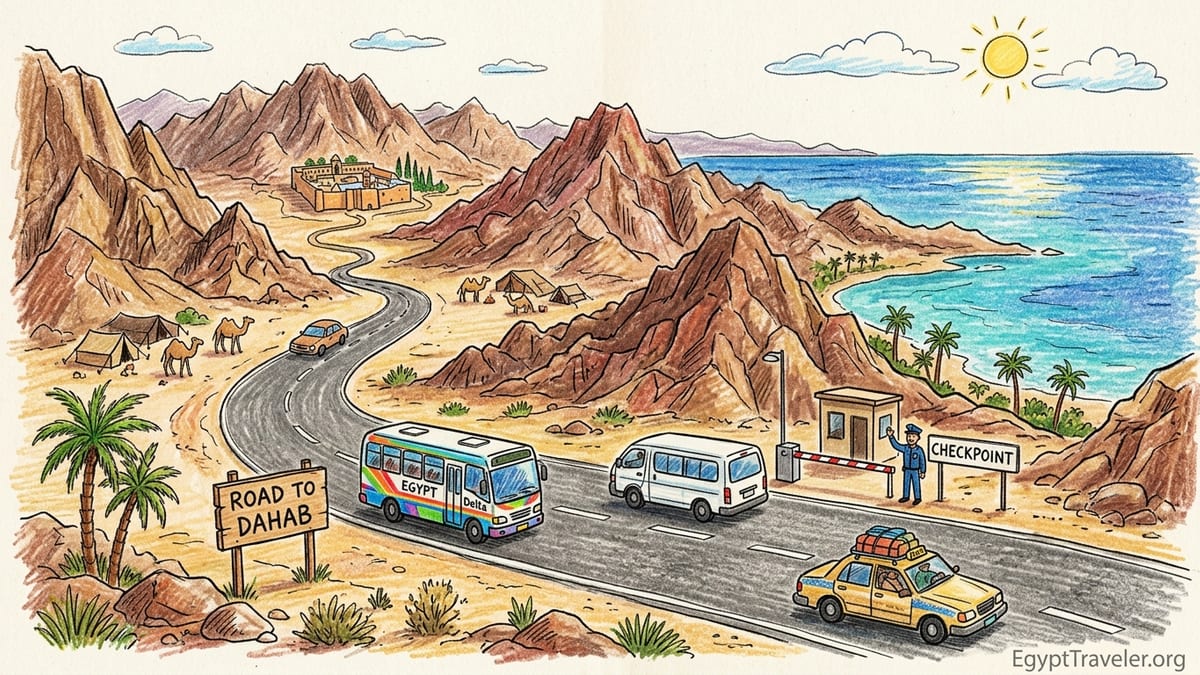
Understanding South Sinai’s Roads and Security Reality
South Sinai’s main tourist corridor runs in a rough triangle: Sharm El Sheikh to Dahab along the Gulf of Aqaba coast, then north to Nuweiba and Taba near the Israeli and Jordanian borders, with a branch inland from the coast to St Catherine in the mountains. Most independent travelers move along these paved highways, which are patrolled and generally in good condition, with typical speeds around 80 to 100 km/h outside towns. As of 2025 and 2026, long stretches remain open to tourists, but police and army checkpoints are a fact of life and officers can ask for passports, hotel bookings and sometimes details of your route.
Security rules in Sinai change in response to local incidents and national policy. A road that is straightforward in one season can suddenly require permits or convoys in another. For example, the highway from the coast up to St Catherine is at times freely open to foreign visitors in regular buses and taxis, and at other times authorities prefer organized tours or registered drivers who pre-submit passenger lists. Likewise, some back roads between desert valleys and Bedouin camps may be off limits to visitors without local guides, even if mapping apps show them as viable options.
For this reason, travelers should always confirm current road access and any restriction on movement a few days before they travel. Check with your accommodation, a reputable local tour office or major bus operators in Sharm or Dahab. Ask very specific questions such as “Can I take an ordinary taxi from Sharm to St Catherine on Tuesday?” or “Are individual travelers currently allowed to drive independently between Nuweiba and Taba?” Answers can be different week to week, so recent experiences from other travelers are useful, but local operators tend to have the most accurate and timely information.
Mobile coverage is fairly good on the main coastal road but can be intermittent in the interior mountains and between checkpoints, especially at night. If you are arranging a pickup at a checkpoint or village crossroads, confirm exactly where you will meet the driver and have their number saved offline. It is also sensible to travel during daylight wherever possible, both for safety and because some checkpoints are more cautious about late night movements in remote areas.
Sharm El Sheikh to Dahab: The Core Tourist Corridor
The 80 to 90 kilometer run between Sharm El Sheikh and Dahab is the easiest and most frequently traveled route in South Sinai. The coastal highway is fully paved, mostly flat and usually takes about 1 to 1.5 hours by car door to door, depending on where in Sharm you start. From Sharm airport to the central Dahab promenade, many travelers report a journey of around one hour in normal traffic, sometimes a little longer if there are slow queues at one of the checkpoints along the route.
Public buses are the cheapest option. East Delta buses and other companies such as Go Bus operate several services daily between Sharm and Dahab, typically departing from Sharm’s intercity bus terminal and Dahab’s main bus station on the edge of town. Travel time is similar to a car at roughly 1.5 to 2 hours when including stops. Ticket prices are modest by international standards, often in the low hundreds of Egyptian pounds, though exact fares fluctuate with fuel prices and inflation. Buses can sell out on holiday weekends or when Cairo connections feed extra passengers into Sharm, so for a tight schedule it is worth buying your ticket at least a few hours ahead.
For door to door convenience, most visitors use pre-booked taxis or private transfers between the airport, Sharm resorts and Dahab. Recent traveler reports indicate that a fair price for a private car from Sharm airport to Dahab in 2024 and 2025 is usually in the 800 to 1200 Egyptian pound range when arranged directly with a local driver or via your hotel, although quotes can be higher if booked through international agencies or during peak times. Some Dahab guesthouses routinely send a driver to meet guests for around 40 US dollars per car, and travelers sharing with another couple often split this cost. Negotiating on the spot at the airport can produce a lower fare, but it also increases the risk of haggling fatigue after a long flight.
Shared minivans and informal “service taxis” run between Sharm and Dahab, but they are less transparent for new arrivals. These typically depart when full from informal stands near bus stations or along the highway. You might pay a fraction of a private taxi fare, but they take longer to depart, sometimes detour to drop off locals en route, and are not practical immediately on landing with luggage at an unfamiliar airport. For most visitors flying into Sharm and moving straight to Dahab, pre-arranged private transport is the most sensible choice, especially if your flight arrives very early in the morning or after midnight.
Dahab to Nuweiba and Taba: North Along the Gulf
Heading north from Dahab, the highway hugs the Gulf of Aqaba towards Nuweiba and then Taba, close to the borders with Jordan and Israel. Distances are modest but services are less frequent than on the Sharm to Dahab stretch. The run from Dahab to Nuweiba covers around 70 to 80 kilometers and usually takes about 1 to 1.5 hours by car. Continuing to Taba adds another hour or a little more, so Dahab to Taba is often around 2.5 hours in real-world conditions. These times assume clear roads and minimal delays at checkpoints, which is typical in the coastal tourist belt, but unexpected inspections can occasionally add 20 to 30 minutes.
East Delta and other intercity operators schedule at least one or two daily buses from Sharm southwards to Dahab, Nuweiba and Taba, and some of these can be used as Dahab to Nuweiba or Dahab to Taba connections. For example, a morning bus might leave Sharm, stop at Dahab to board more passengers, continue to Nuweiba and terminate in Taba. In practice that means you buy a ticket at Dahab’s bus station, board with luggage and travel in one air conditioned bus all the way to Nuweiba or Taba. Recent guide compilations list Dahab to Nuweiba bus journeys at roughly two to three hours with a fare of a few dozen Egyptian pounds, and Dahab to Taba journeys at about three to four hours. Exact schedules shift, so always confirm the latest departures in person or via phone shortly before you travel.
Shared taxis and local minibuses provide more flexible options and are widely used by residents. A common pattern is for white minibuses or pickup trucks to wait near Dahab’s main roundabout or bus station and depart towards Nuweiba once full. Fares per seat between Dahab and Nuweiba are generally described by recent travelers and local guides as budget friendly, broadly equivalent to the price of a casual restaurant meal, though you may be quoted higher as a foreigner. From Nuweiba to Dahab, travelers arriving on the overnight ferry from Aqaba often find taxis waiting in the port area in the early hours, with quotes for the 1 to 1.5 hour ride commonly falling in the low hundreds of Egyptian pounds, negotiable depending on arrival time and demand.
For those heading directly to border crossings, such as the Taba land border on the Israeli side or the Nuweiba ferry to Jordan, a private taxi from Dahab can be worth the extra cost. This avoids waiting for a bus that may not line up neatly with departure times. As a practical example, a traveler planning to catch the Nuweiba to Aqaba ferry at midday might arrange a Dahab to Nuweiba taxi at 8:30 or 9:00 in the morning, arriving with a generous buffer for ticket formalities. Similarly, someone with an early morning bus from Taba Heights back to Cairo might choose to stay the previous night in Taba town rather than attempt a very early departure from Dahab in the dark.
Getting Into the Mountains: Routes to St Catherine
St Catherine, home to the monastery and the trailhead for Mount Sinai, sits high in the interior mountains, well off the coastal strip. Reaching it involves leaving the busy resort belt and climbing through sparsely populated desert, which makes security stakeholders more cautious. The main asphalt road from the south connects Sharm El Sheikh to St Catherine via an interior junction, while another route links St Catherine with Nuweiba and the central Sinai. Distances are significant: the drive from Sharm to St Catherine is roughly 210 to 230 kilometers and typically takes 3 to 4 hours by car in good conditions, while Dahab to St Catherine, usually via an inland turnoff, can take around 2.5 to 3 hours. Nuweiba to St Catherine is slightly shorter, often about 2 to 2.5 hours.
In theory, East Delta and other companies serve St Catherine with intercity buses connecting to Sharm, Dahab and potentially Cairo. In practice, schedules can be thin, seasonal or altered according to security advice. Some guidebooks and local hotel websites mention one or two daily buses between Sharm and St Catherine, often timed so that visitors can arrive during the afternoon, sleep a few hours, then join a night hike up Mount Sinai. However, travelers regularly report that buses on these routes can be canceled, rerouted to other destinations or require a minimum number of passengers to run. Do not rely solely on printed timetables or outdated online lists for this journey.
Because of these uncertainties, most visitors reach St Catherine on organized excursions or with a private driver arranged through their hotel or a licensed local agency. Typical models include a shared minivan tour from Sharm or Dahab that departs in the evening, arrives at St Catherine around midnight, allows for the night climb, then returns mid-morning after sunrise. Alternatively, some travelers pay for a private car from Dahab or Sharm, travel in daylight, stay overnight in a guesthouse near the monastery, then return the next day. Costs vary widely depending on group size and how many services are bundled, but a private round-trip with waiting time is commonly quoted in the equivalent of 100 to 200 US dollars per car from Sharm, and somewhat lower from Dahab, especially if several passengers share.
Checkpoints on the way to St Catherine can be stricter than on the coast. Officers may ask for a copy of your passport, proof of accommodation booking in St Catherine and the name of your driver or tour company. Some periods see informal rules that strongly “recommend” foreigners use registered drivers for this route, even if private cars are not officially banned. When arranging transport, ask explicitly whether your driver routinely does the St Catherine run, whether you will need to provide passport scans in advance, and whether current practice allows self-driving visitors on that road. For solo travelers or those unfamiliar with Egypt, using a well rated local operator for this leg is usually the simplest solution.
Comparing Buses, Shared Transfers, Taxis and Excursions
Public buses are South Sinai’s backbone for budget travel across longer distances. They are inexpensive, air conditioned and relatively reliable on the main Sharm, Dahab, Nuweiba and Taba routes. The trade offs are fixed departure times, the need to travel to and from out of town bus stations, and limited flexibility if your flight is delayed or you want to stop at small beach camps along the way. Buses are ideal for solo backpackers traveling during the day with light luggage who are happy to plan around published schedules and occasional delays.
Shared transfers, including minivans arranged by hotels or dive centers, sit in the middle ground. In Dahab, for instance, it is common for a cluster of guesthouses to coordinate a van that meets several guests arriving on the same Sharm flight and takes them up together. Each traveler pays less than a private taxi, but still enjoys door to door service without navigating the bus system at night. These shared shuttles are particularly useful for arrivals or departures in the small hours when public buses are sparse. The downside is that you may wait for other passengers to clear immigration and baggage claim, and the vehicle may make multiple stops in town before reaching your hotel.
Private taxis and hired drivers provide maximum flexibility. You can leave when you like, stop at viewpoints, negotiate detours to lesser known bays, and use remote guesthouses that are off the bus route. Prices between major hubs like Sharm and Dahab are high by local standards but moderate compared with European taxi fares, especially if split between three or four travelers. For example, a group of four paying the equivalent of 40 to 50 US dollars total for an airport to Dahab transfer may find it cheaper and far simpler than 4 individual bus tickets plus local taxis on each end. Taxis also shine when connecting awkward legs, such as an early morning Nuweiba ferry to a midday Dahab check in, or a late night arrival in Taba followed by a next day hike.
Organized excursions combine transport with guiding and permits, and are particularly important for routes where security rules are fluid, such as to St Catherine or multi stop desert safaris in the interior. Booking a Mount Sinai sunrise tour from Sharm often includes hotel pickup, road transport in a licensed minibus, a local Bedouin guide on the trail, and coordination with authorities if any additional paperwork is needed. While these excursions cost more than just a bus ticket, the extra expense effectively pays for someone else to handle logistics, language barriers at checkpoints and last minute changes in road access. For time constrained travelers or those uneasy about independent navigation in remote desert, this can be money well spent.
Airport Arrivals and Practical Planning Tips
Most international travelers enter South Sinai via Sharm El Sheikh International Airport. If you are heading straight to Dahab, Nuweiba or even Taba from the airport, plan how you will bridge that first leg before your plane touches down. Sharm airport does not have a metro or rail link, and public bus connections are limited, particularly outside daytime hours. While some Go Bus and other intercity coaches stop in Sharm city, they usually depart from town terminals rather than the airport itself, requiring a taxi or shuttle transfer just to reach the bus.
The simplest strategy for many visitors is to arrange a pickup through their accommodation. Dahab hotels and dive centers commonly offer airport transfers at fixed prices, quoted in Egyptian pounds or foreign currency per car. You send your flight details, and a named driver waits with a sign in the arrivals hall, then drives straight to your hotel. Travelers arriving around 3:00 in the morning with heavy dive gear frequently choose this option, accepting that they might pay slightly above local rates in exchange for speed and predictability. Those on tighter budgets might still use this method for the first leg from the airport to Sharm bus station, then switch to a public bus north once they have rested and oriented themselves.
When planning your itinerary, factor in buffer time around border crossings, ferries and long day trips. For example, if you intend to take the boat from Nuweiba to Aqaba, avoid scheduling a same day dive in Dahab that ends just before your planned taxi departure. Allow extra time for ticket queues, passport control and potential road checks on the way. Similarly, if your return international flight from Sharm leaves in the early afternoon, think carefully before committing to a sunrise hike at St Catherine that morning. While some travelers successfully do St Catherine overnight, descend at dawn and rush back to catch midday flights, this only works when everything runs perfectly. A safer approach is to separate mountain excursions and international flights by at least one full day.
Finally, keep in mind that fuel prices, currency fluctuations and tourism demand can shift transport costs relatively quickly in Egypt. A taxi fare that locals describe as “normal” one season may be significantly higher the next. Rather than chasing an exact “right price” from outdated forum posts, use recent anecdotes as a ballpark, then focus on agreeing a clear fare before you start any journey. Writing the figure on your phone screen and confirming whether it is per car or per person can prevent misunderstandings once you are on the road.
The Takeaway
Getting around South Sinai is less complicated than it first appears, but it rewards travelers who do a small amount of advance planning. Sharm El Sheikh to Dahab is the region’s most straightforward link, well served by buses, taxis and shared transfers. The onward run along the coast to Nuweiba and Taba is easy enough with a little schedule checking, particularly if you build in time cushions around ferries and border formalities. Into the mountains, St Catherine remains accessible but is best approached with the help of experienced drivers or organized excursions, especially when security rules tighten.
Across all routes, the essentials are consistent. Confirm current road access shortly before you travel, since restrictions and checkpoint practices can change faster than printed guides. Choose buses for budget travel along the main corridor, shared shuttles when you want value and convenience together, and private drivers or tours for remote destinations or tight schedules. By combining these options thoughtfully, you can link South Sinai’s beach towns, high desert monasteries and international gateways in a way that feels safe, efficient and relaxed, leaving you free to focus on reefs, mountains and Bedouin hospitality rather than bus timetables.
FAQ
Q1. How long does it take to travel from Sharm El Sheikh to Dahab by road? It usually takes around 1 to 1.5 hours by car or taxi from Sharm El Sheikh to Dahab, and roughly 1.5 to 2 hours by public bus including stops and possible delays at checkpoints.
Q2. Is it better to book a taxi or take the bus from Sharm airport to Dahab? For most first time visitors, a pre-booked taxi or hotel transfer from the airport to Dahab is more practical, especially for late night or early morning flights, while budget travelers arriving in daytime may prefer to reach Sharm’s bus station and use a public bus.
Q3. Are there direct buses between Dahab, Nuweiba and Taba? Yes, intercity bus companies run services that connect Dahab with Nuweiba and Taba, often as part of a longer Sharm to Taba route, but departures are less frequent than on the Sharm to Dahab leg so it is important to confirm current schedules locally.
Q4. How much does a taxi from Dahab to Nuweiba usually cost? Prices vary with fuel costs, time of day and negotiation, but recent traveler reports suggest a taxi between Dahab and Nuweiba generally costs the equivalent of a modest restaurant meal per person when shared among two or three passengers.
Q5. Can I visit St Catherine and Mount Sinai independently without a tour? It is often possible to travel independently to St Catherine using buses or private taxis, but because of changing security practices and irregular bus services many travelers find it simpler and more reliable to use an organized excursion or a driver arranged through their accommodation.
Q6. Are there restrictions on road travel in South Sinai for foreign visitors? Movement along the main coastal highways between Sharm, Dahab, Nuweiba and Taba is usually straightforward, but authorities sometimes tighten controls on interior roads, including those to St Catherine, so it is essential to verify current rules with local operators before traveling.
Q7. Do I need to carry my passport on buses and taxis in South Sinai? Yes, you should carry your passport, and ideally a copy of your accommodation booking, because police and army checkpoints along the highways often ask to see identification from both locals and foreign travelers.
Q8. Is it safe to travel between South Sinai towns at night? Many people do travel at night, especially between Sharm and Dahab, but daylight hours are generally preferable for first time visitors, and some routes towards the interior mountains may face tighter checks or informal discouragement after dark.
Q9. How far in advance should I book transport between South Sinai towns? For public buses it is usually enough to buy tickets a few hours to a day in advance except on major holidays, while private transfers to or from the airport and any trip to St Catherine are best arranged at least a day or two before travel.
Q10. Can I rent a car and drive myself around South Sinai? Self driving is possible for experienced drivers who are comfortable with checkpoints and local road culture, but you should confirm where independent foreign drivers are currently permitted, and many visitors still prefer taxis or organized transport for more remote or security sensitive routes.