


Few Middle Eastern experiences are as atmospheric as watching sunrise from the summit of Mount Sinai, then walking down to the ancient walls of St Catherine Monastery. From Sharm El Sheikh and Dahab, the combined overnight trip has become a classic: a late-night hotel pickup, a winding drive into the mountains, a dark climb by headlamp and a slow, glowing dawn over a sea of granite peaks. This guide explains how the excursion actually works today, what it realistically feels like, and how to choose between the many tour options on offer.
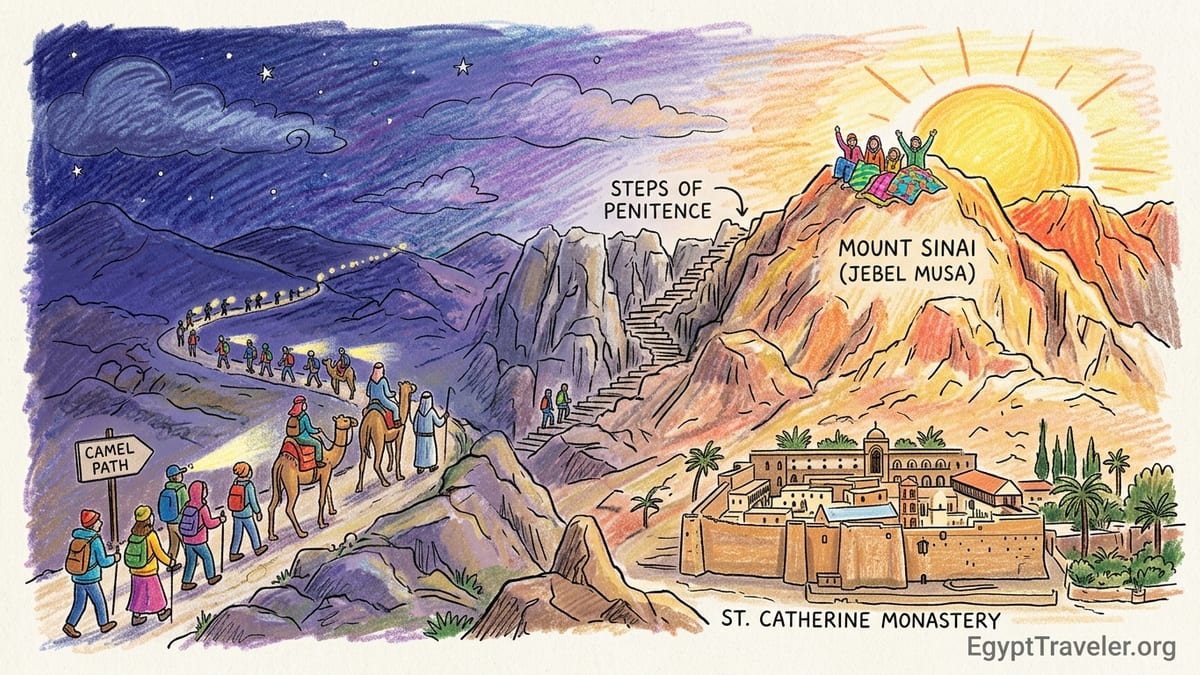
Understanding the Classic Mount Sinai & St Catherine Experience
Modern tours sell Mount Sinai and St Catherine Monastery as a single experience, and in practice they are inseparable. The car park for the trailhead is a short walk from the monastery, and sunrise hikers almost always descend straight to the monastery gate once it opens in the morning. You are not simply booking a hike or a monastery visit; you are signing up for a tightly timed sequence that runs overnight and into late morning.
The mountain itself, also known locally as Jebel Musa, rises to about 2,285 meters above sea level in Egypt’s South Sinai. The neighboring town and high plateau are called St Catherine, and it is here that you will find small hotels, guesthouses, the Bedouin community and the military and police presence that manage tourism in the area. For visitors coming from Sharm El Sheikh or Dahab, this is effectively the “base camp” for the night climb, even if you only ever see it through the minibus window.
Most travelers join an organized trip that includes return transfers, a local Bedouin mountain guide (compulsory on the trail), and a short tour of St Catherine Monastery. Prices vary by season and inclusions, but as a rough guide, shared group excursions in 2026 from Sharm often run in the range that budget travelers pay for a full-day desert safari, with private trips costing noticeably more due to the dedicated vehicle and guide. Because safety regulations and checkpoints change from time to time, tours booked with established Egyptian or international operators tend to navigate any new paperwork more smoothly than improvised arrangements.
While some independent travelers reach St Catherine by rental car or long-distance bus, most visitors still choose packaged excursions because departures are timed around the monastery’s restricted visiting hours and the ideal summit arrival window before sunrise. Booking through a reputable hotel desk or a long-running local agency in Sharm’s Naama Bay or Dahab’s seafront allows you to confirm pickup times, what is included, and whether your group will ascend the Camel Path, the Steps of Penitence, or a combination of both.
Sharm El Sheikh vs Dahab Departures
Sharm El Sheikh is the main mass-tourism gateway for the Mount Sinai sunrise climb. Large resort districts like Naama Bay, Hadaba and Nabq are full of agents advertising “Moses Mountain & St Catherine” on sidewalk boards. Because Sharm lies further south on the coast, transfer times to St Catherine are typically around 3 to 3.5 hours each way, depending on hotel location and checkpoints. For a sunrise climb this usually means hotel pickup around 8:30 to 10:00 in the evening, with arrival at the trailhead after midnight.
Dahab, about 90 minutes north of Sharm, offers a slightly shorter drive into the mountains. Typical pickups in Dahab for the sunrise climb might be closer to 11:00 pm or midnight for a 1.5 to 2 hour transfer. For divers and backpackers based in Dahab, this often makes the excursion feel less punishing, since you spend less time on the road and return earlier in the late morning. Smaller group sizes are also common, as many Dahab guesthouses bundle Mount Sinai with other local activities such as Blue Hole snorkeling or canyon trips.
In practical terms, your choice between Sharm and Dahab usually comes down to where you intend to base yourself on the Red Sea. If you are traveling primarily for package-resort downtime and family-friendly amenities, Sharm is the obvious base, and joining an established coach tour can be convenient and economical. If you favor a slower pace, backpacker-style cafes and easy add-ons like desert trekking, multi-day hikes or freediving, Dahab is often the more natural starting point.
It is also worth considering how early you want to be back. From Sharm, many tours do not return to hotels until late morning or even midday, especially during high season traffic, which can wipe out the rest of your day. From Dahab, return times are often earlier, which can make the following day’s diving or onward travel less exhausting. However, during busy religious holidays or major tour-group weeks, both routes can see convoy-style traffic up and back along the mountain road.
How the Overnight Excursion Typically Unfolds
Most itineraries follow a similar pattern whether you start in Sharm or Dahab. After a late-evening hotel pickup, you travel inland in a minibus or coach, stopping at several security checkpoints along the desert highway. There are usually one or two short bathroom or tea breaks at roadside cafés, where you can also buy bottled water or snacks if needed. The final approach winds up through the mountains and deposits you in the parking area near St Catherine village and the monastery.
Arrivals at the trailhead usually fall between midnight and 2:00 am, depending on the season and the group’s pace. Here you meet your assigned Bedouin mountain guide, often from the local Jabaliya tribe, and any last-minute arrangements are finalized. Those who wish to hire a camel for part of the ascent will negotiate the price directly with the camel handler; fees are often quoted in Egyptian pounds or euros and can vary with demand, so it helps to ask your tour rep in advance for typical current ranges.
The climb itself generally takes 2 to 3 hours via the Camel Path for a reasonably fit adult, with slower groups sometimes needing longer. Most tours plan to reach the summit 30 to 60 minutes before sunrise, leaving time to rent a blanket from one of the summit shacks, drink hot tea and find a position on the rocks. Even in busier months, it is usually possible to sit quietly to one side away from crowds, although weekends and major religious dates can see hundreds of pilgrims and tourists lining the ledges.
After sunrise, there is time for photos and a brief rest before starting the descent back toward the monastery. Many visitors descend via the Steps of Penitence, a steep stone stairway cut into the mountain, which saves time but can be tough on knees and ankles. Others, especially those already tired, follow the Camel Path back down. Once you reach the base, the group is typically guided to St Catherine Monastery for a short visit before rejoining the vehicle for the return journey to the coast.
Camel Path vs Steps of Penitence: Routes and Difficulty
Two main routes lead to Mount Sinai’s summit. The first is the so-called Camel Path, a long, gently rising trail that zigzags up the mountain. The second is the historic Steps of Penitence, a much steeper series of around 3,000 to 3,750 rock steps traditionally associated with monastic devotions. Most commercial tours today ascend via the Camel Path, especially at night, and reserve the Steps primarily for confident hikers and the descent once daylight has made the stones easier to read.
The Camel Path is not technically difficult. It is essentially a broad, rocky track with occasional gravelly sections that can feel slippery on the way down. The main challenge is its relentlessness: nearly 5 kilometers of steady uphill walking at altitude, often on uneven surfaces. Rest stops appear at regular intervals, frequently accompanied by small Bedouin tea huts where you can sit, drink a sugary mint tea or Nescafé and warm your hands over a brazier before continuing. Travelers who walk occasionally at home usually find the path manageable with plenty of breaks, while those unused to any hill walking may find the last hour hard going.
The Steps of Penitence, by contrast, are short, steep and demanding. The stone steps are irregular and sometimes high, and in sections they feel more like a rugged staircase threaded through boulders than a conventional hiking trail. For strong, sure-footed hikers, they provide a more direct and atmospheric route, with dramatic views into the ravines and across the monastery valley. For anyone with knee issues, poor balance or a fear of heights, the steps can be punishing, particularly in the dark or if the stones are dusty or slightly icy in colder months.
A common compromise is to ascend by the Camel Path and, if your legs feel up to it, descend by the Steps of Penitence in daylight for the views. Guides are used to mixed-ability groups and will often split parties so that some go down the steps with one guide while others return via the Camel Path with another. When booking, ask explicitly whether your tour allows this flexibility and whether the guide is comfortable adapting to different fitness levels in the same group.
Nighttime Conditions, Cold at Altitude and What to Wear
One of the most underestimated aspects of the Mount Sinai sunrise climb is the cold. Even when Sharm El Sheikh or Dahab feel hot at sea level, night temperatures on the summit can drop close to freezing in winter and feel sharply chilly at other times of year due to wind. Travelers frequently report standing at the top in several layers, wrapped in rented wool blankets, while June beachgoers down on the Red Sea are still in T-shirts at midnight.
At a minimum, plan to dress as you would for a cold autumn or mild winter hike. Lightweight hiking trousers or sturdy leggings, a breathable base layer, a warm fleece or sweater and a windproof outer layer work well for most seasons. A beanie or warm hat and light gloves make a big difference once you stop moving at the summit. Closed, solid footwear is essential: road trainers with decent grip or trekking shoes are usually sufficient, but open sandals and flimsy slip-ons are not. The rock and gravel underfoot can be rough and uneven, and stubbed toes are a common complaint among under-equipped climbers.
Because temperatures change rapidly as you walk, layering is more important than wearing one heavy coat. On the lower sections of the trail you may feel warm enough in a light top, especially when setting a brisk pace. Closer to the top, as the path steepens and you wait for sunrise, you will want to pull on extra layers. Many local huts at rest points and on the summit rent heavy blankets at modest prices, but these can run short on very crowded nights and may not feel particularly clean. Bringing your own light down jacket or packable fleece blanket is therefore a good idea if space allows.
A simple headlamp or small flashlight is another essential often overlooked by resort visitors. While guided groups carry some spare torches and there is a visible snake of light on busier nights, having your own beam lets you place your feet carefully and avoid tripping on rocks. Carry a small daypack with at least 1.5 to 2 liters of water per person, some high-energy snacks such as nuts or dates, and tissues or wet wipes for basic hygiene at rustic toilets along the way.
Group Coach Tours vs Private Trips and Overnight Stays in St Catherine
Most travelers first encounter the Mount Sinai excursion as a group coach trip: dozens of people collected from various hotels, driven up in a bus or minibus, guided up the Camel Path and back down, with a short monastery visit and immediate return to the coast. This format keeps costs lower, and for many visitors it works perfectly well. The social aspect can be enjoyable, and the presence of many lights on the path can make the night hike feel less intimidating for nervous first-time walkers.
However, group tours typically move at the pace of the slowest members, with fixed rest stops and limited flexibility to adjust timings. If you want to linger on the summit after sunrise, choose a quieter route, or avoid major crowd nights such as weekends or large pilgrimage groups, a private tour can be worth the extra cost. Private operators based in Dahab and Sharm often run trips in smaller vehicles, allowing more control over departure times, rest-stop choices and route options on the descent.
An alternative that is slowly gaining attention, especially among hikers and photographers, is to stay overnight in St Catherine itself rather than returning immediately to the coast. A small cluster of simple hotels and guesthouses lies around the town, from basic Bedouin-run camps with individual rooms or huts to modest three-star style properties used by pilgrimage groups. Booking one of these for the night before or after your climb means you can rest properly, visit the monastery without rushing, and explore quieter side valleys or nearby peaks on daytime walks.
For example, some travelers arrive in the afternoon, check into a local guesthouse, eat an early dinner and catch a few hours of sleep before meeting their guide for the night climb. After descending and visiting the monastery, they return to their room for a shower and a proper rest, then continue to Dahab or Sharm later that day or the next morning. This approach spreads the exertion over more than 12 hours and can feel far less punishing than driving back to the Red Sea straight after the hike.
Walking Fitness, Safety and Choosing the Right Pace
Despite its fame, Mount Sinai is not an extreme alpine climb. There is no technical scrambling and no need for ropes or climbing gear. For most people of average fitness, it is a demanding uphill walk rather than a mountaineering expedition. That said, the combination of night hiking, altitude, cold, and sleep deprivation makes the experience feel more strenuous than its basic statistics suggest, especially if your daily life involves little walking.
Travelers who regularly complete 8 to 10 kilometer walks or city hikes with some hills generally cope well. Those with knee problems, asthma, heart issues or balance concerns should consult a doctor before attempting the climb and be honest with themselves and their guide about limitations. The presence of camels along much of the Camel Path does offer a fallback: if you tire badly on the way up, you can often pay to ride part of the route. However, camels cannot safely negotiate the final steep stretch of steps near the summit, so a short but sharp climb on foot is unavoidable.
Local regulations require hikers to be accompanied by licensed Bedouin guides, and this is genuinely beneficial. Guides know where people tend to slip, how to adjust the pace for mixed groups, and how to steer clients away from crowded bottlenecks on especially busy nights. They also coordinate with monastery staff about group arrival times and handle any route changes required by weather or security instructions. If you are booking a private tour, ask explicitly if your trip includes a local Bedouin guide rather than an outside escort unfamiliar with the mountain.
As with any desert mountain, safety also depends on your own preparation. Do not rely solely on mobile phones, as coverage can be patchy in ravines and batteries drain faster in the cold. Stay with your group, especially on the descent when fatigue and daylight can tempt people to spread out. If you feel unwell, communicate early; guides are used to managing altitude-related lightheadedness or stomach upsets from tired travelers and can adjust accordingly.
Visiting St Catherine Monastery After the Descent
St Catherine Monastery sits in a rocky basin beneath the mountain, enclosed by sturdy stone walls. It is one of the world’s oldest continuously functioning Christian monasteries and is revered across Orthodox, Catholic and other Christian traditions. Access for tourists is restricted to specific hours and selected areas inside the complex, usually in the morning on days when the monastery is open. Your tour operator should confirm up-to-date visiting days, as the monastery occasionally closes for religious festivals or special occasions.
Most tours arrange the monastery visit immediately after the descent, while groups are still in the valley. The walk from the trailhead down into the monastery entrance area takes only a few minutes. Inside, visitors typically see the main basilica, the courtyard with the famous Burning Bush associated with the story of Moses, and a small museum or icon collection when open. Dress codes require modest clothing: shoulders and knees should be covered, and very revealing outfits are discouraged. Bringing a lightweight scarf or shawl makes it easy to adapt resort clothing for monastery-appropriate wear.
The visit is usually brief, often 45 to 90 minutes, because day temperatures climb quickly and long drives back to the coast await. If the monastery is unexpectedly closed on the day of your climb, tours sometimes substitute a short walk in the surrounding valley, a visit to local chapels, or an extended rest and tea stop in St Catherine village instead. This is another argument for booking with an operator that communicates clearly about contingency plans and sets realistic expectations.
For photography, remember that flash and tripods may be restricted inside certain areas and that some pilgrims prefer not to be photographed during prayers. Outside the monastery walls, wide-angle shots capturing the fortress-like complex backed by jagged granite peaks can be particularly striking, especially in the soft light soon after sunrise or on days with wisps of desert cloud.
The Takeaway
The Mount Sinai sunrise and St Catherine Monastery excursion is not a comfortable spa day out of Sharm or Dahab. It is an overnight, sleep-disrupting, sometimes bone-chilling climb that rewards preparation and realistic expectations. Yet for many travelers, the combination of desert silence, the glow of headlamps inching up the mountain, and sunrise spilling over a saw-toothed horizon becomes a defining memory of their time in Egypt.
Choosing between Sharm and Dahab departures, group and private tours, the Camel Path and the Steps of Penitence, and an immediate return versus an overnight in St Catherine all shapes how intense or gentle the experience feels. Whatever you decide, packing proper layers, solid footwear, a headlamp and patience for the early hours will serve you better than any glossy brochure description.
Approach the trip as a pilgrimage of effort as much as a sightseeing outing. Accept that you will be tired, perhaps cold and possibly sharing the trail with a crowd. In return you gain a window into the high Sinai landscape and one of the world’s most storied holy mountains, with the monastery’s ancient walls waiting below as the final act of a long and unforgettable night.
FAQ
Q1. How long does the Mount Sinai sunrise trip take from Sharm El Sheikh or Dahab?
The entire excursion typically lasts around 12 to 14 hours door to door from Sharm El Sheikh and about 10 to 12 hours from Dahab, including transfers, the night climb, sunrise at the summit and a short visit to St Catherine Monastery before returning to the coast.
Q2. Is the Mount Sinai hike suitable for beginners or children?
The Camel Path is manageable for reasonably fit beginners and older children used to walking, but it is still a steady uphill trek at night. Families with young kids or anyone unused to walking several hours should consider a slower-paced tour, bring extra layers and snacks, and be prepared to hire a camel for part of the ascent if someone becomes very tired.
Q3. How cold is it at the summit, and what should I wear?
Even when the Red Sea coast feels warm, temperatures near the summit can drop close to freezing in winter and feel sharply cold in the wind at other times. Wear layered clothing, including a warm fleece or sweater, a windproof jacket, long trousers, a hat, gloves and sturdy closed shoes. You can often rent blankets from summit huts, but having your own warm layers is more reliable.
Q4. Do I need a guide, or can I hike Mount Sinai independently?
Local rules require visitors to be accompanied by licensed Bedouin guides on the main routes, and organized tours automatically include one. Even if independent access were theoretically possible, a guide is strongly recommended for safety, route finding in the dark and coordination with monastery staff and checkpoints.
Q5. What is the difference between the Camel Path and the Steps of Penitence?
The Camel Path is a longer, more gradual trail suitable for most visitors, often used for the ascent. The Steps of Penitence are a much steeper and more direct stone staircase, physically demanding and better suited to confident hikers, usually tackled in daylight on the descent for the views and safety.
Q6. How much water and food should I bring for the climb?
Plan to carry at least 1.5 to 2 liters of water per person, more in warmer months, along with simple, high-energy snacks such as nuts, chocolate, dates or energy bars. There are small huts along the trail selling hot drinks and basic snacks, but you should not rely on them as your only source of hydration or food.
Q7. Is it better to book a group coach tour or a private trip?
Group tours are cheaper and convenient, especially from large resort hotels, but move at a fixed pace and can be crowded. Private trips cost more yet offer flexibility in departure times, route choices and pacing, and they work particularly well for families, photographers or travelers with specific fitness or mobility considerations.
Q8. Should I stay overnight in St Catherine or return to the coast immediately?
Returning directly to Sharm or Dahab is the standard option and is fine if your schedule is tight. Staying one night in St Catherine before or after the climb, however, allows you to rest properly, explore the monastery at a more relaxed pace and experience the quieter mountain atmosphere without immediately facing a long drive.
Q9. Are there toilets and facilities on the mountain?
Basic toilet facilities exist at the trailhead and at a few rest huts along the Camel Path, but they are simple and often not as clean as modern city bathrooms. Bringing your own tissues, hand sanitizer and a small rubbish bag is sensible. There are also tea stalls selling hot drinks and simple snacks at several points on the route.
Q10. Is the Mount Sinai and St Catherine area safe to visit?
The Mount Sinai and St Catherine region in South Sinai is a well-established tourism and pilgrimage destination with security checkpoints and a regular presence of police and local Bedouin guides. Conditions can change, so it is wise to check current travel advisories from your government and to book with reputable operators who monitor local updates and follow official guidance.