


The Sinai Trail has transformed Egypt’s South Sinai mountains into one of the Middle East’s most rewarding hiking destinations, yet many travelers still assume it is only for elite thru-hikers. In reality, this 550 kilometer Bedouin-led route is highly flexible. You can taste its desert wadis and high granite peaks in a single overnight, commit to a three or four day section, or spend weeks crossing the peninsula with camels and guides. This guide explains how the Sinai Trail is organized, the classic routes around St Catherine, what to expect from camping and logistics, and how to arrange a trip directly with the Bedouin cooperative that runs the trail.
Understanding the Sinai Trail: Egypt’s First Long Distance Bedouin Route
The Sinai Trail is a roughly 550 kilometer hiking route that crosses the South Sinai Peninsula from the Gulf of Aqaba on the east to the Gulf of Suez on the west. It links together traditional Bedouin paths used for centuries to move between water sources, gardens, seasonal pastures and sacred places. Rather than one single commercial trek, it is a network of routes and camp spots that can be combined into anything from an overnight micro-adventure to a full multi week crossing.
The trail is managed by the Sinai Trail Bedouin Cooperative, an alliance of several Bedouin tribes who each guide on their ancestral lands. The cooperative sets the official route, trains guides in first aid and navigation, and coordinates logistics such as camels, water and desert transport. When you book a hike through the official Sinai Trail organization, you are hiring local Bedouin guides from the tribes whose territories you walk through, rather than an outside tour agency.
For travelers, this structure has two important consequences. First, independent hiking without a Bedouin guide is currently not permitted in most of the Sinai interior. Authorities require groups to be accompanied by local guides who understand the terrain, weather and security considerations. Second, the cooperative can tailor trips to different fitness levels and time frames, from a one night camp in the high mountains near St Catherine to multi day traverses of remote wadis with camels carrying luggage, food and water.
Because the Sinai Trail is designed as a living cultural route, it is also constantly refined. Camps may shift slightly as water conditions change, and some sections are occasionally rerouted around sensitive areas. This means that up to date information from the official Sinai Trail team and your Bedouin guide is more reliable than any old GPS track or blog post.
How the Trail Is Divided: Sections, Tribes and Typical Itineraries
Although marketing materials often mention the full 550 kilometer route, most visitors walk only a section. The Sinai Trail is divided into stages that roughly correspond to tribal territories and natural landscape units. On the eastern side, near Nuweiba and Ras Shetan on the Gulf of Aqaba, stages wind through sandstone canyons and broad desert plains. Further inland, the trail climbs into the crumpled granite mountains around St Catherine, then eventually descends west toward the desert near Serabit el Khadim and the Gulf of Suez.
A practical way to think about the trail is in blocks of three to seven days. For example, hikers with a week available often choose a high mountain circuit beginning and ending near St Catherine town, reaching summits like Mount Sinai (Jebel Musa) or the higher Mount Catherine, Egypt’s highest peak at about 2,629 meters. Others prefer a mixed desert and mountain experience by starting closer to the coast, walking through wadis and low hills for several days, then being transferred by jeep to St Catherine to finish with a sunrise ascent of Mount Sinai before returning to Sharm el Sheikh or Dahab.
Guided trips commonly operate in small groups of six to twelve people, but the cooperative can also arrange private departures for couples, families or solo travelers willing to cover the fixed costs of guides and camels. As a rough benchmark, a fully supported multi day trek with Bedouin guides, camels for gear, tents, bedding and simple meals can cost a few hundred US dollars per person for three or four days, with prices varying according to season, group size and exact route.
Because the trail is modular, you do not have to commit to walking east west in a straight line. It is equally acceptable to base yourself in St Catherine for three nights and do different out and back hikes with your Bedouin guide, or to join a pre arranged Sinai Trail section that has scheduled departure dates, such as a five day “high mountains” itinerary operating in spring and autumn.
The Classic Ras Shetan to St Catherine Route
Among the most popular introductions to the Sinai Trail is the route that links the Bedouin beach camps of Ras Shetan or Ras Shaitan, north of Nuweiba, with the high mountain settlement of St Catherine. Many hikers start their journey by taking an overnight bus from Cairo or a shared minibus from Sharm el Sheikh to the coast, spending a night in a simple beach camp, then meeting their Bedouin guides there the following morning.
From Ras Shetan, typical itineraries head inland through valleys such as Wadi Zalaga or Wadi Shrayj, depending on conditions and the tribe guiding. Days are usually five to seven hours of walking with frequent breaks in the shade. Camels carry the main luggage, food and large water containers, while hikers carry only a small daypack with 2 to 3 liters of water, snacks and extra layers. Nights are spent in established Bedouin camps in sandy basins or sheltered against granite boulders, with mattresses laid directly on the ground and a central fire where tea and simple meals are prepared.
After three to five days crossing these interior valleys, the route climbs into the St Catherine high mountain region. Many itineraries end with a night or two in a guesthouse or lodge in St Catherine town, followed by a sunrise hike up Mount Sinai. Some hikers extend their trip by adding a challenging ascent of Mount Catherine with a local Jebeleya guide, or by staying in one of the family run Bedouin camps in nearby wadis to experience the quiet away from the main Mount Sinai pilgrimage route.
The Ras Shetan to St Catherine section is a good option for travelers who want a clear sense of progression, from sea level beaches through remote wadis to high, cool mountains. Yet because it can be broken into shorter parts, you could just as easily join the final two or three days of the route from an inland meeting point if you have less time, or if you are arriving overland from Taba or Nuweiba.
High Mountain Routes Around St Catherine
Even if you never set foot on the long distance Sinai Trail across the peninsula, the high mountain area around St Catherine offers enough hiking for several trips. The town sits at around 1,500 meters in the Saint Katherine Protectorate and is surrounded by summits, deep wadis and small gardens that have been terraced and irrigated by Bedouin families for generations. Mount Sinai, or Jebel Musa, rises to about 2,285 meters and is the most famous peak, but many hikers consider the quieter routes to other mountains to be the real highlights.
Mount Catherine, also called Jebel Katerina, is the highest mountain in Egypt and involves a longer, more demanding hike or two day trek, often with a night spent in a stone hut or bivouac near the summit. Other classic objectives include Jebel Abbas Basha, known for panoramic views and an unfinished palace at the top, and Wadi Jebal, a broad valley lined with orchards, ancient olive trees and seasonal Bedouin gardens. Local guides can also link these together into multi day circuits that sleep in remote gardens where permanent springs and small stone shelters provide natural camps.
Most travelers base themselves in a guesthouse or lodge in St Catherine town and arrange day hikes or one night outings. For example, you might arrive from Sharm el Sheikh in the afternoon, rest at a lodge, then leave around midnight with a Bedouin guide to climb Mount Sinai in time for sunrise. The next day, after some rest, you could hike a quieter route such as Wadi Arbain or a loop that visits several mountain gardens, returning to town before sunset. On a third day, a more experienced group might set off for Mount Catherine, starting before dawn and returning by late afternoon, or camping out one night to break up the effort.
Unlike the desert stages where camels are essential to move large water containers, many high mountain day hikes around St Catherine rely on hikers carrying their own water for the day. However, guides often know springs where you can refill, or gardens where tea and a simple meal can be arranged for a small fee, so it is worth carrying some local currency in small notes.
Shorter Guided Hikes and Overnight Treks
The Sinai Trail is deliberately designed so that travelers do not have to walk weeks to experience its landscapes and Bedouin culture. In practice, many visitors opt for one to three day hikes that fit alongside classic Egypt itineraries focused on Cairo and the Nile. From coastal hubs like Dahab, Sharm el Sheikh or Nuweiba, you can join pre arranged overnight trips that meet a Bedouin guide at a trailhead, hike for several hours into the desert, camp under the stars, and return the next afternoon.
One common example is a one night camp in the interior wadis east of St Catherine. A typical schedule might see you picked up from Dahab early in the morning, driven two to three hours to meet your Bedouin guides and camels at the edge of the mountains, then hiking for four to five hours along sandy valleys and low passes. As evening approaches, the group reaches a fixed camp site with a rock overhang or stone shelter, where mattresses and blankets are stored. After dinner cooked over a small fire and stories around the embers, most people sleep in the open, waking before dawn to watch the sun climb over the granite peaks.
Other short treks are built entirely around the high mountains. For example, some operators work with Sinai Trail guides to offer a two day “Mount Sinai and hidden wadis” itinerary, which includes a guided ascent of Mount Sinai for sunrise, time to visit St Catherine’s Monastery during opening hours, then a quieter second day exploring nearby wadis and gardens away from the crowds. Still others focus on family friendly experiences, with shorter walking days of three to four hours, longer lunch stops, and camels available for children or tired walkers to ride.
For travelers with three or four days, a compact mini section of the Sinai Trail can be arranged that includes two or three nights camping in the desert with camels and a final night in St Catherine. This kind of itinerary provides a taste of the thru-hike structure, with daily packing and unpacking of camp, but on a scale accessible to people who may never have backpacked before.
Guides, Camels, Water and Camping Logistics
Hiking the Sinai Trail is not a self supported backpacking trip in the typical North American or European sense. Because there are almost no shops or fixed infrastructure in the interior, and because regulations currently require groups to be accompanied by Bedouin guides, most logistics are arranged locally. Booking directly with the Sinai Trail organization or with a reputable operator that partners with them means your guides will handle permits, route planning, water, food and camel support.
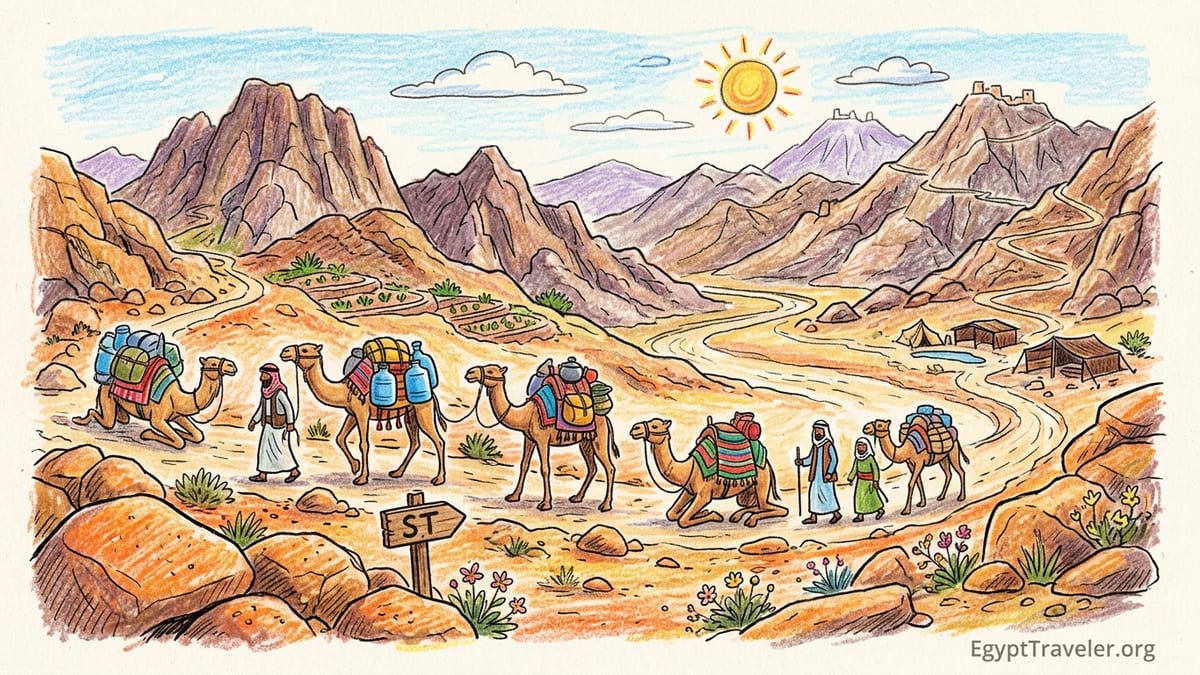
Camels are central to how the trail operates. In the desert sections and on multi day routes, camels carry the bulk of supplies: large jerrycans of water, sacks of rice and lentils, vegetables, tea, cooking equipment, travelers’ duffel bags and communal gear like mattresses and blankets. Hikers usually carry a light daypack with water, snacks, sun protection and an extra layer. In many itineraries the camels take a slightly different line to camps and you meet them again in the late afternoon, when they kneel to be unloaded and join the camp scene.
Drinking water typically comes from these carried containers, refilled in towns or from reliable springs that local guides know. In the high mountains near St Catherine, some camps and gardens have permanent or seasonal springs, but it is still normal to bring a significant amount of water in with camels or vehicles. Food is simple and filling, often based on rice, beans, vegetables, flatbread and occasional chicken or goat. Bedouin tea flavored with desert herbs is served throughout the day, and many hikers bring extra snacks like nuts, dried fruit or chocolate.
Camps are usually low impact and semi permanent rather than built up structures. A typical Sinai Trail camp might consist of a central goat-hair tent for shade, a simple stone shelter, or a flat sandy area protected by boulders. Everyone sleeps on foam mattresses or thick pads laid directly on the sand, usually with heavy blankets provided, though in colder months many visitors are glad to have their own sleeping bag for extra warmth. Toilets are generally wilderness style, with a designated area away from camp and basic privacy screens if at all.
Seasons, Weather, Fitness and Safety
The Sinai mountains experience strong seasonal contrasts, so timing your hike matters. The most popular months for both desert and mountain routes are generally October to April, when daytime temperatures are milder. In the high areas around St Catherine, winter nights from December to February can be very cold, often dropping below freezing, and snow on the highest peaks is not unusual. In contrast, summer days in low desert sections can become dangerously hot, which is why many longer treks avoid June to August or shift walking hours to very early morning and late afternoon.
For a typical traveler with moderate fitness, a three or four day guided section of the Sinai Trail is very achievable, provided you are comfortable walking five to seven hours a day over uneven ground. The trails often follow ancient footpaths, but they are rocky, with loose stones, short scrambles and occasional steep sections, especially near passes and summits. Closed hiking shoes or light boots are strongly recommended, and trekking poles help on long descents such as the stone steps on some Mount Sinai routes.
Safety in the mountains depends heavily on local knowledge. Bedouin guides monitor weather forecasts, know where flash floods are likely after rare heavy rains, and understand which valleys can be safely used in different wind conditions. They also stay informed about any temporary security restrictions or permit requirements. While organized trips include basic first aid supplies, it is wise to carry personal medications, blister care and sun protection, as well as layers for rapid temperature changes between warm afternoons and cold nights.
Travel insurance that covers trekking to around 2,600 to 2,700 meters is a sensible precaution, as the highest peaks in the area reach that elevation. There is no formal mountain rescue service based in St Catherine, so in an emergency, assistance would be coordinated locally through guides and vehicles, with serious cases evacuated to hospitals in coastal towns such as Sharm el Sheikh.
Booking with the Sinai Trail Bedouin Cooperative
To experience the Sinai Trail in a way that supports local communities and respects access rules, the recommended approach is to book directly with the Sinai Trail Bedouin Cooperative or with a trusted partner that works transparently with them. The official Sinai Trail team can suggest sections that fit your time, fitness and interests, and then match you with guides from the relevant tribes. When you reach out, be prepared to share your travel dates, how many days you can hike, the size of your group, your approximate level of hiking experience, and whether you prefer more desert, more mountains, or a mix.
From there, they will propose an itinerary, including starting and finishing points, camp locations, and whether you will end in St Catherine, Nuweiba, or another accessible town. They will confirm what is included in the price, such as Bedouin guides, camels for luggage, meals, drinking water, transfers to and from the trailheads, and any nights in guesthouses or lodges. Payment is typically split between a deposit in advance and the balance on arrival, often in cash, which helps ensure income goes directly to the guides and camel owners.
If you are already in Egypt and make a last minute decision to visit Sinai, many travelers simply travel to Dahab, Sharm el Sheikh, Nuweiba or St Catherine and then contact the Sinai Trail team or local Bedouin coordinators from there. While same week arrangements are often possible for shorter hikes, especially outside peak holiday periods, planning several weeks in advance gives you more choice of routes and allows the cooperative to assemble camels and support staff without rushing.
The key is to clarify from the beginning that you are interested in a Sinai Trail style trek with Bedouin leadership, rather than a quick bus tour to Mount Sinai that only spends a few hours on the mountain. The latter can be worthwhile for some, but they are very different in character from multi hour walks through quiet wadis, evenings around a fire with your guides, and nights under the stars.
The Takeaway
The Sinai Trail is often introduced as a 550 kilometer epic across Egypt’s desert peninsula, but its real strength lies in its flexibility. You do not need to be an ultra-distance hiker or commit weeks of your holiday to benefit from Bedouin knowledge of the mountains. A single overnight in a high wadi, a three day camel supported journey from the low desert toward St Catherine, or a long weekend of summit hikes around Mount Sinai and Mount Catherine can all deliver the essence of the trail.
By booking directly with the Bedouin cooperative that manages the route, travelers help sustain local livelihoods while gaining access to safe, well organized trips that reflect current conditions on the ground. With thoughtful timing, realistic expectations about comfort and fitness, and respect for the desert environment, even first time hikers can experience the Sinai Trail as one of the region’s most memorable adventures.
FAQ
Q1. Do I have to hike the entire 550 kilometer Sinai Trail to enjoy it?
Not at all. Most visitors walk only a short section, such as a one night desert camp, a three or four day trek ending in St Catherine, or day hikes around Mount Sinai and Mount Catherine. The route is modular and can be tailored to your time and fitness.
Q2. Can I hike the Sinai Trail without a Bedouin guide?
Currently it is not permitted to hike independently in most interior parts of the Sinai Trail. Local regulations and common sense both favor going with Bedouin guides, who handle permits, navigation, weather decisions and safety, and whose livelihood is tied to the trail.
Q3. How fit do I need to be for a typical three or four day trek?
If you can comfortably walk five to seven hours a day over uneven, sometimes rocky ground, you are likely ready for a multi day section. Camels carry the heavy gear and water, so you only need to manage a daypack, but there are still climbs, descents and occasional short scrambles.
Q4. What is the best time of year to hike around St Catherine and the Sinai Trail?
The most popular months are generally October to April, when daytime temperatures are milder. Winter nights at higher elevations can be very cold, sometimes below freezing, while summer in the low desert can be uncomfortably hot for long hikes.
Q5. Are camels always included, and do I have to ride them?
On multi day desert sections, camels are usually essential to carry water, food and luggage. Travelers are welcome to walk alongside them and are not required to ride, though it is often possible to ride for short stretches if pre arranged with your guides.
Q6. What kind of accommodation should I expect on the trail?
Most Sinai Trail trips use simple desert camps with mattresses and heavy blankets, plus a central fire for cooking and tea. In St Catherine town, many itineraries include nights in basic guesthouses or lodges with beds and hot showers before or after the trek.
Q7. How do I arrange a hike directly with the Sinai Trail Bedouin organization?
You can contact the Sinai Trail Bedouin Cooperative, explain your available dates, fitness level and interests, and they will suggest suitable sections, provide a price and arrange guides, camels, food, water and necessary transport for your chosen itinerary.
Q8. Is it safe to drink water on the Sinai Trail, and do I need a filter?
Most drinking water on organized treks comes from containers filled in town or at known springs. Many hikers are comfortable drinking this as provided, though carrying a small filter or purification tablets is a personal choice if you have a sensitive stomach.
Q9. Can families or less experienced hikers enjoy the Sinai Trail?
Yes. The cooperative and partner operators often run shorter, family oriented itineraries with easier walking days, extra rest stops, and camels available for tired walkers. An overnight camp or gentle two day trek is suitable for many active families.
Q10. What should I pack for a short Sinai Trail trek?
Essential items include sturdy hiking shoes, a warm layer and windproof jacket for evenings, sun hat and sunscreen, a small daypack, personal medications, and a headlamp. Sleeping mattresses and blankets are usually provided, though some hikers bring their own sleeping bag, especially in colder months.