


Sunrise over the Red Sea looks wonderfully simple from a beach in Sharm El Sheikh or Dahab. Egyptian visa rules, however, are anything but. The South Sinai "Sinai only" entry stamp offers an easy, free way to visit Sharm El Sheikh, Dahab, Nuweiba and Taba for a short holiday, but it comes with strict limits that can catch travelers out. This guide explains, in practical terms, how the South Sinai permission stamp works, who can use it, and when buying a full Egyptian tourist visa is the safer choice.
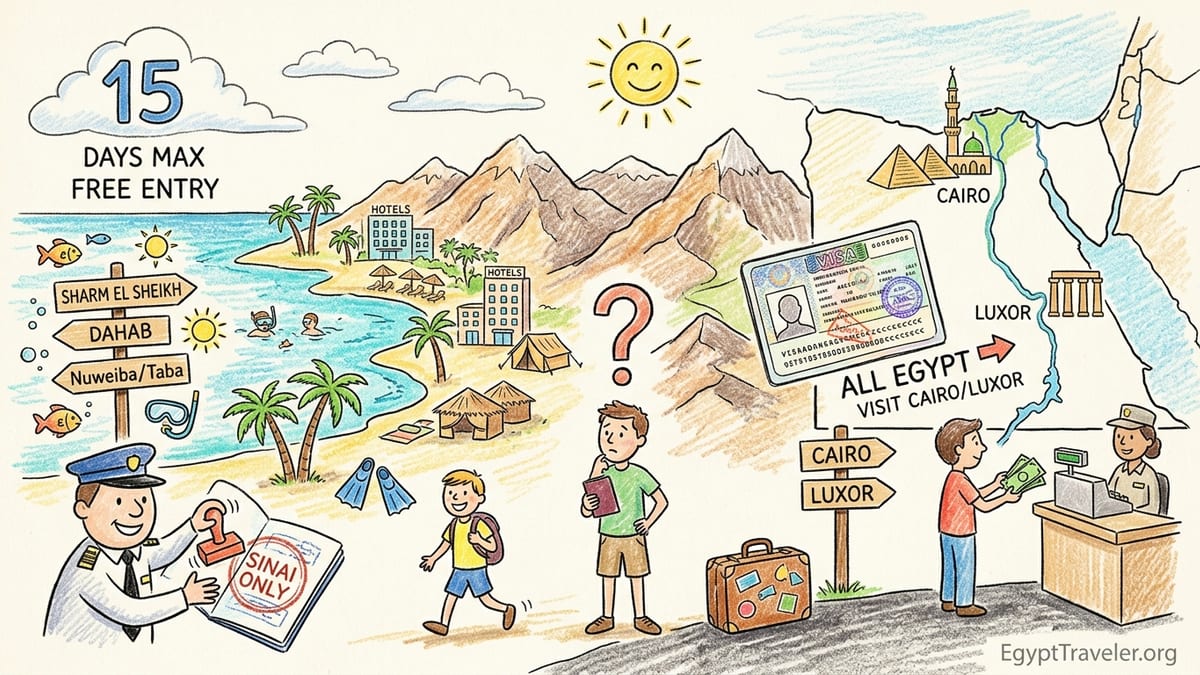
What Is the South Sinai "Sinai Only" Permission Stamp?
For many nationalities, Egyptian border officials offer a special free entry permission when you arrive directly into South Sinai and stay only in the main resort belt. Instead of paying for a full Egyptian tourist visa, you receive a Sinai only stamp in your passport that allows short stays in Sharm El Sheikh, Dahab, Nuweiba and Taba. Travel companies, scuba schools and hotel websites in the region commonly describe this as the "15‑day Sinai stamp" or "Sinai only visa," although technically it is an entry permission, not a full visa.
In practice, this stamp is aimed at typical sun-and-sea trips such as a week at a large all-inclusive resort in Sharm’s Nabq Bay, or a 10‑day dive holiday in Dahab. You pass through immigration, receive the free permission stamp instead of purchasing the standard visa sticker, collect your bags and head for the hotel transfer desk. You skip the visa payment queue and, as long as you remain within the permitted South Sinai zones and leave on time, you never need to think about Egyptian immigration again during that trip.
However, this convenience comes with narrow restrictions. The Sinai only stamp does not allow you to visit the rest of Egypt, even on a short day trip, and overstaying the stamp can lead to sizeable fines at the airport. Importantly, eligibility for the stamp and the exact process can vary by nationality and by your arrival point, so travelers should treat it as a useful option, not a universal right.
The safest assumption is that the Sinai stamp is suitable only if you are absolutely certain you will stay within the South Sinai resorts and stay under or equal to the allowed number of days. If your plans are more flexible, or if you might want to visit Cairo, Luxor or Aswan, buying a full Egyptian tourist visa is usually a much better idea.
How Long You Can Stay and Where You Can Go in South Sinai
The South Sinai permission stamp is designed for short stays. Travel advice from the UK government and major tour operators for British visitors explains that if you arrive by air into Sharm El Sheikh and stay less than 15 days in the resorts of Sharm El Sheikh, Dahab, Nuweiba or Taba, you can receive a free entry permission stamp instead of a paid visa. That practical 15‑day limit is treated as the maximum for Sinai-only stays in most current guidance and local tourism information.
In everyday travel terms, this covers the vast majority of typical Red Sea trips. For example, a British family flying London to Sharm for a 10‑night package at a hotel in Sharks Bay would normally be processed on the free stamp. So would a group of German divers on an 8‑night stay in Dahab’s Lighthouse area, or a couple spending 5 nights at a boutique beach camp south of Nuweiba town. As long as their total time in Egypt does not exceed the permitted days and they fly back out from Sharm, they can rely on the Sinai stamp.
The permitted area is essentially the main coastal resort strip on the eastern side of South Sinai. This includes Sharm El Sheikh’s airport and resort districts such as Naama Bay, Hadaba, Sharks Bay and Nabq; Dahab’s bays and seafront; the Taba Heights and Taba town resort zone; and the Nuweiba coast, including the simple beach camps that line the shore. Travel on the main highway between these resort centers is generally allowed under the Sinai stamp, and coaches and private transfers run this route several times a day.
Where it becomes complicated is when travelers head inland or outside the well-established resort corridor. Trips to St Catherine’s Monastery and Mount Sinai are sometimes possible on the Sinai permission, but rules and security procedures for inland Sinai can change at short notice. Police checkpoints may ask to see your passport and stamp, and tour operators can be instructed to carry only guests with full Egyptian visas. If a desert or mountain excursion is important to your trip, many agencies recommend buying the full visa at the start rather than relying on the Sinai-only permission.
Arriving at Sharm El Sheikh: What to Expect at the Airport
Sharm El Sheikh International Airport is the main entry point for South Sinai leisure travelers. After landing, you will first encounter bank kiosks and visa counters where many passengers purchase the standard Egyptian tourist visa sticker, typically for about 25 to 30 US dollars, payable in cash. Those traveling only to the South Sinai resort areas for less than 15 days may instead head straight to the immigration desks and request the Sinai-only stamp without buying the sticker.
In reality, the flow is often guided by your airline or tour operator. For instance, passengers on large charter flights from the UK, Germany or Italy are sometimes directed by ground staff either toward the visa payment counters or straight to passport control, depending on the typical profile of the route. Staff may ask if you are staying only in Sharm or Dahab and for how long. If your answer clearly fits the Sinai stamp rules, you may be waved past the visa desks and processed quickly at immigration.
At the immigration desk, officials check your passport, confirm your entry type and apply the appropriate stamp. If you are using the Sinai-only option, the stamp will usually indicate your entry point and date and will not include the full visa sticker that occupies a larger section of a passport page. Queue times vary widely. On a busy Saturday in October, travelers sometimes report spending 30 to 45 minutes in the visa queue before reaching passport control, while those on the Sinai stamp may clear formalities in half that time. On a quiet midweek flight, both processes can be much faster.
Because practices can differ slightly between shifts and terminals, it is wise to arrive prepared for both options. Some travelers deciding at the last moment to visit Cairo later in their trip have been advised by airport staff to buy the full visa even though their first few nights are in Sharm. If you think there is any chance you will want to fly onward within Egypt, tell the immigration staff and choose the paid visa rather than relying on the free stamp.
Travel to Dahab, Nuweiba and Taba on the Sinai Stamp
Once you have entered Egypt using the South Sinai permission, moving between Sharm, Dahab, Nuweiba and Taba is straightforward in most cases. Shared minibuses depart from Sharm for Dahab several times a day, taking around 90 minutes to two hours depending on checkpoints and traffic. Many hotels in Dahab, from budget camps on Asalah Beach to mid-range seaside hotels in Mashraba, can arrange private transfers that pick you up directly at Sharm Airport and drive you along the coastal highway without any additional formalities.
Continuing north, the same road serves Nuweiba and Taba. Beach camps along the Nuweiba coast offer simple huts and bungalows, popular with long-time Sinai visitors. Taba Heights, close to the border with Israel, hosts several large resort hotels with sea views across to the mountains of Jordan and Saudi Arabia. If you entered with the Sinai-only permission and your total stay remains under the 15‑day limit, you can usually check into accommodation in these locations with only your passport and entry stamp.
Where problems tend to arise is when travelers misunderstand the geographic limits of their stamp. For example, some visitors staying at a beach camp near Nuweiba decide to take an overnight trip to Cairo by bus, not realizing that their Sinai-only entry does not allow them to leave the peninsula. Others cross by land at Taba from Israel or via ferry from Aqaba to Nuweiba expecting to upgrade easily to a full visa later, only to find that procedures are stricter and more expensive at the border than they anticipated.
Several recent traveler reports describe significant fines for overstaying the Sinai permission by even a day and lengthy discussions with police or immigration when trying to extend or convert the stamp after arrival. While individual experiences vary, the pattern is clear: the Sinai stamp is intended for simple, short resort stays, not for flexible backpacking itineraries or open-ended digital nomad visits. If your plans include more than one base, land border crossings, or the possibility of staying longer if you like the area, a full visa from the start is a safer and often cheaper choice overall.
When You Need a Full Egyptian Tourist Visa Instead
The full Egyptian tourist visa, whether bought on arrival or obtained as an eVisa in advance, is the correct option for anyone who plans to go beyond the limited South Sinai resort zone or who might need more time in the country. As a rule of thumb, buy the full visa if you intend to visit Cairo, Giza’s pyramids, Luxor’s temples, Aswan, the Western Desert oases, Alexandria, or Red Sea destinations on the mainland such as Hurghada and Marsa Alam.
For many nationalities, including US, Canadian and a range of European passport holders, a single-entry tourist visa on arrival is commonly available at major international airports in Egypt for roughly 25 to 30 US dollars. You pay at a government bank counter before immigration, receive a visa sticker, and then present your passport with the sticker at passport control. Official Egyptian eVisa services quote similar prices for a single-entry electronic visa, sometimes with a higher fee for multiple entries, and the eVisa can be attractive if you prefer to complete formalities before departure.
Concrete examples help illustrate when the full visa is essential. A traveler flying to Sharm El Sheikh for a one-week resort package who also wants to add a day trip by air to Cairo to see the pyramids must purchase the full visa. A long-distance runner joining a multi-week training camp between Dahab and St Catherine’s, with possible trips to Luxor afterward, should not rely on the 15‑day South Sinai stamp. A backpacker considering an overland route from Israel to Jordan via Taba and Nuweiba will find life much easier holding a full Egyptian visa from the outset rather than trying to manage upgrades and extensions in remote border areas.
In addition, some nationalities that are not eligible for Egypt’s visa-on-arrival or eVisa schemes may need to obtain a visa in advance from an Egyptian embassy or consulate no matter where they intend to stay. Others may be able to get a visa on arrival only under specific conditions, such as holding a valid residence permit in a Gulf country or traveling as part of an organized tour. Because these rules change and can be applied differently in practice, travelers from outside the common Western visitor markets should confirm details with their nearest Egyptian diplomatic mission well before travel.
Nationality, Border Point and Length of Stay: Why Details Matter
Eligibility for the South Sinai permission stamp and for Egypt’s broader visa options depends on three main factors: your nationality, how and where you enter Egypt, and how long you plan to stay. Advice published for British travelers provides one concrete example: if you arrive by air into Sharm El Sheikh and stay less than 15 days in the resorts of Sharm El Sheikh, Dahab, Nuweiba or Taba, you can receive a free entry permission stamp instead of a paid visa, but if your stay will exceed 15 days or you plan to travel beyond Sinai, you must obtain a visa, either on arrival or online.
Travelers of other nationalities will find similar patterns, but not always identical rules. For instance, US citizens can typically obtain a 30‑day tourist visa on arrival at major airports for around 25 US dollars, and they can also use the official eVisa platform. European Union citizens from many countries enjoy the same options. On the other hand, some Asian and African passport holders report that the eVisa platform does not accept their applications and instructs them instead to apply via licensed travel agents or in person at a consulate. For these travelers, even a short stay at a Dahab dive camp may require a pre-arranged visa rather than relying on the Sinai stamp.
Your border point also matters. The Sharm El Sheikh airport is well accustomed to processing tourists on both the Sinai stamp and full visas, and airline staff and local agents usually understand the difference. Land borders are more nuanced. Crossings at Taba, in particular, have seen fees and procedures change at short notice, with reports of varying border taxes for travelers staying only in Taba, for those continuing deeper into Sinai, and for those going beyond the peninsula. Ferry routes from Aqaba in Jordan to Taba Heights or Nuweiba create another layer of complexity, often involving both port fees and visa decisions.
Because of these moving parts, the most reliable way to protect your trip is to check official sources shortly before you travel, then build some margin into your plans. For example, if you are a British, Canadian or EU traveler planning 12 days between Sharm and Dahab with no intention of leaving Sinai, the free stamp described in current British advice may suit you perfectly. If you are a non-EU citizen based in the Gulf planning 20 days in Dahab with a possible side trip to Luxor, applying for a full visa in advance through the Egyptian eVisa portal or your local consulate is likely to remove stress at the border and during your stay.
Extending Your Stay, Changing Plans and Avoiding Fines
One of the biggest risks with the Sinai-only stamp is how easy it is to underestimate your length of stay. Travelers arrive planning 10 nights in Sharm, then decide to add a few days in Dahab for diving or yoga. Others encounter flight changes that push their departure a day or two later than expected. In both scenarios, someone who entered on the free 15‑day permission can suddenly find they are on the brink of an overstay, even if they never intended to break the rules.
Recent traveler reports from South Sinai mention significant fines for overstaying the Sinai permission by even a single day, with amounts quoted in the low hundreds of US dollars per person, payable in Egyptian pounds at the airport before departure. Some families have reported that fines were applied to children as well as adults. While the exact amounts and enforcement can vary, the overall message is clear: the authorities expect visitors to respect the 15‑day limit, and overstays are treated as an immigration violation, even if the cause is a rescheduled flight or confusion about the calculation of days.
Upgrading the Sinai stamp to a full visa after arrival is also more complicated than many travelers imagine. In theory, it may be possible at certain passport offices or police stations, but experiences are inconsistent. Some visitors have described being sent between multiple offices in Sharm or Dahab, facing unclear fees or being told that upgrades were not available because they entered via a particular border crossing. Others have been warned that having attempted to travel outside the permitted zone on the Sinai stamp could lead to questioning at checkpoints or departure points.
If there is any realistic chance that you will extend your stay in Egypt or change your itinerary to include Cairo, Luxor or other destinations, the least stressful strategy is to secure a full tourist visa in advance or on arrival. The extra 25 to 30 US dollars is usually minor compared with the cost of flights, hotels and tours, and it buys you considerable flexibility. It also reduces the risk that a last-minute change, such as a cancelled flight or a tempting side trip, turns into a stressful encounter with immigration formalities and potential fines.
The Takeaway
The South Sinai "Sinai only" permission stamp can be a convenient way to enjoy a short, focused holiday in Sharm El Sheikh, Dahab, Nuweiba or Taba without paying for a full Egyptian visa. For eligible nationalities arriving directly into Sharm El Sheikh airport and staying less than 15 days within the resort corridor, it often works smoothly. British government guidance, for example, explicitly notes that British travelers on qualifying short stays can receive a free entry stamp covering these resorts rather than a paid visa.
However, the stamp’s convenience is matched by its rigidity. It does not allow travel beyond the restricted South Sinai zone, it cannot be assumed to be available to all nationalities or at all border points, and overstays can be expensive. Plans that involve inland Sinai, land borders, ferries, or potential trips to Cairo, Luxor or elsewhere in Egypt are better served by a full tourist visa obtained either on arrival or in advance via the official eVisa system or an Egyptian consulate.
Entry rules for Egypt continue to evolve, and the way policies are applied on the ground can differ from one border crossing, airline desk or immigration officer to another. Before you travel, always check the latest advice from your own foreign ministry and from the official Egyptian eVisa platform, and if anything is unclear, confirm details with your nearest Egyptian embassy or consulate. The more precise you are about your nationality, arrival point and itinerary, the easier it becomes to choose the right option.
Approach the Sinai stamp as a useful tool, not as a shortcut around Egypt’s visa system. For a simple 10‑day resort break in Naama Bay or Dahab, it can save time and money. For longer, more varied or more spontaneous trips, a full visa is a small investment in peace of mind, ensuring that the only surprises on your Red Sea journey are the color of the reef and the warmth of the water.
FAQ
Q1. Do I need a visa to visit Sharm El Sheikh for a week?
For many nationalities, if you fly into Sharm El Sheikh and stay less than 15 days only in Sharm, Dahab, Nuweiba or Taba, you may receive a free South Sinai permission stamp instead of a paid visa. If you plan to leave South Sinai or stay longer, you should get a full tourist visa.
Q2. How does the South Sinai stamp work for British travelers?
Current guidance for British travelers explains that if you arrive by air into Sharm El Sheikh and stay for less than 15 days in Sharm El Sheikh, Dahab, Nuweiba or Taba, you can enter on a free entry permission stamp. If you travel outside these resorts or stay more than 15 days, you must obtain a visa, either on arrival or online.
Q3. Can I visit Cairo or Luxor if I entered on the Sinai-only stamp?
No. The Sinai-only permission is intended for South Sinai resort stays only. To visit Cairo, Luxor, Aswan or any other destination outside the permitted South Sinai area, you need a full Egyptian tourist visa.
Q4. What happens if I overstay the 15-day Sinai permission?
Overstaying the Sinai-only stamp can lead to significant fines payable on departure, and you may face questioning or delays at the airport. Travelers report that even a one-day overstay can be expensive, so it is important to keep careful track of your arrival and departure dates.
Q5. Is the Sinai stamp available at the Taba land border from Israel?
Procedures at Taba can change at short notice and may involve border taxes and different options depending on whether you stay only in Taba, travel further into Sinai or go beyond the peninsula. Some travelers receive an entry permission covering up to 15 days in South Sinai, while others are required to purchase a full visa. Because of this variation, it is wise to check the latest rules and consider obtaining a full visa in advance if crossing at Taba.
Q6. Should I get an eVisa or visa on arrival instead of using the Sinai stamp?
If you are certain you will stay under 15 days and remain only in Sharm, Dahab, Nuweiba or Taba, the Sinai stamp can be convenient. However, if there is any chance you will extend your stay, visit Cairo or Luxor, or change your route, it is generally safer to obtain a full tourist visa either as an eVisa in advance or as a visa on arrival at the airport.
Q7. Are all nationalities eligible for the South Sinai stamp?
No. Eligibility depends on your nationality and on Egypt’s current visa policy. Many European and North American passport holders can use the Sinai stamp and also have access to visa-on-arrival and eVisa options, but some other nationalities must apply in advance through an embassy or approved agent. Always confirm your specific situation before traveling.
Q8. Can I upgrade my Sinai-only stamp to a full visa after I arrive?
In practice this is often difficult and inconsistent. Some travelers manage to upgrade at passport offices, while others are refused or face complex procedures and extra costs. It is risky to rely on being able to upgrade later, so if you think you might need a full visa, obtain it at the beginning of your trip.
Q9. Is the South Sinai stamp suitable for digital nomads or long stays in Dahab?
Generally not. The Sinai-only permission is intended for short resort holidays of up to about 15 days. Digital nomads or anyone planning longer stays, remote work periods or flexible itineraries in Dahab, Nuweiba or Sharm should arrange a full visa and be aware of Egypt’s wider rules on long-term stays and extensions.
Q10. Where can I check the latest official rules before I travel?
Before traveling, you should check two main sources: the entry requirements pages published by your own government’s foreign ministry or travel advice service, and the official Egyptian eVisa platform or your nearest Egyptian embassy or consulate. These sources provide the most reliable and up-to-date guidance for your nationality and travel plans.