


Two of the most-booked day trips from Dahab and Nuweiba in 2026 could hardly feel more different. The Colored Canyon is a sandstone labyrinth in the desert above Nuweiba, reached by 4x4 and explored on foot. Ras Abu Galum is a quiet stretch of protected Gulf of Aqaba coastline north of Dahab, reached by boat, camel or coastal trail and famous for reef-fringed bays and Bedouin settlements. Tour brochures often list them side by side, yet they ask very different things of your body, your schedule and your expectations. Choosing well can mean the difference between a rushed checklist and an unforgettable South Sinai day.
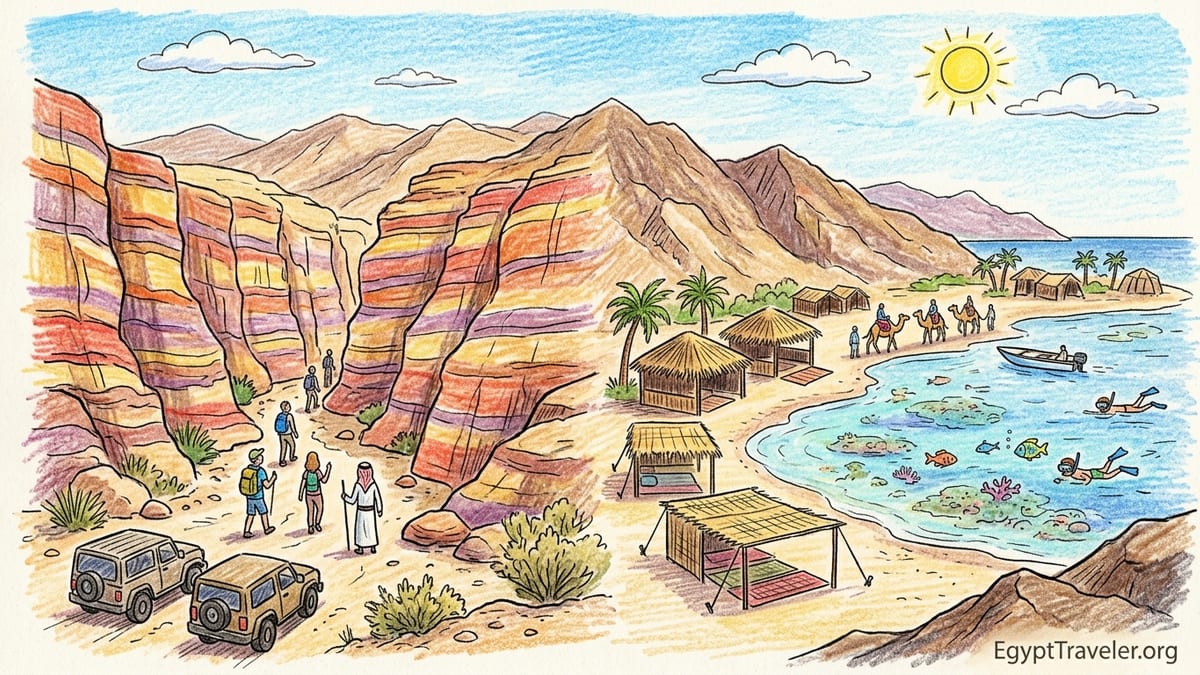
Two Iconic Excursions, Two Very Different South Sinai Worlds
On paper, “Colored Canyon” and “Ras Abu Galum” often appear in the same catalog section of Dahab and Nuweiba tour agencies, both flagged as best-selling excursions for 2026. In reality they sit in different directions, offer contrasting landscapes and suit different kinds of travelers. One is a dry sandstone hike a short drive inland from Nuweiba. The other is a marine protected area north of Dahab’s Blue Hole, where mountains drop into coral-rich shallows and Bedouin families run simple beach camps and lunch spots.
From Dahab’s promenade today, you will see hand-painted signs for “Colored Canyon & Blue Hole Day Trip” alongside “Ras Abu Galum Camel & Snorkel Safari” and “Blue Lagoon Overnight.” Local operators confirm that both routes rank among their most requested outings of the year, particularly in the cooler months from October to April. Yet travelers who try to combine the canyon’s narrow passages with Ras Abu Galum’s long coastal stretch in a single day often return describing it as hurried, hot and more tiring than advertised.
Thinking of these trips as complementary rather than interchangeable helps. Colored Canyon offers a half-day taste of Sinai’s interior rock formations and 4x4 desert access, especially convenient if you are staying in Nuweiba. Ras Abu Galum is better approached as a full coastal day from Dahab, or even an overnight in a beach camp, focused on snorkeling, swimming and unrushed time with Bedouin hosts.
Colored Canyon: Sandstone Labyrinth Above Nuweiba
The Colored Canyon is a winding sandstone gorge in the mountains inland from Nuweiba. Geologists note that the area was once covered by the Red Sea; as the sea retreated it left layers of sandstone, limestone and minerals that now paint the rock in bands of red, yellow and purple. The main hiking section is about 5 kilometers long, with squeezes, scrambles and natural rock steps rather than a flat walking path.
From Nuweiba, the canyon is typically around 25 to 30 kilometers inland by road and then desert track, so travel time from town is usually about 45 minutes to an hour by 4x4. From Dahab, most agencies quote roughly 90 kilometers and allow 1.5 to 2 hours each way, depending on police checkpoints and the condition of the track. This makes the canyon an easy half-day or three-quarter-day excursion if you are already based in Nuweiba, but more of a full-day commitment from Dahab.
In practice, a standard Colored Canyon tour from Dahab or Nuweiba starts with an early pick-up by Toyota Land Cruiser or similar 4x4. Groups are driven north on the coastal highway, then inland on a rough dirt road to the canyon start, where Bedouin guides lead you through the narrower sections. Some passages require basic scrambling, sliding down short drops or stepping carefully along sloping rock. Most travelers in reasonable health manage it, but those with knee issues, limited mobility or strong claustrophobia should think carefully before booking.
Tour operators increasingly package the canyon with other inland highlights. A common 2024–2026 option marketed from Sharm el Sheikh and Dahab combines “Colored Canyon + Abu Galum/Blue Hole,” though in reality the coastal portion usually means a snorkel stop at Dahab’s Blue Hole rather than the longer Ras Abu Galum hike itself unless specified otherwise. This bundling contributes to confusion about what you will actually see, so reading the small print and asking operators to define “Abu Galum” versus “Blue Hole only” is crucial.
Ras Abu Galum: Protected Coastline, Reefs and Bedouin Camps
Ras Abu Galum is a coastal protected area along the Gulf of Aqaba, stretching north from Dahab’s Blue Hole toward Nuweiba. The Egyptian environment authorities describe it as a roughly 400 square kilometer reserve of mountains, desert and sea. The shoreline here is edged by fringing coral reef with some of the highest coral cover in Sinai, making it a prime snorkeling and diving area with clear water, healthy soft and hard corals, and regular sightings of reef fish, rays and occasionally turtles.
Most visitors experience Ras Abu Galum not as an abstract park but as a string of Bedouin-run bays and camps. Simple clusters of huts and reed-roofed shelters line the beach, offering basic mattresses, shade, and freshly cooked lunches of grilled fish, rice and salad. This is where day trippers from Dahab arrive by camel or boat, drop their bags, then wade straight into shallow coral gardens a few steps from the shore. Some continue further north to the Blue Lagoon, a calm turquoise inlet popular for kitesurfing and low-key overnight stays.
The atmosphere contrasts sharply with the tight confines of the Colored Canyon. Here the space opens out. Mountains frame the horizon, but your day is mostly horizontal: snorkeling along the reef edge, resting under a woven palm shelter, watching camels splash in the shallows. There are no loud restaurants, paved promenades or crowds like at more built-up Red Sea resorts. Facilities remain basic: limited electricity, cold-water showers if any, and cash-only payments to Bedouin families who run the camps.
Recent traveler reports from 2025 and 2026 highlight both the magic and the rough edges. Some praise the sense of escape and the quality of the reef compared with busier spots further south. Others describe bumpy sea crossings in small motorboats, improvised safety standards and simple, shared bathrooms at camps. Choosing a reputable Dahab operator and managing your expectations helps you experience Ras Abu Galum as a quiet nature retreat rather than a polished resort excursion.
Getting There from Dahab and Nuweiba
Access logistics are one of the clearest ways these two excursions diverge. The Colored Canyon is overwhelmingly approached by 4x4. From Nuweiba, agencies based in beach camps such as Tarabin or Mahash offer half-day jeep trips inland, sometimes combined with nearby canyons or oases. Prices in 2026 for small-group Nuweiba departures often fall in the range of the equivalent of 30 to 50 US dollars per person, including transport and guiding, with private options costing more. From Dahab, full-day canyon trips that also include a coastal snorkel stop can run higher due to longer driving times and fuel.
Ras Abu Galum, by contrast, is rarely reached entirely by road. From Dahab, most travelers first drive by jeep or taxi to the Blue Hole, a high-profile dive site with parking area and park checkpoint. There, you either transfer to camels for an approximately 1.5 hour coastal trek to Ras Abu Galum village or board a small motorboat for a shorter but sometimes choppy ride along the shore. Group day tours from Dahab that include jeep transfers to the Blue Hole, camel or boat to Ras Abu Galum, lunch and basic snorkeling gear typically range from around 25 to 60 US dollars per person depending on group size and inclusions.
For the energetic, there is also the option to walk part or all of the coastal path from Blue Hole to Ras Abu Galum with a Bedouin guide. The hike involves uneven rocky shoreline, sections of loose gravel and little shade, so it is best suited to experienced hikers carrying sufficient water, with an early start to avoid the midday heat. Independent travelers sometimes arrange their own taxis to the Blue Hole and negotiate boat or camel transport on the spot with local Bedouin operators, though doing so requires time for bargaining and an understanding that safety standards may vary.
Travelers based in Nuweiba can, in theory, reach Ras Abu Galum from the north by arranging boat transfers or hikes from the Nuweiba side of the protectorate. In practice, in 2026 this remains far less common than Dahab-based itineraries. Most Nuweiba agencies still focus on inland canyons and desert oases, while Ras Abu Galum is strongly marketed out of Dahab together with the Blue Hole and the Blue Lagoon further north.
Physical Difficulty, Heat and Who Each Trip Suits Best
Physical demands differ sharply between the two destinations. In the Colored Canyon, the main challenges are scrambling, squeezing through narrow rock corridors and coping with heat reflected from the sandstone walls. There is often limited shade, and summer temperatures in South Sinai can easily push into the high 30s Celsius or more. Tours typically time the canyon walk for the earlier part of the day, but you will still be exposed, and those with limited mobility may struggle with sections where you must lower yourself down short drops or climb over boulders.
Ras Abu Galum’s difficulty is more about endurance and surfaces than technical skill. A camel ride along the coast can be jarring for people with back or hip issues, especially over a 90-minute stretch each way. The coastal hike option demands good footwear, balance on rocks and comfort under strong sun with very little shade. Once at the camp, most of your time is spent snorkeling, swimming and relaxing, which is less intense than canyon scrambling but still tiring under desert sun and salt water.
Families with younger children or older relatives often find Ras Abu Galum gentler as long as they choose the boat transfer rather than the full coastal hike or camel both ways. Children can play at the water’s edge under supervision, duck in and out of the sea to cool off and rest under shaded shelters between snorkels. Conversely, active hikers who want a sense of desert interior and geological formations usually gravitate toward the Colored Canyon, particularly from October through April when midday heat is less severe.
If you or someone in your group is concerned about claustrophobia, acrophobia or balance on uneven ground, it is worth watching videos of the Colored Canyon before booking. The gorge narrows in places, and while there are no extreme drops, the combination of confined space and heat can feel intense. Ras Abu Galum, while still remote, offers visual openness and the psychological comfort of the sea right in front of you.
Tour Combinations and Why “Both in One Day” Often Feels Rushed
Because both areas are strong sellers, tour companies across Sharm el Sheikh, Dahab and Nuweiba have experimented with combination itineraries. A frequent Sharm-based offering advertises a full-day “Colored Canyon & Blue Hole & Dahab” package, which involves a long 4x4 drive to the canyon, the hike itself, then a transfer back to the coast for a snorkel stop at the Blue Hole near Dahab before returning to Sharm in the evening. Marketing language sometimes uses “Abu Galum” or “Abu Gallum” loosely in these contexts, even when the actual coastal visit does not go beyond the Blue Hole parking area.
From Dahab itself, a handful of agencies will, on request, try to stitch together a very ambitious day that touches both the Colored Canyon and Ras Abu Galum. In practice, fitting two drives of 1.5 to 2 hours each between Dahab and the Nuweiba area, a 5-kilometer canyon hike, and a camel or boat leg to Ras Abu Galum with enough time for meaningful snorkeling makes for a packed schedule. Many travelers report feeling that they spent most of the day in vehicles or on camels, with only short windows to actually enjoy each place.
A more balanced approach is to treat the two experiences as separate days, especially if you are staying several nights in Dahab or splitting time between Dahab and Nuweiba. One realistic plan is to devote a full day from Dahab to Ras Abu Galum and, if you also want the canyon, either transfer to Nuweiba for a night or accept a dedicated canyon day with an early start and a simple coastal lunch stop on the way back. This way, each environment can be appreciated on its own terms rather than reduced to a quick photo stop.
There are exceptions. Travelers on tight schedules who value “ticking off” highlights more than depth might still prefer a long combination day, especially outside the peak summer heat. If you go this route, be candid with your operator about your priorities: for example, ask to shorten shopping stops in Dahab in favor of extra snorkel time at Ras Abu Galum or a slower pace through the canyon. However, for most visitors, especially in families or small groups, trying to shoehorn both into a single day is more likely to blur the distinctive character of each experience.
Safety, Regulations and Choosing Responsible Operators
South Sinai’s coastal resorts, including Dahab and Nuweiba, continue to be popular with international visitors, and many travelers report feeling safe during day trips with licensed operators. At the same time, foreign travel advisories remind visitors that parts of the wider Sinai Peninsula carry elevated security risks, and that 4x4 travel across the peninsula requires official permits. This context underscores why you should book canyon and protectorate excursions with established agencies that coordinate with local authorities and understand current regulations for accessing protected areas.
On the ground, there are more practical safety considerations. In the Colored Canyon, heat exhaustion and slips on polished rock are the main issues. Tours should provide clear briefings on footwear, water and pacing, and guides should not pressure anyone to attempt sections that feel beyond their comfort level. Simple precautions such as wearing closed shoes with grip, carrying at least two liters of water per person and using sunscreen and hats make a tangible difference in an environment with almost no shade.
At Ras Abu Galum, safety revolves around sea conditions, boat standards and snorkeling practices. Some visitors in recent seasons have commented on small motorboats driven by very young skippers, crowded pickup trucks used as improvised shuttles between Ras Abu Galum and the Blue Lagoon, and a relaxed approach to life jackets. Before committing to a tour, ask explicit questions about boat capacity, availability of life vests, maximum group size in the water and whether a guide will accompany less confident swimmers. If conditions are windy or the sea is rough, it can be wiser to choose camel or shore options instead of a boat.
Responsible travel here also means respecting the fact that both areas are part of fragile desert and marine ecosystems. In Ras Abu Galum, avoid standing on coral, chase no wildlife and minimize plastic waste, as trash management facilities are limited. In the canyon, stay on established paths and avoid scratching or marking the rock. Many local Bedouin families now depend directly on these excursions for income, so choosing operators who pay fair local rates and limit group sizes helps ensure that tourism continues to support, rather than erode, traditional livelihoods.
How to Choose Between Colored Canyon and Ras Abu Galum
If your time in Dahab or Nuweiba is limited and you can only pick one of the two experiences, your decision should rest on your interests, tolerance for heat and how you prefer to move through a landscape. Choose the Colored Canyon if you are drawn to geology, enjoy scrambling and want a desert interior adventure that feels distinct from the sea-focused rest of your Red Sea itinerary. The canyon is particularly rewarding outside the peak summer months and suits travelers who are comfortable with narrow spaces and moderate physical exertion.
Opt for Ras Abu Galum if you imagine your ideal day as snorkeling over coral gardens, sharing a grilled fish lunch at a Bedouin beach camp and watching the mountains shift color in the late-afternoon light. It is the better choice for mixed-ability groups, as less mobile travelers can still enjoy the setting from the shade while others explore the reef. For photographers and those seeking a quieter, low-key atmosphere away from Dahab’s cafés and kite schools, Ras Abu Galum often becomes the highlight of a South Sinai trip.
Budget can play a role, but in 2026 prices for both experiences overlap. Group day trips typically fall within a broad 25 to 60 US dollar range per person depending on inclusions, with private or custom itineraries costing more. Rather than fixating on small price differences, it is wiser to compare what is actually included: group size limits, quality of vehicles and boats, the presence of licensed guides, and how much actual time you will have on the trail or in the water.
Above all, give each place enough time. A half-day canyon hike with space to pause for photos, listen to your guide’s stories and enjoy the shade between rock walls is more memorable than a rushed push. A Ras Abu Galum visit that allows at least two unhurried snorkel sessions, a proper lunch and a quiet stretch of hammock time will linger long after your tan fades. In South Sinai, distance is not great in kilometers, but heat, terrain and checkpoints make every transfer feel long, so your most precious resource is not money but hours of daylight and energy.
The Takeaway
Colored Canyon and Ras Abu Galum have both earned their spot among the most-booked excursions from Dahab and Nuweiba for good reason. One offers a walk through time, where mineral-rich sandstone folds into pastel corridors under a fierce desert sky. The other places you at the edge of the Gulf of Aqaba, where coral gardens begin a few fin kicks from shore and Bedouin camps still structure the rhythm of the beach. Seeing them as fundamentally different experiences rather than similar “day trips” is the first step to a more satisfying South Sinai itinerary.
If you have at least two free days, treating each as a stand-alone adventure is ideal: Colored Canyon for an inland hiking fix and Ras Abu Galum for a sea-focused, slow day or overnight on the sand. If your schedule forces a choice, let your body and your interests decide. Those who love scrambling over rock and photographing tight geological forms will likely feel at home in the canyon. Those who prefer salt on their skin, mask marks on their face and the lull of waves against a pebble beach will probably remember Ras Abu Galum long after the flight home.
In an era when many trips compress experiences into bullet points, South Sinai quietly rewards those who slow down. The more you respect the heat, the distances and the needs of local communities, the richer your time in this desert-and-sea landscape will be. Whether you end the day shaking sand from your shoes after the canyon’s last scramble or rinsing salt from your hair in a bucket shower behind a Bedouin hut, you will have tapped into two authentic, complementary faces of the same peninsula.
FAQ
Q1. Can I visit both the Colored Canyon and Ras Abu Galum in a single day from Dahab?
It is technically possible on a custom tour, but it usually feels rushed and exhausting. Travel times between Dahab, the Nuweiba area and the Blue Hole, plus a full canyon hike and coastal transfer to Ras Abu Galum, leave limited time for relaxed snorkeling or lingering in the canyon. Most travelers enjoy each destination more when they are visited on separate days.
Q2. Which excursion is better for strong hikers: Colored Canyon or Ras Abu Galum?
Strong hikers who enjoy scrambling and narrow rock passages generally prefer the Colored Canyon, where the main challenge is a 5-kilometer gorge walk with some climbs and squeezes. Ras Abu Galum offers a rocky coastal trail from the Blue Hole that can also be rewarding on foot, but many visitors opt for camels or boats, so the hiking element is less central.
Q3. I am mainly interested in snorkeling. Should I prioritize Ras Abu Galum over the Colored Canyon?
Yes, if snorkeling is your top priority, Ras Abu Galum is the better choice. The protected coastline has rich fringing reefs directly off the beach, with easy entry points and calmer water in the bays. While some canyon combination tours include a Blue Hole snorkel stop, the snorkeling component is shorter and more crowded than a full Ras Abu Galum day focused on the sea.
Q4. How early do tours to the Colored Canyon and Ras Abu Galum usually start?
Most Colored Canyon tours depart Dahab or Nuweiba between 7:00 and 8:00 in the morning to avoid the worst midday heat in the gorge. Ras Abu Galum trips often leave Dahab around 8:00 or 9:00, allowing time to drive to the Blue Hole, organize camels or boats and still arrive at the Bedouin camps by late morning. Exact times vary by operator and season.
Q5. Are these excursions suitable for children?
Both can be suitable for children with some caveats. The Colored Canyon involves scrambling and narrow sections that may be challenging for very young kids or those who dislike confined spaces. Ras Abu Galum can work well for families if you choose the boat option, bring flotation aids and plan for shade and rest between snorkels. Always discuss your children’s ages and abilities with the tour operator in advance.
Q6. What should I wear and bring for a day in the Colored Canyon?
Wear closed shoes with good grip, light but covering clothing, a hat and high-factor sunscreen. Bring at least two liters of water per person, snacks, a small backpack and a basic first aid kit. Many people also carry a light scarf to protect the neck and shoulders from sun and to shield the face during dusty sections.
Q7. Do I need to be an experienced swimmer to enjoy Ras Abu Galum?
You do not need to be an expert swimmer, but basic water confidence helps. The reef begins close to shore and there are shallow sandy patches where beginners can practice with masks and snorkels. Ask your operator to provide life jackets or flotation aids and stay close to shore if you are not comfortable in deeper water or stronger currents.
Q8. How basic are the facilities at Ras Abu Galum?
Facilities are simple. Expect reed-roofed shelters, mattresses on raised platforms, basic toilets and cold-water bucket showers or none. Electricity, if available, is often from small solar setups or generators, so charging options are limited. Food is usually freshly cooked and generous but based on local ingredients, such as grilled fish, rice, bread and salads.
Q9. Is it safe to book canyon and Ras Abu Galum trips with small local agencies?
Many small local agencies and Bedouin guides run excellent, safe trips, but standards vary. Look for offices with clear pricing, written itineraries, vehicles in good condition and staff who answer safety questions directly. If in doubt, ask your accommodation for recommendations and check recent traveler feedback before committing.
Q10. When is the best time of year to visit the Colored Canyon and Ras Abu Galum?
The most comfortable months are generally from October to April, when daytime temperatures are milder and hiking or camel riding is less punishing. Summer visits are still possible, but you will need to start earlier, carry more water and be prepared for intense sun in both the canyon and along the coast.