


In Egypt’s Sinai Peninsula, two very different travel realities coexist. On the southern Red Sea coast, Sharm El Sheikh and Dahab feel, to many visitors, like relaxed beach towns where the biggest daily decision is which reef to dive. Farther north and inland, parts of Sinai remain heavily militarised, with active government operations against armed groups, roadside checkpoints and strict limits on off-road travel. Treating “Sinai” as a single, uniform destination can be misleading and, in some cases, dangerous. To plan a responsible trip in 2026, you need to look at specific towns, roads and routes rather than rely on a blanket yes-or-no judgment about the peninsula as a whole.
Understanding Sinai’s Geography and Why It Matters for Safety
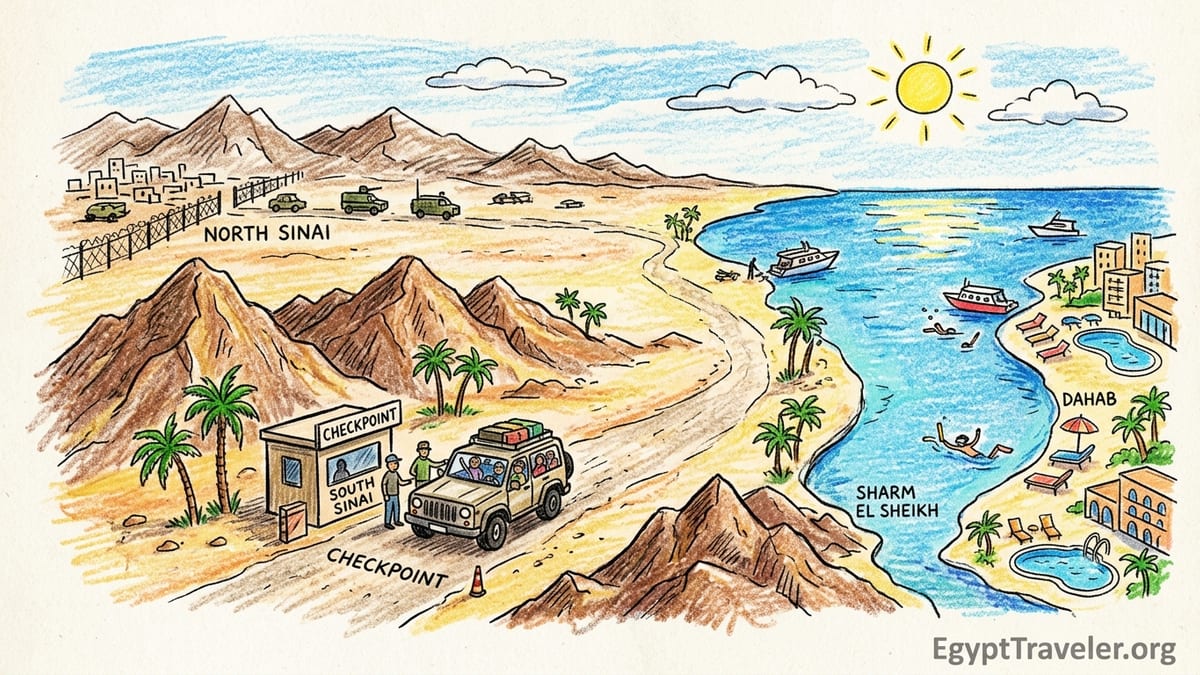
The Sinai Peninsula is not a single travel zone but a large triangle of land that Egypt administratively divides into North Sinai and South Sinai governorates. Sharm El Sheikh, Dahab, Nuweiba and Taba lie in South Sinai along the Gulf of Aqaba and Red Sea, connected by a coastal highway used daily by tourist buses and airport transfers. North Sinai, by contrast, includes towns such as El Arish and Rafah near the border with Gaza and Israel and has seen years of insurgency and counter-terrorism operations. For a traveller, it is crucial to know not just that you are “in Sinai,” but exactly which coast, town and road you are on.
On the ground, this distinction is immediately visible. Fly into Sharm El Sheikh International Airport and you enter a zone dominated by resort compounds, dive centers, all-inclusive hotels and heavily policed access roads. Travel instead toward the interior around central Sinai or the northern coast, and you encounter more frequent military checkpoints, fewer tourist facilities and roads where foreign-plated vehicles may be turned back or questioned. These very different realities sit within the same peninsula but carry sharply different levels of risk and government restriction.
In practice, most leisure visitors experience only a narrow strip of South Sinai’s eastern coast. A typical one-week package might combine a beachfront hotel in Sharm’s Naama Bay with a day trip to Ras Mohammed National Park, an evening stroll along Dahab’s seafront promenade or a boat snorkelling excursion to the Blue Hole. This “tourist corridor” is precisely the area that several foreign governments carve out as an exception when they warn against travel to Sinai more broadly. If you intend to move beyond this corridor, you step into a more complex security environment that requires extra research and, often, local permits.
Understanding this geography is more than academic. Travel insurance policies, local tour operators and government advisories often reference zones like “South Sinai coast,” “northern part of South Sinai,” or “Northern and Middle Sinai.” Those words can determine whether a claim is paid, a tour is allowed to depart or a checkpoint lets you pass. Before you book, you should be able to trace your planned route on a map and align it with these advisory zones, rather than assuming that what feels safe in Sharm automatically applies two hours up the coast or into the mountains.
How Major Government Advisories Classify Sinai in 2026
As of late August 2026, several major governments continue to draw sharp internal lines within the Sinai Peninsula. The United States rates Egypt overall at “Exercise increased caution,” but designates Northern and Middle Sinai as “Do not travel” due to terrorism, while allowing air travel to Sharm El Sheikh and nearby resort areas along the Red Sea coast. In practical terms, that means a nonstop flight from Europe to Sharm for a week at a resort remains within the lower-risk category, while an overland trip toward El Arish or through central desert tracks falls into a substantially higher-risk zone.
The United Kingdom’s travel advice for Egypt similarly distinguishes between the South Sinai tourist coast and more sensitive parts of the peninsula. It notes that large areas of North Sinai are off-limits and advises against all but essential travel to much of inland Sinai, yet it makes an exception for Sharm El Sheikh, Dahab, Nuweiba and Taba, as well as the coastal road that links them and the main road to St Catherine’s Monastery. Travellers planning routes that cross beyond these exceptions need to pay close attention, as doing so may not only run counter to official advice but could also invalidate many standard British travel insurance policies if something goes wrong.
Canada’s advisories also treat Sinai as a patchwork of risk levels. The country currently recommends a high degree of caution for Egypt as a whole, with specific regional warnings flagging North Sinai as an area to avoid because of terrorism and military operations. South Sinai’s resort towns are generally treated differently, so a Canadian spending a long weekend diving the reefs off Dahab faces an officially assessed risk that is not the same as someone driving the coastal road through North Sinai toward Gaza. This kind of fine-grained distinction is why reading only the headline level for “Egypt” or “Sinai” can be misleading.
What these three major advisories have in common is not a blanket condemnation or endorsement of Sinai, but a nuanced view that separates comparatively stable resort areas from more volatile northern and inland zones. For travellers, the practical takeaway is twofold. First, you should always check the detailed regional maps and text of the current advisory for your nationality shortly before departure, and again if you change plans while in Egypt. Second, you should be prepared to explain to both your insurer and local operators exactly which permitted zones you plan to enter, using the same language governments use: for example, “Sharm El Sheikh coastal resort area” or “road between Dahab and Nuweiba,” rather than just “Sinai road trip.”
South Sinai Tourist Coast: What Travel Feels Like in Sharm and Dahab
On the ground in Sharm El Sheikh and Dahab, the security picture feels very different from what headlines about “Sinai” might suggest. In Sharm, transfers from the airport to hotels in Naama Bay, Sharks Bay or Nabq typically follow a short, well-patrolled route. Checkpoints at the entrance to the city and at the airport perimeter control traffic, but once inside the resort areas, visitors mostly encounter a familiar holiday environment of beachfront promenades, dive shops advertising Open Water courses, and hotel security that feels comparable to other Red Sea and Mediterranean resorts. A family staying at a mid-range chain hotel near Naama Bay might never see more than a handful of uniformed officers at access points during their entire week-long stay.
Dahab, around an hour and a half by road northeast of Sharm, offers a smaller, more laid-back vibe, but with similarly visible security at key chokepoints rather than in everyday street life. The approach road passes through a series of guarded gateways where vehicles may be checked and IDs occasionally verified, especially at night or during peak holiday periods. Once you reach Dahab’s Lighthouse or Mashraba districts, however, the atmosphere shifts to barefoot cafes, low-rise guesthouses and backpacker-friendly dive centers. It is not unusual to see solo travellers walking between their hostel and the waterfront long after dark, particularly along the main seafront path, though sensible urban precautions still apply.
Tour operators in both Sharm and Dahab have adapted to the current security framework. Many dive centers, for example, are careful to stick to approved marine sites such as Ras Mohammed, Tiran Island, the Blue Hole or the Canyon, using registered boats and submitting passenger lists in advance to the coastguard. Desert excursion companies tend to run standardised day trips to places like the Colored Canyon or Abu Galum that follow set routes cleared with authorities, often in convoys or with fixed departure times. As a visitor, you might notice that your quad bike tour or jeep safari departs only once there are enough vehicles to go together, not simply when you show up.
It is also worth noting how common it is to meet repeat visitors who treat Sharm or Dahab as a known quantity. British divers might return year after year to the same liveaboard operator based in Sharm’s marina, while European kite surfers book seasonal stays in the lagoons north of town. Their experience does not cancel out valid security concerns about other parts of Sinai, but it illustrates that, for many travellers who stay within the established South Sinai coastal corridor, the perceived risk feels similar to other major diving and beach destinations, with the addition of more visible checkpoints at the city limits and airport.
Restricted Northern and Inland Sinai: Where Travel Becomes High-Risk
Move away from the established resorts and the security picture changes quickly. Northern Sinai, including areas around El Arish and the border with Gaza, has seen a long-running insurgency and heavy Egyptian military operations. This region has been the focus of repeated “do not travel” warnings from several governments, including the United States, and is an area where foreign travellers are rarely seen outside of official or humanitarian contexts. Roadblocks, curfews and active operations mean that even journalists and NGO personnel often face delays or denials of permission to move.
Central or Middle Sinai, the sparsely populated interior between the Red Sea coast and the Suez Canal, presents different but related challenges. The landscape of rocky wadis and high plateaus can create a false sense of remoteness and freedom for those tempted by off-road adventures. In reality, much of this area is considered sensitive by Egyptian authorities, who view unpermitted movement as a potential security threat. It is not uncommon for vehicles diverted off main highways to be stopped at ad hoc checkpoints or for foreign travellers to be escorted back toward more controlled routes. Unsanctioned overland expeditions or wild camping in these zones are strongly discouraged and can lead to detention or questioning.
From a practical perspective, even seemingly benign plans can cross into problematic territory. For instance, driving a 4x4 rental from Cairo across the Suez Canal and then cutting diagonally through Sinai toward Taba via smaller interior roads might look appealing on a digital map, but several segments of that route fall squarely into areas where multiple governments advise against non-essential or all travel. Local car hire companies in Cairo sometimes refuse to let their vehicles be taken into Sinai at all, or require a hefty cash deposit and written confirmation of your route, precisely because of these risks and restrictions.
Travellers occasionally report that, when they attempt overland journeys beyond Sharm, Dahab and the main road to St Catherine, they are turned back at police or military checkpoints, even if they have no malicious intent. Officers on the ground often have broad discretion in how they interpret local orders and may err on the side of denying passage, especially for unaccompanied foreign vehicles. The result is that, while it is technically possible to cross the peninsula by road in certain circumstances, this is a trip best left to professional operators working in close coordination with authorities rather than independent tourists following satellite navigation alone.
Checkpoints, Permits and 4x4 Desert Tours: How Movement Is Controlled
Checkpoints are a defining feature of travel in Sinai. On the South Sinai coastal road between Sharm and Taba, you are likely to encounter multiple fixed checkpoints where uniformed police or soldiers monitor traffic. In many cases, tourist buses and cars are waved through with a simple glance at licence plates, but spot checks of passports or vehicle registration do occur, especially at night or during periods of heightened alert. For travellers, this usually translates into a brief delay rather than a serious obstacle, but it adds time to journeys and reinforces why you should avoid cutting transfer schedules too tight.
When it comes to desert tours and 4x4 excursions, the permit system is stricter. Local agencies that run trips to destinations like the White Canyon, Abu Galum or desert oases typically submit passenger names and nationalities in advance to the security directorate, which issues permission for specified dates and routes. On the morning of your tour from Dahab, you might notice your guide carrying a stack of photocopied passports or a printed permit to show at the first checkpoint outside town. If a group includes a nationality considered higher-risk or if conditions change overnight, an excursion may be modified, delayed or cancelled altogether on the advice of authorities.
Independent off-road driving is particularly sensitive. Renting a 4x4 in Sharm and attempting to explore unmarked tracks toward central Sinai without a licensed guide is widely regarded as a bad idea. Not only are some areas mined or poorly mapped, but you can easily stray into restricted military zones where photography is banned and unannounced foreign presence is treated with suspicion. Even well-equipped overlanders have reported being stopped and escorted back toward the coast after veering off main highways, sometimes with stern warnings and inspections of camera equipment.
For visitors who want a taste of Sinai’s desert landscapes while respecting these controls, the practical solution is to book with reputable local operators who understand the permit process and current red lines. In Dahab, that might mean a small Bedouin-run company that offers a sunset hike in the mountains above town followed by a campfire dinner, returning the same night. In Sharm, it could be a pre-arranged 4x4 trip to the Colored Canyon organised by a hotel concierge using a long-established partner. These tours are designed to stay within approved corridors, travel in convoys when required and coordinate with checkpoints, which dramatically lowers the likelihood of unpleasant encounters with security forces.
Border Crossings, Ferries and Overland Routes: Why Exact Itineraries Matter
Sinai’s position between Africa and Asia makes it attractive to overland travellers linking Egypt with Israel, Jordan or Saudi Arabia, but this is precisely where generalisations about “Sinai” become dangerous. Border areas are often treated as highly sensitive by Egyptian authorities, and multiple governments flag them as higher risk than the coastal resort strip. The overland route from Taba to Eilat or Aqaba, for example, may seem straightforward on a map, yet advisories highlight that the surrounding region has seen security incidents and remains under close surveillance, particularly nearer to North Sinai and Gaza.
Similarly, travel between mainland Egypt and Sinai via the Suez Canal road bridges or tunnels is not just a simple highway crossing. Vehicles heading east out of Cairo toward the peninsula routinely pass through layered checkpoints where drivers may be asked where they are going and why. A bus full of resort guests with vouchers for a Sharm hotel usually raises few questions, but a pair of independent travellers in a rental jeep hoping to cut across to Nuweiba via smaller inland roads could face detailed questioning or outright refusal. Authorities are especially wary of unsanctioned travel that might approach military zones or border fences.
Ferry and boat routes require attention as well. Services across the Gulf of Aqaba or between Sharm and mainland Red Sea ports can be suspended or altered at short notice for security reasons or weather. A traveller who books a non-refundable hotel in Dahab based on last season’s ferry schedule may find, on arrival, that the boat no longer runs or that additional documentation is required. In contrast, the heavily trafficked flight corridors in and out of Sharm El Sheikh International Airport, which serve package tours from Europe and the Middle East, tend to be more stable, although airlines and travel companies do occasionally adjust schedules based on changes in regional security perceptions.
All of this underscores the importance of planning with specific, dated information rather than assumptions. Before committing to any overland route through Sinai, verify not only your own government’s advisory but also current Egyptian practice: ask your hotel in Sharm whether independent driving on your intended road is permitted this season, check with a licensed tour operator if they are still running the route, and be prepared with backup options if checkpoints turn you around. Time spent clarifying your exact itinerary in advance is one of the most effective safety tools you have.
Practical Safety Tips for Staying Within the Low‑Risk Tourist Corridor
If you choose to visit South Sinai’s main resorts while avoiding the higher-risk zones, certain practical habits can further reduce your exposure. Start by aligning your stay with the areas that multiple governments consistently treat as lower risk: hotel districts inside Sharm’s main perimeter barrier, central Dahab along the seafront, and the primary coastal roads that connect them to the airport and, where permitted, to St Catherine’s Monastery. Book airport transfers through your hotel or a known agency rather than hailing informal taxis outside terminal gates, so that drivers are registered with local authorities and familiar with current checkpoint routines.
Once in resort areas, apply the same common-sense precautions you would in other busy tourist zones. In Naama Bay’s nightlife district, for instance, keep valuables concealed, watch your drinks, and use hotel safes for passports and large amounts of cash. In Dahab, be mindful when walking on the unlit back streets behind the seafront, particularly late at night, and avoid accepting invitations to private desert camps from individuals who are not affiliated with licensed operators. Petty theft and scams can occur here as anywhere else, even if violent crime rates remain comparatively low in the resort corridor.
Health and environmental safety deserve attention too. South Sinai’s summer temperatures can be extreme, and a day-long boat trip to the reefs or a hike above Dahab can quickly become dangerous if you underestimate the heat. Carry more water than you think you need, wear proper footwear instead of flip-flops on rocky ground, and be cautious when renting scooters or quad bikes on informal terms. Many local accidents involve sun exposure, dehydration or road mishaps rather than security incidents, yet they can be just as trip-ending, particularly if you are far from medical facilities.
Finally, maintain a flexible mindset. Security conditions in Sinai can change with limited warning. Keep an eye on local news outlets and your embassy’s alerts during your stay, and consider registering with consular services if your government recommends it. If authorities suddenly restrict access to a desert site or your dive operator decides not to visit a specific remote reef on a given day, treat that as a safety buffer, not an inconvenience. Being willing to adjust plans is a key part of travelling responsibly in a region whose security picture remains dynamic.
The Takeaway
The safety of Egypt’s Sinai Peninsula in 2026 cannot be summarised with a simple yes or no. For most visitors flying directly into Sharm El Sheikh or staying in Dahab, the experience is of a heavily managed but welcoming resort region where routine tourism continues much as it has for years. Checkpoints, bag scanners at hotel entrances and controlled access to the airport form part of the background, but daily life revolves around coral reefs, seaside dinners and desert sunsets. Within this defined South Sinai coastal strip, major governments continue to treat travel as permissible, albeit with a call for heightened awareness.
Beyond this narrow corridor, however, the picture shifts. Northern Sinai and parts of central Sinai remain areas of serious concern, with ongoing counter-terrorism operations, restricted access and explicit “do not travel” warnings in several national advisories. Independent overland journeys that stray into these zones, or improvised 4x4 trips into the interior, are not simply adventurous; they can be illegal, uninsured and personally dangerous. In these regions, even seasoned local drivers often defer to military or police decisions about where and when travel is allowed.
For travellers weighing whether to visit Sinai, the most responsible approach is to think in terms of specific routes and towns, not the peninsula as a single destination. A week of diving between Sharm and Dahab, booked through established operators and confined to permitted routes, is a different proposition from a road trip through North Sinai or unsupervised desert camping in the interior. By cross-checking up-to-date government advisories, listening to local expertise and being willing to adapt your plans, you can enjoy much of what South Sinai offers while respecting the genuine risks that persist elsewhere on the peninsula.
Above all, remember that security conditions and official guidance can change quickly. Before you fly and again during your stay, read the latest detailed advisory from your own government, confirm plans with local partners in South Sinai, and keep your itinerary flexible enough to respond to new information. That combination of preparation and adaptability is the best answer to the question of whether, and how, to visit Sinai safely today.
FAQ
Q1. Is it currently safe to visit Sharm El Sheikh and Dahab in 2026?
Many travellers continue to visit Sharm El Sheikh and Dahab in 2026, and several governments treat these South Sinai resort areas differently from higher-risk parts of Sinai. However, they still urge increased caution, so you should check your own government’s latest advisory and stay within established tourist routes.
Q2. How is North Sinai different from South Sinai for travellers?
North Sinai has experienced prolonged insurgency and heavy security operations, leading multiple governments to advise against travel there, while South Sinai’s main coastal resorts, such as Sharm El Sheikh and Dahab, remain open to tourism under tighter controls and visible security measures.
Q3. Can I drive across Sinai from Cairo to Sharm El Sheikh or Dahab?
Some official buses and private transfers do run between Cairo and South Sinai via established highways, but independent road trips can encounter multiple checkpoints and occasional refusals, especially if you try to divert onto interior routes. Always confirm with local operators and consider flying into Sharm to avoid sensitive areas.
Q4. Do I need special permits for desert trips or 4x4 tours in Sinai?
Yes, reputable tour companies usually obtain permits from local security authorities for specific routes and dates, particularly for desert excursions and 4x4 trips. Attempting to explore desert tracks independently without permits and a licensed guide is strongly discouraged and can result in being turned back or questioned.
Q5. Are popular sites like Ras Mohammed and the Blue Hole considered safe to visit?
Ras Mohammed National Park near Sharm and the Blue Hole near Dahab are among Sinai’s most visited dive sites and are typically accessed through licensed operators who coordinate with authorities. While no site is risk-free, these locations fall within the main tourist corridor that most governments treat as lower risk compared with northern and inland Sinai.
Q6. Could travelling to Sinai affect my travel insurance coverage?
Yes, if you enter areas where your government advises against non-essential or all travel, many insurance policies may limit or exclude coverage. It is important to read your policy’s fine print, match it to the advisory map and keep your itinerary within permitted zones such as the designated South Sinai resort areas.
Q7. How visible is security in Sharm El Sheikh and Dahab?
Security is noticeable primarily at access points such as airport entrances, city gates and hotel checkpoints, where bags may be scanned and vehicles inspected. Inside resort areas and along seafront promenades, the atmosphere generally feels relaxed, with plainclothes or low-profile security rather than a heavy, constant military presence.
Q8. What practical steps can I take to stay safe in South Sinai?
Book transfers and excursions through reputable operators, carry identification for checkpoints, avoid unsanctioned detours into the interior, follow local instructions if conditions change and apply normal urban safety practices regarding valuables, alcohol and late-night movements.
Q9. Can I visit St Catherine’s Monastery from Sharm or Dahab?
Day trips to St Catherine’s Monastery and Mount Sinai are commonly offered from Sharm and Dahab, usually along a main road that authorities have repeatedly permitted for organised tours. However, access can be tightened at times, so you should book with a licensed operator and confirm that trips are currently running before you plan around them.
Q10. How often do security conditions in Sinai change?
Conditions can shift quickly in response to regional events or local incidents, sometimes resulting in new restrictions, added checkpoints or temporary suspension of tours. For that reason, you should recheck official advisories close to your departure date and remain flexible in case your route or activities need to be adjusted while you are there.