


The lower half of Egypt’s Sinai Peninsula looks small on the map, but its mix of reefs, desert and high mountains can feel overwhelming when you try to turn it into a coherent route. Many visitors end up zigzagging between resorts, repeating long road sections or skipping the mountains entirely. With a bit of planning, you can link Sharm El Sheikh, Dahab and St Catherine into one logical arc, adding Nuweiba or Taba only when they genuinely improve the trip rather than forcing a full loop around the peninsula.
Understanding South Sinai’s Geography and Travel Times
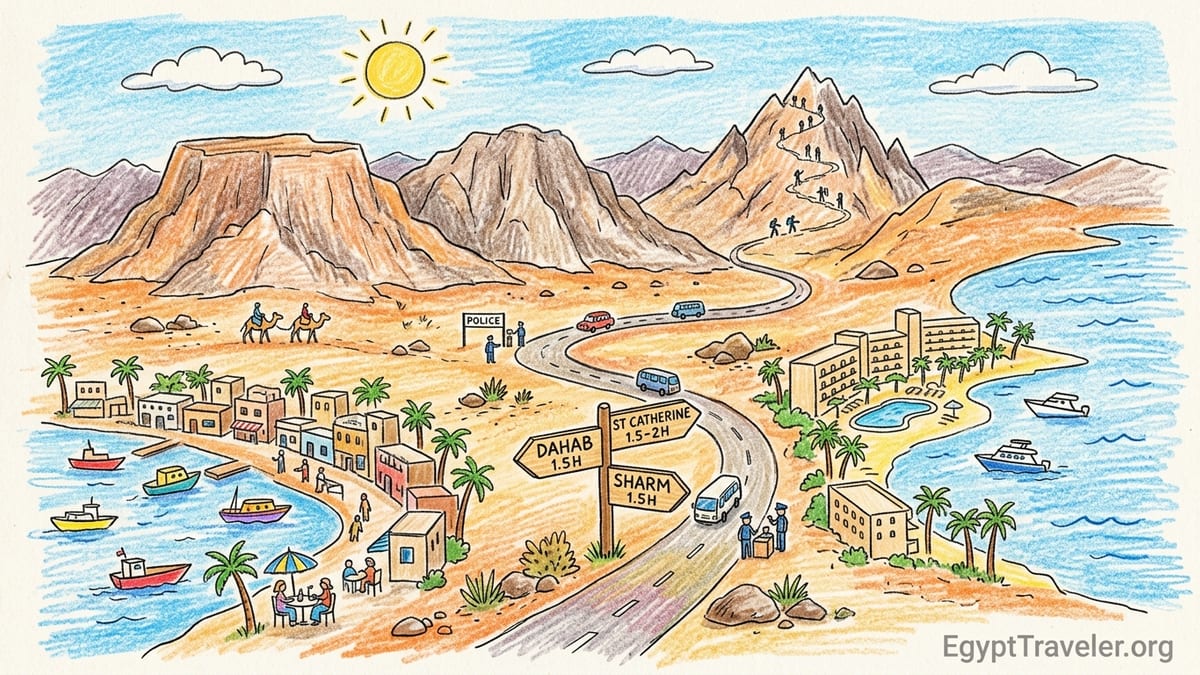
South Sinai is essentially a triangle: Sharm El Sheikh anchors the southern tip, Dahab sits about 80 kilometres to the northeast on the Gulf of Aqaba, and St Catherine lies inland in the high granite mountains. Nuweiba and Taba continue north along the coast towards the Israeli border. Distances look modest, but the roads cross desert plateaus and police checkpoints, so realistic timing matters more than pure kilometres when you plan your route.
The coastal highway between Sharm El Sheikh and Dahab is straightforward, paved and busy with tourist traffic. The direct drive is roughly 115 kilometres and usually takes about 1.5 hours in normal conditions by private car or taxi. Regular tourist transfers and hotel drivers use this road multiple times a day, and it is generally considered the easiest overland hop in South Sinai for visitors coming straight from Sharm’s airport to Dahab’s smaller, more laid‑back scene.
From Dahab to St Catherine you turn inland across the plateau into the Saint Katherine Protectorate. Road distance is roughly 125 to 130 kilometres, with most travelers reporting 1.5 to 2 hours by private car or minibus, and around 1 to 1.5 hours on the direct local bus when it runs on schedule. The road climbs steadily, and temperatures can drop sharply as you approach the town of St Catherine, especially from November to March.
Further north, Nuweiba and Taba are connected by the same coastal road. Nuweiba to St Catherine is commonly quoted around 1.5 hours by car, while Nuweiba to Dahab can take roughly 1.5 to 2 hours depending on stops and checkpoints. Taba is further again, so it makes sense mainly for travelers combining Egypt with Israel or Jordan. For most purely Egyptian trips, the core triangle of Sharm, Dahab and St Catherine offers plenty without adding long coastal detours.
How Safe and Practical Is Overland Travel in South Sinai?
South Sinai has seen security incidents in the past, and most foreign ministries still differentiate between relatively stable resort zones and higher‑risk interior or northern areas. As of late 2026, many governments advise against travel to North and Middle Sinai but consider travel to Sharm El Sheikh, Dahab, St Catherine and the main coastal highway acceptable with precautions. You should always check your own country’s latest advisory before locking in a route, as restrictions on specific roads can change.
On the ground, visitors typically experience a heavily policed but functional travel environment. Expect multiple checkpoints between Sharm, Dahab and St Catherine where officers verify passports, hotel bookings and occasionally ask about your plans. Buses and licensed tour vehicles are familiar to local police, so group transfers usually glide through faster than solo self‑drive vehicles. If you are renting a car from Sharm or Cairo, factor in extra time around these stops, and carry passport, visa and hotel confirmations in printed or easily accessible digital form.
Because of the checkpoints and the variable bus schedules, a private transfer is often the most practical option for the key legs between Sharm and Dahab or Dahab and St Catherine. For example, many Dahab guesthouses can arrange a shared minivan from Sharm airport for the equivalent of roughly 20 to 30 US dollars per person, while a private taxi from Dahab to St Catherine for a small group might cost around 60 to 100 dollars return, depending on bargaining and whether the driver waits during your hike. Costs fluctuate with fuel prices and demand, so confirm rates in advance by email or messaging apps rather than assuming prices you read in older blogs.
If you prefer public transport, local companies such as GoBus or GoMini periodically run services to Dahab and sometimes to the St Catherine stop on the Dahab route, but slots can be hard to find and timetables change frequently. Travelers often report booking a Dahab ticket and then selecting the “St Catherine” bus stop option if available. In practice, most first‑time visitors planning a compact South Sinai itinerary will find that arranging a driver through their accommodation removes a lot of uncertainty for a modest price.
Building a Logical Sharm El Sheikh, Dahab and St Catherine Route
The most efficient way to sample both coast and mountains is usually to fly into Sharm El Sheikh and move north in stages rather than backtracking. A common pattern is Sharm El Sheikh to Dahab to St Catherine, then back to Dahab or Sharm depending on onward travel. This creates a neat arc that uses the main coastal highway only once in each direction and limits inland driving to the Dahab–St Catherine corridor, which is short and direct.
One practical example starts with two or three nights in Sharm El Sheikh to recover from international flights and enjoy easy resort comforts. From Sharm, you transfer by private car or shared shuttle to Dahab in about 1.5 hours. Base in Dahab for several nights to dive or snorkel at sites like the Blue Hole, Lighthouse or Eel Garden; many dive centers offer multi‑day packages that include equipment, guiding and accommodation. Once you have had your fill of the sea, you arrange a driver or guided transfer to St Catherine, arriving in the afternoon to acclimatize before a night climb of Mount Sinai or a morning visit to the monastery.
Another clean option starts in Dahab and uses Sharm only as an entry and exit point. For instance, you could land in Sharm, transfer directly to Dahab the same day, spend most of your time there, make a one‑ or two‑night detour to St Catherine, and then return to Sharm only to catch your outbound flight. This approach works well if you prefer Dahab’s smaller‑scale, independent atmosphere over Sharm’s large all‑inclusive resorts but still need Sharm’s flight connections.
What both patterns share is that they avoid the temptation to “circle” the entire peninsula. Driving a big loop from Sharm up to Taba, then down through Nuweiba to Dahab and finally inland to St Catherine adds long, repetitive highway days for limited extra payoff unless you specifically want to cross the land borders. For travelers focused on South Sinai itself, the triangle route between Sharm, Dahab and St Catherine is a better balance of time, logistics and experience.
When Nuweiba and Taba Actually Improve the Trip
Nuweiba and Taba make the most sense when they plug into wider Middle East travel rather than as stand‑alone destinations on a compact Sinai break. Taba sits next to the border with Israel and near ferry routes to Jordan across the Gulf of Aqaba. If you are combining a Sinai road trip with time in Eilat, Petra or Wadi Rum, routing yourself up to Taba at the start or end of your journey can be practical. From there, you can cross the land border on foot and connect with Israeli or Jordanian transport networks.
Nuweiba occupies a quieter stretch of coast between Dahab and Taba and suits travelers seeking rustic beach camps, slower rhythms and fewer large hotels. Many of its accommodation options are simple huts or chalets directly on the sand, with shared bathrooms and communal dining. A realistic pattern might be Sharm to Dahab, Dahab to Nuweiba for a few nights in a beach camp, then back to Dahab or on to Taba if you are crossing a border. The Dahab to Nuweiba drive is typically quoted at around 1.5 to 2 hours, so it fits comfortably into a travel morning.
If your priority is a tight South Sinai loop focused on diving, hiking and monastery visits, adding Nuweiba or Taba often stretches the route without adding enough new experiences to justify the extra driving. A better use of your days might be an additional guided trek in the highlands around St Catherine or more time exploring lighthouse‑side cafés and relaxed waterfront evenings in Dahab. Consider Nuweiba and Taba “modular add‑ons” rather than core pieces of the route, only slotting them in when they neatly serve a larger regional plan.
Combining Diving, Snorkeling and Mountain Experiences
South Sinai is one of the few places where you can be finning over coral at breakfast and watching the sun rise from a 2,200‑metre summit the next day. The key is to sequence diving and altitude sensibly. Mount Sinai is not extremely high by mountaineering standards, and most visitors approach by road to around 1,500 metres before hiking, but you should still follow standard dive medicine advice. As a rule of thumb, avoid serious altitude or strenuous mountain hiking within 18 to 24 hours of your last dive to minimize decompression risk. This is another reason to push your mountain segment to the end of a Dahab stay rather than dropping it abruptly between dive days.
A typical pattern could involve several days of diving or snorkeling in Dahab, then a dry rest day with only light activities in town, followed by a transfer to St Catherine in the afternoon. After checking into a simple guesthouse, you rest a few hours before joining a guided night hike up the camel path to the summit of Mount Sinai for sunrise, then descend in the morning to visit St Catherine’s Monastery. Many local companies in Dahab and Sharm sell exactly this combination as a package that includes transport, guiding, national park fees and sometimes a simple breakfast near the monastery.
If you are based in Sharm El Sheikh, you can follow a similar pattern using boat trips and resort‑based diving rather than Dahab’s shore dives. Spend several days diving or snorkeling Ras Mohammed National Park, Shark’s Bay or local house reefs, then book a one‑ or two‑night excursion inland. Some Sharm tour operators offer overnight buses to St Catherine for a night ascent, but the journey is longer and can feel rushed. Many travelers prefer to transfer to Dahab first, cut the driving time, and then continue on to St Catherine from there.
Non‑divers or mixed groups can still build a satisfying sea‑and‑mountain route by leaning on snorkeling days, glass‑bottom boat trips and coastal hikes around Dahab’s bays, then shifting to Bedouin‑guided camel treks or day hikes in the wadis around St Catherine. For example, you might snorkel at the Blue Hole and then, the next day, walk a half‑day trail to a nearby oasis with a local guide before heading up to the high mountains.
Guided Transfers, Tours and When to Stay Overnight Near Mount Sinai
Guided transfers are particularly useful on the Dahab–St Catherine leg and for night ascents of Mount Sinai. A typical guided excursion from Dahab leaves town around 10 or 11 pm, reaches the trailhead after about 1.5 hours, and begins the climb around midnight with a Bedouin guide. You reach the summit in time for sunrise, then descend to visit St Catherine’s Monastery when it opens in the morning, returning to Dahab early afternoon. The price usually includes the driver, local guide and park fees; recent traveler reports suggest figures in the range of 40 to 80 US dollars per person, depending on group size and whether meals are included.
Staying overnight in or near St Catherine makes sense in a few scenarios. First, if you prefer a daytime hike rather than the standard night climb, spending a night in town allows you to set out at dawn and avoid the busiest hours. Second, if you are traveling in winter when night temperatures around the summit can drop below freezing, a daylight hike with a warm bed waiting nearby can be more comfortable than dozing on a bus back to the coast. Finally, if you are interested in longer treks in the highlands, such as multi‑day routes linking nearby wadis and peaks, a local trekking operator based in St Catherine will likely propose at least one night in the village before or after your hike.
In practical terms, accommodation in St Catherine is simple but adequate for most travelers: basic hotels and guesthouses, sometimes run by local Bedouin families, with hot showers, heavy blankets and hearty meals. Book ahead in peak seasons such as Easter, major Orthodox religious holidays and school breaks when local and international pilgrim traffic spikes. If you are content with the classic night ascent and monastery visit and you are reasonably fit, an overnight excursion from Dahab without a hotel stay in St Catherine still works well and is the most common pattern.
Between Sharm and Dahab, you can rely on hotel‑arranged transfers or established taxi contacts. Many frequent visitors suggest arranging a specific driver by phone or messaging apps rather than picking a taxi on arrival at the airport, both to agree a fair price in advance and to avoid haggling when you are tired from your flight. In all cases, use licensed vehicles, confirm that your driver has the paperwork required at checkpoints, and keep your passport, entry stamp and, if relevant, your full Egyptian visa rather than a restricted Sinai‑only stamp easily accessible.
Short, Realistic South Sinai Route Examples
For travelers with limited time, it helps to think in terms of modular mini‑routes rather than fixed week counts. A compact coastal and mountain sample could look like this: arrive in Sharm El Sheikh, transfer straight to Dahab, spend a few days diving or snorkeling and enjoying café life by the sea, then schedule a single night excursion to Mount Sinai and St Catherine from Dahab before returning to Sharm for your flight. With efficient transfers, this kind of arc delivers both Red Sea and high‑mountain experiences without feeling frantic.
A different short pattern might focus more heavily on Sharm’s resort scene while still touching the mountains. You might spend several days in a mid‑range hotel in Naama Bay or Sharks Bay, alternating boat trips to Ras Mohammed with pool time, then book a one‑night, two‑day trip inland that drives you from Sharm to St Catherine for a night ascent and monastery visit before continuing on to Dahab. After one or two relaxed days in Dahab, you finish with a daytime drive back to Sharm for outbound flights. This route is efficient if your flights in and out of Sharm are fixed and you want only a taste of Dahab rather than a full stay.
Travelers interested in quieter beaches and cross‑border links might build a short route like Sharm to Dahab, Dahab to Nuweiba for hut‑style beach living, then Nuweiba to Taba for a night before crossing into Israel or taking a ferry toward Jordan. In this case, the mountain section around St Catherine may drop out of the plan entirely in favor of the coast. That trade‑off makes sense if your broader trip already includes desert and highland experiences elsewhere, such as Wadi Rum or Jordan’s Dana Reserve.
Families or cautious travelers who prefer to minimize night journeys can still include Mount Sinai by choosing an early afternoon transfer from Dahab or Sharm to St Catherine, sleeping in a guesthouse, hiking at sunrise and returning during daylight hours. Though slightly slower and more expensive than a single night‑bus excursion, this pattern can feel safer and less taxing, especially for younger children or older relatives who need more rest.
The Takeaway
Designing a South Sinai itinerary does not require circling the entire peninsula or racing between every coastal stop. By focusing on the natural triangle of Sharm El Sheikh, Dahab and St Catherine, you can combine Red Sea reefs, relaxed seaside towns and stark granite peaks in a route that feels both coherent and achievable. Nuweiba and Taba remain valuable extras for overland cross‑border trips or quieter beach time, but they are not essential to a satisfying Sinai journey.
What matters more than covering distance is sequencing experiences sensibly: cluster your diving or snorkeling days together, leave a rest gap before heading to altitude, and decide in advance whether you want the classic night ascent of Mount Sinai or a slower, daylight exploration with an overnight in St Catherine. Use guided transfers where they simplify logistics, especially on inland routes and nighttime journeys, and let your accommodation help with drivers and permits.
Finally, remember that travel conditions and advisories in Sinai evolve. Before you commit to any route, check fresh guidance from your foreign ministry, ask your hotel or tour operator about current road conditions and security procedures, and stay flexible enough to adjust your plans if needed. With realistic expectations and a clear, compact route, South Sinai rewards you with some of Egypt’s most memorable contrasts: coral gardens at breakfast, orange granite peaks at sunset and star‑filled desert skies in between.
FAQ
Q1. Is South Sinai, including Sharm, Dahab and St Catherine, safe to visit now?
Travel advisories typically distinguish between higher‑risk North and Middle Sinai and the more heavily policed tourist areas of South Sinai. As of 2026, many governments advise that Sharm El Sheikh, Dahab and St Catherine can be visited with standard precautions, while warning more strongly against travel further north. You should always consult your own foreign ministry’s latest guidance before traveling and follow local security instructions on the ground.
Q2. How long does it realistically take to drive between Sharm El Sheikh and Dahab?
The direct coastal road between Sharm El Sheikh and Dahab is about 115 kilometres and usually takes around 1.5 hours by private car or taxi in normal conditions. Traffic is rarely heavy, but police checkpoints and occasional roadworks can add a little time, so it is wise to allow up to two hours when connecting with flights or tours.
Q3. Do I need a guide to visit Mount Sinai and St Catherine’s Monastery?
A licensed local guide is required for standard night ascents of Mount Sinai and is strongly recommended even for daytime hikes, both for navigation and for dealing with checkpoints or park regulations. Many visitors join organized excursions from Dahab or Sharm that bundle transport, guiding and fees into one package. For the monastery itself, you can explore independently during opening hours, but going with a guide adds useful historical and religious context.
Q4. Should I stay overnight in St Catherine or can I visit on a long day trip?
Both options work. Many travelers do a night ascent of Mount Sinai and a morning visit to the monastery in a single overnight excursion from Dahab or Sharm, sleeping mostly on the bus. If you prefer a slower pace, are traveling with children, or are visiting in colder months, spending a night in a guesthouse in St Catherine allows a daylight hike, better rest and less time on the road in the dark.
Q5. How can I combine diving or snorkeling with a visit to the mountains safely?
The main concern is leaving enough time between your last dive and heading to altitude. A common approach is to group your dive days together in Dahab or Sharm, schedule a dry rest day with only light activity, and then travel inland to St Catherine for your hike. Snorkel‑only visitors have more flexibility but may still appreciate a rest day before tackling the pre‑dawn climb up Mount Sinai.
Q6. Is it better to base in Sharm El Sheikh or Dahab for this kind of route?
Sharm El Sheikh suits travelers who want full‑service resorts, extensive flight connections and boat‑based diving, while Dahab appeals to those who prefer smaller guesthouses, shore diving and a more relaxed, backpacker‑style atmosphere. Many visitors use Sharm as an entry and exit hub for flights but spend most of their time in Dahab, then add a side trip to St Catherine from there to reduce inland driving times.
Q7. Are public buses reliable between Dahab and St Catherine?
There are usually local buses or minibuses running between Dahab and St Catherine, and travel times can be as short as a little over an hour when services run smoothly. However, schedules change frequently, and seats may be limited in peak seasons. For hikers on fixed timetables, arranging a private car or joining a tour through your hotel in Dahab or St Catherine is generally more reliable than depending solely on public buses.
Q8. When do Nuweiba or Taba make sense to include in a South Sinai route?
Nuweiba and Taba are most useful if you are combining Sinai with Israel or Jordan or if you specifically want quieter, simpler beach camps. For example, you might travel Sharm to Dahab, Dahab to Nuweiba for a few low‑key days in a hut‑style camp, then continue to Taba to cross the border. For a compact route focused on diving and mountains within Egypt, you do not need to include them.
Q9. Can I self‑drive between Sharm, Dahab and St Catherine?
Self‑driving is possible on paved roads, and international car rental firms operate in Sharm and Cairo, but you must be comfortable with checkpoints, local driving styles and limited roadside services inland. Many visitors find that hiring a local driver or using guided transfers is more relaxing, especially at night or on the mountain roads around St Catherine. If you do self‑drive, always carry your passport, rental documents and insurance and keep fuel topped up.
Q10. What kind of clothing and gear should I pack for a combined coast and mountain itinerary?
For the coast, light, modest clothing, a hat, reef‑safe sunscreen and sturdy sandals work well, plus swimwear for beaches and boats. For St Catherine and Mount Sinai, pack warmer layers, a windproof jacket, closed shoes or hiking boots, and a headlamp for night ascents, even in warmer months. Temperatures in the high mountains can feel wintry when the Red Sea coast is still comfortably warm, so layering is essential.