


The Sinai desert begins just beyond the hotel zones of Sharm El Sheikh, Dahab and Nuweiba, yet what lies past the last resort lights can feel like another world entirely. Here mountains fold into silent wadis, camels pad between canyons, and Bedouin guides read the night sky like a map. Choosing the right safari is less about ticking off activities and more about deciding how deeply you want to step into this landscape and its culture. This guide compares the main desert experiences available from the Red Sea towns and shows you how to tell a quick tourist outing from a genuine Bedouin‑guided journey.
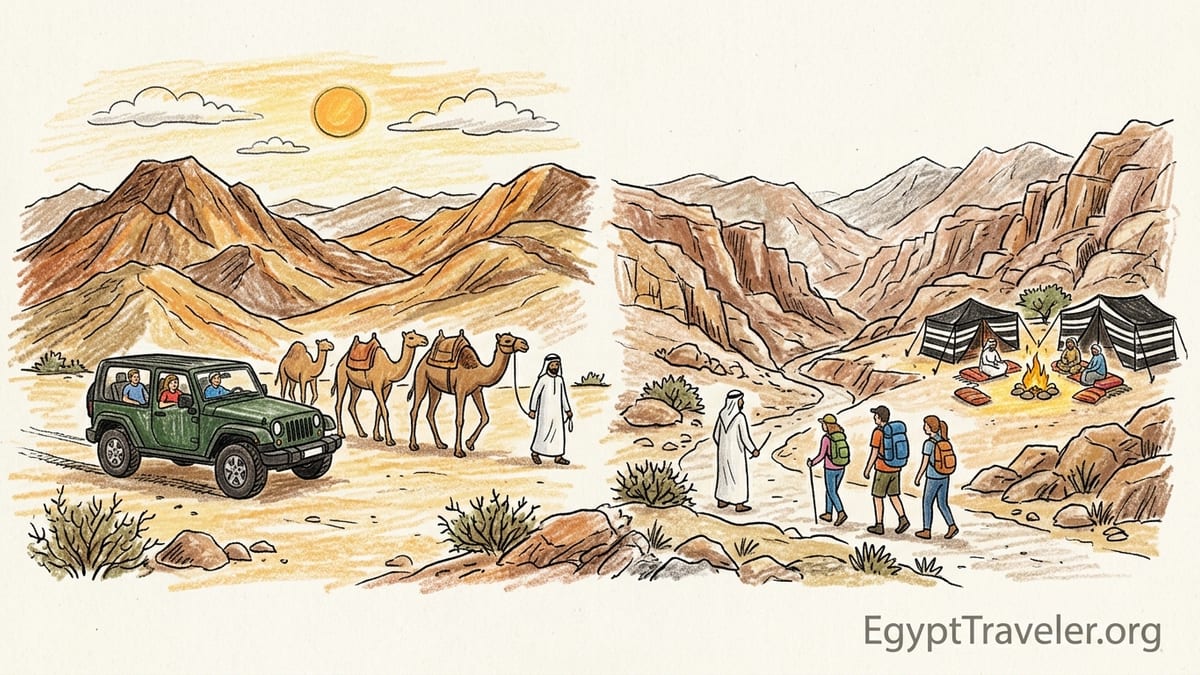
Understanding Sinai Desert Safaris Today
Sinai safaris now range from short, four‑hour jeep runs into the hills behind Sharm El Sheikh to week‑long expeditions that cross mountain passes and sleep in remote wadis. A typical visitor might only see the desert during a combined quad‑bike and Bedouin dinner package offered by a Sharm resort, while a hiker flying into Dahab or Nuweiba may come specifically for a multi‑day trek guided by local Bedouin tribes. Both are valid ways to experience Sinai, but they offer very different levels of immersion, effort and risk.
From Sharm El Sheikh, the most common safaris are half‑day or evening trips that pair 4x4 or quad‑bike driving with a short camel ride, barbecue dinner and a basic stargazing session. In Dahab and Nuweiba, shorter trips also exist, but there is a stronger culture of canyon hikes, camel safaris and longer treks that might run three days between desert oases, with all food cooked on open fires and nights spent on mattresses under the stars. Rough Guides and other publishers note this spectrum, from easy half‑day outings to more demanding journeys that require solid fitness and planning in partnership with Bedouin communities.
For travelers, the key question is not just “What can I do?” but “How far from the resort corridor do I really want to go?” Short safaris are usually designed to get you back to your hotel the same night and involve minimal walking. Longer treks leave behind paved roads and mobile signal and depend heavily on your guide’s knowledge of wells, weather and tribal land. This article will walk through each option and help you choose the format that suits your time, budget and appetite for adventure.
Short 4x4 and Jeep Safaris from Sharm, Dahab and Nuweiba
Short 4x4 trips are the default introduction to the Sinai desert, especially from Sharm El Sheikh. Tour brochures in Naama Bay and near Nabq typically advertise three‑hour “desert safaris” that include hotel pick‑up, a 20 to 40 kilometre jeep ride into the rocky desert, a stop at a simple Bedouin tent for tea, and occasionally a brief camel ride at sunset. Prices in 2026 often fall in the range of 25 to 40 US dollars per person in a shared group, with discounts for families or large parties negotiated on the spot.
What is usually included is transport from your hotel, the use of the 4x4 vehicle with driver, soft drinks or bottled water, and a very light snack or barbecue dinner if you book an evening departure. The driving time tends to be longer than the time actually spent walking or sitting by the fire. On a typical Sharm trip you might be in the jeep for 60 to 90 minutes in total, broken by photo stops at viewpoints or in a wide sandy wadi, and only 15 to 30 minutes on foot exploring nearby rocks or climbing a low hill for sunset views.
Dahab offers similar jeep excursions, but the focus often shifts toward specific locations such as the so‑called “White Desert” above the town or remote valleys behind the Blue Hole. Operators based in Dahab’s Lighthouse and Mashraba districts usually sell half‑day trips starting around the equivalent of 30 to 45 US dollars per person, again with door‑to‑door transfers included. From Nuweiba, jeep safaris might head into nearby canyons or to desert lookouts above Tarabin beach camps, often arranged directly with camp owners who know which local drivers are available that day.
On short 4x4 safaris, group sizes commonly range from 8 to 20 people per jeep convoy, sometimes with several vehicles travelling together. Private trips are easy to arrange but cost more; a family or couple hiring a jeep for themselves might pay close to 100 US dollars or more for a customised four‑hour outing, depending on negotiation, fuel prices and the season. In every case, your main physical effort is getting in and out of the vehicle and walking short distances on sand or uneven rock.
Camel Excursions, Bedouin Dinners and Stargazing Evenings
Camel excursions and Bedouin dinners are among the most atmospheric but also most variable experiences on offer, especially from Dahab and Sharm. In Dahab, early evening trips such as mountain dinners or stargazing experiences typically begin with a short transfer by jeep into the low hills behind town, followed by a 10 to 20 minute walk or camel ride to a Bedouin camp where dinner is prepared. Some Dahab operators advertise four‑hour “Bedouin dinner and stargazing” packages that include a simple grilled chicken or vegetarian meal cooked in the sand, unlimited Bedouin tea and a guided look at the night sky through a telescope, starting at roughly 700 Egyptian pounds per person.
From Sharm El Sheikh, resort desks and local agencies in the old market commonly sell combined quad‑bike, camel ride and Bedouin dinner evenings. A typical package might have you ride quad bikes for an hour on a marked track, transfer by jeep to a camp, take a ten‑minute camel loop around the site, then sit on cushions for a buffet‑style barbecue. Many of these programs also include a short folkloric show with music or belly dancing before the stargazing portion. Prices are often quoted in euros or dollars, with recent travelers reporting around 50 to 60 euros per person for the full evening, including hotel pickup and drop‑off.
In Nuweiba, the emphasis is less on staged shows and more on quiet beach or desert nights. Several eco‑style camps north of town arrange informal Bedouin dinners in the desert plateau behind their properties or in nearby wadis, usually for small groups. You might be driven 20 to 40 minutes inland in a pickup or 4x4, then walk a short way into a sheltered valley where your hosts light a fire, bake fresh bread on the coals and grill fish or chicken. Stargazing here is particularly impressive because light pollution is minimal; on moonless nights the Milky Way arches clearly above the silhouettes of the Sinai mountains.
In all three hubs, most evening safaris involve more sitting than walking. Expect a short climb up a low hill to watch sunset, a few minutes mounting and dismounting camels if they are part of the program, and then an hour or more seated on mats around a communal fire. Specialist stargazing providers, including small outfits that base themselves near Nuweiba, sometimes operate multi‑night programs that combine seaside camp stays with guided telescope sessions and one or two Bedouin dinners in the interior. These tend to be more expensive per night but also more focused on astronomy and desert silence than on entertainment.
Canyons, Oases and Classic Day Trips
For many visitors, the first taste of a wilder Sinai comes on day trips to canyons and oases that lie a couple of hours’ drive from the coast. The most famous example is the Coloured Canyon near Nuweiba, a sandstone gorge carved into swirling red and yellow rock. From Sharm, full‑day outings to the Coloured Canyon often combine a long 4x4 transfer across the desert with a guided hike through the narrow sections of the gorge, lunch at a roadside restaurant and sometimes a quick swim stop at a beach on the Gulf of Aqaba. Total prices can easily reach 70 to 100 US dollars per person once transport, lunch and park fees are included.
From Dahab and Nuweiba, canyon trips are usually shorter and more flexible. You might leave Dahab mid‑morning in a jeep, reach the start of the canyon hike within 90 minutes and spend two to three hours scrambling, squeezing and sliding through the rock before returning to town by late afternoon. Local agencies also advertise day trips that link multiple sites, such as the White Canyon and Ain Khudra oasis, or hikes in the wadis that run between Nuweiba and St Catherine. Walking distances on these trips are still manageable for most reasonably fit travelers, but there are sections that require climbing small rock steps, balancing on boulders and tolerating heat in confined spaces.
Another popular variation from Dahab is the classic desert and sea combination around Ras Abu Galum and the Blue Lagoon. One common itinerary has you driven or taken by boat to the Blue Hole area, ride camels for an hour or so along the coastline to the palm‑lined Ras Abu Galum reserve, snorkel among coral gardens and share a simple fish lunch cooked by a Bedouin family in a beach hut. While this is not a desert safari in the strict inland sense, it does introduce the coastal side of Bedouin life and often includes an overnight option in a basic hut, which can be an excellent stepping stone before committing to more remote inland treks.
Nuweiba’s spread‑out coastline, with its small beach camps and view of Saudi Arabia’s Hejaz mountains across the water, also makes it an appealing base for mixed sea and desert days. Many camps can arrange morning snorkelling followed by afternoon jeep rides up into the mountains behind town, where you might explore short slot canyons, seasonal gardens or hidden viewpoints. These outings typically remain within an hour or two of the coast and return before dark unless you specifically ask to sleep out in the desert.
Multi‑Day Treks and Authentic Bedouin‑Guided Journeys
For travelers seeking a deeper experience, Sinai’s multi‑day treks are the closest thing to the classic desert journeys described in older travel literature. These are usually organised with Bedouin guides from tribes such as the Jebeleya, Muzeina or Tarabin, and they often follow ancient footpaths and camel routes between wells, oases and high passes. A typical three‑day trek from Dahab or Nuweiba might involve daily hikes of 10 to 18 kilometres with 300 to 700 metres of elevation gain, supported either by camels carrying luggage or by a 4x4 vehicle that meets the group at prearranged camping spots.
Commercially, three‑day small‑group treks sold through international platforms often start in the range of 350 to 600 US dollars per person, depending on the level of support and group size. This usually covers local transport from a coastal town to the trailhead, licensed Bedouin guides, all meals cooked on open fires, camping equipment such as mattresses and blankets, and drinking water or the means to purify it. Privately arranged treks booked directly with Bedouin guides or community‑run organisations may cost less per day, but the total price still needs to reflect fair wages for the team, permit fees and the additional logistics of carrying gear safely through remote terrain.
A multi‑day trek typically involves far more walking than driving. You may spend only one to two hours in a 4x4 at the start and end of the route, then walk for five to seven hours each day, with long lunch breaks in the shade of an acacia tree or rock overhang. Nights are usually spent in open desert campsites, sometimes with low stone windbreaks but no permanent buildings. Meals are based on simple staples such as rice, lentils, vegetables, flatbread, and occasionally meat cooked in traditional styles. Many itineraries also include time for quiet reflection at viewpoints, visits to small Bedouin gardens or orchards, and informal lessons in reading tracks, plants and stars from your guides.
In contrast with more theatrical “Bedouin villages” built to entertain bus tours, these treks are embedded in real Bedouin life. The guides often use routes and camping spots known to their families for generations, and decisions about water, weather and timing are made with reference to both tradition and modern safety considerations. Because these journeys leave the resort corridor far behind, it is essential to go with properly licensed operators or recognised local guides who understand permit systems, restricted military areas and recent changes in access rules. Travelling with unofficial guides or without permits can result in trips being turned back at checkpoints or, more importantly, compromised safety if an emergency arises.
How to Choose: Tourist Safari vs Genuine Trek
Distinguishing a short tourist safari from a genuine multi‑day Bedouin‑guided trek starts with examining the balance of driving to walking, and the advertised level of comfort. If an experience promises hotel pickup in Sharm at 3 pm and a return by 9 pm, includes quad bikes, a camel ride, a buffet dinner, a show and stargazing, then by definition it is a compact tourist outing. These trips can be fun and family‑friendly, but the desert component is limited to accessible areas close to roads and large groups. You will likely share the experience with dozens of other travelers and see power cables, floodlights and sound systems around the camp.
By contrast, a real multi‑day trek usually replaces engines with feet or camels for most of each day, and trades fixed camps with generators for wild camps in quiet wadis. The brochure or website will talk about daily walking hours, elevation gain and what kind of sleeping arrangements are offered, rather than focusing on quads, shows or karaoke. Group sizes are often smaller, sometimes capped at eight to twelve guests, and departure dates may be tied to cooler months or moon phases rather than running every evening of the year.
Price is another indicator, but it needs to be interpreted with context. A three‑hour sunset jeep and dinner package from Sharm for under 40 US dollars makes sense because the operator can run the same route daily, feed large groups with simple buffet food and rely on a short supply chain. A three‑day trek that costs under 200 US dollars per person inclusive of food, transport and staff should raise questions about how guides and camel owners are being compensated and whether corners are being cut on safety equipment or permits. At the same time, very high prices quoted through international middlemen might not reflect what local teams are actually paid, which is one reason many experienced hikers prefer to connect directly with Bedouin‑run outfits once on the ground.
Finally, look at who leads the trip and how they talk about the land. On a tourist safari, your main contact may be a multilingual host or entertainer whose job is to move the group smoothly between activities. On an authentic trek, your Bedouin guide is central not just as a pathfinder but as a cultural bridge. Expect them to set the pace, choose rest stops, explain local customs and handle interactions at checkpoints or with other Bedouin along the way. When researching, seek providers who clearly identify which tribe or community they work with, and who mention specific mountains, wadis and seasonal considerations rather than only generic “desert adventures.”
Practicalities: What Is Included, Group vs Private and Etiquette
Across most Sinai desert experiences, a standard inclusions list covers transport from your hotel or camp, guiding, basic safety oversight and in the case of evening or multi‑day trips, meals and hot drinks. On short safaris from Sharm or Dahab, that typically means hotel pickup by minibus or jeep, the main activity such as quad biking or a jeep ride, a simple Bedouin tea stop and perhaps a barbecue dinner. Alcohol is rarely included and often not served at all in desert camps, so travelers who wish to drink usually do so back at their hotels. Bottled water is almost always provided, though bringing your own refillable bottle is a good idea in the dry air.
For day hikes to canyons or mountain viewpoints, the price normally includes return 4x4 transfers, a licensed desert or mountain guide, and sometimes a picnic lunch or a hot meal cooked at an oasis. Entry permits or park fees are often bundled into the ticket price, but it is wise to confirm this when booking to avoid surprises at checkpoints. On multi‑day treks, inclusions expand to cover all meals on the trail, camping equipment such as mattresses and blankets, and sometimes a small support team that may include a cook and camel handlers. You will usually bring your own sleeping bag and personal gear, while the guides supply cookware, communal shelter and navigation.
Group tours are the default for budget‑conscious travelers and for short safaris marketed through hotels. These are sociable and good value, but the pace is set for the group and there can be queues for activities such as telescope viewing or narrow canyon sections. Private tours, whether for an evening or a week, are easier to tailor. A family with young children might request slower walks and longer rest stops, while experienced hikers could ask for more demanding daily distances and quieter routes. Private arrangements also give you more space to interact with your Bedouin hosts and to ask questions without competing with a large group’s timetable.
Cultural etiquette is central to a rewarding experience. In Bedouin settings, modest clothing is appreciated, especially on visits to villages or family homes. For both men and women, covering shoulders and knees is a simple sign of respect, even if beachwear is normal back at the coast. Always ask before photographing people, particularly women or elders. Accepting at least one cup of tea is polite, as tea is a ritual of hospitality, and it is customary to remove shoes before sitting on cushions around low tables if your hosts do so. During Ramadan or around religious holidays, schedules may change and meals break for prayer, so patience and flexibility go a long way.
Safety, Licensed Guides and When to Go
Even short Sinai safaris venture into environments where temperature swings, sudden wind and uneven ground can catch visitors by surprise. Longer treks add the challenges of navigation, water management and remoteness from medical care. This is why traveling with licensed guides and reputable local operators is strongly recommended. Licensed desert and mountain guides are familiar with local regulations, know where permits or police notifications are required and maintain working relationships at checkpoints. They also bring practical knowledge of flash‑flood risks in wadis, recent rockfalls in canyons, and the condition of tracks that may have been altered by winter rains.
Using unofficial guides or trying to walk independently without local knowledge can lead to real problems. Some areas of Sinai remain sensitive border zones, and access rules can change, with some valleys or passes suddenly closed to visitors. A licensed Bedouin guide will hear about such developments quickly through community networks. They also understand where mobile phone coverage is available or absent, which wells are currently reliable and how to manage emergencies, from minor injuries to vehicle breakdowns. Responsible operators carry at least basic first‑aid kits and communication options such as radios or satellite messengers on more remote routes.
Seasonal timing matters greatly. The main trekking season in South Sinai typically runs from late October to April, when days are cooler and nights can be cold but manageable with proper clothing. Winter can bring occasional rain and even rare snow on the highest peaks around St Catherine, which makes campfires and warm layers essential. In the peak summer months from June to September, full‑day hikes in the interior can be dangerously hot for those unaccustomed to desert conditions, and many serious treks either shift to higher elevations, start very early in the morning or pause entirely until temperatures drop.
Regardless of season, travelers should be realistic about fitness levels and disclose any medical conditions when booking. Even jeep‑based trips can involve bumpy rides that are uncomfortable for those with back issues, while canyon hikes may not be suitable for people with severe claustrophobia or limited mobility. Bringing sunscreen, a hat, sturdy closed shoes and a warm layer for night is a basic non‑negotiable. If in doubt, start with a shorter evening safari from Dahab or Nuweiba, see how you feel in the desert environment, and then decide whether to commit to longer journeys.
FAQ
Q1. How long do desert safaris from Sharm El Sheikh usually last?
Most popular safaris from Sharm are half‑day or evening trips lasting 3 to 6 hours, including hotel transfers, with only a small portion of that time spent outside vehicles.
Q2. What is a realistic price range for a Bedouin dinner and stargazing evening in Dahab?
Shared group evenings that include transfers, dinner, tea and basic stargazing commonly start around the equivalent of 20 to 30 US dollars per person, with higher prices for smaller or private groups.
Q3. Are camel safaris comfortable for people who have never ridden before?
Short camel rides of 15 to 45 minutes are designed for beginners and are usually comfortable, though some people experience mild muscle stiffness afterward, so longer rides should be approached gradually.
Q4. Can I do a canyon hike such as the Coloured Canyon with children?
Many canyon trips are suitable for active children aged 8 and above, but they involve scrambling over rocks and narrow passages, so parents should discuss specific routes and any height or age limits with the operator.
Q5. How many days do I need for a genuine Sinai trekking experience?
A three‑day, two‑night trek is often the minimum for a meaningful journey that includes full days of walking, remote camping and time to connect with your Bedouin guides and the landscape.
Q6. Do I need special permits to hike in the Sinai desert?
Permits and notifications are required in some areas, but these are almost always handled by your licensed tour operator or Bedouin guide, which is another reason to avoid independent travel off established tourist routes.
Q7. What should I wear on a desert safari in Sinai?
Light, breathable clothing that covers shoulders and knees, sturdy closed shoes, a sun hat and a warm layer for after dark are recommended for both comfort and cultural respect.
Q8. Is it safe to join a shared group safari as a solo traveler?
Solo travelers commonly join shared jeep or dinner‑and‑stargazing tours from Sharm, Dahab and Nuweiba, and these are generally considered safe when booked through reputable, licensed operators.
Q9. How do I know if a Bedouin camp or trek is genuinely community‑run?
Community‑run trips usually name the tribe involved, describe how income supports local families, and feature Bedouin guides as the main hosts rather than as background staff to a large outside company.
Q10. When is the best time of year for stargazing in the Sinai desert?
The clearest, darkest skies are usually found between late autumn and early spring on moonless nights, when humidity is low and there is little haze from summer heat.