


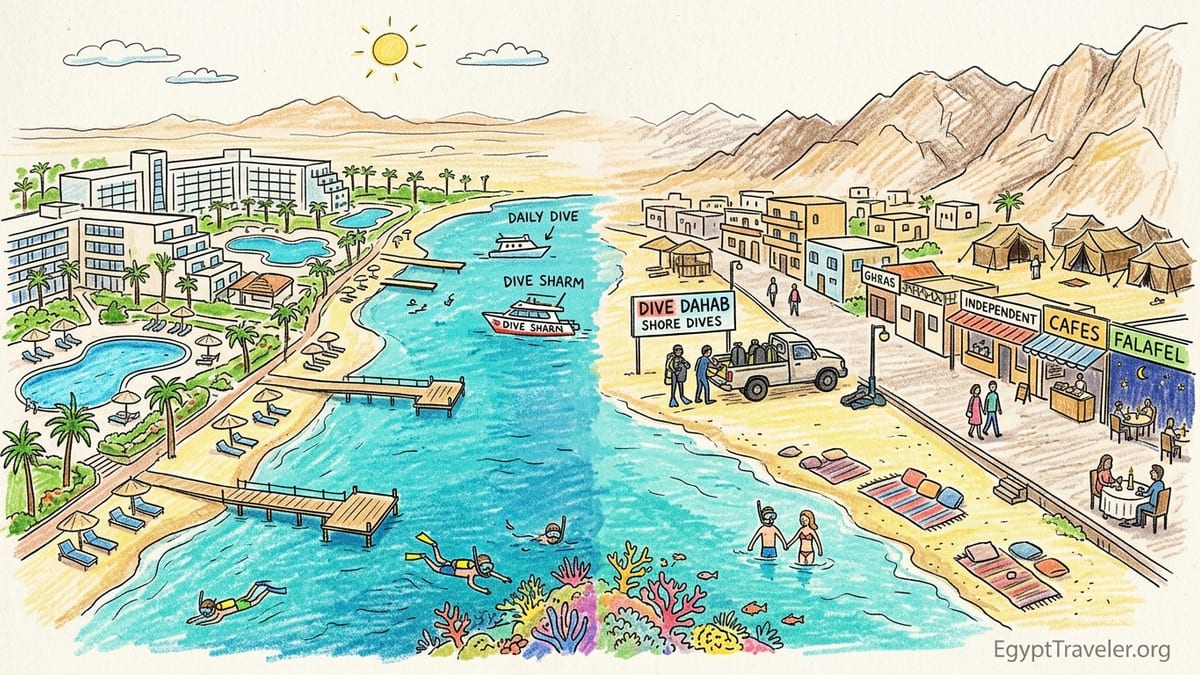
On Egypt’s South Sinai coast, only 90 kilometers of desert road separate Sharm El Sheikh and Dahab, yet they deliver two very different styles of Red Sea holiday. One is a global resort hub of all inclusive hotels, beach clubs and boat trips. The other is a laid back town of small guesthouses, shore dives and barefoot cafes. Choosing the right base will shape everything about your trip, from budget and nightlife to how you dive, snorkel and explore the desert.
Overview: Two Very Different South Sinai Bases
Sharm El Sheikh sits at the southern tip of Sinai and has grown into one of Egypt’s largest resort destinations, with long strips of gated four and five star hotels, shopping promenades and family focused beach complexes. Areas such as Naama Bay, Sharks Bay and Hadaba are packed with large properties that include multiple pools, private beaches and on site dive centers. Package deals from European tour operators often bundle flights, transfers and an all inclusive stay, which helps keep daily costs predictable for resort style travelers.
Dahab began as a Bedouin fishing village and still feels more like a small town than a resort city. The seafront promenade that runs through the Lighthouse, Mashraba and Assalah neighborhoods is lined with small hotels, backpacker hostels and local owned dive centers. Most properties have 10 to 40 rooms rather than hundreds, and it is still common to find simple camps or guesthouses a short walk from the water. The atmosphere is slower, with more independent cafes, falafel stands and juice bars than global franchises.
In practical terms, you are deciding between a self contained resort hub and a relaxed, walkable town. Both share the same clear Red Sea water and dramatic desert mountains, and both give access to world class reefs. The choice is about how you prefer to stay, move and spend: all inclusive packages and polished infrastructure in Sharm versus à la carte spending and a more bohemian, long stay vibe in Dahab.
Because the two are only around 90 minutes apart by road, some travelers split their time, for example three days of resort life in Sharm followed by four days of chilled shore diving in Dahab. If you must decide on a single base though, it helps to match each destination to your travel style, budget and expectations for nightlife, diving, family facilities and desert excursions.
Accommodation & Cost: Luxury Resorts vs Independent Stays
Sharm El Sheikh’s accommodation market is dominated by large, often international brand resorts. Along Sharks Bay and Nabq Bay you will find names like Rixos, Hilton, Jaz and Sunrise, with complexes featuring several pools, on site water parks, kids’ clubs and multiple buffet and à la carte restaurants. A typical seven night all inclusive package from Europe in shoulder season might cost in the region of 500 to 900 euros per person including flights, depending on hotel category and timing. On the ground, this can work out cheaper than paying separately for meals and drinks, especially for families who spend most of their time inside the resort.
Mid range stand alone hotels do exist in Sharm, particularly in Naama Bay and Hadaba, but they are overshadowed by the sheer number of big resorts. Many mid range properties still mimic the resort model with half board or all inclusive pricing, large pools and private beach access. For independent travelers who prefer to eat out and choose activities day by day, that can feel restrictive, and prices at hotel restaurants, spas and shops are typically higher than in town.
Dahab’s accommodation scene is almost the mirror opposite. Here, small hotels, beach camps and guesthouses dominate, with a scattering of mid scale boutique properties and only a handful of true resort style complexes. It is common to find a simple sea view room along the Lighthouse promenade or in Mashraba for a price that is often significantly lower per night than Sharm’s four star resorts, especially outside of peak holiday periods. Many of these places offer bed and breakfast only, leaving you free to try different waterfront cafes and grill restaurants each evening at local prices.
Budget travelers and long stay guests tend to favor Dahab because monthly deals on apartments or guesthouse rooms can be comparatively affordable, especially further back from the seafront in Assalah or around the lagoon area. Divers often negotiate discounted room and dive packages directly with centers when booking a week of guided shore dives or a full certification course. Overall, Sharm generally suits travelers who like paying upfront for comfort and convenience, while Dahab works better for those who value flexibility, independent dining and longer, slower stays.
Nightlife, Atmosphere & Who Each Town Suits
Sharm El Sheikh has the liveliest nightlife scene in South Sinai. Naama Bay in particular is known for its promenade of bars, shisha lounges and late opening restaurants where music spills out onto the walking street. Large beach clubs host DJ nights during busier seasons, and areas such as Soho Square near Sharks Bay add illuminated fountains, cocktail bars, ice bars and bowling alleys to the mix. Many resorts also run their own evening entertainment programs with live music, dance shows and kids’ discos, so you do not have to leave the property to find something to do after dark.
The crowd in Sharm is a broad mix: all inclusive package holidaymakers from Europe, families from across the Middle East, and short break visitors combining sun, spa and a couple of boat trips. Dress codes are relaxed in tourist areas, and you can expect a fairly classic resort town feel: souvenir shops, desert safari agencies, neon lit arcades and promenade touts. If your ideal evening is choosing between multiple restaurants, people watching along Naama Bay, then finishing with a drink at a hotel bar, Sharm is built for you.
Dahab presents a very different kind of nightlife. Along the waterfront, simple restaurants lay low cushions and rugs by the water, serving grilled fish, mezze and fresh juices. Many close around midnight or a little later, and the tone is more social than high energy. Expect candle lit tables under the stars, acoustic music at a local bar, or a low key beach bonfire organized by a dive center. Alcohol is available at some venues, but the overall atmosphere is less about clubs and more about conversations after a day in the water.
This calmer rhythm attracts a different mix of travelers: digital nomads working from seafront cafes, long term freedivers training at the Blue Hole, kite surfers based near the lagoon, and backpackers combining Egypt with wider Middle East routes. Families with teenagers and active kids often appreciate Dahab’s safe feeling, compact promenade, where young people can walk between gelato shops and falafel stands without needing a taxi. If you want a slower, more communal atmosphere and are happy with nightlife measured in stargazing and storytelling rather than laser lights, Dahab is the better fit.
Beaches, Snorkeling & Diving Style
Sharm El Sheikh’s coastline is indented with bays backed by resorts, and many hotels are built directly on coral fringed ledges. This makes for spectacular snorkeling, but it also means that at many properties the beach is a platform or narrow band of sand with jetty access to deep water, rather than long natural sand beaches. To swim or snorkel you often walk along floating pontoons that drop you at the edge of the house reef. Popular snorkeling areas include Ras Um Sid near Hadaba, where cliff top cafes overlook a sweeping coral wall, and fan favorite boat trip destinations such as Ras Mohammed National Park and Tiran Island.
Diving in Sharm is predominantly boat based. Divers typically join daily dive boats from the jetty at Sharm El Maya or from jetties in Sharks Bay and Nabq, heading to sites like Shark Reef and Yolanda Reef in Ras Mohammed, or Jackson, Thomas, Woodhouse and Gordon Reefs around Tiran. This setup suits those who enjoy full day excursions with lunch on board and a social, group based feel. It is especially convenient for resort guests because many dive centers include hotel pickups, gear storage at the center and rinse facilities back at the marina.
In Dahab, the rhythm of diving and snorkeling is entirely different. Most dive sites are shore accessible, meaning you kit up at the dive center, walk or drive a few minutes along the coast, and enter the water from the beach or rocky shoreline. Classic locations such as Lighthouse, Eel Garden, the Canyon and the Blue Hole are all reached this way. A typical Dahab dive day might involve loading tanks onto the back of a pickup or local truck, driving ten to twenty minutes along the coast, having tea at a Bedouin style shore cafe, then walking straight into the water for a dive.
This shore diving culture appeals strongly to independent divers, photographers and those who dislike long boat rides. It also makes training courses more relaxed, because beginner divers can repeat skills in the same sheltered bay without worrying about boat schedules. For snorkelers, Dahab’s accessible drop offs and shallow coral gardens just off the beachfront cafes provide an easy way to spend hours in the water with minimal logistics. If your Red Sea dream is waking up in a small guesthouse, sipping coffee, then strolling 50 meters to a dive site, Dahab is likely to match that vision better than Sharm.
Families, Couples, Backpackers & Slower Travel
For many families, particularly those traveling with younger children, Sharm El Sheikh is the clear front runner. The major resorts offer children’s pools, splash parks, supervised kids’ clubs, buffet restaurants where fussy eaters can always find pasta or chips, and evening mini discos. Parents can arrange babysitting through the hotel and enjoy spa treatments or a quiet dinner without leaving the property. Transfers from Sharm El Sheikh International Airport to resort areas like Sharks Bay or Nabq Bay often take 10 to 20 minutes in a pre arranged hotel shuttle or private car, which keeps arrival day simple.
Dahab can work well for families, especially those with confident swimmers or teenagers, but it demands more involvement from parents. Most accommodations are smaller and have simple pools or none at all, so days revolve more around the sea and outdoor activities than water slides and kids’ clubs. Families who enjoy active travel often appreciate Dahab’s walkable seafront and the ability to drop into local bakeries, fruit stalls and Egyptian restaurants without feeling they are confined to a resort bubble. It is common to see families renting basic apartments near the promenade and integrating into local daily rhythms for a week or longer.
Couples have good options in both destinations, depending on their priorities. Those seeking a classic romantic resort break with spa treatments, polished service and private hotel beaches may gravitate to Sharm’s five star properties. Honeymooners often choose rooms with direct pool access or sea view suites in Naama Bay or Sharks Bay, combining lazy resort days with one or two boat trips to Ras Mohammed. In contrast, couples who prize shared experiences over formal luxury might favor Dahab’s boutique guesthouses or small seaside hotels, spending evenings in low key cafes and taking shared jeep trips to remote snorkel coves.
Backpackers and long term travelers overwhelmingly lean toward Dahab. Nightly dorm beds in hostels, discounted monthly rates in simple rooms, and the possibility of combining casual work with afternoon dives or kite sessions make it a hub for budget conscious, slow travelers. Co working friendly cafes have sprung up along the seafront, and it is common for visitors to extend a planned week into a month. In Sharm, budget travelers exist but are less visible among the big resort complexes, and costs for food and nightlife within resort zones can add up quickly compared to Dahab’s local eateries.
Access, Airport Transfers & Getting Around
One of Sharm El Sheikh’s major advantages is direct air connectivity. Sharm El Sheikh International Airport receives regular seasonal and year round flights from multiple European cities as well as domestic connections from Cairo and other Egyptian hubs. This makes it straightforward to arrive on a package holiday where airport transfers are included in the price, or to arrange a simple private transfer if you book flights and accommodation independently. New arrivals can often be on a sun lounger at a resort in Sharks Bay or Naama Bay within an hour of landing, including immigration and baggage claim.
Dahab does not have its own airport, so almost all international visitors fly into Sharm and then continue by road. The journey typically takes around 80 to 90 minutes, following the coast road through the desert. Private taxis are widely available on arrival and many Dahab hotels and dive centers will pre arrange a transfer, with typical prices that are modest when shared between two or three people. Shared minibuses and local buses also operate, though schedules can change and are best confirmed locally once you arrive. For most travelers, the extra transfer is a minor inconvenience rather than a major obstacle.
Within Sharm El Sheikh, distances between bays are significant enough that you will mainly rely on hotel shuttles, taxis or ride services to move around. A family staying in Nabq Bay, for example, might take a hotel shuttle or taxi to spend an evening in Naama Bay, then return to the quieter resort strip to sleep. Walkable areas do exist, particularly in Naama Bay, but overall Sharm is spread out along the coast. Many visitors simply stay within their chosen bay and join organized excursions that include hotel pickup.
Dahab, in contrast, is compact and highly walkable along the seafront. Travelers commonly stroll from the Lighthouse area to Mashraba in the evening, choosing a restaurant simply by ambiance and menu. Short taxi hops or local pickups cover trips to more distant sites such as the Blue Hole or the lagoons. The smaller scale means you quickly recognize faces in cafes and dive shops, which adds to the sense of community and makes Dahab feel especially welcoming for solo travelers and slow travelers who appreciate routine.
Desert Excursions & Access to Mount Sinai
Both Sharm El Sheikh and Dahab offer a wide range of land based excursions into the surrounding Sinai desert, including quad biking at sunset, camel rides, Bedouin style dinners and star gazing trips. Tour agencies are highly visible in Sharm’s resort areas, often with desks inside hotels, and can arrange half day or full day jeep safaris to the colored canyons near Nuweiba, sandboarding trips and combined sea and desert packages. Prices vary by operator and level of group versus private service, but competition is strong so you can usually compare quotes along Naama Bay or via your resort concierge.
Dahab benefits from being physically closer to some of the classic desert attractions along the Gulf of Aqaba coast, such as the Blue Lagoon and Abu Galum Protected Area. Bedouin run trips from Dahab commonly combine boat or camel rides with snorkeling and simple fish lunches served under palm shelters on remote beaches with no road access. Because many of these experiences are run by local families who have used the same spots for generations, they often feel more personal and rooted in Bedouin culture, though standards of comfort and organization can be more rustic than large operator tours from Sharm.
Access to Mount Sinai and St Catherine’s Monastery is broadly similar from both bases. Overnight tours that depart around midnight to allow for a pre dawn summit and sunrise are widely sold in Sharm and Dahab alike. Travel time by minibus is usually around two and a half to three hours each way, depending on pickup points and rest stops. Many visitors book through their hotel or a trusted local agency rather than waiting until the last minute, as group sizes and departure days can fluctuate with demand and security considerations.
If climbing Mount Sinai and visiting St Catherine’s is a central focus of your trip, Dahab’s slightly more central position on the Gulf of Aqaba coast can shave some time off travel compared with resorts at the far southern tip of Sharm. However, the difference is not dramatic enough to be the sole deciding factor. In both cases you will be committing to a long, late night excursion, so it is wise to keep the day before or after relatively light, especially if you are also diving on the same trip and want to plan around recommended surface intervals before flying.
Which Base Works Best for Your Travel Style?
For resort oriented travelers who want a straightforward holiday with minimal planning, Sharm El Sheikh usually comes out ahead. If your priority is a modern room, multiple pools, organized kids’ activities, a spa and a choice of restaurants all inside your hotel gate, then areas such as Sharks Bay, Nabq Bay and Naama Bay deliver exactly that. You can add in two or three signature experiences, such as a boat day to Ras Mohammed, a desert quad safari and perhaps a glass bottom boat trip, all booked through your resort without ever negotiating on the street.
For divers, the decision is more nuanced. If you are an experienced diver keen to explore famous boat accessible sites with dramatic walls, currents and occasional big pelagic sightings, Sharm’s daily boat trips to Ras Mohammed and Tiran are a major draw. Liveaboard itineraries also frequently start or end in Sharm, which can be convenient if you want a few land based days before or after a safari. On the other hand, if you prefer a relaxed, shore based routine where you can repeat favorite sites, shoot photography without time pressure and enjoy informal post dive hangouts at beachfront cafes, Dahab’s shore diving culture is hard to beat.
Backpackers, budget travelers and digital nomads almost always find Dahab a better long term base. The combination of relatively low accommodation costs, inexpensive local food, walkability and a community of like minded travelers makes it easy to settle in. For couples and small groups of friends who see their accommodation primarily as a place to sleep between swims, hikes and shared meals, Dahab’s simple guesthouses and apartments offer good value without locking you into resort routines.
Travelers seeking a slower atmosphere, with more spontaneous interactions and a feeling of living in a town rather than visiting a tourist complex, also lean toward Dahab. By contrast, travelers who feel reassured by 24 hour reception desks, branded hotels and structured entertainment tend to relax more fully in Sharm. Families with young children and multi generational groups often appreciate Sharm’s amenities and short airport transfer, while families with older children who can snorkel, dive or kite surf independently may prefer Dahab’s active, outdoors oriented scene.
The Takeaway
In the end, Sharm El Sheikh and Dahab are complementary rather than competing destinations. Sharm is the polished resort gateway to South Sinai, with direct flights, large all inclusive hotels, boat based diving and an unmistakable holiday town atmosphere. Dahab remains a more intimate, low rise town where independent stays, shore diving and slow evenings by the water define the experience. Both share the same luminous Red Sea and desert mountains, yet the way you inhabit that landscape differs significantly.
If you picture your ideal Sinai break as a week of swim up bars, kids’ clubs, spa sessions and a couple of organized excursions, you will likely be happiest basing yourself in Sharm El Sheikh. If instead you imagine waking up in a small guesthouse, choosing a local cafe for breakfast, then wandering barefoot to a shore dive and chatting with the same group of travelers each evening, Dahab is your natural home. Many visitors who return to South Sinai time and again eventually try both and appreciate each on its own terms.
For travelers with flexible itineraries, a smart compromise is to fly into Sharm, spend a short time enjoying the easy comforts of a resort, then transfer up the coast for a slower stretch in Dahab. That way you experience the full spectrum of what South Sinai offers, from polished holiday infrastructure to laid back coastal town. Whichever base you choose, planning around your own priorities for comfort, cost, diving style and pace of life will reward you with a Red Sea stay that feels tailored rather than generic.
FAQ
Q1. Is Sharm El Sheikh or Dahab better for a first time visitor to South Sinai?
For a first time visitor who wants an easy, low planning holiday with resort comforts and packaged excursions, Sharm El Sheikh is usually the better introduction. Dahab suits first timers who are already comfortable traveling more independently and are happy with smaller hotels and a slower, more local feeling environment.
Q2. Which destination is cheaper overall, Sharm El Sheikh or Dahab?
On a day to day basis, Dahab tends to be cheaper for accommodation, food and diving when you book locally and avoid packaged extras. However, Sharm can be very cost effective if you secure a competitively priced all inclusive package from your home country, because flights, transfers and meals are bundled in.
Q3. Where is the better base for scuba diving, Sharm El Sheikh or Dahab?
Both are excellent, but with different styles. Sharm is stronger for boat diving to Ras Mohammed and Tiran, with dramatic walls and currents, while Dahab excels at shore diving with easy access to sites like Lighthouse, the Canyon and the Blue Hole. Experienced divers who prefer boat days often choose Sharm, while those who like a relaxed shore based routine gravitate to Dahab.
Q4. Is Dahab safe and practical for solo travelers?
Dahab is widely regarded as friendly and practical for solo travelers, with a compact, walkable center, plenty of small guesthouses and a strong community of divers, backpackers and digital nomads. As in any destination, it is wise to follow normal travel precautions, but the town’s scale and social scene make it easy to meet people and find reputable operators.
Q5. Which is better for families with young children, Sharm El Sheikh or Dahab?
Families with young children typically find Sharm El Sheikh easier, thanks to large resorts with children’s pools, slides, kids’ clubs and all inclusive dining. Dahab can work well for active families and those with older children who enjoy snorkeling, shore diving and walking around town, but it offers far fewer dedicated children’s facilities.
Q6. How hard is it to get from Sharm El Sheikh Airport to Dahab?
Getting from Sharm El Sheikh Airport to Dahab is straightforward. The road journey usually takes around 80 to 90 minutes by private taxi or pre arranged hotel transfer. Many Dahab accommodations and dive centers can organize a driver to meet you, and costs are moderate, especially when shared by two or three people.
Q7. Can I visit both Sharm El Sheikh and Dahab in one trip?
Yes, visiting both in one trip is common and often the best way to experience South Sinai. Many travelers spend a few days in a Sharm resort to relax after their flight, then transfer to Dahab for shore diving and a slower pace, or do the reverse if they prefer to end with resort comforts.
Q8. Which base is better for Mount Sinai and desert excursions?
Both Sharm and Dahab provide easy access to Mount Sinai and St Catherine’s Monastery through overnight tours, and both offer a range of desert safaris. Dahab is slightly closer to some Gulf of Aqaba coastal spots and can have a more local, Bedouin feel to its excursions, while Sharm offers a wider range of tour operators and more polished, large scale trips.
Q9. Is there good snorkeling directly from the beach in both places?
Yes, but the access differs. In Sharm, many resorts sit on coral ledges with jetty access to deep water, giving excellent house reef snorkeling but sometimes limited sandy entry. In Dahab, popular sites like Lighthouse and Eel Garden can be entered from the shore near waterfront cafes, with drop offs and coral gardens a short swim from the beach.
Q10. Which destination has a slower, more relaxed atmosphere?
Dahab has the slower, more relaxed atmosphere overall, with a low rise townscape, small independent hotels and a promenade of simple cafes and dive centers. Sharm is more developed and feels busier and more resort focused, especially around Naama Bay and the larger hotel strips.