

The Western Desert of Egypt stretches from the Nile Valley to the Libyan border, a vast sweep of sand, rock and oases that feels worlds away from Cairo and Luxor. For travelers, choosing between Siwa, Bahariya, the White and Black Deserts, Farafra, Dakhla and Kharga is less about ticking sights off a list and more about matching landscapes and local culture to your style of adventure. This guide compares the main Western Desert hubs in practical, real-world terms, helping you decide where to go for wild scenery, hot springs, archaeology, couples’ escapes and deeper desert safaris.
How to Choose Your Western Desert Base
Egypt’s Western Desert oases sit in a wide arc, from Siwa near the Libyan border down through Bahariya, Farafra and Dakhla to Kharga in the south. Most travelers visit on organized safaris from Cairo, often 2 to 7 days by 4x4, with camping in the White Desert or Black Desert and overnights in simple guesthouses or desert camps. Trips typically start around the price of a mid-range Cairo hotel night per day, rising if you want private vehicles, hot showers in camp and high-end ecolodges.
If you primarily want surreal desert landscapes with a one-night camp under the stars, Bahariya plus the White Desert is usually the most efficient choice. For a slower, more cultural journey with traditional villages, mud-brick architecture and Roman and early Christian sites, the southern oases of Farafra, Dakhla and Kharga work better on a 4 to 6 day loop from Cairo or Luxor. Siwa, far northwest, is best for travelers with at least 3 or 4 days to spare and who like cycling between palm gardens, salt lakes and iconic hot springs.
Accessibility and infrastructure vary sharply. Bahariya and the White Desert see the most safari traffic and have the widest choice of operators and basic desert camps. Farafra remains quiet and feels remote despite improved roads. Dakhla and Kharga are larger and more developed, especially Kharga, which serves as the administrative center of the New Valley Governorate. Siwa still feels like a world apart, with Berber culture, mud-brick villages and boutique eco-lodges around its lakes and dunes.
Different travelers will gravitate to different corners of the Western Desert. Couples and photographers may prefer Siwa and the White Desert. Serious hikers and off-road enthusiasts gravitate to Bahariya, the Black Desert and multi-day loops through Farafra and Dakhla. History-focused visitors will get the most from Dakhla and Kharga, where Roman forts and early Christian necropolises sit just beyond fields of date palms.
Siwa Oasis: Berber Culture, Salt Lakes and Romantic Escapes
Siwa lies roughly 560 kilometers from Cairo, closer to Libya than to the Nile. The journey usually takes 8 to 9 hours by private car or about 10 hours by bus, which is why most travelers commit at least three nights. In return, you get a distinctive Amazigh (Berber) culture, a compact palm-filled town, and a series of hot and cold springs that make Siwa one of Egypt’s most atmospheric desert getaways.
The best-known spring is Cleopatra’s Bath, a stone-edged pool of clear water where locals and visitors come to swim, especially in the milder hours of the day. A more low-key option is Fatnas Island west of town, where simple cafés look out across a salt lake framed by palm trees and distant dunes. Small ecolodges around Dakrur Mountain and in the palm gardens advertise natural hot-water pools that bubble up at a bath-like temperature, ideal after a day of dune bashing or cycling.
Siwa’s built heritage is unusually picturesque. The ruins of the old mud-brick fortress of Shali rise from the center of town, particularly striking at golden hour when the sun catches its crumbling walls. On the outskirts, the Temple of the Oracle of Amun recalls the oasis’ role as a pilgrimage and political center in pharaonic times. Between visits, many travelers rent a bicycle from a shop in central Siwa and follow quiet palm-lined tracks to springs, gardens and small villages.
For couples, Siwa is one of the most romantic places in Egypt: think sunset on a dune above the Great Sand Sea, a simple candlelit dinner in a mud-brick guesthouse and stargazing in dry, crystal-clear skies. Adventure travelers use Siwa as a gateway to multiday expeditions into the Great Sand Sea on 4x4s, with nights in remote camps among giant dunes. These deeper safaris require reputable local operators, as conditions are isolated and weather and sand can shift routes quickly.
Bahariya, White Desert and Black Desert: Classic Safari Country
Bahariya Oasis is the classic launchpad for desert safaris from Cairo, set roughly 360 kilometers southwest of the capital along a paved highway. Most short trips combine Bahariya with the Black Desert, the Crystal Mountain quartz ridge and a night camping in the White Desert. Operators sell two-day, one-night safaris that depart Cairo early, reach Bahariya by late morning, continue into the desert and return the next evening.
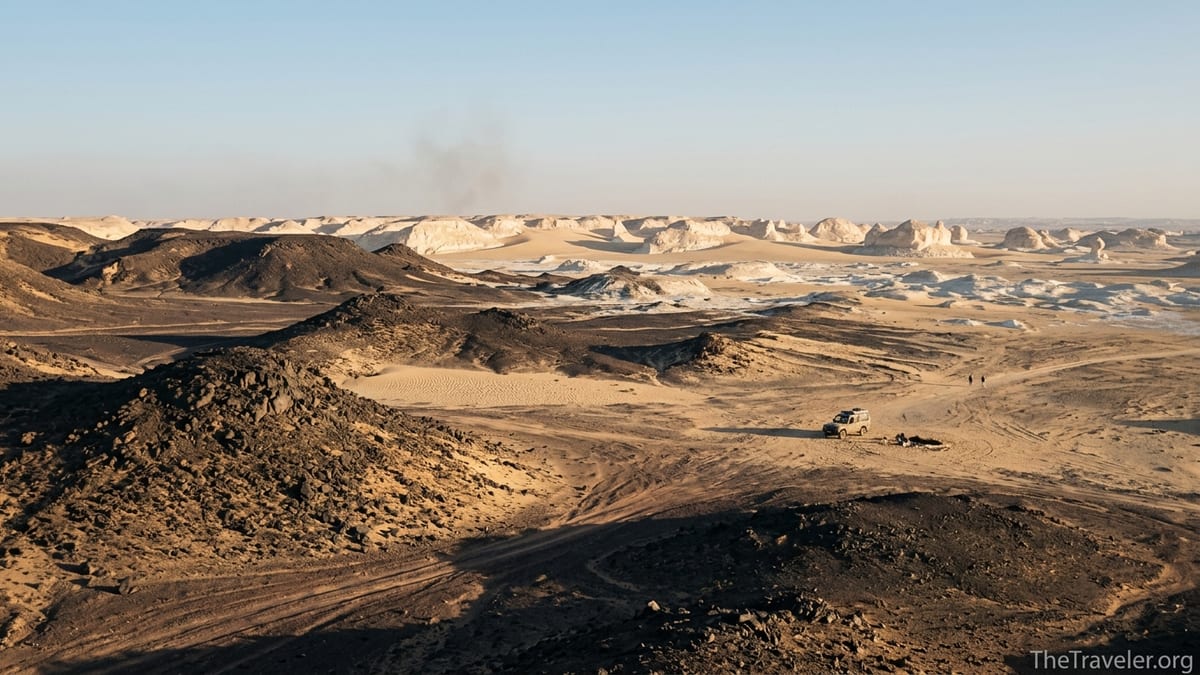
The White Desert National Park is the star attraction. Here, wind and time have sculpted the chalk plateau into an otherworldly landscape of white pinnacles, mushroom-shaped formations and eroded ridges. Guides typically drive across the plateau in late afternoon, set up a simple Bedouin-style camp among the formations, and cook dinner over a charcoal fire. Facilities are basic: think thick blankets, sleeping bags and a windbreak rather than permanent tents. In exchange, you get an unfiltered desert night sky and sunrise over pale limestone that slowly changes from pink to gold.
On the way from Bahariya to the White Desert, many trips cross the Black Desert, a wide field of low hills capped with dark volcanic rock, and pause at Crystal Mountain, where veins of quartz glint in the sun. The contrast between black-capped hills, honey-colored sand and white chalk makes this route one of Egypt’s most photogenic desert drives. Daytime temperatures can be intense from late spring to early autumn, so travelers often prioritize winter months for camping.
Bahariya itself offers palm gardens, hot and cold springs and sleepy villages. A handful of small lodges and guesthouses cluster around Bawiti, the main town, some with simple pools fed by natural springs. Compared with Siwa, Bahariya feels less oriented to independent travelers and more to organized safari groups, though you can still arrange hikes, sandboarding sessions and extra nights in the desert. For first-time visitors to the Western Desert, Bahariya plus the White Desert is the most straightforward introduction.
Farafra & the White Desert South: Quiet Villages and Artist Studios
Farafra, to the south of Bahariya, is the smallest and quietest of the main oases. It sits at the edge of the Farafra Depression, not far from the southern reaches of the White Desert. For travelers who prefer a less trafficked route into the chalk formations, approaching from Farafra can feel more contemplative. The main village is compact, with low-rise houses, small shops and a slow rhythm oriented around agriculture.
One of Farafra’s most distinctive experiences is the Badr Museum, an outdoor and indoor sculpture space created by local artist Badr Abdel Moghny using desert clay and found materials. The sculptures draw on oasis life, animals and regional history, and the complex functions as both a gallery and a personal statement about living in the desert. Travelers on multi-day tours often stop here on their way between Bahariya and Dakhla.
Farafra is also a base for visiting nearby hot and warm springs. Simple local pools ringed by date palms allow for a soak under the open sky, sometimes with basic changing structures but few other facilities. Safaris from Farafra can camp in quieter corners of the White Desert or explore little-visited desert valleys and escarpments to the south. Roads connecting Farafra to Dakhla and Bahariya are paved, yet traffic is light, which preserves the sense of isolation.
Compared to Bahariya, Farafra suits travelers who do not mind a leaner choice of accommodation and restaurants in exchange for peace and a more local feel. Couples who want uncrowded hot springs and artists’ spaces, and photographers seeking minimal human disturbance in their frames, often consider Farafra an ideal two-night stop on a larger Western Desert loop.
Dakhla Oasis: Mud-Brick Villages, Hot Springs and Desert Farming
Dakhla Oasis, midway between Farafra and Kharga, is larger and more populated than Farafra but retains a traditional character in many of its settlements. Unlike the single compact village pattern of some oases, Dakhla is a string of towns and hamlets spread out along a depression, with fields of wheat, dates and vegetables stretching between them. The main town, Mut, serves as a gateway, but the real appeal lies in smaller villages and the surrounding landscape.
Old al-Qasr, perched at the edge of the cultivation, is one of the most atmospheric examples of mud-brick architecture in Egypt’s Western Desert. Narrow alleys wind between multi-story houses, mosques and granaries, some with carved wooden lintels and inscriptions. Walking tours led by local guides illustrate how the village functioned when it was the main fortified settlement for the oasis, before modern expansion shifted daily life downhill.
Like other oases, Dakhla has numerous hot springs, some developed as simple pools attached to lodges or small camps, others used mainly by locals. Travelers might spend a day walking in the fields, visiting Old al-Qasr, then soak in a sulfur-rich pool at sunset. Multi-day safaris that include Dakhla often connect visits to Roman-period sites, early Christian remains and prehistoric rock art out in the desert. The distances are large, but paved roads link the communities efficiently.
For travelers, Dakhla balances comfort and authenticity. Accommodation includes modest hotels and guesthouses, some with air conditioning and basic Wi-Fi, but the oasis remains far from mass tourism. This makes it appealing for those who want to mix gentle exploration and hot springs with glimpses of everyday oasis farming life. In a Western Desert circuit, Dakhla frequently serves as a middle stop between the stark chalk of the White Desert and the more monumental Roman and Christian remains of Kharga.
Kharga Oasis: Roman Forts, Desert Highways and Crossroads of History
Kharga is the largest and southernmost of the main Western Desert oases and the administrative center of the New Valley Governorate. The main town feels more like a modern desert city than a village, with broad streets, government buildings and a bus station connecting to the Nile Valley. Travelers generally come for the archaeological sites scattered around the depression, which highlight Kharga’s role as a crossroads between the Nile and the Sahara trade routes.
The Temple of Hibis, one of the best-preserved Persian-period temples in Egypt, stands just outside the town, framed by cliffs of the Western Desert. Nearby, the early Christian necropolis of al-Bagawat preserves hundreds of mud-brick chapels with painted interiors, reflecting Kharga’s importance as a Christian center in Late Antiquity. Further out, Roman forts and way stations line old caravan routes, their orientations reflecting the prevailing desert winds and the need to guard movement across open terrain.
Because Kharga is linked by a good road to Luxor as well as Cairo, some travelers use it as an entry or exit point for desert circuits that begin on the Nile and end back on the river in Upper Egypt. Accommodation ranges from basic local hotels to more comfortable government-run lodgings, generally simpler than what you might find in Luxor but convenient for overnight stays between site visits.
Kharga is not an oasis for remote camping or hot springs in the same casual way as Bahariya or Siwa, though there are thermal wells in the broader area. Its strength is its layered human history: Persian, Ptolemaic, Roman and Christian remains set amid palm groves and desert cliffs. Historically-minded travelers, including those interested in military architecture and early Christian art, often rank Kharga as a must-stop on a longer Western Desert odyssey.
Matching Each Oasis to Your Travel Style
When comparing Siwa, Bahariya, the White and Black Deserts, Farafra, Dakhla and Kharga, it helps to think in terms of traveler profiles rather than isolated sights. For a short, high-impact desert experience from Cairo, Bahariya plus the White Desert is the most practical combination: easy to arrange, visually spectacular and doable in a long weekend. You will sleep in a simple desert camp, see the Black Desert and Crystal Mountain, and have time for one or two hot springs around Bahariya.
Cultural travelers and those interested in traditional architecture might prioritize Siwa and Dakhla. Siwa adds the Amazigh dimension, the ruins of Shali fortress and the Oracle Temple, plus cycling and lakeside sunsets. Dakhla offers Old al-Qasr and a chain of villages where visitors can walk among fields and date palms, with hot springs as a daily ritual. Both oases feature mud-brick construction and long histories of adaptation to desert life, though Siwa has more established boutique accommodations and ecolodges.
For couples seeking atmosphere and relative privacy, Siwa, Farafra and remote White Desert camps stand out. Siwa’s salt lakes and palm gardens lend themselves to slow days and quiet evenings. Farafra remains under the radar, with small family-run lodgings and creative spaces like the Badr Museum. Private White Desert camps, arranged with reputable operators, can position you away from standard group sites, giving the desert an almost personal feel. Operators can also organize special touches like simple candlelit dinners and dune-top sunset drives.
Adventure travelers, including those who enjoy off-road driving, multi-day hikes and star photography, will likely gravitate to circuits combining Bahariya, the Black Desert, White Desert, Farafra and Dakhla. On longer trips, some routes push further to Siwa or loop down to Kharga and then back to the Nile Valley. These itineraries involve hours of desert driving each day, limited facilities and nights under wide skies, so they suit travelers who value wildness and are comfortable without urban comforts for several days at a time.
Practical Planning: Seasons, Costs and Safety
The ideal time to visit Egypt’s Western Desert is between roughly November and March, when daytime temperatures are milder and nights are cool to cold. In summer, midday temperatures in exposed areas can rise to levels that make hiking and sightseeing uncomfortable or even dangerous, and some safari operators pause overnight camping or shift to very early and late activities. Even in winter, nights in the White Desert or Black Desert can feel sharply cold, so quality sleeping bags, layers and windproof jackets are important.
Costs vary by length, comfort level and whether you join a group or arrange a private safari. As a rough guideline, a two-day, one-night White Desert safari from Cairo including transport, camping equipment, meals and permits may start around the cost of a mid-range Cairo hotel room per person per day when booked with a local operator, with higher prices for private trips, experienced guides and more elaborate camps. Longer Western Desert loops of four to seven days naturally cost more, but the daily rate sometimes drops slightly on group departures.
Safety in the Western Desert, as in any remote region, depends heavily on using knowledgeable local guides, complying with permit rules and following current government advice. Many areas, including the White Desert National Park, require permits that operators usually arrange on your behalf. Roads between oases are paved but cross long empty stretches with intermittent cell coverage, so traveling in well-maintained vehicles with enough water, fuel and communication equipment is essential. Most travelers visit as part of organized tours precisely because of these logistical and safety considerations.
Independent travelers who prefer to self-drive should be particularly cautious about venturing off paved roads without experience, as tracks in the White Desert, Black Desert and surrounding plateaus are not always obvious, and sands can shift overnight. In the oases themselves, dress modestly, ask before photographing people and expect a slower rhythm than in the Nile Valley. Cash remains important in small towns and for tips to drivers, cooks and local guides at archaeological sites or villages.
The Takeaway
Egypt’s Western Desert is not a single destination but a mosaic of landscapes and communities, from Siwa’s palm-fringed salt lakes and Berber culture to the sculpted chalk of the White Desert, the volcanic hills of the Black Desert and the historic villages and forts of Farafra, Dakhla and Kharga. Choosing where to go depends less on chasing superlatives and more on matching each oasis’ character to your interests, time frame and tolerance for roughing it.
If you have just a couple of days and want maximum visual drama, head for Bahariya and the White Desert. If you have a week and want a blend of archaeology, oasis life and hot springs, consider a loop combining Farafra, Dakhla and Kharga or pairing Siwa with a shorter camping trip. Couples, photographers, history buffs and adventure travelers will each find a corner of the Western Desert that feels as if it was made for them.
Travel here rewards patience and curiosity. The farther you go from the Nile, the more the modern world thins out and the more the essentials of light, heat, water and wind come into focus. Whether you are soaking in a hot spring under date palms, walking the shaded alleys of a mud-brick village or watching stars burn above white limestone towers, the Western Desert offers one of Egypt’s most memorable and quietly transformative journeys.
FAQ
Q1. Is it better to visit Siwa or Bahariya for a first Western Desert trip?
For a short first-time trip from Cairo, Bahariya plus the White Desert is usually more practical, as it requires less travel time and has more safari operators. Siwa is better if you have at least three or four days, want a slower pace and are interested in Berber culture, salt lakes and hot springs.
Q2. Can I camp in the White Desert and Black Desert without a guide?
Camping is generally arranged through licensed local operators who handle permits, 4x4 vehicles and safety. Independent camping without a guide is strongly discouraged and may not be allowed in protected areas, because navigation, weather and vehicle issues can quickly become serious in such a remote environment.
Q3. Which oasis has the best hot springs for relaxing?
Siwa, Bahariya, Farafra and Dakhla all offer hot or warm springs, but Siwa is particularly known for Cleopatra’s Bath and lodge-fed pools, while Bahariya and Farafra have simple, scenic pools ringed by palms. Dakhla combines hot springs with visits to mud-brick villages, making it attractive if you want culture and soaking in one stop.
Q4. Are the Western Desert oases suitable for couples and honeymooners?
Yes, especially Siwa, Farafra and private camps in the White Desert. Siwa’s boutique ecolodges, salt-lake sunsets and hot springs create a romantic setting, while Farafra’s quiet villages and art spaces feel intimate. Private White Desert camps, when arranged with good operators, add an adventurous yet atmospheric overnight under the stars.
Q5. How many days do I need for a Western Desert safari?
A quick White Desert safari from Cairo can be done in two days and one night, but three days allows a less rushed pace and more time in Bahariya. To include Farafra, Dakhla and Kharga, plan at least four to six days. Siwa alone typically warrants three or more nights because of the longer travel time.
Q6. What is the best season to visit the Western Desert?
The most comfortable period is roughly from November to March, when daytime temperatures are mild and nights, though cold, are manageable with proper clothing and sleeping bags. Summer can be extremely hot, making midday activities difficult and limiting safe camping options.
Q7. Do I need special permits to visit the White Desert and the oases?
Many areas, including the White Desert National Park and some border regions, require permits that local safari operators normally arrange as part of your tour. You generally do not need to manage paperwork yourself for standard trips, but independent travelers should check current regulations carefully before attempting to drive between oases or approach sensitive areas.
Q8. Are there good options for photographers in the Western Desert?
Yes. The White Desert’s chalk formations, the dark hills of the Black Desert, Siwa’s salt lakes and mud-brick Shali fortress, and Dakhla’s Old al-Qasr village all offer striking scenes, especially at sunrise and sunset. Clear desert air and low light pollution also make the region well suited to night sky and star trail photography.
Q9. Is it safe to travel with children to the oases and deserts?
Families do visit, particularly on shorter, well-organized safaris that prioritize comfort and minimize long off-road stretches. Children need to be able to cope with long drives, dust, basic facilities and temperature swings. Choosing reputable operators, traveling in cooler months and being realistic about your child’s tolerance for rough conditions are key.
Q10. Can I combine a Western Desert trip with a Nile or Red Sea holiday?
Yes. Many travelers start in Cairo, take a two or three day White Desert safari from Bahariya, then continue to Luxor and Aswan on the Nile or fly on to Red Sea resorts such as Hurghada or Marsa Alam. Longer itineraries might include Siwa at the start or end of an Egypt journey, using internal flights or overnight buses to connect.