


The Western Desert of Egypt, from Bahariya and the surreal White Desert to the far-flung oases of Farafra, Dakhla, Kharga and Siwa, is no longer a fringe destination. As of 2026, more operators are running 4x4 safaris and desert circuits than ever, and prices have crept up with fuel, permits and demand. This guide pulls together realistic, on-the-ground figures to help you budget a 2-, 4- or 7-day trip, whether you are joining a shared group from Cairo or commissioning a fully private expedition deep into the dunes.
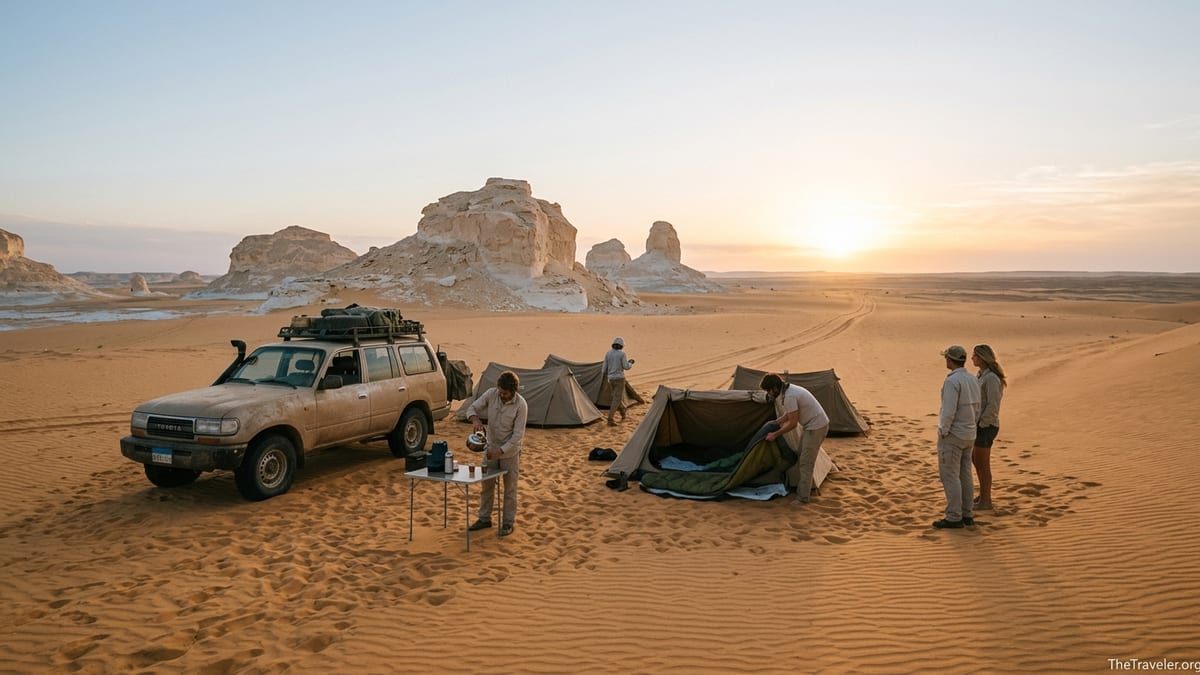
What a Western Desert Egypt Trip Really Costs in 2026
Western Desert trips are usually sold as packages that bundle Cairo transfers, 4x4 transport, guiding, camping gear, national park fees and most meals. For a classic overnight or 2-day White Desert safari from Cairo, recent 2026 prices for shared group tours typically run from about 120 to 200 US dollars per person, depending on group size, inclusions and how early you book. Travellers booking directly with local Bahariya-based outfits still report deals close to 100 US dollars per person for simple, no-frills camps if they are in a full jeep of four or more.
Private Western Desert tours, especially those starting and ending in Cairo with hotel pickups and more flexible itineraries, cost more. A realistic current range for a private 2-day Cairo–Bahariya–White Desert trip for two people is roughly 350 to 550 US dollars per person, with the lower end using basic camps and guesthouses, and the upper end including comfortable boutique lodges in Bahariya and higher service levels. For longer 4-day trips combining Bahariya, the White Desert and at least one other oasis, expect 220 to 350 US dollars per person per day in private mode, compared with 120 to 220 US dollars per person per day in a small group.
For the deep Western Desert circuits that link Farafra, Dakhla and Kharga or add Siwa on a longer loop, costs climb further because of distances, fuel and the need to move empty vehicles back to Cairo. A 5-day Farafra–Dakhla–Kharga circuit including one night of White Desert camping, three hotel nights and all 4x4 logistics commonly sits in the 900 to 1,500 US dollars per person band for private departures, with group departures from big agencies or overseas tour wholesalers sometimes higher once margins are added.
These figures assume mid-season travel outside Christmas, New Year and Easter, when many Egyptian operators add surcharges and hotel prices jump. They also assume you are starting from Cairo, which is how most visitors organise their Western Desert safaris. Starting trips from other hubs such as Luxor or Hurghada requires custom overland transfers and usually raises the overall cost.
Private vs Shared Tours: How Pricing Really Breaks Down
The biggest decision for your budget is whether to join a shared jeep or book privately. In shared tours, the key costs of the safari – 4x4 rental, fuel, driver-guide wages, camping fees and logistics – are spread across the whole group. In practice, this means a solo traveller in a shared vehicle might pay around 140 US dollars for a 2-day White Desert adventure that includes a return minibus between Cairo and Bahariya, a shared 4x4 from the oasis to the White Desert, one night camping and four basic meals.
In contrast, a couple who wants their own private 4x4 and guide for the same route will often see quotes between 400 and 700 US dollars per person. You are no longer sharing the 4x4 and fuel with three or four others, and you are paying a premium for flexibility: you can stop for photos whenever you like, camp in quieter spots and adjust timings on the day. Families of four or five often find that private tours become competitive again, because a single 4x4 can be filled by their group alone while costs are split across more people.
It is also important to understand what “shared tour” means in Western Desert terms. In many cases you will share a coaster bus or minivan from Cairo to Bahariya with a dozen or more people, then be allocated to a specific 4x4 with a maximum of four or five passengers for the off-road sections. Campsites still feel relatively intimate, with perhaps two to six small desert groups setting up around different campfires. On a private trip, you might still use the same camp area but have your own tents, cook and guide focusing solely on you.
When comparing quotes, ask each operator to itemise what is included: Cairo transfers, 4x4 legs, park permits, camping equipment, sleeping bags, drinking water and gratuities. Some larger Cairo agencies bundle tips for local drivers and cooks into the tour price, which can add 10 to 20 percent to the base rate but reduces your need to carry small cash for everyone.
4x4 Transport, Guides and Accommodation: Where Your Money Goes
Western Desert safaris are logistics-heavy, and the price you pay is largely driven by transport. A single 4x4 with a skilled desert driver and guide, fuel and permits is often costed internally by operators at well over 250 US dollars per day, before any overheads or profit. For example, a basic two-day Bahariya–White Desert–Bahariya loop using one 4x4 may cost the operator 500 to 600 US dollars in local expenses. If that jeep has four paying guests on a group trip, the base cost per person per day becomes reasonable; if it is carrying just two private guests, the per person share doubles.
Guides are often included as driver-guides on budget and mid-range trips, with one person driving and leading the excursion. On higher-priced private departures, you might have both a professional English-speaking guide and a separate driver, which increases costs further. If you request a guide in a second language, such as German, French or Spanish, expect a modest surcharge or a slightly higher base quote, particularly for more remote multi-day itineraries.
Accommodation is the next major variable. A simple overnight in the White Desert typically involves dome tents or windbreaks, foam mattresses, blankets and a shared desert toilet setup. This “wild camp” style is usually included in the package cost with no clear line item. When trips add hotel nights in oases such as Bahariya, Farafra or Dakhla, the type of property you choose will shape the final price. A straightforward local guesthouse in Bahariya can work out to around 30 to 50 US dollars per room per night in a package, while a characterful eco-lodge in Dakhla or Kharga might add 80 to 150 US dollars per room per night on top of the core safari costs.
Meals and water are generally good value but can still shift the budget, especially on longer trips. On basic safaris, breakfast and dinner at camp plus a picnic lunch are included, featuring dishes like grilled chicken, rice, salads and flatbread. On more upmarket itineraries, your operator may pre-book lunches in oasis restaurants or upgrade dinners at boutique lodges. In those cases, it is worth clarifying if bottled water, soft drinks and tea or coffee are unlimited or limited to a certain number per day.
Cairo Transfers and Sample Budgets for 2-, 4- and 7-Day Trips
Most Western Desert journeys begin in Cairo, and your transfers to and from Bahariya or other oases will account for a meaningful slice of your budget. Shared minivans or tourist buses running the six-hour Cairo–Bahariya route are usually bundled into group tours, but if you organise things independently, you might pay the equivalent of 20 to 40 US dollars per person each way in a shared vehicle. A private air-conditioned car or minivan with driver between Cairo and Bahariya commonly costs in the 140 to 220 US dollars each way range, depending on the vehicle size and season.
For a 2-day budget-friendly shared tour from Cairo to Bahariya and the White Desert, a realistic all-in cost for 2026 might be 200 to 260 US dollars per person. This would typically include round-trip shared transport from Cairo, one night camping, meals from lunch on day one to lunch on day two, and a shared 4x4 and guide. Add around 10 to 20 US dollars per person for tips and a little more if you buy snacks or extra drinks along the way.
A 4-day mid-range private itinerary might string together Cairo, Bahariya, the White Desert and Farafra with one night camping and two nights in oasis guesthouses. For two people, a practical budget is 1,800 to 2,800 US dollars in total, covering a private car or minivan between Cairo and Bahariya, a private 4x4 in the desert, three nights of accommodation, three days of guided excursions and full-board meals. Daily costs per person would fall in the 230 to 350 US dollar range, before any significant souvenir shopping.
Seven-day itineraries that combine multiple oases and perhaps Siwa or Luxor are naturally more expensive but offer better value per day if you are sharing the trip with others. A couple might spend 3,000 to 4,500 US dollars in total for a week-long circuit that includes Cairo–Bahariya–White Desert camping, then on to Farafra, Dakhla and Kharga with guesthouse and ecolodge stays and a transfer back to Cairo or Luxor. If four friends or family members travel together on the same private itinerary, the per person cost can drop sharply, often into the 180 to 260 US dollars per day range.
Longer Oasis Circuits: Bahariya, Farafra, Dakhla, Kharga and Siwa
While many visitors limit themselves to the famous White Desert overnight, serious desert travellers look to the oasis circuits that connect Bahariya, Farafra, Dakhla and Kharga, or that loop out to Siwa and back. These are longer, more expensive journeys, but they reward you with remote villages, old mud-brick towns, palm groves and hot springs that very few people reach. Because the distances are large and fuel stops are limited, your operator must plan carefully, and the cost of 4x4 logistics grows each day you stay out.
A typical 5-day Western Desert circuit might start in Cairo, continue to Bahariya for a night, spend one night camping in the White Desert, then thread through Farafra and on to Dakhla and Kharga, with hotel nights in the latter oases before returning to Cairo. For a private departure for two people in 2026, realistic price quotes often fall between 2,200 and 3,000 US dollars, excluding optional extras like alcoholic drinks and large tips. Joining a scheduled small-group version of the same route with a major overland or adventure travel company might cost a similar amount per person, because overseas tour operators fold in international marketing, sales commissions and contingency margins.
Adding Siwa to the mix raises the budget further and requires at least seven days to be worthwhile. Siwa sits far to the northwest near the Libyan border, and reaching it overland from Cairo or Alexandria means a long initial transfer before you turn south into the central oases. Week-long itineraries that pair Siwa with the White Desert and one or two other oases are now offered by a few specialist operators. Pricing for private trips of this type commonly starts around 3,000 US dollars per person for two travellers and rises with hotel standards and added activities such as dune driving, salt lake swims and visits to more remote springs.
If your budget is limited but you still want more than a quick White Desert taste, consider mixing one organised multi-day safari with independent travel to one oasis reachable by bus. For example, some travellers ride the bus from Cairo to Bahariya or Farafra, stay a night or two in a local guesthouse at a modest nightly rate and then join a shorter 4x4 excursion into the desert, reducing the number of costly private vehicle days.
Daily Budgets, Hidden Costs and Saving Money
Translating package quotes into realistic daily budgets is essential if you want to avoid surprises. On a basic shared Western Desert safari, a sensible all-in daily figure for 2026 is around 130 to 180 US dollars per person. That includes your tour cost, tips and a little spending money for snacks or drinks in oases. For private trips using mid-range hotels and eco-lodges, daily budgets of 220 to 350 US dollars per person are more accurate, especially once you account for one or two nights in Cairo at either end, airport transfers and a contingency for price inflation.
Hidden or easily overlooked costs include tipping, permits and seasonal surcharges. In the Western Desert, tipping is a normal part of the wage structure. On a simple two-day tour you might tip the main driver-guide 10 to 20 US dollars per person and give smaller amounts to cooks or camp helpers if they are not clearly covered by a pooled group tip. Multi-day circuits with multiple driver-guides, cooks and local guides for temples and historical sites will require a larger tipping pool. Some agencies now offer “all tips included” pricing for overseas clients, which can be reassuring if you prefer not to manage envelopes of cash.
National park permits and entry to certain historic sites such as the Temple of Hibis near Kharga or old towns around Dakhla are often included in your package cost, but not always. When they are not, expect to pay modest fees in local currency at the gate. Desert weather and security conditions can also influence prices: if a planned overland border route is closed or fuel prices rise sharply, some operators will adjust quotes mid-season, especially for customised private safaris.
To save money without sacrificing safety, consider travelling with at least one companion, joining a small group departure rather than insisting on a fully private 4x4, and accepting simpler camps and guesthouses rather than boutique lodges. Booking directly with reputable Egyptian operators instead of through multiple overseas intermediaries can also help, provided you verify their credentials and read recent reviews.
Choosing the Right Operator and Level of Comfort
With dozens of Cairo-based agencies and local Bahariya, Farafra and Siwa outfits competing for business, prices vary widely even for similar itineraries. When comparing quotes, look beyond the headline cost and examine how each operator treats safety, equipment and responsible travel. A company that insists on well-maintained 4x4s, adequate first-aid kits, extra drinking water and second drivers on remote stretches will usually cost a little more than a bare-bones rival, but the added security is worth it in desert conditions.
Comfort levels also matter. At the budget end, expect simple camps with thin mattresses, basic toilets and cold water, and local guesthouses where rooms are clean but plain. Mid-range tours might upgrade you to cozy ecolodges with better bedding, private bathrooms, small pools and shaded gardens. At the top end, a few properties in oases such as Dakhla offer atmospheric mud-brick suites and carefully prepared meals inspired by local farms, pushing your nightly costs up but turning the desert into more of a slow-travel retreat.
Language support is another factor. English is commonly available, but if you require guiding in another language, especially outside peak European seasons, you may face limited availability and higher quotes. When you receive an estimate, ask whether your guide will stay with you throughout the itinerary or whether you will switch to local guides at certain oases, which can affect the feel and value of the trip.
Finally, clarify booking terms. Some smaller outfits offer generous flexibility but require cash payments or bank transfers on arrival, while larger agencies prefer card payments and have stricter cancellation penalties. Exchange rate shifts can also impact final costs in Egypt, so check whether your quote is locked in US dollars or subject to local currency changes between booking and travel.
FAQ
Q1. How much does a basic 2-day Western Desert tour from Cairo cost in 2026?
A realistic range for a shared 2-day Cairo–Bahariya–White Desert tour is about 200 to 260 US dollars per person, including transfers, camping and most meals.
Q2. What is the price difference between shared and private Western Desert tours?
Shared tours usually start near 120 to 180 US dollars per person per day, while private trips commonly run from 220 to 350 US dollars per person per day, depending on group size and comfort level.
Q3. How much should I budget per day for a week-long Western Desert circuit?
For a seven-day multi-oasis circuit, most travellers should plan on 180 to 260 US dollars per person per day in a shared or full private group of four, or 230 to 350 US dollars per person per day for a private trip for two.
Q4. Are Cairo transfers usually included in Western Desert safari prices?
On most packaged tours the round-trip transfer between Cairo and the first oasis is included, but if you arrange travel independently, budget around 20 to 40 US dollars per person one way in shared transport or 140 to 220 US dollars per vehicle for a private car or van.
Q5. How much do I need to allow for tips on a Western Desert trip?
For a short 2-day tour, tipping 10 to 20 US dollars per person to the main driver-guide is typical, with a little extra for cooks or camp helpers; longer circuits require a larger tipping pool spread across more staff.
Q6. Can solo travellers join Western Desert safaris without paying private prices?
Yes, solo travellers can join shared group tours, paying roughly the same per person rate as other guests, but private trips where you are the only customer in a 4x4 will be significantly more expensive.
Q7. Are hotels in Bahariya and other oases expensive?
Simple guesthouses in oases are generally affordable, often equivalent to 30 to 50 US dollars per room per night within a package, while eco-lodges and boutique properties can add 80 to 150 US dollars or more per night.
Q8. Is it cheaper to book Western Desert tours online or in Cairo?
Booking in Cairo with a reputable local operator can sometimes yield lower prices than overseas agencies, but online booking through established companies may offer clearer inclusions, fixed pricing and stronger consumer protection.
Q9. When is the most economical time of year to visit the Western Desert?
Shoulder seasons such as October to early December and late February to April often combine reasonable temperatures with lower prices than peak periods like Christmas, New Year and Easter.
Q10. How far in advance should I book a Western Desert safari to get good value?
Booking several weeks to a few months in advance usually secures better availability and more choice of group or private options, while last-minute bookings may limit you to higher-priced or less flexible itineraries.