


Egypt’s Gulf of Aqaba coast is often lumped into generic “Red Sea Riviera” coverage, yet it deserves its own map in the traveler’s imagination. From the built-up resorts of Sharm el Sheikh to the quiet beaches near the Israeli border at Taba, this shoreline combines deep offshore waters, steep desert mountains and some of the Red Sea’s best fringing reefs with a spectrum of places that feel radically different from one another. Here, polished all-inclusive resorts sit a couple of hours’ drive from sandy bays with palm‑frond huts and no phone signal, all facing the same narrow sea.
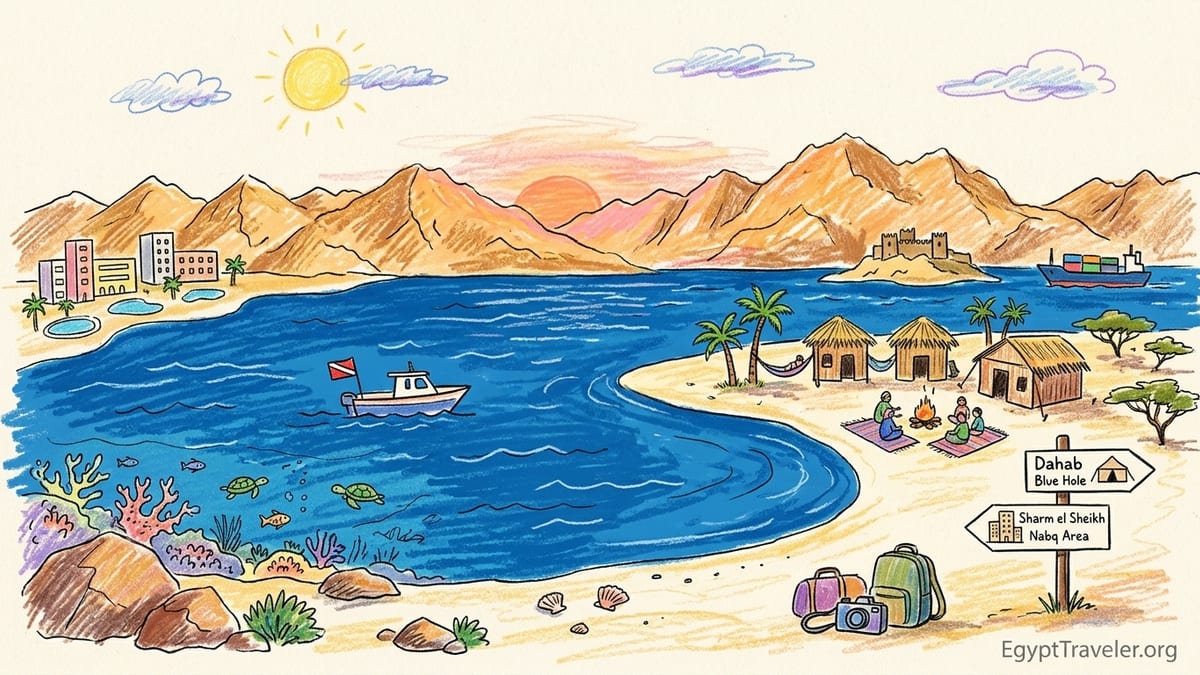
Why the Gulf of Aqaba Coast Deserves Its Own Spotlight
The Gulf of Aqaba is the northeastern arm of the Red Sea, a long, narrow trench bordered by Egypt’s Sinai Peninsula to the west, Saudi Arabia to the east, Jordan at its northern tip and a short stretch of Israeli coastline around Eilat. Unlike the broader Red Sea coast further south, this is a steep-sided rift with very deep water lying close to shore, often dropping to hundreds of metres only a short swim beyond the reef edge. That geology shapes everything from the clarity of the water to the way resorts have been built in narrow strips between mountains and sea.
At the southern entrance to the gulf lies the Strait of Tiran, the channel that separates the tip of Sinai from Saudi Arabia. For divers and snorkellers, names like Gordon, Thomas and Jackson reef have near-legendary status, but the same strait also funnels shipping and marks a geopolitical choke point between Africa and Asia. The result is a landscape where container ships and liveaboard dive boats share the same panorama, backed by bare ochre mountains that glow red at sunset.
Tourism economies on this coastline differ sharply even over short distances. Around Sharm el Sheikh, large international hotels, malls and entertainment complexes dominate, serving package holidaymakers on direct flights into Sharm International Airport. Ninety minutes north, Dahab feels closer to a backpacker beach town, with low-rise guesthouses, family-run dive centres and waterfront cafés where people linger over mint tea. Around Nuweiba and Taba, you find simple palm‑roofed beach camps, mixed with a smaller number of mid-range and upscale resorts. Treating this as a single monolithic “Red Sea Riviera” misses those contrasts and the different kinds of trips each area suits.
Environmental protection is another reason the Gulf of Aqaba coast stands apart. Egypt declared Nabq and Ras Abu Galum as protected areas in 1992, and Taba as a protected area in 1998, creating a chain of managed coastlines that remain largely undeveloped away from their access tracks. Within a few hours’ drive you can move from an international congress centre in Sharm to a Bedouin camp where electricity comes from a solar panel and the main evening entertainment is the sound of the waves.
Understanding Access, Transport and the Sinai-only Entry Stamp
For most visitors the gateway to the Egyptian side of the Gulf of Aqaba is Sharm el Sheikh International Airport, which handles direct flights from a range of European and Middle Eastern cities alongside domestic flights from Cairo and other Egyptian hubs. From Sharm, a modern highway runs north along the coast to Dahab, Nuweiba and Taba. The drive to Dahab is roughly 85 to 100 kilometres and usually takes about 1 to 1.5 hours by car depending on checkpoints and traffic, with buses taking slightly longer. Shared shuttles, private taxis arranged through hotels and intercity buses from companies such as East Delta Travel and Go Bus connect the main towns.
Travellers arriving overland from Israel or Jordan typically enter at Taba. From the Taba land border crossing you can reach Taba Heights, Nuweiba or continue all the way down to Sharm by road. Ferry services across the gulf link Aqaba in Jordan with both Taba Heights and Nuweiba, useful for overland itineraries that combine Jordan’s sites with time on the Sinai coast. North of Nuweiba, services are less frequent and schedules can change, so it is worth checking locally close to your travel dates rather than relying on outdated timetables.
One quirk of entry to this region is the “Sinai-only” permission stamp. Many nationalities eligible for visas on arrival or e-visas can instead obtain a free stamp at Sharm el Sheikh Airport or the Taba border that allows up to 14 or 15 days of stay in designated South Sinai resorts, including Sharm el Sheikh, Dahab, Nuweiba and Taba, without paying for a full Egyptian visa. In practice, this stamp limits you to the Sinai Peninsula and does not legally allow travel to mainland Egypt or extended trips inland beyond the permitted zone. Travellers who later decide they want to visit Cairo, Luxor or even fly out of a mainland airport usually need to obtain a full visa from an Egyptian consulate or immigration office rather than upgrading easily in Sinai.
This has a few practical implications. If your plans might expand beyond Sinai, it is generally safer to buy a regular Egyptian visa in advance or on arrival where available, instead of relying on the free Sinai-only stamp. If you arrive at Taba and know you want the flexibility to continue to Cairo or beyond, budget both time and money for visa arrangements, and be aware that overstaying the Sinai permission or travelling outside its permitted area can create complications when you exit. For travellers whose entire trip is confined to the Gulf of Aqaba coast, the stamp can still be convenient and cost-saving, but it is worth double-checking current rules with an embassy or official travel advice service before departure because regulations can change.
Sharm el Sheikh by District: From Sharks Bay to Hadaba
Sharm el Sheikh sprawls for more than 30 kilometres along the southern tip of Sinai, and treating it as a single, interchangeable resort does not do it justice. The key districts for visitors along the Gulf of Aqaba side are Sharks Bay and Nabq to the north, Naama Bay in the middle and Hadaba further south. All sit within easy reach of Sharm International Airport, with transfer times ranging from around 10 minutes to Sharks Bay to roughly 30 to 40 minutes to Nabq and Hadaba, depending on traffic and hotel location.
Sharks Bay lies quite close to the airport and the Strait of Tiran boat jetties. Accommodation here leans toward mid-range and upscale hotels built on terraced hillsides, many with jetty access over fringing reefs. The beaches are often narrow and sometimes man‑made platforms rather than broad natural sand, but house reef snorkelling can be excellent when currents are manageable. Divers use Sharks Bay as a convenient jumping-off point for day trips to Tiran’s reefs, which typically take around an hour by boat. On land, dining options cluster in hotel complexes and a few small plazas, with nightlife focused on hotel bars and occasional live music rather than big clubs.
Nabq, further north, feels newer and more spread out. Here, large all-inclusive resorts with extensive pools and landscaped grounds front a shallow, sandy shoreline. At low tide the water can retreat far from the beach, so many properties rely on long jetties for swimmers and snorkellers to reach deeper water beyond the seagrass shallows. The payoff is broad family-friendly beaches and space for amenities like kids’ clubs. Just north of the last resorts begins the Nabq Protected Area, a 600 square kilometre managed zone declared in 1992 that preserves mangrove stands, dunes, seagrass beds and the rusted remains of the Maria Schröder, a cargo ship that ran aground on the reef. Local operators in Sharm arrange guided jeep or pickup trips into Nabq for birdwatching, snorkelling and simple Bedouin-style lunches, usually as half-day or full-day excursions.
Naama Bay remains Sharm’s most recognisable hub, a natural curve of sand backed by a promenade of hotels, restaurants, shisha cafés and small malls. Accommodation ranges from long-established four- and five-star properties to more modest mid-range hotels set a few streets back from the waterfront. The gently shelving sandy beach makes Naama Bay popular with families, and there are roped-off swimming areas alongside floating pontoons for snorkelling. After dark, Naama is the centre of Sharm’s nightlife, with bars, open-air clubs and late‑night cafés. This is the place to base yourself if you want to combine day trips to dive sites like Ras Mohammed or Tiran with evenings out and plenty of dining choice, though it will not suit travellers seeking silence.
Hadaba, around the headland south of Naama, is more low-key and residential, though it also includes the busy Hadaba plateau around the shopping and entertainment area often referred to as the Old Market. Many hotels here perch on cliffs with steps or lifts down to small coves, and the reefs can be very good for house-reef diving and snorkelling, with steep drop-offs close to shore thanks to the gulf’s deep water. Beaches are mostly compact and sometimes reached via ladders or platforms, so they are less ideal for long barefoot walks than Nabq’s sands, but underwater life is rich. Hadaba suits divers and repeat visitors who prioritise reef quality and mid-range prices over huge beaches. The main drawbacks across Sharm’s districts are the scale of development, traffic on main roads and, in some areas, a sense of separation from the surrounding desert landscape once you are within the hotel strip.
Nabq Protected Area: Mangroves, Dunes and the Maria Schröder
North of Sharm’s last resort compounds, the paved road narrows and low dunes and acacia trees take over. This is the gateway to Nabq Protected Area, which, along with Ras Abu Galum, was declared a protected area in 1992. Within its boundaries you find some of the northernmost mangrove forests on the Red Sea, extensive seagrass meadows, coastal dunes and desert wadis that descend from the Sinai mountains. The shallow marine shelf here makes it an important feeding ground for turtles and fish, while migratory birds use its wetlands as seasonal stops.
One of Nabq’s more unusual landmarks is the wreck of the Maria Schröder, a German cargo vessel that ran aground on the reef in the mid‑20th century and now lies partially above the waterline, its rusting hull contrasting with the pale turquoise shallows. Snorkellers can explore nearby coral gardens, while those content to stay dry often visit for the desert scenery and the chance to walk among mangroves whose roots twist into clear water. Simple Bedouin-run huts offer tea and basic grilled meals, and many excursions include a pause for lunch on mats under palm‑frond roofs.
Access is usually by 4x4, pickup truck or organised excursion from Sharm, taking around 45 minutes to an hour from most city hotels. There is no accommodation within the core protected area itself, so you stay back in Nabq’s resort strip or central Sharm and visit on a tour. Beach quality inside the protected zone is natural and sometimes windy, with wide sand and patches of seagrass. Snorkelling can be very rewarding on calm days but currents and shallow coral heads require care, and there are no concrete jetties or lifeguard stations as at the resorts. The main advantage of Nabq is its relatively wild feel so close to a major tourist centre; the main disadvantage is that you depend on organised transport and facilities are intentionally limited to protect the environment.
Given its protected status, Nabq is managed with entry checkpoints and fees that help fund conservation, and visitor numbers are controlled. If you plan to dive the area’s reefs or explore beyond the popular mangrove stretch, it is wise to use operators who work regularly with the protected area management and follow local guidelines. This helps reduce pressure on sensitive habitats and ensures your visit supports the Bedouin communities who act as stewards of the land.
Dahab, Ras Abu Galum and the Blue Lagoon
Dahab, about 1 to 1.5 hours’ drive north of Sharm, has evolved from a handful of beachfront huts frequented by overlanders into a laid-back town that still feels far more independent than Sharm. Accommodation ranges from simple rooms above cafés on the seafront promenade to boutique guesthouses and a few larger hotels on the outskirts. The main stretch of town curves around a pebble and sand shoreline lined with dive centres, restaurants and kitesurfing schools. You will not find endless rows of sun loungers here; instead, there are low tables, cushions and hammocks where people work remotely, chat after dives or linger over late breakfasts.
Diving and freediving are Dahab’s biggest draws. Sites such as the Blue Hole and Canyon are within a short drive or jeep ride and offer easy shore access to deep vertical walls and rugged gullies. Numerous dive centres cater to beginners and technical divers alike, and prices for guided dives and courses are often lower than in more resort-heavy parts of the Red Sea. Wind and kite sports are another pillar of Dahab’s appeal. The bay just north of town is a recognised windsurfing and kitesurfing spot with several centres renting boards and kites, benefitting from regular afternoon winds, especially in spring and autumn.
Transport in Dahab relies on walking, bicycles and cheap local pickups called “pick‑ups” or small taxis, and the town’s compact scale makes it easy to get around without a car. Nightlife is relaxed rather than high‑energy, with a handful of bars and live-music spots, but the focus remains on early starts for dives or desert trips. Food options skew towards casual eateries, including Egyptian grills, falafel stands, simple seafood restaurants and a few international cafés catering to long-stay visitors. The main disadvantages for some travellers are the stony sections of beach in the central area and the lack of large, soft‑sand hotel beaches, though some accommodations on the lagoon side offer more conventional sandy stretches.
North of Dahab the road becomes rougher as it enters Ras Abu Galum Protectorate, another area declared protected in 1992. The best-known access point is the gravel parking area at the Blue Hole, where divers kit up at waterside cafés and jeep tracks head further along the coast. From here, many travellers reach the small cluster of Bedouin camps at Ras Abu Galum either by hiking along the coast, riding camels with local guides or taking boats in suitable weather. Accommodation at Ras Abu Galum is deliberately simple: basic huts with mats and mattresses, shared facilities, limited electricity and meals cooked over open fires.
Beyond Ras Abu Galum lies the Blue Lagoon, a shallow, sheltered bay with pale turquoise water that has become a favourite spot for kitesurfers. The lagoon’s flat, waist-deep water and steady winds create near‑ideal learning and freestyle conditions when weather cooperates. There are no roads all the way to the lagoon, and access requires either a long hike, a camel ride or a small boat from the Blue Hole area, so visitors typically stay at least one or two nights in the basic camps there rather than attempting a rushed day trip. The lack of mobile coverage at times and minimal infrastructure are part of the appeal for those seeking a digital detox, but can be a drawback if you need constant connectivity or comfort.
Nuweiba: Tarabin, Ras Shitan, El Mahash and the Art of Doing Very Little
Nuweiba, roughly midway between Dahab and Taba and around 2.5 to 3 hours’ drive from Sharm, remains the sleepiest of the main Gulf of Aqaba hubs. The town itself is spread out, with a port area that sees ferry traffic to and from Aqaba, a small commercial centre and, further along the coast, clusters of simple camps and a few more developed hotels. The main zones for visitors are Tarabin, Ras Shitan and El Mahash, each with its own feel but united by a slower pace than either Sharm or Dahab.
Tarabin, closest to Nuweiba town, has a long history as a backpacker hangout. Palm‑frond huts, open‑sided restaurants and simple guesthouses line a wide, sandy bay looking across to the mountains of Saudi Arabia. Electricity can be intermittent, and at night the brightest lights are often the stars. Beach quality here is generally good for swimming, with a gradual slope and sandy entry, though snorkelling straight from the beach is limited to small coral patches. The atmosphere is social, with travellers gathering around low tables for tea and shared meals, but nightlife is mellow; music tends to wind down earlier than in Dahab.
Further north along the coastal road, Ras Shitan (sometimes written Ras Shaitan) and El Mahash host a string of low‑key beach camps that have become favourites for Egyptians from Cairo seeking quiet weekends as well as longer-stay foreign visitors. Many camps offer colourful, hand‑built huts or tents set just metres from the water, communal dinners, yoga decks and hammocks. Some sections of shoreline here mix sand and rock, so bringing reef shoes is wise, but the water is usually clear and inviting. Snorkelling is better than in Tarabin, with accessible coral gardens a short swim from shore at some camps, although there are no lifeguards or jetties.
Because the area has minimal public transport, most travellers arrive by private transfer, long-distance bus to Nuweiba plus local taxi, or on organised retreats. Once you are settled, you can spend days doing very little beyond reading, swimming and chatting. Simple excursion options include jeep trips inland into wadis that form part of the wider Taba Protected Area or visits to coloured canyons and desert plateaus. The main disadvantage of Nuweiba and its camp zones is the lack of urban services: cash machines, supermarkets and pharmacies can require a drive back to town, and medical facilities are basic compared with Sharm. Those who require nightlife, shopping or a range of dining choices will likely find the area too quiet.
Taba, Fjord Bay, Pharaoh’s Island and Inland Protected Landscapes
At the northern end of Egypt’s Gulf of Aqaba coast, only a few kilometres from the borders with Israel and Jordan, lies Taba. For overland travellers crossing between Eilat, Aqaba and Egypt, Taba often serves as a gateway rather than a final destination, but the surrounding coastline and mountains reward slowing down. Taba is also the northernmost point of what is marketed as the Red Sea Riviera, yet feels markedly different from big resort towns further south.
One of the area’s most photographed spots is Fjord Bay, a crescent of sand backed by jagged hills with a deep blue patch of water where the seafloor drops away more sharply. It lies a short drive south of Taba town along the coastal road and can be visited on half-day trips by taxi or minibus. Snorkellers appreciate the clear water and coral around the bay’s edges, although entries can be over rocks in places. Beaches are smaller and more enclosed than around Nuweiba, framed by steep slopes that catch the sun from early morning to late afternoon.
Just offshore from the coast stands Pharaoh’s Island, topped by the small medieval fortress often called Saladin’s Citadel. Boat trips from Taba hotels and the nearby marina visit the island, allowing time to walk the ramparts and look out across the gulf to the mountains of Jordan and Saudi Arabia. The island also offers good snorkelling spots where clear water and coral gardens surround the rocky shoreline. As with any boat-based activity, conditions depend on weather and sea state, particularly during winter winds.
Most resort-style accommodation in the Taba area clusters at Taba Heights, a self-contained resort development about 25 kilometres south of Taba and the Israeli border and roughly 210 kilometres by road from Sharm. Here, several four- and five-star hotels share a broad sandy beach, landscaped gardens and a small central area with shops and restaurants. Golfers come for the 18-hole course laid out against a mountain backdrop, while divers and snorkellers access local reefs by boat or from beach entries. Families appreciate the enclosed, secure feel and kids’ facilities. The trade‑off is that Taba Heights can feel somewhat isolated from everyday Egyptian life, and dining and nightlife choices beyond the hotel and resort promenade are limited.
Inland from Taba’s coast lies the Taba Protected Area, declared in 1998 to safeguard rugged desert landscapes, high plateaus and narrow sandstone canyons carved by seasonal floods. Guided excursions visit sites such as the Coloured Canyon and other wadis that showcase the geological layers of the Sinai mountains. These trips often combine short hikes with tea in Bedouin tents and panoramic viewpoints over the gulf. Access requires a 4x4 vehicle and is subject to security regulations and sometimes to seasonal closures after heavy rain. The main disadvantage is that public transport does not reach these areas, so you need to join a tour or charter a vehicle through your accommodation.
How Long to Stay: Matching Destinations to Different Travelers
Because the main Gulf of Aqaba hubs lie within a half‑day’s drive of one another, it is feasible to combine several in a single trip. The best mix depends on your priorities, tolerance for long transfers and whether you are travelling with children, dive gear or simply a small backpack. Indicative drive times from Sharm are around 1 to 1.5 hours to Dahab, roughly 2.5 to 3 hours to Nuweiba and about 3.5 to 4 hours to Taba, although checkpoints and rest stops can lengthen journeys.
Families with school-age children often do well with Sharm plus a short taster of somewhere quieter. A three-day stay might base entirely in Naama Bay or Nabq, using one day for a boat trip to Tiran or Ras Mohammed and another for a desert or Nabq Protected Area excursion. Over five days, you could spend three nights in Sharm, enjoying pools and structured kids’ activities, then transfer to Dahab for two nights so older children experience shore diving, snorkelling and the relaxed promenade. With a full week, consider splitting four nights in a family-oriented Sharm or Nabq resort with three nights in a small Dahab hotel or a comfortable camp near Nuweiba, giving a gentle introduction to simpler beach life without committing the entire holiday to basic facilities.
Dedicated divers might design even short trips around access to specific sites. In three days, basing in Sharm’s Sharks Bay or Hadaba allows you to focus on boat dives at Tiran and Ras Mohammed, staying close to marinas and decompressing in hotel spas between early morning departures. Over five days, combining three nights in Sharm with two in Dahab gives you both classic boat diving and iconic shore sites like the Blue Hole or Canyon. With a week, a popular pattern is three to four days in Dahab for shore-based diving, followed by two or three days at a quieter Sharm or Taba Heights resort to rest, perhaps with one final day trip to local reefs. Divers considering technical or deep training should factor in no‑fly times when planning return flights from Sharm.
Independent and budget travellers often gravitate to Dahab and Nuweiba. In three days, Dahab alone can fill your time with one day of introductory diving or snorkelling, one day of wind sports or a trip to Ras Abu Galum and an extra day to simply wander, eat and adjust to the slower rhythm. Over five days, adding one or two nights in a Ras Shitan or El Mahash beach camp from Dahab provides a contrast between Dahab’s relatively developed seafront and the more minimal camps further north. A seven-day trip could start with two nights in Sharm (perhaps required by flight timings), move to three nights in Dahab, then finish with two nights in Nuweiba’s camps before looping back to Sharm or exiting overland at Taba.
Travellers seeking isolation and a digital detox have the most to gain from Ras Abu Galum, the Blue Lagoon and Nuweiba’s quieter stretches. In three days, a focused escape might involve travelling directly from Sharm or Taba to a favourite camp at Ras Shitan or El Mahash, where your main decisions involve which hammock to choose. Over five days, spending a night or two at Ras Abu Galum or the Blue Lagoon, reached on foot, camel or small boat from Dahab, gives a deeper feel of off‑grid living. In a full week, you could combine two nights at the Blue Lagoon, two or three nights at a quiet Nuweiba camp, and a night on either end in Dahab or Sharm to handle transport and any last‑minute logistics.
The Takeaway
Egypt’s Gulf of Aqaba coast rewards looking past the “Red Sea Riviera” label to see the distinct personalities along its shore. Sharm el Sheikh’s districts offer everything from family-friendly sands in Nabq to reef-rich cliff hotels in Hadaba and lively nights in Naama Bay. Nabq, Ras Abu Galum and the Taba Protected Area, declared in the 1990s, protect wild stretches of coastline where mangroves, dunes and canyons sit almost unchanged above clear water. Dahab blends world-class shore diving with an independent, café-lined waterfront, while Nuweiba and its camps offer the art of doing very little on wide, quiet beaches. At the far north, Taba combines fjord-like bays and a medieval island fortress with self-contained resorts overlooking three countries across the water.
Planning a trip here involves a few practical choices, from whether to rely on a Sinai-only entry stamp to how to split time between high-comfort resorts and simple beach huts. Yet even a short stay can deliver both the intense colours of coral walls dropping into blue depths and the muted tones of desert mountains at dusk. Treated as its own world rather than a footnote to the broader Red Sea, the Gulf of Aqaba coast offers a rare combination of accessibility, variety and, in the right corners, genuine quiet.
FAQ
Q1. What is the best time of year to visit Egypt’s Gulf of Aqaba coast?
The most comfortable months are broadly from October to April, when daytime temperatures are warm rather than extremely hot and sea conditions are often favourable for diving, snorkelling and wind sports. July and August can be very hot, with stronger sun exposure, though sea breezes make coastal areas more bearable than inland cities.
Q2. How do I choose between staying in Sharm el Sheikh, Dahab, Nuweiba or Taba?
Choose Sharm if you want full-service resorts, structured activities and nightlife, Dahab for independent diving and a café atmosphere, Nuweiba for simple beach camps and quiet, and Taba if you prefer self-contained resorts with easy access to fjord-like bays and views of neighbouring countries.
Q3. Is the Sinai-only entry stamp enough for a holiday on this coast?
For travellers whose plans stay entirely within Sharm el Sheikh, Dahab, Nuweiba and Taba for less than about two weeks, the Sinai-only stamp can be sufficient. If there is any chance you will visit Cairo, Luxor or other parts of Egypt, or need more flexibility with flights, it is safer to obtain a full Egyptian visa instead.
Q4. How easy is it to travel between Sharm, Dahab, Nuweiba and Taba without a car?
It is possible but requires some planning. Intercity buses serve Sharm, Dahab and Nuweiba, and there are services north towards Taba, though frequencies can be limited. Many travellers use private transfers or taxis arranged through accommodations, especially if carrying dive gear or travelling late at night.
Q5. Are the simple beach camps around Nuweiba and Ras Shitan safe and suitable for first-time visitors?
For many travellers they feel welcoming and relaxed, with long-established camps used by Egyptian families and foreign visitors alike. Facilities are basic, so they suit people comfortable with simple huts, shared bathrooms and limited electricity rather than those needing hotel-style services.
Q6. Can non-divers still enjoy Dahab and Sharm el Sheikh?
Yes. Non-divers can snorkel from beaches and boat trips, take beginner courses, try wind or kitesurfing, join desert excursions or simply enjoy the cafés and promenades. Many visitors never dive yet still find plenty to fill a week.
Q7. What should I expect from food and nightlife along the Gulf of Aqaba coast?
Food options range from all-inclusive buffets and international restaurants in Sharm and Taba Heights to small Egyptian grills, seafood places and simple camp kitchens in Dahab and Nuweiba. Nightlife is liveliest in Naama Bay, moderate and relaxed in Dahab, and very low-key in Nuweiba and the smaller camps.
Q8. Is snorkelling good directly from the beach or do I need boat trips?
In many areas, particularly around Sharm’s house-reef hotels, Hadaba, parts of Dahab and some Nuweiba camps, coral reefs are accessible from shore, sometimes via jetties. Boat trips open up additional sites like Ras Mohammed, Tiran reefs, Pharaoh’s Island or more remote coral walls with fewer people in the water.
Q9. How many days do I need to combine several destinations on this coast?
With three days, it is realistic to focus on a single base with one excursion. Five days lets you combine two places, such as Sharm and Dahab. A week or more gives enough time to include a simple camp around Nuweiba or a resort stay in Taba Heights alongside time in a main hub.
Q10. Are there any environmental rules I should follow in the protected areas?
Yes. In Nabq, Ras Abu Galum and the wider Taba Protected Area, follow local guides’ instructions, avoid standing on or touching coral, take all rubbish back out, respect wildlife and stay on established tracks. Using reputable operators helps ensure your visit supports conservation rather than harms it.