


I went to Dahab’s famous Blue Lagoon expecting the remote, meditative paradise that fills Instagram grids and kitesurfing brochures. What I found instead was a long chain of transfers, extra fees, thin shade, and a very different sort of “paradise” than the one I had been sold in town. This is not the mellow southern windsurfing lagoon right next to Dahab’s hotels, but the remote Blue Lagoon beyond Ras Abu Galum, reached only after passing through the Blue Hole. That distinction matters, because it is the starting point of the gap between glossy images and real logistics on the ground.
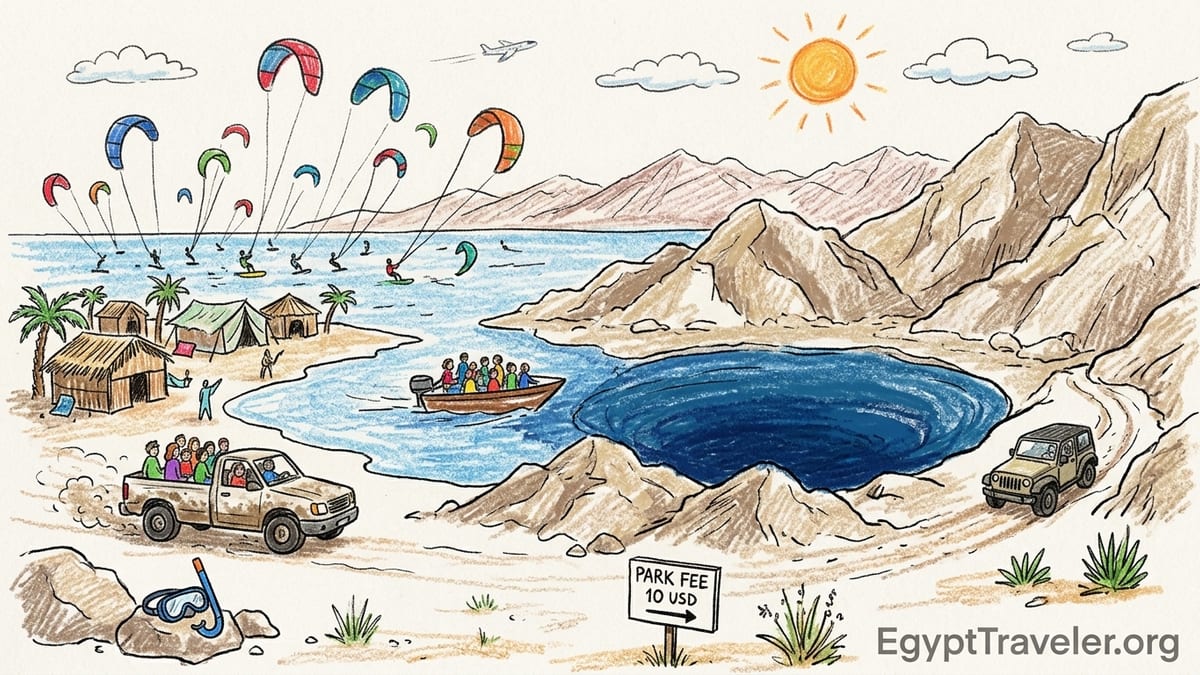
The Tour I Actually Bought, Not the Dream I Was Sold
In Dahab in early 2026, every second travel agency window seemed to show the same photograph: a glassy turquoise pool ringed by beige mountains and two lonely Bedouin huts, marketed simply as “Blue Lagoon.” The standard pitch was a full-day Blue Hole–Abu Galum–Blue Lagoon excursion for the rough equivalent of 30 to 40 US dollars per person, usually quoted to me in Egyptian pounds around 1,200 to 1,500, sometimes with a vague “plus park fees.” One central point the salespeople rarely emphasized: this tour goes north, past the famous Blue Hole, into the Ras Abu Galum protected area, and ends at the remote Blue Lagoon, not at Dahab’s in‑town windsurfing lagoon beside the resort strip.
My particular booking was typical of 2025–2026 offers. The agency in Masbat described it as a “Blue Hole snorkeling and Blue Lagoon by boat” day. The price was just under the equivalent of 35 US dollars at that month’s exchange rate. It supposedly included Dahab hotel pickup, transport to the Blue Hole, the onward boat to Ras Abu Galum and the lagoon, a Bedouin camp lunch, and return to town by late afternoon. Environmental fees were mentioned only in passing. When I probed, the agent waved a hand and said, “Maybe ten dollars for Blue Hole, it can change. We see tomorrow.”
That ten‑dollar figure roughly aligns with what dive and freediving operators now communicate as a local environmental or national park fee at Blue Hole and Ras Abu Galum, around 10 US dollars per person per day, payable in cash at the site. But there is no single posted price board that covers every combination of visitor, car, and site, and several operators still advertise tours “excluding entrance fees” in their fine print. The result is that many travelers, including me, only discover the true cost landscape after they are already in the jeep.
The itinerary I was promised sounded straightforward: 8:30 pick‑up, arrive at the Blue Hole by 9:00, snorkel for an hour, then take the boat to Abu Galum and on to the Blue Lagoon, arrive there around 11:00, enjoy several hours of swimming and relaxing, have lunch at a Bedouin camp, then return by boat and jeep, back in Dahab around 5:00. On paper, it appeared to be a balanced mix of travel and beach time; in hindsight, the balance tilted far more toward logistics than lagoon.
From Dahab to Blue Hole: Fees, Checkpoints, and the First Time Sink
The day began with the usual Dahab choreography: a pickup truck that arrived forty minutes late, followed by a slow shuffle through town to collect other guests. It took almost an hour before we even left Dahab proper. Only then did we drive the 8 or so kilometers north along the coast road toward the Blue Hole, a journey that on a straightforward private transfer can take about 20 minutes, but with shared pickups and one fuel stop was closer to 45.
The first mild shock came at the checkpoint before the Blue Hole. The group was asked to present passports or ID, and the driver stepped out to handle what he called “police and park paperwork.” No one demanded a bribe in my case, but the process added another 20 minutes of sitting in a dusty minibus with the sea tantalizingly close. Once we finally reached the Blue Hole parking area, a local fixer appeared at the door to collect the separate environmental or national park fee in cash. The agencies in town had been vague, and even on the ground people disagreed on whether part of this fee went to the car, part to the site, or all of it under a single heading. What mattered as a traveler was simple: the tour price I had paid the night before did not cover this charge.
By the time we had paid, signed our names in a logbook, rented any missing snorkel gear, and been briefed by our guide, it was after 10:30. We had spent nearly two hours in transit or administration, and had not yet reached the part of the day that had sold the tour: the pristine emptiness of the Blue Lagoon further north. The Blue Hole itself is world renowned for diving, with sheer drop‑offs and deep‑water freediving lines, but our guide made it clear this stop would be short. The boat to Abu Galum operated on an informal schedule that did not align with the fantasies of unlimited snorkeling time.
We were given roughly 40 minutes in the water inside the Blue Hole area before being told to hurry back for the boat. On a different day, without wind and with more experienced snorkelers, it might have felt relaxed. With a mixed group, a guide checking everyone’s fins and masks, and the constant awareness that we were paying for a boat slot, it felt compressed. At this point the day was nearly three hours old, and our true destination still lay over the horizon.
Boat to Ras Abu Galum and Onward to the Lagoon: Scenic, Bumpy, and Crowded
The small motorboats that run from the Blue Hole to Ras Abu Galum are the backbone of the lagoon excursion. They are also one of the most unpredictable elements of the day. On paper, the coast is only around 8 to 10 kilometers north, and operators describe the crossing as 20 to 30 minutes. In practice, it took us almost 45 minutes in moderate chop, partly because the boat was loaded with more than a dozen passengers plus gear, and partly because the captain detoured to pick up two additional people from another jetty.
The view was admittedly spectacular. The Sinai mountains glowed in brown and purple layers, and the shallow reef shelf sparkled in milky turquoise over darker blue depths. However, those Instagram‑famous angles generally come from drones or shore‑based photographers standing far back from the practical reality of crowded fiberglass boats bobbing up and down, everyone clutching their bags to avoid spray. Several travelers with mild motion sensitivity were already visibly uneasy before we even saw the low huts of Ras Abu Galum appear ahead.
Ras Abu Galum itself is a broader protected area that stretches along this piece of coast. It holds a small Bedouin settlement, a cluster of simple camps, and several shore dive and snorkel spots that divers rate highly. It is also, according to Egyptian environmental affairs documents and recent government inspections, an area under increasing pressure from unregulated day trips and informal developments. In 2025, the environment minister visited both Blue Hole and Ras Abu Galum and announced plans for improved waste management systems and more structured services. By 2026, parts of that plan were visible in the form of new bins and some cleaner corners, but long‑term infrastructure was still patchy.
From Ras Abu Galum to the Blue Lagoon, our group had the choice of staying on the boat or riding camels. Most chose to remain on the boat, seeing camels as an unnecessary extra discomfort and time loss. The second short hop along the coast took about 20 minutes. Altogether, from the moment we stepped into the first boat at the Blue Hole to the moment we set foot on the sand of the Blue Lagoon camp, almost 70 minutes had passed. The entire morning since hotel pickup had taken over four hours.
Counting the Hours: How Much Time Do You Really Get at the Lagoon?
Reality only snapped fully into focus once we asked our local guide, standing under a fraying piece of tarpaulin, what time we would be leaving. He pointed to the horizon, where other boats were appearing and disappearing, and said, “About three hours here, maybe a bit more if wind is good for kites later.” Three hours sounded reasonable until we started subtracting time for lunch, tea, toilet lines, and packing.
In practice, we had something closer to two hours of usable, free‑choice time at the lagoon itself. Lunch took about 40 minutes from the moment the first salad plates appeared to the last piece of grilled fish being shared. Another 20 minutes disappeared into ordering and paying for drinks, sorting out who had brought enough cash, and queuing at the basic pit toilet behind the hut. For a day marketed as an escape to a serene, remote bay, the time actually available to sit by the water or float in it without checking the time was surprisingly short.
If we reconstruct the day in rough blocks, the imbalance becomes clear. From 8:30 to about 12:45 was spent on pickups, road transfer, checkpoint formalities, park fee payment, quick snorkeling at the Blue Hole, and two boat segments. From 12:45 to roughly 15:30 was at the Blue Lagoon, of which around two hours could be called “free relaxation.” Then from about 15:30 to 18:30 unfolded in reverse: boat back to Ras Abu Galum, another crossing to Blue Hole, waiting for the jeep, slow drive through sunset traffic, and return to Dahab. Out of a ten‑hour day, no more than a quarter felt like unhurried time at the bay the entire trip was named after.
Some operators in 2026 advertise more expensive versions of the excursion, especially those bundled with dedicated kitesurfing time or higher‑end guiding, with prices advertised at 90 to 100 euros for a lagoon day that prioritizes kite rental and coaching and may include longer water time. However, the budget version widely sold in Dahab’s center for roughly the dollar equivalent of 35 remains centered on moving people along a chain of sites rather than giving them long hours in one place. That is not a scandal, but it is a clear gap between the promise of a peaceful, empty lagoon and the reality of a tightly managed, transport‑heavy schedule.
How Remote and Empty Is It Really? Camps, Kites, and Visitor Numbers
The biggest mismatch between the social media version of the Blue Lagoon and the real 2026 experience is not that the bay is ruined or overbuilt. It is that “empty” in marketing language often translates to “modestly developed but busy at peak hours” on the ground. In satellite images and tourism brochures, the lagoon shows a thin crescent of huts along a shallow turquoise arc. In person, I counted around a dozen distinct camp clusters spread along the shore, ranging from kite schools with branded flags to simple Bedouin compounds with low palm‑leaf roofs.
On the weekday I visited in spring, there were perhaps 70 to 100 day‑trippers scattered along the beach during the busiest hour, plus a smaller number of overnight guests who stayed in the huts. Boats arrived in little waves: two or three at a time, then a lull, then another run from the Blue Hole. It never reached the density of a mass‑tourism resort, but it also was not the near‑empty desert cove portrayed in many influencer posts. Instead, it felt like a modestly busy rustic sports beach, with conversations in English, Arabic, Russian, and French blending with the slap of kites hitting the water.
The kitesurfing presence is impossible to miss. Several schools now market the lagoon as their jewel, and the bay’s shallow, mostly flat water in the main wind season draws both learners and seasoned riders. I counted more than 30 kites on the water at one point, with a few advanced riders tacking far out and beginners wobbling closer in. That is not “permanent overcrowding,” and there were still pockets of space, especially at the downwind end of the lagoon. But it significantly changes the atmosphere compared with a classic swim‑and‑snorkel beach. Lines tangled in the sand, instructors shouted instructions over the wind, and the sky was rarely free of canopies.
For visitors hoping to sit in silence with a book or float quietly in the shallows, the constant whoosh of kites, calls between riders, and occasional crashes into the water may feel more like a busy water sports center than a remote sanctuary. In that sense, the lagoon is not overrun in a conventional sense, but it is specialized. The emptiness in many promotional shots is a selective truth, often photographed at off‑hours or from angles that deliberately exclude the small but significant infrastructure of kitesurfing tourism and the clusters of people it brings.
Swimming, Snorkeling, and the Wind: Expectations vs Reality in the Water
Much of the lagoon’s appeal in photos lies in its color and apparent calm. Shallow, milky turquoise water suggests effortless swimming, gentle wading, and child‑friendly depths. On the day I visited, the water near shore was indeed shallow and relatively warm, with soft sand underfoot rather than coral. That makes simple wading pleasant but also means the lagoon is not the richest place in the Ras Abu Galum area for coral snorkeling. The reef life that draws divers and snorkelers to other stops along this coast feels muted inside the main body of the lagoon, where heavy use and the natural sediment of a shallow basin combine into a less dramatic underwater landscape.
For stronger snorkeling, several guides recommend staying longer at Ras Abu Galum proper or choosing a tour that emphasizes specific coral patches along the way rather than rushing straight to the inner lagoon. Some 2024 and 2025 price lists from dive centers treating “Ras Abu Galum” as a separate snorkel or dive destination hint at this difference by listing it as an independent highlight. That technical detail rarely filters into the mainstream day‑trip pitch, which lumps the entire northern itinerary together and leaves many visitors assuming that the Blue Lagoon itself will offer the same kind of coral walls and drop‑offs as the Blue Hole or nearby reefs.
Wind is the other crucial factor. The very conditions that make the lagoon a sought‑after kitesurf spot can work against visitors who want relaxed surface swimming. On my visit, the wind built gradually through the late morning, reaching a level by early afternoon where chin‑level chop formed out toward the middle of the bay and even standing waist‑deep near shore came with small slaps of water against the chest. Confident swimmers will not mind, but less comfortable ones either hugged the shoreline or stayed out of the water once the kite traffic picked up. It was not dangerous, but it was a far cry from the glass‑calm, windless pool implied by many travel posters.
Add kitesurfing activity to that equation and the safe swimming corridor narrows further. Most schools mark a learning zone and try to keep kites and swimmers separated, but the boundaries are informal, and no one is posting official red‑and‑white ropes across the water. As the afternoon progressed, we saw a couple of near‑misses where boards skimmed closer to swimmers than anyone would have preferred. It is entirely possible to enjoy a swim here, especially upstream from the busiest kite areas, but the experience requires awareness and compromise rather than the carefree bobbing in empty water that brochure writers love to invoke.
Huts, Lunch, and Facilities: Rustic Charm with Real Trade‑Offs
The Bedouin camp lunch is often marketed as a cultural highlight of the Blue Lagoon excursion: fresh grilled fish, rice, salads, and tea, served in a simple hut on cushions by the sea. In broad strokes, that description holds. Our lunch featured whole fish cooked over coals, a mound of rice, basic tomato and cucumber salad, and unlimited sweet tea. The portions, however, felt calibrated just tightly enough that anyone with a big appetite might leave a little hungry. A second small piece of fish or more salad required negotiating and sometimes an extra cash contribution.
Shade is another scarce resource. The main hut where we ate had a low roof of palm fronds and fabric, and could comfortably shade perhaps 12 to 15 people. When three boats’ worth of visitors arrived in quick succession, some simply could not fit in the deepest shade and ended up under partial cover or back on the beach. On a mild spring day, that was tolerable. On a high‑summer visit with temperatures well above 35 degrees Celsius, the difference between solid and partial shade could feel significant, especially for children or older travelers.
Sanitation remains bluntly basic. The main toilet available to our group was a squat or simple seat behind the main camp hut, with a rough concrete floor, a barrel of water with a scoop, and no soap. It was functional, but nowhere near the standard implied by some agencies in town, which talk vaguely about “basic facilities” without highlighting what that actually means after an hour‑long boat ride. There was no running water for handwashing in a true sink, and certainly no separate changing cabins or showers. Anyone who needed privacy to change into swimwear improvised behind a corner of the hut or wrapped themselves in a towel.
Drinks were another small but telling detail. The tour price included tea and water at lunch, but soft drinks and extra bottled water outside that meal window were sold at what felt like a predictable “remote markup.” They were not extortionate, but also not aligned with Dahab town supermarket prices. Combined with the separate park fee and any snorkel gear rentals, these small extras nudged the total cost of the day above the initial headline price. None of this was scandalous by global tourism standards, but it did erode the sense that the tour was a simple, all‑inclusive escape into nature.
Environmental Pressure: Waste, Power, and the Limits of “Untouched”
Blue Lagoon marketing loves the word “untouched.” Official designations, however, describe Ras Abu Galum as a managed habitat and species area, and various environmental assessments in the past decade have flagged visitor pressure and waste handling as ongoing challenges. On the ground in 2025 and 2026, the picture is mixed. I did not encounter heaps of plastic bottles strewn across the beach, and camp owners have a clear incentive to keep their immediate frontage reasonably tidy. But a short walk behind the first line of huts revealed scattered old building materials, rusting metal, and some buried trash pits.
Recent government inspections and announcements about improved waste management and entry‑fee systems for Blue Hole and Abu Galum indicate that authorities are at least aware of the tension between increasing visitor numbers and the fragility of the coast. Some camps have taken steps like installing more rubbish barrels and organizing informal beach cleanups, particularly after stormy days when currents deposit debris onshore. Still, the combination of daily boat landings, disposable water bottles, and food packaging means the lagoon does not feel like an untouched desert cove. It feels like a lightly regulated, semi‑permanent water sports micro‑resort perched on a sensitive shoreline.
Electricity illustrates this tension further. There is no mains power in the lagoon area. A handful of camps now use small solar setups or generators for part of the day, mainly to charge phones and run a few lights after dark. Kitesurfing‑oriented huts sometimes advertise limited charging windows in the evening for those staying overnight. That is part of the charm for some guests, but it also means that the infrastructure available to deal with larger‑scale waste, water treatment, or even reliable refrigeration of food is inherently constrained. For a day tripper, these limits are just noticeable quirks. For the ecosystem absorbing this human presence year after year, they are structural pressures.
The result is a paradoxical environment where travelers who arrive expecting “nature untouched by mass tourism” instead discover a thin layer of tourist infrastructure that both enables access and quietly strains the very setting they came to enjoy. Not every visitor sees obvious litter, and it would be misleading to call the lagoon a dump. But to describe it as pristine in any full‑time, literal sense in 2026 is to ignore both the boats lined up at the shoreline and the slow accumulation of human traces just out of frame.
Five Concrete Drawbacks Most Visitors Actually Feel
Over the course of this day, at least five significant drawbacks emerged that many travelers will experience, even if they arrive with flexible expectations. The first is access and time. Reaching the lagoon on a standard shared tour involves at least three vehicle legs and two boat crossings, plus checkpoint and fee formalities. Adding it up, more hours are spent in motion or waiting than actually sitting by the water you came for.
The second drawback is extra charges and opaque pricing. The frequently quoted 30 to 40 US dollar tour price in Dahab town rarely includes the full suite of environmental or national park fees, nor does it cover drinks, extra lunch portions, or snorkel rentals. Travelers who do not ask precise questions in advance are likely to see their real cost creep significantly higher by the end of the day, especially if they expect a truly “all‑inclusive” experience.
The third issue is that snorkeling expectations often outstrip reality. The Blue Lagoon itself, with its shallow, sandy bottom and heavy kite and swimmer use, is weaker for coral and fish than the Blue Hole or specific Ras Abu Galum snorkel sites. Visitors who primarily want vibrant reef scenery might be better served by tours that focus on those locations instead of treating the lagoon as the day’s centerpiece.
The fourth drawback is environmental conditions and water use conflicts. The wind that kitesurfers celebrate can make relaxed surface swimming more tiring, and the density of kites on the water in peak hours narrows safe space for casual bathers. This is not simply a matter of individual taste; it changes the basic character of the bay from quiet swimming hole to active water sports arena.
The fifth and perhaps most underappreciated downside is the level of facilities relative to what some agencies imply. Shade is limited, toilets are extremely basic, and there is no reliable running water or proper handwashing. For some travelers that is part of the adventure. For others, especially families with young children or visitors used to even modest resort standards, the gap between expectation and reality can be jarring once the long logistics of the day are factored in.
How It Stacks Up Against Nuweiba Camps and Dahab Shore Snorkeling
To judge whether the Blue Lagoon is overrated, it helps to compare it with realistic alternatives in the same region. One is the string of simple beach camps north of Nuweiba, places like the informal line of huts along wider bays, where guests often stay overnight in cabins or tents. An overnight in one of these camps can cost a similar amount to, or only slightly more than, a single Blue Lagoon day trip once all fees and extras are counted. The trade‑off is a longer road journey from Dahab, but then far more unhurried time actually sitting by the sea, reading, swimming, or walking the beach without fixed departure deadlines.
Another baseline is Dahab’s own shore snorkeling. Sites like Lighthouse, Eel Garden, and the Canyon area, reached by short taxi rides or even on foot from town, offer coral and fish life that is at least as impressive as anything a casual snorkeler will see inside the Blue Lagoon itself. Several freediving centers list house‑reef sessions at far lower additional cost than a full‑day northern safari, and they can be scheduled flexibly across several days. For travelers who care more about underwater scenery than the particular name of the bay, everyday Dahab often delivers better value.
Social and atmospheric factors also matter. A Dahab shore‑snorkeling day typically ends back in town by late afternoon, with access to cafés, hot showers, and a broad choice of dinner options. A Nuweiba overnight combines long naps in hammocks, slow conversations under string lights, and simple meals in a camp that you do not have to leave at a fixed hour. In contrast, the Blue Lagoon day feels bounded and orchestrated, with most decisions made for you once you step into the jeep. If you fall in love with the scenery and want to stay longer, you cannot simply extend your visit on a whim without reworking transport and accommodation.
None of this means the Blue Lagoon is worthless. For committed kitesurfers, the shallow, flat water and wind statistics make it a bucket‑list spot. For those who have already explored Dahab’s town reefs and want at least one adventure day that combines boats, mountains, and a very particular kind of Sinai emptiness, the trip can still feel worthwhile. But for many general visitors, especially those primarily attracted by images of quiet, empty water and leisurely swimming, a combination of Dahab shore days and a carefully chosen Nuweiba camp night might deliver more of the peace they imagined with less of the logistical friction.
When the Blue Lagoon Is Still Worth It, and Whether to Stay Overnight
After a full day tracing the classic Blue Hole–Abu Galum–Blue Lagoon route, my feeling is that the lagoon is not a scam and not destroyed, but it is significantly overrated in the way it is commonly sold to broad audiences in Dahab. The spot has a real, particular magic when the light hits the water just right and the wind has not yet built to full strength, and for certain travelers that narrow window justifies the effort. The key is to be honest about who those travelers are.
If you are a kitesurfer or a wind‑focused water sports enthusiast, the lagoon can absolutely live up to its reputation. Booking with a specialist kite operator that structures the day around time on the water, rather than simply bundling the lagoon onto a generic sightseeing safari, changes the equation. You are then paying primarily for access to wind and flat water, not for an imagined quiet swim. Similarly, if you have already spent several days in Dahab and want a change of scene, and you understand that the journey itself is part of the experience rather than an unfortunate side effect, the day can feel like a worthwhile adventure.
For others, an overnight stay at the lagoon or in the wider Ras Abu Galum area may be the only way to approach the postcard serenity they have in mind. Arriving in the afternoon and remaining after the day‑trip boats leave grants a few precious hours where the kite numbers drop, the noise fades, and the sky deepens into layers of orange and purple over a much quieter bay. Simple dinners of fish and rice under the stars, with only a handful of fellow guests and a lantern or two for light, feel closer to the “remote paradise” cliché, although the same caveats about basic toilets, limited electricity, and sparse shade still apply.
Ultimately, though, even an overnight does not transform the Blue Lagoon into an undiscovered secret; it simply gives you more time to find stillness between the moving parts. Travelers whose main priorities are easy swimming, rich snorkeling, and relaxed facilities might find their expectations better met by staying in Dahab and exploring its shore sites thoroughly, or by investing their adventure energy in an overnight further up the coast where logistics are front‑loaded into the journey rather than scattered through the whole day.
The Takeaway
Standing at the edge of the Blue Lagoon as our boat horn signaled it was time to leave, I understood both why this place captivates people and why so many visitors later describe feeling let down. In just a few hours, the bay had offered flashes of unreal beauty: the way the color of the water merged almost seamlessly with the sky at noon, the silhouette of a single rider carving silently across the surface at distance, the stark simplicity of huts and mountains with no high‑rise hotels in sight. At the same time, the day had been dominated by transfers, small surprises in cost, cramped shade, and a constant background hum of boats and kites.
Is Dahab’s remote Blue Lagoon overrated? For the average traveler lured by images of an empty, calm swimming pool of turquoise, I would say yes. Not because the lagoon is ugly or ruined, but because the marketing selectively erases the long hours of movement, the limited comfortable space, the wind and sports activity, and the modest, sometimes strained infrastructure that shape the real experience. For dedicated kitesurfers and for those who value the feeling of being at the edge of things enough to accept the trade‑offs, it remains a compelling, even unique, place. The essential task is to match your expectations to the actual character of the lagoon in 2026, not to the frozen frame of a perfectly timed photograph.
FAQ
Q1: Is the Blue Lagoon north of Dahab the same as Dahab’s in‑town lagoon?
The remote Blue Lagoon discussed here lies beyond Ras Abu Galum and requires a boat or camel journey from the Blue Hole. Dahab’s southern lagoon near the hotels is a different, easily accessible windsurf and kite area right next to town.
Q2: How much does a typical Blue Hole–Abu Galum–Blue Lagoon day trip cost in 2026?
In Dahab, street agencies commonly quote the equivalent of about 30 to 40 US dollars per person for a shared day trip, but this usually excludes separate environmental or national park fees, drinks, and snorkel rentals, so the total out‑of‑pocket cost ends up higher.
Q3: How long is the travel time compared with time actually spent at the Blue Lagoon?
On a standard shared tour, it is common to spend six to seven hours of the ten‑hour day in pickups, road transfers, checkpoint formalities, short snorkeling at the Blue Hole, and boat crossings, leaving only about two hours of genuinely free time at the lagoon itself.
Q4: Is the snorkeling at the Blue Lagoon better than at the Blue Hole or other Dahab sites?
No. The lagoon’s shallow, sandy bottom and heavy use make it weaker for coral and fish than the Blue Hole, Ras Abu Galum reef spots, or Dahab’s shore sites like Lighthouse and Eel Garden, which usually offer more dramatic underwater scenery.
Q5: How busy is the Blue Lagoon, and will it feel overcrowded?
It rarely feels like a packed resort, but on a typical day you may share the bay with dozens of other visitors and a noticeable number of kitesurfers. It is more like a modestly busy water sports beach than an empty desert cove.
Q6: What are the toilets and facilities like at the Blue Lagoon camps?
Facilities are very basic, usually involving simple squat or basic seat toilets without running water, limited shade under palm‑leaf roofs, no proper showers, and only small solar or generator power for minimal charging, especially in the evening.
Q7: Are there hidden or extra costs I should budget for on a lagoon day trip?
Besides the tour price, expect to pay separate fees at the Blue Hole or Ras Abu Galum, extra for soft drinks or additional food at the camp, and possibly for snorkel gear rental or optional camel rides, all of which can significantly increase the day’s total cost.
Q8: Is the Blue Lagoon suitable for non‑swimmers or people who dislike waves and wind?
The water is shallow in parts, but afternoon wind, chop, and kitesurfing activity can make the bay feel busy and less relaxing for those who prefer calm, quiet swimming. Non‑swimmers might feel more comfortable at Dahab’s sheltered shore sites.
Q9: Would staying overnight at the Blue Lagoon give a better experience than a day trip?
Overnight stays can offer quieter evenings after day‑trip boats depart and a stronger sense of remoteness, but facilities remain very rustic. You gain more unhurried time, yet still accept basic toilets, limited electricity, and simple food.
Q10: If I only have a few days in Dahab, is the Blue Lagoon worth prioritizing?
If you are a kitesurfer or specifically drawn to the idea of a remote, rustic bay even with logistical hassles, it can be worthwhile. If your main goals are easy snorkeling, comfort, and flexibility, focusing on Dahab’s shore reefs and perhaps a Nuweiba camp night may be a better use of limited time.