


On my first full day in Sharm el Sheikh this year, I booked what I thought was a classic Red Sea fantasy: a full-day “Tiran Island” boat trip with snorkeling, lunch and hotel transfers. The thumbnail image on the hotel tour desk showed a sand-and-turquoise beach framed by rugged mountains. The description talked about "visiting Tiran Island" and "discovering untouched shores." Nowhere, in the glossy photos or the agent’s quick sales pitch, did anyone say the one crucial sentence that would define the whole day: you will not actually set foot on Tiran Island.
The Sell: An “Island Trip” That Never Reaches the Island
My introduction to Tiran began at a hotel tour desk just off Naama Bay. The board listed Ras Mohammed, quad bikes in the desert, and a “Tiran Island by boat” excursion. The laminated leaflet for Tiran showed a yacht anchored off a pale sand strip with guests walking in ankle-deep water, mountains behind them and not a sign of another boat. The wording promised a “trip to Tiran Island in the Strait of Tiran” with three snorkeling stops, lunch and “time to relax and enjoy the island views.” The phrase that stuck in my mind was “island trip.” Where I come from, that implies stepping ashore.
Only later, cross-checking local information sites and operator pages, did I discover what the small print really means. Several current Sharm operators make it explicit that landing is not allowed because Tiran is a protected military and natural zone, and that their yachts “remain in the surrounding marine area.” Others bury that crucial fact in a FAQ, or hint at it with phrases like “enjoy the island from the sea.” One long-running Sharm guide politely spells it out: in boat-excursion language, “visit” often means cruising and snorkeling around an island rather than going ashore. The problem is that the marketing photographs rarely match that nuance.
The confusion is made worse by the wider tourism vocabulary. Tiran and nearby Sanafir lie at the mouth of the Gulf of Aqaba, and since a 2017 agreement their administration has shifted toward Saudi Arabia. Going ashore is tightly restricted, for political, security and environmental reasons, and landmines are reported to remain in places. Yet the tourism industry still uses “Tiran Island trip” as a shorthand for a boat day focused on the famous reefs of the strait: Jackson, Woodhouse, Thomas and Gordon. The result is a gap between what the trip actually is, and what many visitors picture when they hand over their cash.
In my case, nobody at the desk actually lied. When I asked “Do we go to the island?” I was told, “You will see it, beautiful mountain views, and the best reefs in Sharm.” That is technically accurate. But with a beach photo in front of me and a word like “island” floating in the air, I walked away assuming that at some point I would be walking on sand, not just looking at it from 200 meters offshore.
From Hotel Pickup to Marina Reality
The day itself began in familiar Red Sea fashion. A minibus collected us from the hotel around 8:00, after a few minutes of the usual confusion over who had paid for what. Everyone on board was clutching a slightly different voucher, some from online booking sites, some from in-house reps. All of them said “Tiran Island.” None of them mentioned that we would never touch land except at the marina.
We drove past Sharks Bay and the gated resorts around Soho Square and turned down toward a small harbor that several Reddit users had already described as the departure point for many Tiran boats. This marina, smaller and less chaotic than the main jetty used for some Ras Mohammed trips, still had rows of day boats loading boxes of bread, crates of soft drinks and tanks for divers. Check-in was a quick name tick-off and, for some nationalities, a glance at passport copies for the coast guard permit. There was no clear signboard explaining where we were going or how the day would unfold, only a man with a clipboard shouting boat names.
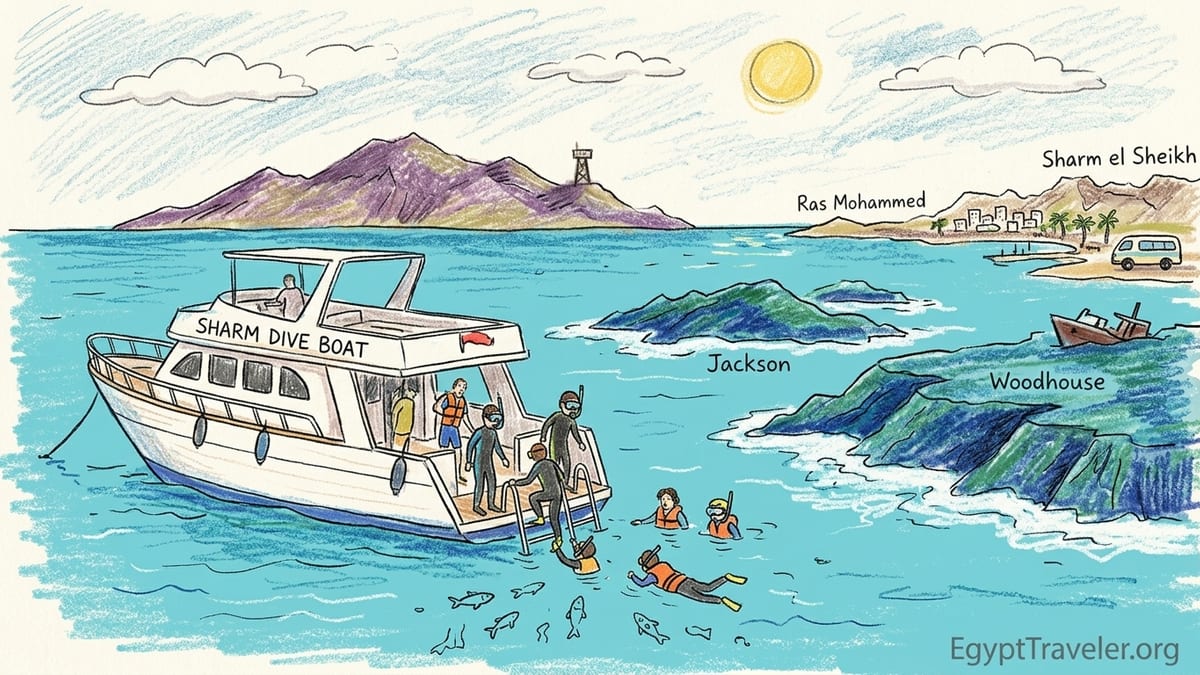
On board, the picture became clearer. Our guide gathered us in the shaded saloon for the safety briefing and, crucially, the schedule. “Today we go to the Strait of Tiran, to three different reefs,” he said, pointing at a faded diagram of four rectangular blocks in a line, labeled Jackson, Woodhouse, Thomas and Gordon. “We will not land on Tiran Island because it is a protected area and military zone. The trip is snorkeling and diving only.” That line, so critical to understanding the nature of the excursion, took less than fifteen seconds. Several people looked up, surprised. A couple with young children exchanged glances; one of them quietly asked, “But what about the beach?”
By that point, of course, we were already leaving the dock. Any disappointment had to be swallowed or turned into resignation. The reality of a Tiran trip begins the moment the ropes are cast off. From Sharm’s northern marinas it takes roughly 60 to 90 minutes of sailing each way to reach the main reefs, depending on wind and sea state. That means, on an eight- to nine-hour excursion door-to-door, at least a third of your day will be spent simply getting there and back, not in the water.
Time Budget: Long Sailing, Short Snorkeling
If that were made explicit at the booking stage, expectations could be managed. In practice, many brochures focus on the number of snorkeling stops rather than the time you actually spend at each, or the long transit required to reach them. On our day, we left the marina shortly after 9:00 and reached the first mooring around 10:30. We were back at the dock a little after 16:30, then back at the hotel just before 17:30 once the minibus had fought its way through Sharm traffic and dropped everyone at their respective lobbies. That is roughly eight and a half hours between pickup and return.
How much of that did we spend in the water? Less than I had imagined when I saw “three snorkeling stops” on the flyer. Each session ran about 25 to 30 minutes of actual mask-in-water time, hemmed in by gear distribution, fitting life jackets, shuffling down ladders and the inevitable boarding chaos at the end. In total, we got around an hour and fifteen minutes in the water on a full-day excursion. The rest was sailing, eating, queuing for the toilet, and waiting for other people’s add-on dives and photographs to finish.
It is important to say that this imbalance is not evidence of a scam. The reefs that make Tiran famous sit in the middle of a busy shipping lane at the entrance to the Gulf of Aqaba. Jackson, Woodhouse, Thomas and Gordon rise from deep water, and in several cases there are no fixed moorings on the exposed corners, only drift routes dictated by wind and current. Reaching them safely takes time, and responsible operators will not rush the briefings or the entries just to cram more minutes into the water. But if your mental image is of a lazy island beach day with the boat as a shuttle rather than the main venue, the time budget will feel very different.
This is why the marketing emphasis on “three stops” can be misleading. Many Ras Mohammed boat trips advertise only two snorkeling sites plus an optional visit to the tidal sandbar known as White Island, yet your total water time can be equivalent or even longer because those sites are closer and better sheltered, with easier entries. On our Tiran day, we visited three different reefs, but the third was a short drift that felt rushed and exposed, added more because the package had promised a trio of stops than because conditions truly called for it.
The Reefs Themselves: Jackson, Woodhouse, Thomas and Gordon
It helps to understand what you are actually coming to see. The Strait of Tiran is a bottleneck where the deep waters of the Gulf of Aqaba flow into the Red Sea. Four main reefs rise here, oriented roughly northwest to southeast: Jackson, Woodhouse, Thomas and Gordon. Their topographies range from dramatic vertical walls swept by nutrient-rich currents to broader plateaus where snorkelers can drift over shallower coral gardens. Long-time Red Sea guides often rate Thomas as one of the best dives in the northern Red Sea, while Gordon, with its fixed mooring and shallower plateau, is considered the kindest to snorkelers.
On our trip, we moored near Gordon for the first session. The rusting hulk of the Loullia wreck sat stranded on the northern edge of the reef, visible in the distance. From the mooring on the southern plateau, we finned over fields of hard coral and clouds of anthias. The guide stayed close to the less confident swimmers, towing a life ring. The reef edge dropped into that characteristic blue void that makes Red Sea walls legendary, with jacks and barracuda cruising beneath us. It was beautiful, and a reminder that despite overuse in places, these reefs still justify their reputation.
The second stop, closer to Thomas, showed the other side of Tiran. Here the current picked up and the crew insisted on a strict drift pattern. We jumped together, held onto the surface line, and followed the guide along the reef, the boat shadowing us downwind. The coral was richer, with gorgonian fans and big sponges, but for weaker swimmers the sense of being pushed along was unnerving. Several snorkelers retreated early to the zodiac. It was world-class scenery, but not the kind of relaxed bobbing in shallow water that many “island trip” customers imagine.
The third stop, a shorter drift along part of Woodhouse, felt like an afterthought. Wind had built through the day, and the captain was clearly using the most sheltered line available. We spent barely twenty minutes in the water before the crew called us back. Counting from the first “mask on” to the last person up the ladder, that final session delivered perhaps fifteen minutes of real reef time. It technically fulfilled the promise of three stops, but it underlined how fragile that number is in the face of conditions, currents and crowd management.
Three Operators, Three Very Different Packages
Looking back, what shocked me most was how many small details can change the feel of a Tiran excursion, even when the headline price and itinerary look almost identical. For this article I compared three current operator offerings that all sell “Tiran Island by boat” from Sharm, each with snorkeling and lunch. Their names are less important than the pattern they reveal.
The first, sold online and through some hotel desks at around the equivalent of 30 to 40 US dollars per adult in late 2026, included hotel transfers within Sharm, basic snorkeling equipment, lunch and soft drinks. Marine park fees were listed as “included.” Diving was offered as an optional extra at about 25 US dollars for a short introductory dive purchased on the boat. Towels were not provided. Photographs were handled by independent photographers, with prices negotiated privately. The FAQ clearly stated that there would be “no landing on Tiran Island.”
The second operator, positioning itself as a step up, priced the day in the region of 45 to 55 US dollars. That price covered transfers, lunch, unlimited soft drinks, snorkeling gear and one short introductory dive, plus the guide’s supervision in the water. However, marine fees were listed separately in small print, to be paid in cash on the day. Wetsuits were available for hire at an additional charge. Towel rental and on-board Wi-Fi were extra. The brochure proudly mentioned “maximum 30 guests on board,” but did not spell out how many of those would be divers versus snorkelers, or whether that cap applied year round.
The third package was run by a long-established local company and sold both directly and through international agents. It cost roughly 60 to 70 US dollars and presented itself as a more environmentally conscious choice. The operator highlighted its adherence to CDWS regulations and the Green Fins environmental standards that Egypt has adopted along the Red Sea coast. In practice, that meant clear rules against touching or standing on coral, limits on group size in the water, and a preference for existing moorings over dropping anchors on sensitive areas. Snorkeling gear and one introductory dive were included, as were soft drinks, lunch and hotel transfers. Marine fees were folded into the price. The FAQ again made it explicit that landing on the island was not permitted.
Standing on the deck, looking around at our own boat, I realized how much these fine-print differences matter. We had around thirty guests on board, in line with what some operators describe as a “limited group.” That still meant tight space on the sun deck and a scrum at the ladder each time we entered or exited the water. On peak days, other travelers report boats carrying more, up to the local legal maximums, which makes the already short snorkeling windows feel even shorter as people wait their turn. The capacity question should be one of the first things a prospective guest asks, yet it is rarely highlighted at the point of sale.
Safety, Site Changes and the Role of Green Fins
It would be easy to blame every disappointment on the operators and stop there. The reality is more nuanced. The Strait of Tiran is a high-energy environment. The same currents that feed the coral also create dangerous eddies and strong surface flows, especially around the corners between the reefs. Local dive guides have colorful names for some of these features, like the “washing machine” near the saddle between Woodhouse and Jackson. When wind and current line up the wrong way, taking novice snorkelers into certain sections is simply not safe.
On our day, the crew skipped part of the planned route at Woodhouse for exactly this reason. The guide pointed at the whitecaps and shrugged: “Too strong today.” That decision probably saved the less confident swimmers a terrifying experience. It also meant that one of the three advertised stops was effectively shortened. Responsible operators make these calls all the time, and several of the better-known companies state in their conditions that the captain may change or cancel specific sites in the interest of safety. The question is whether that possibility was really made clear to you before you booked, or whether it only emerges as a footnote during the briefing, by which time any sense of choice has vanished.
Here, environmental and safety standards offer a useful lens. Egypt’s Chamber of Diving and Watersports (CDWS) has been working with the Green Fins initiative to implement internationally recognized environmental guidelines for dive and snorkel operators in South Sinai and the Red Sea. Green Fins encourages practices like using mooring buoys rather than anchors, keeping fins and equipment off the coral, and limiting the number of people in the water at one time to reduce damage. Some Sharm-based boats now display their Green Fins membership or CDWS compliance as a badge of honor. When I compared my own experience with that framework, the picture was mixed: our crew did use fixed moorings where available, and the guide was vocal about not touching coral, but too many guests were still allowed to stand on bommies in the shallows while posing for photos.
If you care about reef protection and safety, choosing an operator that genuinely follows CDWS and Green Fins guidelines can make a tangible difference to your day. It may mean fewer people in the water at once, slightly higher prices due to stricter staff ratios, and a more structured briefing that honestly explains the limitations of the sites. It is not a guarantee against crowding or frustration, but it does suggest a seriousness of intent that pure price-chasers may lack. Before you book, it is entirely reasonable to ask the seller whether the operating boat holds a current CDWS license and whether it follows Green Fins practices.
What You Give Up If You Expect an Island Beach Day
By the time we turned back toward Sharm in the late afternoon, five genuine disappointments had crystallized in my mind, all stemming from that first vague promise of an “island trip.” The most obvious was the simple fact of no island landing. If your idea of a perfect day includes bare feet on sand, a swim from a shore rather than down a ladder, and perhaps a short walk or viewpoint, Tiran by boat will not deliver it. The island remains a hazy backdrop, not a destination you inhabit.
The second disappointment is the ratio of travel to immersion. Ninety minutes of sailing each way, give or take, might be a pleasant cruise for some. For others, particularly families with small children or anyone prone to seasickness, it feels like a long haul for a relatively short reward. Add in the early wake-up and the late return and you start to see why some regulars recommend saving your energy for a shorter road-and-reef day instead.
Third comes the limited water time. An hour to an hour and a half of snorkeling spread across three stops is not nothing, and the quality of the coral can be outstanding. But once you realize that a big chunk of your expensive “snorkel day” is spent waiting, queuing, or eating, the experience can feel thin, especially if one of the stops is curtailed by wind or current. A two-stop trip where you linger 45 minutes at each reef can actually give you more connection with the underwater world than a rushed three-stop circuit.
Fourth, the extras add up in ways that are rarely obvious on the glossy leaflet. Mask and fins may be included, but wetsuits, towel rental, marine fees, and even the photographer’s USB stick can easily double what you thought you were spending. One operator I looked at offered a headline price that seemed a bargain, then quietly added a per-person marine park fee in small print and quoted 25 US dollars for a ten-minute introductory dive sold on board. None of that is inherently unfair, but it chips away at trust when it is not made crystal clear before you commit.
Finally, there is the question of boat capacity and crowding. On our day, with about thirty guests, every surface was occupied once people stretched out to sunbathe. Moving from the bow to the stern required careful navigation around towels and bags. In the water, the guide did their best to keep the group together, but fins in faces and accidental kicks were inevitable. Some travelers enjoy the sociable chaos of a busy dive deck. Others imagined something closer to the brochure image of a half-empty yacht anchored in a private lagoon. The gap between those visions is another reason why so many Tiran reviews read like a clash of expectations rather than a failure of the destination itself.
Tiran vs Shore Snorkeling and Ras Mohammed
So if Tiran by boat is not the barefoot-island day many expect, how does it compare with the alternatives Sharm offers? Start with shore snorkeling. Several hotel house reefs in Sharm, particularly around Sharks Bay, Ras Um Sid and parts of Hadaba, offer very good coral and fish life accessible from a jetty. You trade the drama of mid-channel reefs and open blue water for the convenience of walking from your room to the sea in five minutes, with no bus transfers or fixed timetable. For families or nervous swimmers, that can be a better use of time and energy than an eight-hour boat commitment.
Then there is Ras Mohammed, the national park at the southern tip of Sinai. Here, you have two broad styles of visit. One is a road trip that loops through viewpoints and coastal spots like the mangrove-fringed pools and cliff lookouts, with shore entries for snorkeling. That offers a genuine land component: you stand on headlands, look back at the Sinai mountains and visit bays like Shark Observatory or Yolanda Beach. The other is a boat excursion that, like Tiran, focuses on offshore reefs but often includes a shallow stop near the tidal sandbar known as White Island when conditions allow. That sandbar is not an “island” in any permanent sense, but for many visitors, the chance to stand ankle-deep in clear water with desert on the horizon scratches the itch that a purely boat-based Tiran trip cannot.
In terms of pure reef quality, experienced divers and snorkelers disagree over whether Tiran or Ras Mohammed is “better.” The truth is that both regions hold world-class sites, and day-to-day conditions matter more than labels. What is more important for the average visitor is the structure of the day. Ras Mohammed boat trips often involve slightly shorter sailing distances, while the road variant lets you control, to some extent, how long you stay in or out of the water. If your priority is maximizing your time face-down in coral gardens, a carefully chosen Ras Mohammed operator can match or exceed what you get at Tiran with less transit.
What Tiran does uniquely well is the sense of being out in the open sea. When you float above the dropoff at Gordon or Thomas and watch the reef wall disappear into deep cobalt, with nothing but water between you and the hazy outline of Saudi Arabia, you understand why liveaboard divers wax lyrical about this strait. If that offshore feeling and the names of the reefs themselves are what drew you here, then a Tiran trip can be deeply satisfying despite its structural compromises.
The Takeaway
Back in my hotel that evening, sunburned despite the shade and vaguely annoyed at my own naïveté, I realized that my Tiran day had been neither a disaster nor the fantasy I had purchased in my head. The reefs were beautiful. The crew, for the most part, were competent and safety-conscious. The frustrations came from the disconnect between the simple promise of an “island trip” and the more complicated reality of a mid-channel reef circuit governed by wind, current, regulations and group logistics.
Who, then, should book a Tiran boat excursion from Sharm el Sheikh? If you are genuinely interested in the offshore reefs themselves, if names like Jackson and Thomas mean something to you or you want to experience the drama of deep blue dropoffs and currents, this trip is worth considering. Choose your operator carefully, ask direct questions about boat capacity, inclusions, marine fees and the possibility of site changes, and go in with your eyes open about the long sailing times and limited snorkeling windows. Treat any beach photograph as mood imagery, not a promise of sand underfoot.
On the other hand, if the phrase “island trip” makes you picture a tropical-style beach day with a village to wander, palm trees to sit under and the freedom to come and go from the water at your own pace, Tiran by boat is almost certainly the wrong choice. You will not land on the island. You will spend several hours on a shared boat, and your contact with the sea will be structured into relatively short bursts dictated by the schedule. In that case, a Ras Mohammed road-and-reef itinerary, a White Island boat day, or simply investing in a hotel with a good house reef at Sharks Bay or Ras Um Sid may fit your vision better.
The Strait of Tiran deserves its iconic status in Red Sea lore. What it does not deserve is to be sold as something it is not. The more honestly operators describe the trip as a day on the water around Tiran’s reefs, rather than an “island landing,” the fewer disappointed faces will be staring at the mountain silhouette from the deck, wondering when the tender will finally take them to shore.
FAQ
Q1. Do Tiran Island boat trips from Sharm actually land on the island?
In practice, standard day boats from Sharm do not land on Tiran Island. The island is treated as a protected military and natural zone, and regulations prohibit routine tourist landings, so the entire excursion takes place on the boat and in the surrounding waters.
Q2. How long is a typical Tiran boat excursion door to door?
Most Tiran trips run as full-day excursions of around eight to nine hours in total, including hotel pickup, transfers to and from the marina, sailing time to the reefs, snorkeling sessions, lunch, and the return journey to your hotel.
Q3. How much actual snorkeling time do you usually get?
On a standard shared boat itinerary with three advertised snorkeling stops, guests commonly experience around one to one and a half hours of real mask-in-water time in total, divided into two or three sessions of roughly 20 to 30 minutes each, although sea conditions and group management can shorten or lengthen this slightly.
Q4. Are three snorkeling stops always better than two?
Not necessarily. A three-stop plan may sound superior, but if one stop is rushed due to wind, current or timing, you can end up with less meaningful water time than on a two-stop trip that allows longer, more relaxed sessions at higher-quality or more sheltered reefs.
Q5. Why do operators sometimes change the planned reef stops?
Captains and guides regularly adjust routes in the Strait of Tiran because currents, wind and visibility can change quickly. Skipping or shortening a stop is often a safety decision, especially around exposed corners or drift sites, and responsible operators reserve the right to alter the plan for passenger safety and environmental protection.
Q6. What should I look for when comparing different Tiran packages?
When comparing offers, pay close attention to what is included in the price, such as hotel transfers, marine park fees, snorkeling gear, introductory dives, soft drinks, lunch, towels and any photography services, and ask directly about maximum boat capacity, group size in the water and whether the operator follows CDWS and Green Fins environmental standards.
Q7. How crowded are the boats on a typical Tiran trip?
Boat loads vary by operator and season, but many shared excursions carry around 25 to 30 guests, which can feel busy on deck and at the ladders; some boats may carry more up to the legal limit, while higher-priced or private charters keep numbers lower for more space and quieter water entries.
Q8. Is Tiran better than Ras Mohammed for snorkeling?
Neither is universally “better.” Tiran excels at dramatic offshore reefs and deep blue dropoffs, while Ras Mohammed offers a mix of superb reefs and, on some itineraries, accessible shore entries or a shallow stop near the White Island sandbar. The best choice depends on whether you prioritize mid-channel reef walls, shorter travel times, or the ability to step onto land during your day.
Q9. Can beginners and children safely snorkel at Tiran?
Many families do snorkel at Tiran, but currents and depth make some sites challenging. Safer experiences come from choosing a cautious operator, listening carefully to the briefing, using life jackets where needed, and accepting that the captain may restrict certain sections or shorten a stop if conditions are not suitable for weaker swimmers.
Q10. Who should skip Tiran and choose a different trip instead?
Travelers whose main dream is a relaxed island beach day with time ashore, anyone who dislikes long boat rides or crowded decks, and guests who are nervous in deeper water with some current will likely be happier choosing a Ras Mohammed road-and-reef tour, a White Island boat trip when conditions allow, or simply focusing on good house-reef snorkeling directly from their hotel.