


The Egyptian shore of the Gulf of Aqaba offers some of the closest and most dramatic coral reef access anywhere in the Red Sea. In many places the reef crest starts just a few metres from dry sand, which makes for spectacular snorkeling but also creates a constant trade off. Getting into and out of the water safely can be tricky where coral heads rise almost to the surface and waves break directly onto the reef. This guide follows the coast from Dahab to Taba and then offshore to the Strait of Tiran, focusing on how to balance easy access with healthy coral, and how to choose safe, responsible snorkel operators that follow CDWS Green Fins principles.
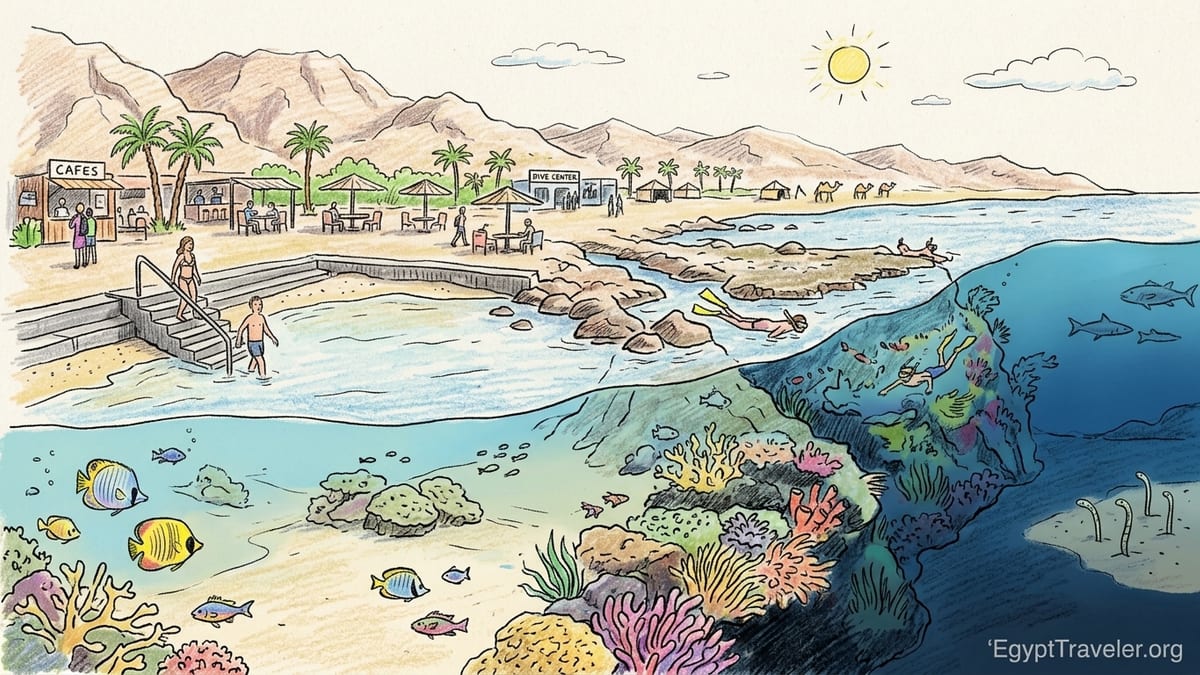
Dahab’s Shore Reefs and the Entry Trade Off
Dahab is one of the few places in the world where you can finish breakfast in town and be finning over hard coral within minutes. The main bay, a curve of shoreline that locals often refer to simply as Lighthouse and Masbat, is lined with dive centers, cafes and rental outfits. Behind the relaxed waterfront scene there is a structural reality: the fringing reef runs very close to shore, broken only by narrow sandy channels and entry pools. That makes the snorkeling visually rich, but also means you cannot treat it like a flat sandy beach where you simply walk straight in without thinking.
The fundamental pattern repeats almost everywhere on this coast. Sand and rock at the waterline give way quickly to a shallow hard coral platform. Then, at somewhere between waist and chest depth, the reef lip drops away into 5 to 15 metres of water or more. For snorkelers this is ideal viewing depth, but the shallow lip is easily damaged by careless fin kicks and can be dangerous for bare feet in choppy conditions. Understanding where those access gaps are, and how local guides use them, is more important here than in destinations where coral lies well offshore.
Because of this geometry, Dahab’s most popular snorkeling sites tend to be places where natural sand patches or man-made steps have created relatively gentle entries. Others are best approached with a local guide who knows the coral channels and prevailing wind. This is why some spots have a very different reputation among experienced residents than among first-time visitors who may only see them on glossy posters.
Lighthouse Reef: Dahab’s Easiest Central Snorkel
Lighthouse Reef sits directly in front of Dahab’s central promenade, close to the old lighthouse structure and the main concentration of dive centers and cafes. Access is on foot from town, and the entry point is usually a short set of concrete or stone steps leading into a sheltered basin. Beneath the surface a sandy patch extends a few metres before low coral heads rise and then slope gently away from shore. This combination of a clear walk-in and a gradual drop off is the reason so many dive schools list Lighthouse as their primary training and try dive site.
For snorkelers, Lighthouse works especially well for beginners and mixed-ability groups. Non-swimmers can stay over the inner sand at about 1 to 2 metres, where rental shops often conduct mask and fin practice. Confident swimmers can fin out along the reef edge where depth increases to 8 to 15 metres, following colourful hard coral blocks and looking for butterflyfish, anthias clouds, masked pufferfish and the occasional blue-spotted ray in the sand. In normal conditions current is light and mostly wind driven, so out and back routes parallel to shore are practical.
Lighthouse is also one of the few places in Dahab where support infrastructure is immediately on hand. Multiple CDWS-registered dive centers on the waterfront rent masks, snorkels, fins and short wetsuits, usually on a per-day basis, and some can provide a dedicated snorkeling guide for a half-day fee. There are shaded seating areas, freshwater showers, restaurants and easy access to taxis. The main limitations are crowding, especially in high season and at sunset, and the environmental impact that comes with heavy use. You will often see broken coral near the entry from years of careless standing, which underlines why correct technique and buoyancy are important even in such a forgiving site.
Dahab’s Other Reefs: Eel Garden, The Islands, Three Pools, Canyon and Blue Hole
Just north of Lighthouse lies Eel Garden, named for a patch of garden eels that extend from the sandy bottom beyond the reef lip. The shoreline here is rockier and the entry depends heavily on sea conditions. In calm weather experienced snorkelers can use natural rock channels to swim out, but in wind chop or swell the shallow coral platform becomes more hazardous. Once outside the lip, the reef wall drops to around 20 metres and the eel garden itself is deeper than comfortable snorkeling range, which is why this site is primarily promoted for scuba. For surface snorkelers, it can still be enjoyable to cruise over the shallower coral but it is not an ideal choice for nervous swimmers or small children.
South of central Dahab, between the town and the Lagoon, the site known as The Islands offers a different topography. Here, coral bommies and ridges create a maze of channels in only a few metres of water, forming a sort of natural coral garden that can be spectacular in clear light. The entry is usually from a marked access point off the coastal track, often used by guided groups. Because the coral rises so close to the surface, snorkelers need good fin control and should avoid entering at low tide or in significant wave action. The reward is intricate shallow scenery that suits underwater photographers, with table corals, schools of glassfish and frequent anemonefish in sheltered pockets.
Three Pools, further south along the coast road, is one of Dahab’s classic multi-use sites. The name comes from three natural sandy basins separated by coral ridges. There is road access and an entry fee is often charged at simple shore camps and cafes lining the beach. Entry generally involves wading from a stony shore and then using one of the sandy bowls to put on fins before crossing low coral ridges. This can be slightly awkward for complete beginners, and protective footwear helps on the rocks, but once in deeper water most of the snorkeling follows a defined route along the outer reef edge. Currents are usually manageable for competent swimmers, and the site is popular for combined snorkeling and introductory dives.
The Canyon, north of Dahab, and the famous Blue Hole should be approached very differently by snorkelers. The Canyon’s main feature, a deep crack in the reef dropping well below normal snorkeling depths, is a technical draw for scuba and freedivers. From the surface you mostly see standard fringing reef, and water entry involves negotiating shore rocks and sometimes significant waves, depending on wind. There is little reason for casual snorkelers to prioritise it over easier sites closer to town.
The Blue Hole, reached by vehicle or camel track north of Dahab, is even more specialised. The inner pool is a deep vertical shaft in the reef, with a lip at roughly a few metres and a bottom far below safe recreational snorkeling depth. Marketing photos often show people floating in dark blue water that looks like a simple natural swimming pool. In reality, the combination of a sheer drop, frequent swell on the outer reef and, in places, strong currents, makes this a location where beginners should only enter the water under the direct supervision of certified guides and with flotation if needed. Experienced snorkelers can enjoy the coral on the outer saddle and the lip of the pool, but this site should never be promoted as a casual children’s splash zone.
Ras Abu Galum, reached either by boat or by coastal camel path north of the Blue Hole, adds another layer of complexity. The protected area includes stretches of relatively untouched reef with steep slopes into deep water. Most visitors arrive on organised day trips that combine snorkeling with time at simple beach camps. Access is usually from pebble or sand strips between coral heads, sometimes via basic jetties. Currents can be stronger here than inside Dahab Bay and there are few formal facilities beyond shaded seating, simple food and toilet huts. For strong swimmers accompanied by local guides the snorkeling can be outstanding, but families with very young children or anyone reliant on lifeguards or formal medical support should understand that this is a remote setting.
Understanding Nuweiba’s House Reefs: Ras Shitan to Abou Lou Lou
Driving north from Dahab toward Nuweiba, the coast straightens and the atmosphere shifts from resort town to scattered camps and small lodges. Many of these places market themselves around so called house reefs. These are sections of fringing reef immediately offshore from beach camps such as those around Ras Shitan and further south and north toward Nuweiba town. The best known in this stretch is the area often labelled Japanese Garden near Ras Shitan, which several long established ecolodges use as their primary snorkeling draw.
At Japanese Garden the reef structure is typically accessed via a narrow sand or rubble channel between coral heads, sometimes marked by buoys or ropes maintained by the camp. In calm weather it is possible to wade out until the water is around waist deep, put on fins and then swim across the shallow coral platform to reach the outer slope. Coral cover here is often quite dense, with plate corals, small pinnacles and occasional larger blocks dropping away into around 10 to 20 metres of water. For intermediate snorkelers who are comfortable with a slightly fiddly entry and no formal lifeguard, the site can be excellent. First-time visitors should ask camp staff to physically walk them through the preferred entry and exit point before going in alone.
Further south near Nuweiba, house reefs such as the one in front of Abou Lou Lou and other small lodges follow a similar pattern but with important variations. Some properties have cleared or naturally sandy strips that allow easier wading, making them better suited to families. Others border sections of very shallow coral where walking out is impractical and a short jetty or floating platform is used to protect both reef and feet. Facilities vary from very simple beach huts with shared bathrooms to more hotel-style rooms with power, fresh water showers and dedicated equipment rooms.
In this region it becomes particularly important to clarify with owners what is available on site. Some camps provide masks, snorkels, fins and rental wetsuits along with guided sessions on the house reef, often led by CDWS-affiliated dive centers or freelance guides. Others expect guests to bring their own gear and do not have qualified snorkeling guides, only local boatmen. Before you book, it is worth asking directly whether there is a CDWS-registered operator attached to the camp and whether guided snorkeling is available on request. If you rely on on-site medical support, note that formal clinics are concentrated in Nuweiba town rather than at remote camps.
Taba and the Northern Gulf: Fjord Bay, Hotel Reefs and Pharaoh’s Island
North of Nuweiba the road climbs and falls between mountains and sea before reaching the Taba area, close to Egypt’s borders with Israel and Jordan. Here, the coastline includes a mix of dramatic natural bays and purpose-built resorts. Fjord Bay, a scenic inlet south of Taba, is often photographed from the hillside road, showing a deep blue inner basin framed by lighter turquoise shallows. From the water level, the shore is a mixture of pebbles and sand, with coral patches along the sides of the bay rather than across its full width.
For snorkelers, Fjord Bay is accessible by road from Taba and Nuweiba, and some local operators include it on day tours that combine photo stops with swimming. Entry is generally from the beach near the base of the hill, where the bottom slopes away into deeper water. The central part of the bay is relatively deep and better suited to confident swimmers, while the flanks hold reefs that drop into blue water close to shore. There is usually no built jetty, and shade and facilities may be limited to temporary tents or mobile vendors during busier periods. Currents can be present, especially nearer the mouth of the bay, so it is unwise to venture far alone without local knowledge.
In and around Taba itself, several large hotels and resorts front sections of reef. These properties often advertise house reef snorkeling directly from their private beaches or jetties, and some have small dive centers or water sports desks on site. It is important for independent travelers to understand that booking a room nearby does not automatically grant access to every private beach along this strip. In many cases, shoreline sections in front of individual hotels are reserved for in-house guests and visiting snorkelers from outside cannot simply walk in from the road.
That does not mean the reefs are off limits. In practice, non-resident visitors sometimes join half-day snorkeling excursions run by hotel-based CDWS centers as paying guests, or they choose public-access sections in cooperation with local operators that have formal permission to use certain entry points. As arrangements and security rules can change, particularly in this border region, it is sensible to confirm current access conditions with accommodation or tour providers before travelling specifically for a particular hotel reef.
Pharaoh’s Island, also known as Geziret Faraun, sits offshore with a small historic fortress on its heights and fringing reef around its flanks. Snorkeling trips here typically depart by boat from Taba or nearby jetties under CDWS-regulated operators. In most cases, visitors remain on the boat or transfer to the island’s small landing areas for fortress visits, then return to the water by ladder or platform near mooring buoys. Landing directly on random parts of the island’s shoreline or trampling the reef flat is not allowed. When considering such a tour, ask explicitly where the snorkeling will take place, whether there will be one or multiple stops and what safety equipment is on board.
Offshore Snorkeling in the Strait of Tiran: Jackson, Woodhouse, Thomas and Gordon
At the southern opening of the Gulf of Aqaba, off the coast near Sharm el Sheikh, the Strait of Tiran concentrates currents between the Sinai Peninsula and Saudi Arabia. Four main reef plateaus rise from deep water here: Jackson, Woodhouse, Thomas and Gordon. These are among Egypt’s best known dive sites and also support snorkeling in carefully chosen zones. However, the environment is significantly more exposed than sheltered shore sites around Dahab, and conditions vary with wind, tide and boat traffic.
Most snorkeling visitors experience the Tiran reefs on full-day boat trips that include transfers from Sharm or, less commonly, from Dahab via longer drives and then boats. Operators licensed through the Chamber of Diving and Watersports are expected to follow standards for boat safety, staff qualifications and environmental briefings, and many use Green Fins materials when explaining correct reef etiquette. Unlike shore entries, access at Tiran is almost always directly from the boat into deep water, where the bottom may lie 10 to 30 metres or more below. This is suitable only for swimmers comfortable in open sea who can maintain buoyancy and orient themselves in mild current.
Each Tiran reef has zones that may or may not be appropriate for snorkelers on a given day. For example, some boats favour moorings on the more sheltered sides of Gordon or the southern plateau of Jackson when wind and surface chop are moderate, allowing snorkelers to drift gently along the reef wall while staying within the protection of the reef shoulder. Other areas, such as the outer northeastern edge of Jackson where strong currents and waves can run, are reserved for experienced divers and are not a place to float unattended on a snorkel. Woodhouse and Thomas also have stretches exposed to the full force of the channel, and competent guides will choose routes accordingly.
Crucially, typical Tiran excursions do not include landings on Tiran Island itself. Boats anchor or tie to fixed moorings near the reefs, and all in-water activity takes place from the vessel. This is both a safety measure and a way to protect the reef flats and island shoreline from trampling and uncontrolled access. When comparing tours, look for operators who clearly describe their planned snorkeling stops in terms of reef name, expected depth and current, and who provide life jackets or snorkeling vests for those who want additional flotation. Avoid any operator that appears casual about briefing or that clusters too many snorkelers into small entry points without supervision.
Safety, Conditions and CDWS Green Fins Practices
Across the Gulf of Aqaba, the Chamber of Diving and Watersports acts as the main regulatory body for diving and snorkeling operators in Egypt’s Red Sea governorates. In cooperation with the international Green Fins program, CDWS has adopted environmental codes of conduct that member operators are expected to follow. For snorkelers this translates into simple but essential rules. Avoid touching or standing on coral, even if it looks like dead rock. Keep fins and equipment under control to prevent accidental kicks. Do not chase turtles, rays or fish for photographs. Never feed fish or collect shells, coral fragments or sand as souvenirs.
Green Fins materials, which CDWS distributes to member centers, also emphasise waste management and briefings. Many CDWS-affiliated dive centers now provide pre-snorkel talks that cover not only safety but also reef-friendly behaviour, explaining why, for example, a single careless fin stand on a branching coral can break years of growth. When you are choosing an operator in Dahab, Nuweiba, Taba or Sharm, ask whether they follow CDWS and Green Fins guidelines and look for evidence in practice. Simple signs include staff stopping clients from standing on the reef crest, rubbish being collected from boats at the end of the day and clear explanations about no-touch policies.
In terms of practical safety, the main environmental variables on this coast are wind-generated waves, currents along the reef edge and, in summer, heat on exposed shores. Conditions can change during the day, particularly in regions like Ras Abu Galum and Tiran where local wind patterns are pronounced. For example, a shallow entry channel that was calm in the morning may have small breaking waves by afternoon, making exit complicated. This is another reason to time sessions with local staff advice rather than assuming conditions will remain constant.
Equipment quality also matters more than many first-time snorkelers realise. Mask leaks or poorly fitting rental fins are at best annoying and at worst a stress factor in unfamiliar water. In Dahab and Sharm, several established dive centers offer branded masks and fins for daily rent and may allow you to test fit in calm shallows at Lighthouse or similar sites before heading to more exposed reefs. In remote camps, gear may be more basic and quantities limited, so packing your own well-fitting mask and snorkel is a sensible investment if snorkeling is a primary aim of your trip.
Choosing the Right Site: Recommendations by Traveler Type
For absolute beginners and nervous swimmers, Dahab’s Lighthouse Reef stands out as the most practical introduction to Gulf of Aqaba snorkeling. The combination of a clear, sandy entry, nearby cafes for shade, immediately accessible equipment rental and the presence of multiple CDWS centers makes it an obvious first stop. Within a single session, newcomers can practice floating and breathing in waist-deep water before venturing to the reef edge. Families with school-age children who are already comfortable in pools often appreciate the ability to exit quickly onto solid steps rather than scrambling over rocks.
Families seeking sandy entries and as few sharp rocks as possible should clarify their priorities when booking accommodation, especially at Nuweiba and Ras Shitan camps. Some properties maintain small man-made coves or cleared patches where children can play in very shallow water without encountering coral heads. Others are focused entirely on preserving a wild shoreline, which is appealing to experienced snorkelers but less so to toddlers. Asking for current photos of the beach at low tide and for a description of how children usually enter the water can be more reliable than generic promotional phrases.
Confident swimmers who want visually rich reefs straight from shore might favour The Islands and certain Ras Abu Galum and Japanese Garden sections, provided they accept trickier entries and the absence of lifeguards. Underwater photographers, in particular, tend to appreciate shallow coral labyrinths like The Islands and the outer slopes of Japanese Garden because they allow long, slow explorations in only a few metres of water, with shafts of sunlight highlighting coral structures. These sites reward patience and close observation rather than high-speed finning.
Strong swimmers comfortable in deep open water, and those specifically interested in dramatic drop-offs and larger pelagic sightings, might plan day trips to Ras Abu Galum’s deeper outer walls or offshore boat excursions to the Tiran reefs. Here, the appeal lies in the sense of space, schools of fusiliers and jacks, and the possibility, in the right season, of seeing larger species such as trevallies or even passing sharks from the surface. The trade off is exposure to current and waves, and the requirement to trust captain and guide judgment. These are not sites to attempt self-guided without substantial local experience.
If your priority is combining history with reef time, Taba-based excursions that include Pharaoh’s Island offer an unusual blend of fortress views and snorkeling stops from the boat. However, because access rules and security procedures around the island can change, it is worth treating the snorkeling component as a bonus rather than the sole purpose of the trip. In all cases, aligning your own swimming ability and risk tolerance with the specific entry conditions and exposure of each site will give you the best chance of enjoying the Gulf of Aqaba’s reefs safely and responsibly.
The Takeaway
The Gulf of Aqaba’s Egyptian shore offers an almost continuous line of coral reef, but not all of it is equally accessible from the surface. Sites like Dahab’s Lighthouse Reef prove that with the right geography and infrastructure, spectacular snorkeling can begin just a few fin kicks from a cafe terrace. Others, including The Islands, Japanese Garden, Ras Abu Galum, Fjord Bay and the Tiran reefs, ask more of the snorkeler in terms of entry, current awareness and self reliance. Understanding that the very features that make a reef beautiful shallow coral, clear drop offs, exposure to clean water also create hazards, is the key to choosing well.
A cautious, informed approach pays off here. Checking in with CDWS-registered centers, asking clearly about shore access and depth, and favouring operators who use Green Fins guidelines will not only keep you safer but also help ensure that the corals you come to see remain intact for future visitors. Avoid any pressure to stand on the reef crest for photos or to treat deep sites like Dahab’s Blue Hole as simple natural pools. With realistic expectations about access, depth and facilities, you can tailor an itinerary that might start with gentle laps at Lighthouse, progress to the coral gardens of The Islands or Japanese Garden and, for those who want it, culminate in drifting along the deep blue walls of Tiran.
Whether you are a first time snorkeler or an experienced freediver, this stretch of coastline rewards those who match their ambitions to their abilities and who treat the reef as a living, fragile environment rather than a theme park. Approach each site with respect, listen carefully to briefings and give yourself time to adapt to local conditions. The payoff is some of the most memorable, easily reached coral scenery anywhere in the Red Sea, framed by Sinai’s stark mountains and the deep blue of the Gulf of Aqaba.
FAQ
Q1. Is Dahab’s Lighthouse Reef suitable for complete beginners and children?
Yes, Lighthouse is one of the easiest sites on this coast, thanks to its clear stepped entry, sheltered bay and nearby facilities, but children should still use flotation and remain supervised.
Q2. Can I snorkel the Blue Hole in Dahab if I am not a strong swimmer?
You should only enter the water at the Blue Hole with a certified guide, appropriate flotation and realistic self assessment. It is a deep, exposed site and not a casual swimming pool for non swimmers.
Q3. Do I need a guide to snorkel The Islands or Three Pools near Dahab?
Experienced, confident snorkelers sometimes go independently, but first time visitors benefit from a local guide who knows the coral channels, recommended routes and exit points.
Q4. How can I tell if a snorkeling operator follows CDWS and Green Fins standards?
Look for visible CDWS membership certificates, ask staff directly about Green Fins guidelines, and pay attention to whether briefings include clear no touch, no stand instructions and environmental advice.
Q5. Are Nuweiba and Ras Shitan house reefs easy for young children?
Some camps have small sandy entries that suit families, while others front shallow coral with rockier access. Always ask for a precise description of the shoreline and entry depth before booking with children.
Q6. Can I access hotel house reefs in Taba if I am not staying at the resort?
Private hotel beaches are usually reserved for guests, but some dive centers allow outside visitors to join paid snorkeling trips that use their jetties. You need to arrange this in advance.
Q7. Do Tiran snorkeling trips land on Tiran Island?
Standard snorkeling excursions in the Strait of Tiran operate entirely from the boat, using fixed moorings near the reefs. Landings on the island itself are not normally part of these trips.
Q8. What kind of marine life can I realistically expect to see while snorkeling?
Common sightings include hard and soft corals, butterflyfish, angelfish, parrotfish, anthias, pufferfish and blue spotted rays. Turtles and larger pelagic fish are possible but not guaranteed.
Q9. Is it worth bringing my own snorkeling gear to Egypt?
Yes, bringing a well fitting mask and snorkel is a good idea, especially if you plan to visit remote camps where rental options may be limited or basic. Fins and wetsuits can often be rented on site.
Q10. What is the best season for snorkeling on the Gulf of Aqaba coast?
Spring and autumn generally offer a balance of warm water and manageable air temperatures. In mid winter the sea can feel cool without a wetsuit, and in midsummer heat and surface glare can be intense.