


Somewhere between Dahab and Taba, the tarmac narrows, the mountains close in and the sea turns an impossible shade of ink-blue. That is where I left behind the idea of a conventional Red Sea resort and checked into a simple Bedouin beach camp on the Ras Shitan coast near Nuweiba, a strip of sand wedged between the Sinai mountains and the Gulf of Aqaba. One night there was enough to show me both the quiet magic and the very real inconveniences of swapping a multi-pool resort for a mattress in a hut a few meters from the water.
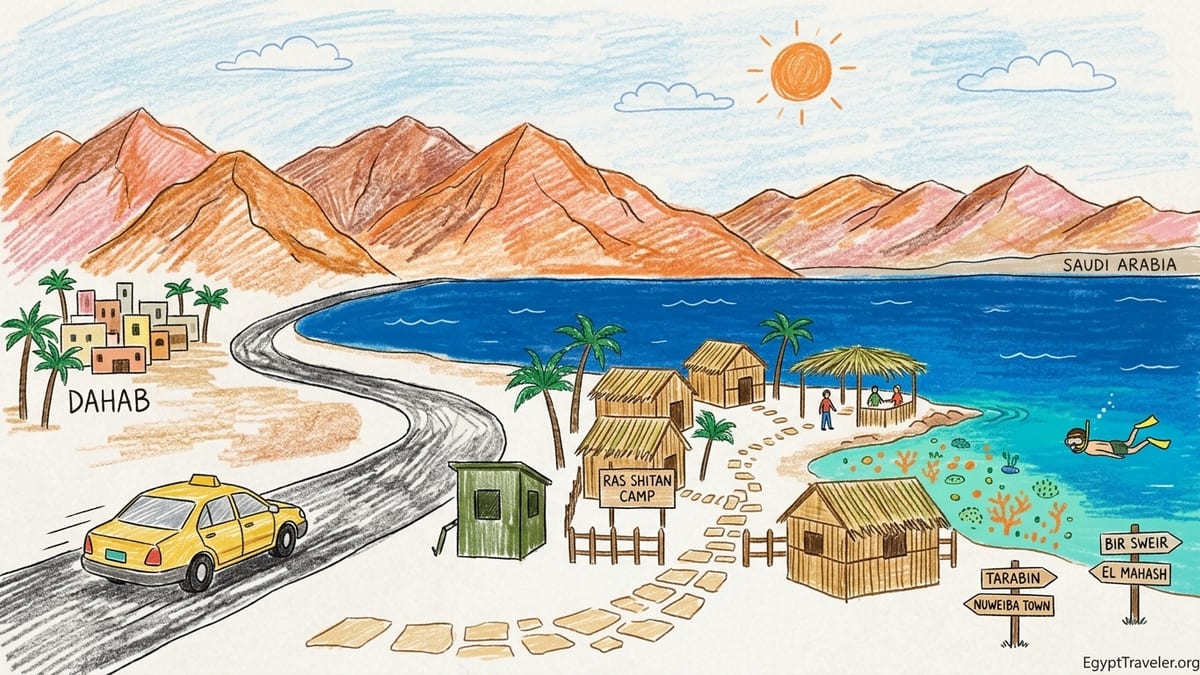
Getting From Dahab to Ras Shitan
I started the journey in Dahab, where most visitors either bargain with local taxi drivers or book a private transfer through small agencies that arrange rides up and down the coast. Recent quoted prices for a private taxi from Dahab to Nuweiba town hover around 1,500 to 1,800 Egyptian pounds for the car, depending on the season and how hard you negotiate, with minivans costing more for larger groups. Shared microbuses are cheaper, but they run on local schedules, are often crowded and less predictable if you are aiming for a specific camp entrance rather than Nuweiba town itself.
The drive from Dahab to Ras Shitan takes about an hour and a half on the coastal road that threads between bare, rust-colored mountains and the deep blue water. Police checkpoints break the distance into segments, and foreign travelers are accustomed to having passports checked and details logged. The asphalt itself is mostly in good condition, but the road can feel lonely. Once past Nuweiba town, it is important to have already agreed with the driver which camp you are heading to, because there are no large road signs announcing the cluster of beach camps by name.
My destination was a Ras Shitan camp a short drive north of Nuweiba, in the same general area as places like Bedouin Star, New Moon Island and Sahara Beach Camp. These camps share the same long stretch of shoreline, but their standards vary dramatically. Some, such as Salah Boutique Camp and Sondos Camp models listed with air conditioned rooms and private bathrooms, look almost like small boutique hotels. Others still offer only very simple bamboo huts with shared facilities, closer to what Ras Shitan was known for a decade ago.
We left the main highway down a rutted track of compacted sand and stone. There was no formal gate, just a hand-painted wooden sign and a line of palm-frond fencing. The last hundred meters felt like entering another pace of life entirely: a few scattered huts, a central restaurant shaded by woven palm branches, and the sea, flat and metallic in the late afternoon heat, only a few footsteps away.
Choosing Ras Shitan Over Bir Sweir, El Mahash and Tarabin
Nuweiba’s coast is often talked about as if it were one continuous scene of dreamy beach camps, but each area has a slightly different character. Ras Shitan, where I stayed, is a low-key ribbon of camps squeezed between a steep mountain slope and the water. Bir Sweir, a little farther north, feels more spread out, with some camps edging toward slightly sandier entries and larger sandy patches between rocky segments. El Mahash has become known for several more developed properties and for some camps with more pronounced rocky shelves, while Tarabin, near Nuweiba town, has a more lived-in, local village feel, with cafes, a bit more street life and easier access to basic shops.
I chose Ras Shitan because I wanted that sense of being cut off from everything without going all the way into complete isolation. Taba is roughly an hour north by car, and Nuweiba town around 20 to 30 minutes south. There are no promenades or supermarkets here, but there is just enough clustering of camps that you can walk along the shoreline and see lanterns from neighboring places. A camp like Salah Boutique Camp at Ras Shitan advertises air conditioned double rooms with private bathrooms and sea views, whereas older style camps nearby still lean into shared bathrooms and unaired mattresses on low wooden frames.
In contrast, if I had booked in Tarabin I would have been closer to small groceries, ATMs in town and options for street food. Bir Sweir, by most recent accounts from travelers, can offer a similar kind of simplicity to Ras Shitan but with some stretches that feel a little softer underfoot in the water and sporadic mobile signal improvements. El Mahash hosts camps that have gradually modernized, some adding pools and more solid bungalows, pulling the atmosphere toward something between a camp and a small hotel.
With all that in mind, Ras Shitan still felt like the purest expression of the classic Nuweiba camp experience: rough edges, endless water, the silhouette of Saudi Arabia faint on the horizon at night, and a sense that the mountains are pressing right up to the beach.
The Hut I Booked: Simple Comforts and Missing Conveniences
I booked a seafront bamboo hut, a style still widely available along Ras Shitan even as some camps now advertise air conditioned cabins. The hut was a square structure made of wooden posts and woven palm fronds, raised on a low concrete base. Inside, there was a single mattress on a wooden frame, two thin pillows and a cotton sheet, with an extra blanket folded at the foot of the bed in case the desert night turned surprisingly cool.
There was no air conditioning. Instead, a ceiling fan whirred lazily overhead when the power was on, which at this camp meant more or less around the clock but with the occasional unexplained cut. Mosquito protection came down to a simple net draped from a hook above the bed and the camp’s offer of a coil or spray if needed. In October the insects were present but not overwhelming; earlier in autumn and in spring they can be more aggressive, especially on windless evenings.
Electricity reached the hut via a single wall socket that had seen better days. Charging more than one device at a time would have required a small power strip, something I wished I had packed. As it was, I rotated phone and camera batteries in the socket and occasionally left things charging in the restaurant area where there were more outlets. There was no in-room fridge, no television and no safe, only a simple wooden latch on the door. Valuables felt reasonably secure, but someone used to resort security might find it minimalist.
Water was available from shared taps and showers a short walk behind the row of huts, where a block of tiled bathrooms served the camp. The showers offered brackish but usable water, with heat depending on the solar tank and recent sun. It was fine for a quick rinse after the sea, but not the kind of long, pressurized hot shower you might expect at a resort. Some Ras Shitan camps and newer units such as the panoramic or model rooms at more modern properties advertise private bathrooms and more reliable hot water; my hut was firmly in the older, shared-facility category.
Facilities, Wi-Fi and Cash: What Life at Camp Actually Feels Like
The camp’s restaurant and communal area was the only real indoor-outdoor living space beyond the huts themselves. It consisted of a low, open-sided structure with a roof of palm branches, a sand floor, cushions and low tables arranged to face the sea. Wi-Fi, when it worked, radiated weakly from a router there. Speeds were enough for messaging and checking email but not for streaming. Mobile data on Egyptian SIM cards came and went with the mood of the mountains.
Food at Ras Shitan camps tends to be a package deal, because there are almost no alternative restaurants nearby and no quick walk to a convenience store. At my camp, a simple breakfast of ful, bread, eggs and tea was included in the nightly rate for the hut, which was the equivalent of roughly 700 to 1,000 Egyptian pounds at recent walk-in prices for a basic beachfront hut, depending on season and negotiation. Dinner was extra and priced per dish. A plate of grilled fish with rice and salad was around 250 to 300 pounds, while vegetarian stews and pasta dishes were somewhat less. It was affordable compared with resort restaurant prices, but with no competing eateries in walking distance, there was no shopping around.
Crucially, everything operated on cash. While a few of the more modern camps in Nuweiba advertise card payments, most Ras Shitan places still prefer or require cash, especially for small extras and drinks. There was no ATM at the camp. I had withdrawn cash in Dahab, but by the second day I would have been counting notes carefully. Travelers without enough cash can face the inconvenience of hiring a taxi back to Nuweiba town or relying on the camp to help arrange a ride just to reach an ATM.
In terms of comfort, the biggest difference from a full-service resort was the absence of climate control and soundproofing. During the afternoon, even in October, the hut heated up noticeably, and shade was easier to find in the communal seating area than on the mattress itself. At night, sounds traveled clearly: the gentle slap of water, the occasional rumble of a truck on the highway above, soft conversations in Arabic from the kitchen, and distant music floating from another camp along the beach.
First Swim, Coral Shoreline and the Japanese Garden Question
I reached the camp a few hours before sunset, hot and dusty from the drive. The sea was only a few paces from my hut, but the shoreline was not the kind of gentle, sandy entry many travelers imagine when they hear “beach.” Ras Shitan’s coast is famous for its coral plateau. At low tide the first meters are often very shallow and dotted with coral heads and rocks. The camp had laid a rough path of sandbags and small stones through the shallows to a slightly deeper channel, but proper water shoes or sturdy sandals were essential.
For snorkeling, this kind of reef shelf is both a gift and a responsibility. One misstep can damage living coral. I entered carefully, floating as soon as the water was knee-deep, and kicked out to where the color of the sea shifted from turquoise to deep blue. Beneath me, the reef dropped off along a wall of cauliflower and branching corals, with flashes of parrotfish and anthias in the transitional zone. Visibility was excellent, and within a few minutes I saw a pair of cornetfish ghosting by in the hazy middle water.
Many visitors to Nuweiba hear about Japanese Garden, a well-known reef site accessed by boat in the wider area. While some camps can help arrange snorkeling trips by small boat to offshore sites, this is not a reef you simply wade to from the standard Ras Shitan shore. Access is usually by arranged excursion with local boatmen who know the currents and safe entry points. On my one-night stay I stayed close to shore, limiting myself to the house reef directly in front of the camp and a short swim along the coastline rather than venturing further without proper local guidance.
The sea that afternoon was gentle, with only a low chop and light wind. In stronger winds, which are common in Sinai, waves can make the shallow coral entry more challenging, another reason why simple beach shoes and a patient, unhurried approach to getting in and out of the water are more important here than at a sandy resort bay.
Sunset, Dinner and the Slow Fall of Night
Sunset came not as a blazing spectacle but as a gradual dimming of the contrast between the mountains and the sea. The Sinai range behind the camp shifted from dusty brown to deep violet, and the first faint lights of the Saudi coast appeared as pinpricks across the water. There was no resort animation team, no thump of poolside speakers, only the occasional starter cough of a generator at a neighboring camp and the soft clink of tea glasses.
Dinner was served in the communal area under warm yellow bulbs. That night the options were grilled fish, chicken, or a vegetarian lentil and vegetable tagine, along with rice, salad and fresh flatbread. I chose the fish, caught earlier that day according to the camp owner, though in reality camps sometimes supplement local catches with fish brought up the coast. The meal cost just under 300 Egyptian pounds, including a large bottle of water and several glasses of very sweet Bedouin tea.
There was no organized campfire circle that night, no drumming performance or formal storytelling session. Instead, the few guests present, a mix of Egyptian weekenders and two foreign backpackers, scattered themselves along the cushions, reading, scrolling when the Wi-Fi held up, or talking quietly. One of the staff tuned a small radio to low-volume Arabic songs, more background hum than event. It felt less like a curated “desert night” experience and more like being a temporary guest in someone’s very relaxed seaside home.
By ten o’clock, the camp was largely quiet. Without city light pollution, the sky was dense with stars. The wind picked up a little, and I was glad of the extra blanket on the bed. Temperatures on the Gulf of Aqaba coast can drop more than expected at night outside of high summer, and the combination of cool air and the constant rustle of palm thatch made sleep come more easily than I had anticipated despite the simplicity of the surroundings.
Insects, Wind and the Realities of a Night in a Hut
The romance of sleeping in a hut a few meters from the sea comes with smaller, more practical realities. In my case, insects were present but manageable. With the mosquito net tucked carefully under the mattress and a quick spray of repellent on ankles and wrists, I escaped with only a couple of minor bites. Other travelers in warmer months report more bothersome mosquitoes and occasional sand flies, particularly when the air is very still. Good repellent and loose, light clothing that covers limbs are worth packing.
The wind, on the other hand, is as much a character as any staff member. When it gusts, it pushes dry, fine sand through gaps in the hut walls and can rattle the palm-frond roof. My night was breezy but not harsh, enough to cool the interior when the fan alone might not have been sufficient. In winter, those same winds can make the uninsulated huts feel significantly colder, and an extra layer or even a lightweight sleeping bag can make the difference between cozy and uncomfortable.
Noise carries easily. A dog barking far down the beach, the clatter of pots in the kitchen, even the low hum of a generator can seem amplified without the muffling effect of proper walls and glass windows. Earplugs would have been a smart addition to my packing list, especially for light sleepers. At the same time, the sound of waves and the occasional distant truck on the highway created a strangely reassuring rhythm, a reminder that the world beyond the sandy compound was still turning.
The bathroom run in the middle of the night was the one clear inconvenience compared with a room with an en-suite. The path to the shared facilities was dark except for a few solar garden lights, and I had to use my phone torch to navigate. The tiles in the shower were cool under bare feet, and a small gecko retreated into a crack between the walls when I entered. It was all very manageable, but anyone with mobility issues, small children or a preference for en-suite privacy would likely be more comfortable in one of the newer air conditioned rooms with private bathrooms now available at some Nuweiba camps.
What I Paid, What I Packed and What I Wished I Had
For the basic seafront hut, I paid the equivalent of around 800 Egyptian pounds for the night on a direct booking basis including a simple breakfast. Prices along Ras Shitan shift with demand and with how modern the room is. Recently, air conditioned rooms with private bathrooms at more upgraded camps in the same area have been listed at two to three times that rate, sometimes bundling breakfast and dinner into a half-board package. It is increasingly important to check exactly what type of room you are booking rather than assuming all huts are equally spartan or that all “bungalows” include air conditioning.
Meals and drinks over the course of my stay added another 400 to 500 pounds. A couple of large bottles of water, multiple teas, and dinner made up most of that. With no shops nearby and camp prices set by the only kitchen within walking distance, bringing at least some snacks felt wise. I had carried a few energy bars and some nuts from Dahab, and they were welcome between meals.
I was glad I had packed a small headlamp and extra power bank. With the headlamp, moving around the hut and to the bathroom after dark was easier than trying to juggle a phone as a flashlight. The power bank bridged the gap when other guests’ devices occupied the few sockets in the restaurant area. I also used reef-safe sunscreen, a hat, and of course water shoes, which are arguably the most essential item for this particular coastline due to the coral plateau.
What I wished I had brought were a light sleeping bag liner for that extra layer of comfort, earplugs for windy nights, and a little more cash. With card payments not guaranteed and no ATM nearby, carrying enough cash to cover the stay, meals, drinks and at least one extra night of accommodation and food would be sensible. Prearranging both arrival and departure transport also matters here; flagging a passing taxi on the coastal road is possible but not something to rely on if you are catching a bus or flight later in the day.
Who Will Love a Nuweiba Camp and Who Might Not
By the time I left the next morning, after a quiet breakfast of bread, olives, eggs and strong coffee under a whitening sky, I had a clearer sense of who should trade a full-service Red Sea resort for a Ras Shitan beach camp. The simplicity felt, for me, more liberating than uncomfortable, but only just. One night was the right amount of time to soak in the silence, the raw beauty of the mountains plunging into the sea, and the novelty of waking up almost at the water’s edge, without the minor inconveniences turning into real frustrations.
Travelers who value constant air conditioning, en-suite bathrooms, strong Wi-Fi and immediate access to shops will likely be happier either at the more modern camps in El Mahash or at conventional resorts nearer to Nuweiba town or farther south toward Dahab and Sharm. Families with very young children may find the combination of coral shoreline, shared facilities and long distances to medical care or pharmacies unnecessarily stressful for a first foray into Sinai.
On the other hand, travelers who already enjoy camping, who are comfortable with shared bathrooms and variable water pressure, and who are looking for long hours of reading, swimming and simply staring at the water will find Ras Shitan rewarding. Budget-conscious visitors who want to stretch their stay without resort-level prices are also drawn here, though as some camps upgrade and add air conditioned rooms, the cost gap with cheaper hotels is slowly narrowing.
The key is not to romanticize all of Nuweiba’s coast as a single, timeless hippie enclave. Modern Ras Shitan sits in a transitional moment, with camps ranging from almost hotel-like bungalows with private bathrooms and AC to very simple huts where power cuts and shared cold showers are still part of daily life. Choosing the right camp and room type within Ras Shitan, Bir Sweir, El Mahash or Tarabin can make the difference between a liberating digital detox and a night of wondering why you left the resort pool behind.
FAQ
Q1. How do I get from Dahab to a Ras Shitan beach camp?
Most travelers either hire a private taxi from Dahab, arranged via local drivers or small agencies, or take a shared microbus toward Nuweiba and then a taxi from town to their chosen camp; private cars are faster and more reliable for reaching a specific camp entrance.
Q2. How much should I budget for transport between Dahab and Ras Shitan?
Recent quotes for a private taxi between Dahab and Nuweiba or Ras Shitan are often in the range of 1,500 to 1,800 Egyptian pounds per car each way, with shared microbuses costing less but running on less predictable schedules.
Q3. Are all Nuweiba beach camps as basic as they used to be?
No, standards now vary widely, with some camps offering simple huts and shared bathrooms while others at Ras Shitan, El Mahash or nearby areas have air conditioned rooms and private bathrooms that feel closer to small boutique hotels.
Q4. What is the beach like at Ras Shitan compared with a sandy resort bay?
Ras Shitan has a coral plateau close to shore, so entries are shallow and rocky, and water shoes are highly recommended, whereas many resort bays offer wide sandy entries with few rocks and easier barefoot swimming.
Q5. Can I snorkel directly from the shore at Ras Shitan?
Yes, most camps have a house reef directly offshore that can be reached carefully through shallow coral areas, and once you are floating in deeper water the snorkeling can be excellent, though care is needed to avoid stepping on living coral.
Q6. Is Japanese Garden reef accessible from Ras Shitan without a boat?
No, Japanese Garden is an offshore reef site usually reached by arranged boat trips rather than by wading in from the standard Ras Shitan shoreline, so you would need to organize an excursion with local boatmen or through your camp.
Q7. Do Ras Shitan camps have Wi-Fi and phone signal?
Many camps provide basic Wi-Fi in the main restaurant or communal area, but speeds are slow and mobile data can be patchy, so visitors should not rely on fast internet or strong signal for work or heavy streaming.
Q8. How much cash do I need for a night or two in a Ras Shitan camp?
You should bring enough cash to cover your room, all meals, drinks and any potential extra night, since many camps prefer or require cash and there are no ATMs on the beach, only in Nuweiba town or larger hubs such as Dahab.
Q9. What should I pack that I might not need at a standard resort?
Useful items include water shoes for the coral shoreline, strong insect repellent, a headlamp or flashlight, a power bank, earplugs, and possibly a light sleeping bag liner or extra warm layer for cooler nights.
Q10. Is one night in a Nuweiba camp enough, or should I stay longer?
One night is enough to experience the atmosphere and simplicity, but many travelers who enjoy the quiet, basic setup choose to stay several nights, while those who miss resort comforts may be content with just a short taste before returning south.