


Dahab has quietly become one of the most reliable wind playgrounds on the Red Sea, but for first-time visitors the geography and spot names can be confusing. The town’s famous southern lagoons where most windsurfing and kitesurfing take place are several kilometres from the remote Blue Lagoon near Ras Abu Galum, which is a separate, more isolated trip. This guide focuses on Dahab’s main windsurfing and kitesurfing areas by the southern lagoon, explaining how the wind works, how the zones are organised, what a realistic lesson budget looks like in 2026, and how to plan anything from a four-day taster to a full week of progression.
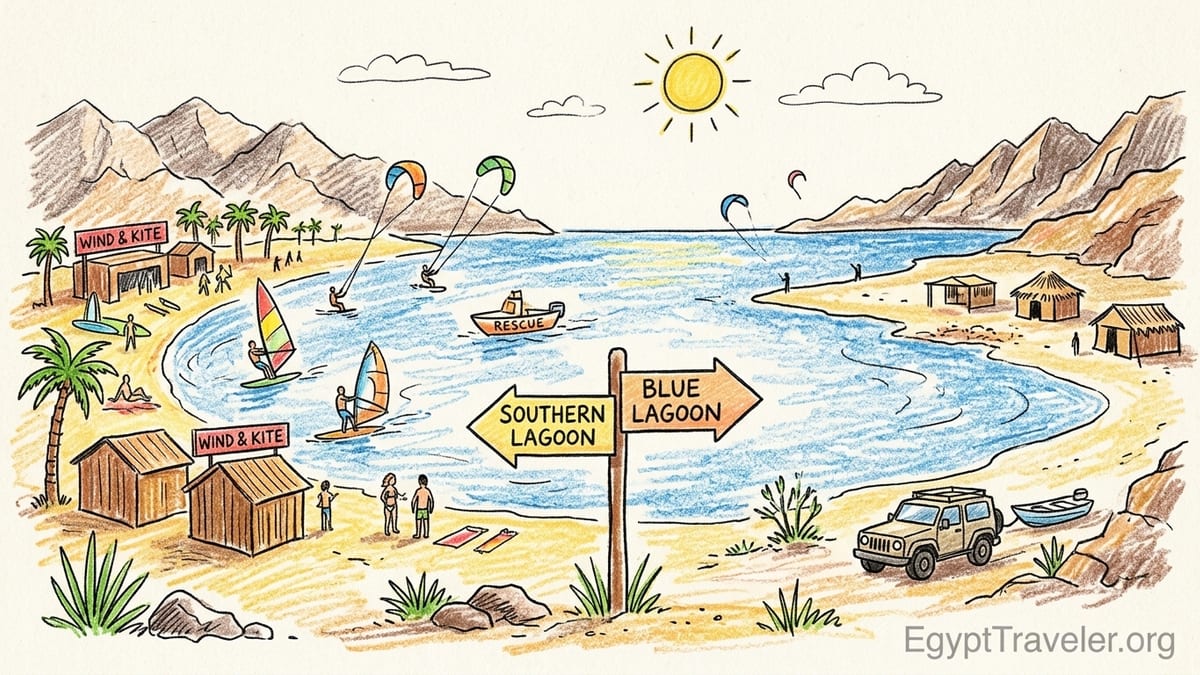
Dahab’s Lagoons vs the Remote Blue Lagoon
When riders talk about “Dahab Lagoon” they usually mean the shallow bay at the southern end of town where almost all daily windsurfing and kitesurfing happens. This is where you find the big centres such as Harry Nass, ION Club, Soul Kiters, KiteDahab and several Egyptian-run schools right on the sand. The water here is semi-enclosed behind sandbars, with a defined windsurfing lagoon, a separate kitesurfing lagoon and dedicated launch areas, plus nearby hotels and camps that cater specifically to wind sports.
The “Blue Lagoon” that features in many dreamy Instagram posts is something else entirely. It lies roughly an hour north of Dahab by boat or 4x4, close to Ras Abu Galum. There is no road along the coast, limited infrastructure and no permanent rescue service in the way lagoon-based schools provide. Many kitesurf centres in Dahab run day trips or overnight camps up there, but it is generally recommended for confident upwind riders who already know how to manage themselves and their gear in an isolated setting.
For most travelers planning lessons or easy daily freeriding, the southern lagoon is where you will actually be spending your time. It has easy taxi access from town, established rescue boats that patrol during operating hours and plenty of options for renting modern windsurf and kitesurf equipment or taking structured IKO and VDWS courses. Blue Lagoon trips can come later in the week for advanced kiters who want a change of scenery and dreamlike flat water.
Keeping the distinction clear between these two locations is important for planning. A week in Dahab staying by the southern lagoon with one optional guided Blue Lagoon excursion is a very different experience from spending several days camped at Blue Lagoon with basic facilities and no nightlife. This article treats them separately and focuses primarily on the main, serviced spots around Dahab town.
How Sinai’s Mountains Shape Dahab’s Wind
Dahab sits on the western shore of the Gulf of Aqaba, a long north–south trench of deep water framed by high mountains on both the Sinai and Saudi Arabian sides. This geography funnels the prevailing northerly and north-northwesterly winds down the gulf, then accelerates them again where the coastline bends at Dahab. The effect is a classic venturi, which is why the town records more sailable wind days than many open-coast Red Sea spots.
Historical wind statistics from forecasting platforms show that from roughly May to September average afternoon wind speeds often sit in the 15 to 25 knot range, with a notable percentage of days exceeding 20 knots in midsummer. In spring and autumn the averages ease slightly, with more days in the 12 to 20 knot window that many beginners and improvers find ideal. In winter, particularly December through February, wind probability drops and conditions become more variable, though strong fronts can still bring several good sessions in a row.
The mountains do more than simply strengthen the breeze. They also create differences in gustiness between areas that are only a few hundred metres apart. Near the beach inside the windsurfing lagoon the wind that has just rolled off the land can be patchier, especially on very strong days. Out in Area 2, where the flow has stretched across more water, it tends to smooth out into the kind of steady, powered-up wind that freeride windsurfers and confident kiters relish. Beyond Napoleon Reef, in Area 3, wind can increase another notch as open-gulf swells meet accelerated breeze.
For planning, it is helpful to think of Dahab’s seasons in terms of wind strength and comfort rather than crude marketing figures. Spring and autumn balance good wind with pleasant air and water temperature. High summer brings stronger, often more reliable wind at the cost of heat and intense sun exposure. Winter delivers some memorable sessions for those who accept lower statistical odds and pack thicker wetsuits.
Understanding Dahab’s Sailing Areas: 1, 2, 3 and the Kite Lagoon
Local centres commonly describe Dahab’s main windsurfing and kitesurfing water as a set of zones. Harry Nass, one of the longest-established operators in the bay, offers a useful framework that many riders and other schools now use in practice. Area 1 is the sheltered windsurfing lagoon that stretches for about 2.5 kilometres along the bay. This is the first place most beginners and intermediates sail, with relatively flat, forgiving water and a clearly visible downwind shore.
Area 2 sits slightly further out, beyond a shallow sandbar and closer to the deeper central channel. Here the water is flatter and faster, with fewer beginners in the way. Intermediate and advanced windsurfers use this zone to blast back and forth on smaller boards, practice carve gybes or work on freestyle. It is also where experienced kiters can ride on the leeward side of the windsurf traffic, under the supervision of their kite schools, provided they have passed basic level checks and are linked to the radio-rescue systems.
Area 3 lies still further out beyond Napoleon Reef, where the water becomes more open and low, clean swells roll in from the gulf. This is Dahab’s wave zone, though by global standards it is more about bump-and-jump and small ramps than true down-the-line wave riding. The sense of exposure increases here, as the Egyptian coast drops away to the desert and the Saudi mountains loom across the gulf. Riders using Area 3 normally carry radios provided by their centre, and rescue boats patrol to pick up anyone who breaks equipment or is blown too far downwind.
Separate from these three shared areas is the dedicated kitesurf lagoon, positioned beside the windsurfing lagoon but clearly marked and controlled. Schools describe it as roughly 300 by 500 metres, with sandy shallows that are waist to chest-deep for much of the area. By regulation and local agreement, windsurfing is not allowed inside the kite lagoon, and kites are not permitted in certain windsurf beginner zones or in small bays closer to the hotels. This separation keeps lines and rigs apart, reduces accidents during busy periods and gives both communities enough space to progress.
Why Windsurfing and Kitesurfing Cannot Just Mix Everywhere
At first glance newcomers sometimes wonder why windsurfers and kitesurfers do not simply share the same water. In Dahab’s lagoon the answer lies in a mix of safety, licensing and practical space management. The prevailing wind usually blows from the north or northwest, which is side-offshore relative to the main beaches. This means any fall, broken mast, kite tangle or exhausted beginner tends to drift away from shore rather than towards it, and riders rely heavily on organised rescue systems.
Because of this offshore tendency, local authorities and the Chamber of Diving and Watersports license centres to operate only within defined areas, with clear responsibilities for their guests. The kite lagoon concentrates kites in a space where schools can launch and land them safely, manage line lengths and coordinate rescues without masts, sails and foils slicing through crowded air space. Windsurf beginner zones closer to the beach are protected from loose kites and allow instructors to focus on sail control rather than line tangles.
In practical terms, this means kiters staying with a school will usually be given a briefing that sets out where they may ride, where deep water or coral patches begin and which invisible lines they must not cross without explicit permission. Advanced riders who want to explore leeward of Area 2 or take on the waves of Area 3 are often required to carry radios linked to their base station, so that rescue crews know exactly where to look if something goes wrong.
For windsurfers, the restrictions are gentler but still present. They are expected to keep clear of the kite lagoon and respect traffic flow, particularly when crossing between Area 1 and Area 2. Many centres colour-code sails by ability so that rescue teams can prioritise vulnerable riders. This kind of zoning may feel formal compared with unregulated beaches elsewhere, but with dozens of riders on the water on a good afternoon it is one of the reasons Dahab retains a strong safety record.
Season by Season: Wind, Temperatures and Lesson Reliability
Climate records for Dahab show a classic desert pattern moderated by the sea. Average air temperatures in midsummer often reach the mid to high 30s Celsius during the day, dropping to the mid-20s at night. Winter days are milder, often in the high teens to low 20s, with cooler evenings. Sea temperatures peak in late summer at around the high 20s Celsius and dip to about 21 to 22 degrees in late winter. These figures translate directly into equipment choices and comfort levels for riders.
Spring, from March through May, is a favourite for many. Wind statistics indicate a good proportion of days with afternoon winds between about 15 and 22 knots, which are ideal for 8 to 12 square metre kites and freeride windsurf sails in the 4.7 to 6.0 metre range, depending on rider weight. The air is warm without being oppressive, and a shorty wetsuit or thin full suit usually suffices. For lessons, schools often report solid reliability, with enough wind on most days to complete a beginner course within four or five days.
Summer, June through August, shifts the balance toward stronger wind and harsher sun. Many afternoons see 20 to 25 knots or more, sometimes gustier close to shore where the air rolls off the hot land. Experienced windsurfers rig down to 3.7 to 5.0 metre sails, and advanced kiters may be on 7 to 9 metre kites. Water temperatures are very comfortable, and some locals ride in boardshorts or thin lycra tops, though visitors often still prefer a 2 mm shorty for sun and rash protection. Lesson reliability is high in terms of wind, but midday heat can make long beginner sessions exhausting, so schools often shift teaching windows to earlier mornings and late afternoons.
Autumn, from September into early November, brings a second comfortable season. Wind strengths often resemble spring, with a mix of moderate powered-up days and lighter training days. Air and water are still warm, making it attractive for those who dislike wetsuits. Lesson planning remains straightforward, and many European riders use this period to extend their summer on the water.
Winter, late November through February, is more of a lottery. Long-term statistics and local school reports suggest fewer windy days overall, and more light or non-sailable days where kayaks and SUPs come out instead. Strong spells can still appear when passing weather systems strengthen the pressure gradient, and these days can offer crisp, powerful riding in cooler air. Wetsuits in the 4/3 mm range with booties become common, especially for longer sessions. For those booking primarily to learn within a single short stay, other seasons provide more reliable odds.
Safety and Offshore-Wind Rescue in Dahab
Dahab’s main lagoon faces into side-offshore and offshore winds relative to its beaches, which makes professional rescue support non-negotiable. Reputable centres operate fleets of rigid inflatable boats and small rescue craft that idle or patrol during opening hours, often in radio contact with instructors and sometimes directly with riders. For windsurfers heading into Areas 2 and 3, some centres provide waterproof walkie talkies that clip to the harness, allowing riders to call for help immediately if they break a mast, snap a boom or suffer an injury.
Kitesurf schools take a similar approach. Inside the kite lagoon, instructors remain within sight of their students and carry radios to coordinate with the shore team and boats. Outside the lagoon, advanced kiters who ride leeward of Area 2 or out towards the reef are frequently required to remain affiliated with a specific centre on that session. In practice this means checking in before heading out, so that staff know who is on the water, and carrying some form of communication. If a kite drops and cannot be relaunched in offshore wind, the rider can signal with the kite or call in via radio, and a boat is dispatched.
Rescue services are not free in Dahab, though policies vary by school. Many centres include basic rescue coverage automatically for anyone renting gear from them or taking lessons. Independent riders bringing their own equipment often pay a daily or weekly “rescue and beach use” fee, which can sit roughly in the tens of US dollars per day, in return for launch support, storage space and boat backup. Before your first session, it is worth asking specifically how their rescue system works, what is included and whether there are extra charges for repeated call-outs or for recovering equipment far downwind.
Comprehensive travel insurance that covers kitesurfing and windsurfing is strongly advised. Some insurers treat these as higher-risk sports and require an add-on; others include them up to certain wind strengths or distances from shore. Without appropriate cover, the cost of medical treatment or evacuation following an offshore injury would far outweigh any savings made by choosing a cheaper, unlicensed operator. Combining a reputable centre’s radio-rescue system with suitable insurance is the safest way to enjoy Dahab’s otherwise inviting offshore winds.
Beginner Lessons, Courses and Costs in 2026
Dahab has evolved into one of the more competitively priced places to learn kitesurfing and windsurfing with certified instruction. For kitesurfing, several lagoon-based schools publish transparent prices pegged to international currencies. As of late 2026, multiple providers cluster around a similar range: an IKO Level 1 and 2 beginner course of roughly 10 to 12 hours spread across three to five days typically costs between about 350 and 500 US dollars equivalent, including kite, board, harness, helmet, impact vest and radio support, plus the IKO certification card upon completion.
For example, one Dahab lagoon school lists a six-hour beginner course starting at the equivalent of around 280 to 330 euros depending on whether you choose group or private tuition, while a full ten-hour “Zero to Rider” package designed to take a student from first kite control through consistent water starts and basic upwind riding sits around 430 to 520 euros. Other operators in the lagoon promote similar packages and confirm in their English-language materials that equipment, insurance and rescue coverage are included in the price, which avoids the common surprise of add-on rescue fees once on site.
Windsurfing instruction is generally somewhat cheaper per hour than kite lessons, reflecting lower equipment and safety overheads. Beginner windsurf packages for two or three days often appear in the low hundreds of US dollars, including beginner boards with soft decks, small training sails and harness instruction once the basics are secure. Many windsurf centres are certified through bodies such as VDWS, and successful students can obtain level cards that some other centres worldwide recognise when renting equipment.
Across both sports, it is common practice in Dahab to teach in small groups of two to four students per instructor for beginner sessions, with private lessons available at a premium. Serious learners who want to maximise progress within a one-week holiday often combine a structured beginner course with one or two extra private sessions focused on specific skills such as water starts, first jumps or fast tack refinement. When comparing options, it is worth weighing not only the base price but also group size limits, language skills of the instructors and the quality and age of the gear.
Progression for Advanced Riders: Rental, Storage and Trips
For riders who already pass basic independence checks, Dahab’s centres double as large rental pools with current or near-current equipment. Published price lists for lagoon-based kite schools often show full kite and board rental in the range of about 40 to 60 US dollars per day or 200 to 280 dollars per week, with discounts for longer periods. Gear typically includes kites from well-known brands such as Cabrinha, North, Duotone or F-One, replaced every two or three seasons and maintained by in-house repair services.
Independent kiters who bring their own kites can usually pay a daily centre fee that covers storage, launch and landing assistance, use of washing areas and rescue coverage. For frequent visitors, weekly or monthly packages may work out better value. Advanced coaching sessions, sometimes led by visiting pros or local senior instructors, are also available for riders who want to refine unhooked tricks, strapless techniques or first foil rides. These are typically charged by the hour or as half-day clinics, often including dedicated boat cover.
Windsurfers find a similar ecosystem. Rental centres offer a quiver of freeride and freestyle boards along with a full range of sail sizes to match Dahab’s variable wind range across the seasons. Storage for personal boards and rigs is usually available by the week or longer, often bundled with rescue services and use of the centre’s facilities. Some operations still organise downwind safaris or longer excursions along the coast by truck and boat, though these depend on local regulations and security advisories at the time of travel.
Experienced kiters often look to include at least one day trip to the remote Blue Lagoon in their Dahab itinerary. Several lagoon-based schools advertise guided excursions that include transport by boat, rescue oversight and sometimes lunch at the camp-style huts on the sandspit. Prices vary, but the key distinctions to look for are whether the trip includes structured supervision or simply a drop-off and pick-up. Given the lack of permanent rescue infrastructure up there, experienced riders usually favour guided options that keep a safety boat near the group when the wind is strong.
Where to Stay: Southern Lagoon vs Masbat and Lighthouse
Dahab stretches along the coast, with the windsurfing and kitesurfing lagoon at the southern end and the older, more atmospheric village area of Masbat and the Lighthouse reef further north. Choosing where to base yourself is as important as picking a school, because it shapes how easily you can get to the water, what kind of evenings you enjoy and whether you will rely on taxis or transfers every day.
Staying near the southern lagoon means you can usually walk from your accommodation to your chosen centre in a few minutes, rig and launch with minimal delay and pop back to your room between sessions. Several mid-range hotels and budget camps sit directly behind the windsurf centres, with shaded board racks and grassy rigging areas leading down to the sand. This setup is particularly convenient if you plan intensive courses or expect to sail twice a day, as you can rest in air-conditioned comfort at lunchtime and keep gear in storage at the centre.
Masbat and Lighthouse, by contrast, form Dahab’s social heart. Here you find a long string of seafront restaurants, laidback cafes, bars with live music and small guesthouses clustered along the promenade. The Lighthouse area also doubles as one of Dahab’s best-known shore-diving and snorkeling entries, with coral heads starting close to shore. While there is some wind activity here, especially for small-scale wingfoiling or occasional training, the main windsurf and kitesurf infrastructure remains at the lagoon. Riders staying in Masbat typically organise daily taxis or school transfers south, which add time and modest costs but repay with more varied dining and nightlife.
For a dedicated wind week, many riders choose the lagoon area for pure convenience, perhaps heading into Masbat by taxi a couple of evenings for dinner or drinks. For mixed groups where only some members are riding and others prioritise cafes, shopping and snorkeling off the reef, basing in Masbat or Lighthouse with daily transfers to the lagoon can make more sense. Travellers sometimes split a longer stay, beginning with a few high-intensity days at the lagoon to complete courses, then moving into the village for a more relaxed finale.
Four-Day and Seven-Day Learning Itineraries
Short breaks in Dahab can still deliver meaningful progression if you structure them well. On a four-day kitesurf introduction, many schools recommend booking a six-hour or eight-hour beginner package that can run as two to three hours per day. Day one typically focuses on safety theory, rigging and first kite control on land, then body dragging in the water. Day two adds more powered body drags and introduces the first water-start attempts with a board. Depending on wind and talent, day three consolidates water starts and short rides under close supervision, while day four either reinforces these basics or, for fast learners, introduces riding toeside and edging upwind inside the lagoon.
A seven-day stay opens more possibilities. Kitesurfers can comfortably complete a full ten to twelve-hour IKO Level 1 and 2 course, reaching the point of consistent water starts and controlled rides both ways. If wind cooperates, days five to seven might mix supervised practice sessions with one or two private coaching hours targeting weak points. Confident riders may fit in a boat-supported session in Area 2 or a carefully selected day at the remote Blue Lagoon through their school. Windsurfers over a week can move from uphauling on a large board in Area 1 to planing in the footstraps in Area 2, especially if they add harness training and carve gybe clinics.
Beginner windsurfers on a four-day schedule often start with two half-day group sessions focusing on uphauling, steering and basic tacks, followed by one private lesson that introduces beach starts or, in strong wind, the first taste of planing. Intermediate riders can use similar trip lengths to fix specific issues: a gybe-focused four-day stay with two coached sessions and plenty of free sailing can transform confidence in carving turns. Throughout, it is wise to keep some flexibility, as even Dahab’s strong wind record includes occasional light days better suited to theory, simulator work or snorkeling.
On both four-day and seven-day plans, pacing is important. Desert sun, reflected glare from the water and the mental load of learning safety procedures all add up. Planning for a rest block in the middle of each day, or a lighter third day during a week-long stay, usually results in faster overall progress than attempting to sail to exhaustion every session. Off the water, easy activities such as a sunset walk along Masbat’s promenade or tea at a beach cafe can help you absorb the day’s learning and reset for the next session.
When Dahab Excels: Windsurfing, Kitesurfing or Snorkeling
Deciding whether Dahab will work better for you primarily as a windsurfing, kitesurfing or snorkeling destination comes down to matching your interests with the town’s seasonal strengths. If strong, consistent wind on flat to choppy water is your main goal and you already ride independently, Dahab particularly shines for windsurfing in late spring, summer and early autumn. The layout of Areas 1, 2 and 3 creates a natural progression ladder, from sheltered learning through high-speed blasting to gentle bump-and-jump beyond the reef.
For kitesurfers, Dahab’s combination of a dedicated beginner-friendly lagoon and more challenging outside areas gives it a balanced appeal. The kite lagoon’s shallow water and clear boundaries make it attractive for first lessons and early independent riding, while confident kiters can expand into the leeward side of Area 2 and, with proper guidance, the wavelets of Area 3. Factoring in current 2026 course prices that sit around 350 to 500 US dollars for a full IKO beginner program, Dahab also undercuts many better-known European and island spots, which makes it appealing for those looking to learn without overspending.
Snorkeling, meanwhile, comes into its own on lighter-wind days or for non-riding friends and family. The Lighthouse area in town and the reefs to the north and south offer easy access to coral gardens, and several dive centres can arrange guided snorkeling or combined dive-snorkel trips to sites like Eel Garden or the Caves. For travelers who want a single base where some members of the group can chase wind every afternoon while others spend their time in the water watching fish or relaxing in cafes, Dahab is unusually well suited.
In practice, many visitors build trips that blend all three. Over a seven-day stay, you might complete an IKO or VDWS course, enjoy two or three fully powered sessions in the main lagoon, take one day trip to Blue Lagoon or a desert canyon and still have a calmer morning exploring Masbat’s reef with mask and snorkel. Thinking of your time less as a single-focus surf camp and more as a flexible Red Sea break often leads to happier companions and a more rounded sense of the place.
The Takeaway
Dahab’s reputation as a windy town on the Gulf of Aqaba is well deserved, but the details matter. The developed southern lagoon and its structured Areas 1, 2, 3 and the kite lagoon form the heart of daily windsurfing and kitesurfing life, while the remote Blue Lagoon near Ras Abu Galum is a separate adventure best reserved for confident riders. Understanding how Sinai’s mountains focus the wind, what seasonal patterns to expect and how the zones are arranged helps you pick the right time and training plan for your level.
In 2026, Dahab offers competitive prices for IKO and VDWS-certified lessons, modern rental gear and established rescue systems that mitigate the risks of offshore wind. Whether you choose to stay steps from the lagoon for maximum water time or in Masbat and Lighthouse for stronger nightlife and reef access, you can tailor four-day and seven-day itineraries that balance focused learning with rest and exploration. With realistic expectations about wind probability, safety procedures and daily logistics, Dahab stands out as a place where both new and experienced riders can progress quickly without losing the laidback, small-town charm that first put it on the wind map.
FAQ
Q1. Is Dahab’s main lagoon the same as the Blue Lagoon near Ras Abu Galum?
They are different places. The main windsurf and kitesurf lagoon sits at Dahab’s southern edge, close to hotels and schools, while the remote Blue Lagoon is about an hour north by boat or 4x4 and usually visited on guided day or overnight trips.
Q2. When is the best season to learn kitesurfing in Dahab?
Spring and autumn generally offer a mix of reliable wind and comfortable temperatures, while early summer adds stronger, more consistent wind but also higher heat. Winter can still deliver good days but with lower overall wind probability.
Q3. How much does a beginner kitesurf course cost in Dahab in 2026?
Most lagoon-based schools advertise full beginner IKO courses of about 10 to 12 hours for roughly 350 to 500 US dollars equivalent, including equipment, rescue cover and certification.
Q4. Do I need a wetsuit for Dahab?
From late spring to early autumn many riders are comfortable in a shorty wetsuit or even just lycra and boardshorts, while in winter and early spring a 4/3 mm full suit with booties is recommended, especially for longer sessions.
Q5. Is the wind in Dahab offshore, and is that dangerous?
The dominant wind direction is side-offshore relative to the main beaches, so without support it could be hazardous. Licensed centres mitigate this by providing radio-linked rescue boats and clear riding zones, which is why using an established school or centre is strongly advised.
Q6. Can windsurfers and kitesurfers use the same areas?
There is some overlap offshore, but close to the beach Dahab separates sports for safety. Windsurfing is not allowed inside the dedicated kite lagoon, and kites are kept out of key windsurf beginner zones to avoid collisions and tangled equipment.
Q7. Is Dahab suitable for complete beginners in windsurfing or kitesurfing?
Yes. The sheltered windsurfing lagoon and shallow kite lagoon, combined with certified schools and structured progression, make Dahab a strong choice for first lessons, provided you book with reputable operators.
Q8. How reliable is the wind if I only have four days?
In peak seasons many riders do manage multiple sailable days in a four-day window, but no destination can guarantee wind. Planning a slightly longer stay or accepting that one day might be devoted to theory or snorkeling gives a more realistic margin.
Q9. Should I stay near the lagoon or in Masbat if I am mainly riding?
If your priority is maximum water time with minimal transfers, staying by the southern lagoon is more convenient. If you value restaurants, cafes and nightlife as much as riding, basing in Masbat or Lighthouse and taking daily taxis to the lagoon can be a better compromise.
Q10. Is Dahab better for windsurfing, kitesurfing or snorkeling?
Dahab is particularly strong for windsurfing and kitesurfing from spring through autumn, thanks to its venturi-boosted winds and structured areas, while Lighthouse and nearby reefs provide very good snorkeling. Many visitors combine all three within a single trip.