


Somewhere between Dahab and Nuweiba, squeezed into the back of a jeep and counting the third police checkpoint of the morning, it dawned on me that the “Colored Canyon Safari” I had booked was not the focused hiking and geology day I thought I had paid for. It was a loosely stitched desert sampler, heavy on driving and sales language, light on clarity and safety. What shocked me most was not the dust or the bumps, but how casually the operators blurred together completely different canyons and wadis into one vague “canyon safari” label.
These Are Not The Same Canyon: A Crucial Clarification
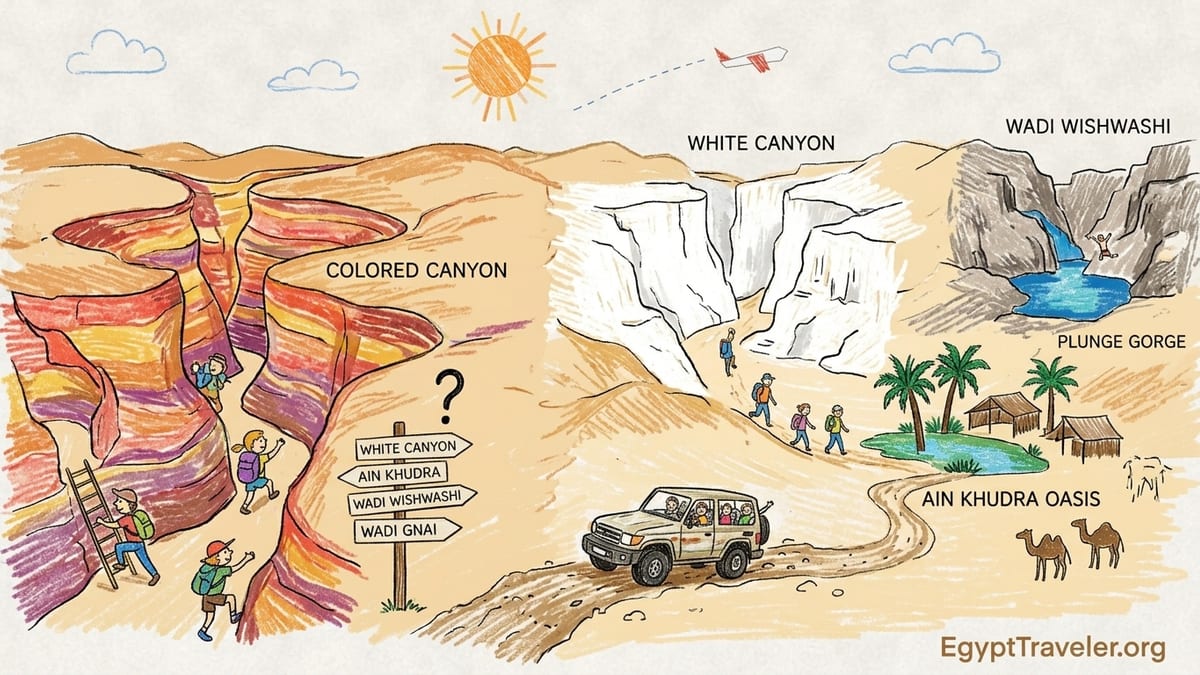
The most important truth to state upfront is that the places sold under “canyon safari” banners in South Sinai are not interchangeable. Colored Canyon, White Canyon, Wadi Wishwashi, Wadi Gnai and Ain Khudra are distinct locations, with different rock types, profiles and walking difficulty. Yet brochures and WhatsApp flyers from Dahab, Nuweiba and Sharm routinely mix their names as if they were all one attraction, or simply “the canyon.” This confusion is not a harmless marketing shortcut. It directly affects how much you walk, how hard the terrain is and what risks you face.
Colored Canyon, also called Salama Canyon, lies inland from Nuweiba in the Wadi Watir system. It is a sandstone slot about 800 metres long, with sculpted, fluted walls almost polished by ancient Red Sea waters. White Canyon, by contrast, is a chalky, pale limestone defile usually walked downhill towards the small oasis of Ain Khudra, a completely different setting of date palms and gardens. Wadi Wishwashi is not a stroll through sandstone at all but a rough granite gorge that hides a plunge pool, closer to Nuweiba and Ras Shitan. Wadi Gnai, near Dahab, is yet another valley, broader and more open, with easier walking in many sections. Lump them together and you mislead visitors about both beauty and exertion.
On the ground, this confusion plays out in packages that sell, for example, “Colored Canyon & White Canyon & Ain Khudra Jeep Safari” from Dahab, or “Wadi Weshwash & Ras Shitan” from Dahab or Sharm. One Dahab-based consolidator currently advertises full-day jeep safaris that combine White Canyon, Ain Khudra and a colored sandstone canyon in about eight hours, with prices starting around 40 to 50 US dollars per adult, depending on group size and inclusions. Another operator sells Wadi Weshwash plus Ras Shitan days for the equivalent of roughly 40 US dollars, including a desert jeep transfer, guided walk to the pools and time at the beach camp. The problem is not that these prices are outrageous. The problem is that the marketing gloss suggests one coherent “canyon day” when in reality you are racing between multiple sites, barely scratching the surface of any.
Before my own trip, I saw flyers in Dahab that listed “Colored Canyon – White Canyon – Ain Khudra – Mushroom Rock – Bedouin lunch” on a single eight to nine hour itinerary. Another agency pitched Wadi Wishwashi together with “Blue Lagoon snorkeling” in a similar full-day window from Sharm. When I asked which canyon involved ladders, tight squeezes or scrambling, the answers were vague. “All easy hiking,” one salesperson smiled. Only later, while dropping into a loose, rubble-filled descent above Wishwashi’s pool, did I realise how unhelpful that description had been.
What I Actually Booked: Operator, Price and Itinerary
My first safari was booked in Dahab with a local intermediary who channels business to several jeeps and guides. The advertised program was an eight and a half hour “Colored Canyon – White Canyon – Ain Khudra” loop from Dahab, priced at the equivalent of about 49 US dollars per person in a shared jeep, including hotel pick up, desert transport, a “Bedouin lunch” and bottled water. The flyer used dramatic photos of both narrow white limestone walls and layered sandstone, conveniently ignoring that these are in different locations, some quite a distance apart.
The itinerary printed on the agency’s counter described a 7:30 pick up, jeep drive towards Nuweiba, walk through “Colored Canyon,” continue by jeep to Ain Khudra for lunch, then walk White Canyon and return to Dahab around 16:00. Travel time was estimated at “about one hour each way” with “two to three hours hiking in total.” The same sheet promised “easy walking suitable for almost everyone” and “professional Bedouin guide.” Entrance fees and drinks with lunch were listed as “included,” though it did not specify how much water would be provided or whether there was any emergency communication equipment in the vehicle.
My second outing, booked later from a beach camp north of Nuweiba, was a Wadi Wishwashi and Ras Shitan package. The camp’s English-language board quoted about 39 US dollars for a shared trip including a jeep ride from the coast to the trailhead, guided walk to the pools, a short camel ride near Ras Shitan and a simple lunch. The program claimed “about eight hours,” with 90 minutes at Wishwashi and two hours at the beach. It was sold as “medium difficulty,” but when I asked what that meant, the only clarification was “there is some climbing but the guide helps.”
In both cases, I paid cash in Egyptian pounds at the agreed rate. No receipt itemised park permits, lunch cost or guide fee separately. Nothing written mentioned flash-flood risk in the wadis, nor did anyone ask about my hiking experience or medical conditions. The glossy talk was all about “the magical colors of the canyon” and “authentic Bedouin day in the desert.”
Reality Check: Pickups, Jeeps, Checkpoints and Actual Walking Time
The day of the Colored Canyon–White Canyon safari began with a 7:45 collection in Dahab’s town centre in an aging Toyota Land Cruiser that already had six tourists in the back. By the time we had picked up the final couple from a hotel beyond the Lagoon, an hour had passed. We left Dahab closer to 8:40, heading north on the main road that threads the South Sinai coastal plain. Within forty minutes we were stopped at the first police checkpoint, passports collected, details copied into a ledger. This was repeated at least twice more before we left the tarmac for a rough dirt track into the desert.
From Dahab to the starting point of our first walk took roughly one hour and forty-five minutes in total. The route followed the Wadi Watir road towards Nuweiba, then turned inland along a track pitted by previous flash floods. Once we stopped, the guide briefed us in less than two minutes. “We walk about one hour, easy, then the jeep meets us at the end,” he said. There was no explanation of escape routes, no mention of where to shelter in case of sudden rain and no check that everyone carried enough water. Each person had been given a single small bottle at pickup. No more were handed out before we set off.
The Colored Canyon section itself was gorgeous, but brief. We spent around 55 minutes moving through the most photogenic stretch, including time waiting at two narrow chutes where slower walkers descended carefully. In several spots we had to use hands to down-climb over boulders or slide on our backsides down smooth rock drops. The walls were close enough that larger group members had to turn sideways and shuffle. By the time we emerged on the far side, some guests were sweaty and anxious, voices muttering, “I did not realise it would be that tight.” This was exactly the “easy hike” described in town.
Back in the jeep, there was another hour of jolting across open desert towards Ain Khudra. Lunch at the oasis, charming as the setting was, expanded to almost ninety minutes as the food was prepared and cleared. Afterwards we walked White Canyon downhill to meet the jeep again, another 60 to 70 minutes of descent on loose gravel and soft sand between pale walls. Overall, on a nominal eight and a half hour safari, my group spent almost five hours in vehicles or waiting, and around two and a half hours actually walking inside the canyons. The “canyon safari” had been, by any honest measure, a driving safari with two short hikes attached.
“Easy Hiking” That Was Not So Easy
One of the most persistent misrepresentations across Sinai canyon tours is the language of difficulty. Agencies in Dahab, Nuweiba and Sharm routinely describe Colored Canyon, White Canyon and even Wadi Wishwashi outings as “easy” or “suitable for all ages,” sometimes with the more cautious “medium” thrown in. After actually walking these routes behind large mixed-ability groups, I would argue that this is inaccurate and at times irresponsible.
Colored Canyon involves sections of deep sand, shelves of sandstone polished smooth, and boulder steps as high as mid-thigh on an average adult. People with knee issues or reduced mobility, or anyone uncomfortable with using hands to scramble, will struggle. In our group, two travelers had to be physically assisted by the guide and fellow tourists down several drops. There were no fixed ropes or ladders, only handholds carved by thousands of feet. Slips would not have been fatal, but a twisted ankle that far from the road would have turned into a serious evacuation problem.
White Canyon, while not as narrow, presents a long, uneven descent. Much of the route is on loose stones and powdery sand that behave like ball bearings underfoot. Our guide wore plastic sandals, which might have been culturally normal but did not inspire confidence. Several people slid to their backsides, raising small avalanches of pebbles that rolled into those behind them. Children in the group alternated between delight and tears. Nowhere in the sales pitch had anyone suggested that this was a genuine hike with a sustained downhill gradient and footing that demanded concentration.
Wadi Wishwashi raises the bar again. The path from the parking area climbs and then drops over rough granite ledges, with sections that feel more like light scrambling than walking. In places you must use both hands to steady yourself, and the final access to the pool on my visit required downclimbing a short but exposed rock step. The guide pointed to an alternative route that he described as “for Egyptians only” and laughed. It was obvious that someone fear-of-heights prone would freeze on that move. Yet in Nuweiba and Sharm, this tour is still sold with cheery claims of “easy to medium” that casually ignore what “medium” might mean for an unprepared holidaymaker in beach sandals.
Wadi Wishwashi’s Water, Weather and Safety Blind Spots
Wadi Wishwashi deserves special scrutiny because it combines rough terrain with changing water levels and sits inside a broader catchment where flash floods are a real, documented hazard. Hydrology studies of Sinai’s main wadis, including Wadi Watir and adjacent systems, underline how heavy rain in the mountains can send a sudden surge of water through narrow channels that may seem perfectly dry minutes beforehand. Yet on the day I visited Wishwashi there was no evident system in place to monitor remote weather or warn guides of upstream storms.
Our jeep left the coastal road near Ras Shitan and followed a sandy track inland, climbing gently between rounded granite hills. The guide mentioned that the pool at Wishwashi was “deep enough for jumping” thanks to recent rain, but also noted casually that “sometimes in summer it nearly dries up.” That variability alone should trigger a more serious briefing. A deep pool can conceal submerged rocks. A very shallow pool can encourage injured ankles and scrapes from people attempting dives or jumps. Neither the agency nor the guide provided life jackets or made any attempt to assess guests’ swimming ability.
What unsettled me more, however, was the complete absence of visible communication gear. There was no radio in the guide’s hands, no satellite phone in evidence, and mobile signal disappeared as soon as we entered the granite valley. When I asked how they would call for help in an emergency, the guide shrugged and said, “Other jeeps come, we help each other.” Perhaps in practice there is an informal network. From a traveler’s safety perspective, this is not the same as a plan.
Flash-flood risk is not theoretical in these wadis. Scientific research and regional meteorological agencies have documented destructive floods in multiple Sinai catchments, including Wadi Watir. In such landscapes, standard safety advice is clear: avoid narrow gorges if heavy rain is forecast anywhere in the basin, and always have a way to receive updated weather information. On my tours there was no evidence that the companies checked forecasts beyond a cursory look at the sky on the day. Nobody asked where we were staying or left a written record of our exact route. It was assumed that clear blue morning skies meant we were safe all day.
Environmental Pressure: Tracks, Litter and Erosion
The jeep approach tracks to Sinai’s canyons and pools tell their own story. The dirt roads leading into Wadi Watir’s side valleys and beyond Nuweiba are crisscrossed with parallel wheel ruts, fanning out where soft sand has bogged vehicles or flash floods have carved channels. At several points on my Colored Canyon safari, our driver simply veered off the main track to bypass a rocky bottleneck, creating yet another pair of tire marks in the fragile desert crust. No one mentioned sticking to established routes as a principle. The unspoken assumption seemed to be that the desert is infinite and resilient.
Inside the canyons themselves, the picture is more mixed. Colored Canyon was relatively clean during my visit. White Canyon, too, showed only sporadic trash, mostly plastic bottles abandoned where groups had paused to rest. Guides sometimes gathered these, sometimes not. Around Ain Khudra, however, the accumulation of day-trip waste was impossible to ignore. Behind the charming palm gardens and tea shelters lay clumps of discarded plastic plates and soft-drink cans half buried in sand. The same was true at the Wishwashi parking area, where a line of informal kiosks and shade structures spilled rubbish into the nearest gullies.
It would be unfair to blame canyon tours alone for every crisp packet or bottle cap. Local communities, independent drivers and campers all contribute. Yet the acceleration of packaged jeep safaris, taking ever more groups on identical loops, clearly intensifies the pressure. Each stop that adds another half hour of waiting time, another cup of tea in a plastic cup, another cold drink in a plastic bottle, has a cumulative impact if there is no effective collection and removal system. So far, travelers are rarely told anything about waste or erosion, and few operators make environmental stewardship a visible selling point, let alone a strict practice.
The track damage has another hidden cost: safety for both humans and wildlife. Deep ruts concentrate run-off during rare rains, speeding erosion. Multiple braided tracks confuse less experienced drivers and can lead jeeps into softer ground, increasing the chance of breakdowns far from help. I saw one vehicle nose-deep in sand near Ras Shitan, its rear wheels spinning while passengers stood watching under a high sun. Our own driver detoured yet again to avoid that hole, contributing to the widening scar.
The “Bedouin Experience” That Was Mostly Performance
Almost every Sinai canyon safari advertises some form of “Bedouin experience,” a phrase that proves extremely elastic in practice. On my Colored Canyon–White Canyon day, the promised “Bedouin lunch” at Ain Khudra consisted of a simple but tasty plate of rice, vegetable stew and chicken, served at low tables under a woven-roof shelter near the oasis gardens. Tea arrived in small glasses, poured with a practised flick of the wrist. Our guide, from a local tribe, chatted about the family that ran the camp and mentioned in passing how water is trucked in when the spring runs low.
All of this was pleasant. It was not, however, a deep cultural encounter. There was no context given about Bedouin land rights in the protected area, no explanation of how tourism income is shared within the community, no discussion of how climate change or restrictions on grazing have altered traditional life. After lunch, we were steered to a small display of scarves, bracelets and carved stone camels. The atmosphere shifted from hosting to hawking. There was no pressure, but there was also little space to understand the social realities behind the hospitality.
The Wadi Wishwashi and Ras Shitan day was even more thinly interpreted. Our time at the beach camp included tea on arrival and another basic lunch after swimming. The guide made a brief joke about Bedouin coffee and pointed out a few herbs used for tea growing on the hillside. That was the sum total of cultural content. The optional camel ride along the sand felt more like a photo prop than a glimpse into a working animal’s role. Nowhere in the eight hours was there a structured opportunity to talk meaningfully with residents about their relationship with the canyons and the sea.
To be clear, many Bedouin families in Sinai rely on tourism to supplement precarious livelihoods. Selling crafts and offering short camel rides is a rational response to demand. The problem is that tour companies, especially those based in Sharm and operating at a distance, inflate these very brief interactions into “authentic Bedouin days” in their brochures. The gap between the marketed promise and the actual experience leaves some travelers feeling oddly empty, and it does little to foster the kind of respectful, informed engagement that could actually benefit both guests and hosts.
Hidden Costs, Overpacked Days and Misleading Names
Across my two safaris, five recurring problems stood out. The first was the misuse of canyon names. In Dahab I saw multiple boards that labeled photos of narrow white limestone as “Colored Canyon,” or that bundled Wishwashi under “Colored Canyon trip” headings even though it is a different gorge in a different rock type. This blurring might sell more places under one recognisable label, but it deprives travelers of the ability to choose the kind of walk they actually want. Someone with claustrophobia may cope fine in White Canyon’s more open sections yet panic in Colored Canyon’s tight turns. People who love geology may prefer sandstone’s layered patterns to chalk’s stark faces.
The second problem is the relentless packing of itineraries. An eight and a half hour day that promises Colored Canyon, White Canyon, Ain Khudra, a Bedouin lunch, photo stops at Mushroom Rock and souvenir browsing is, by definition, a rush. The long road transfers between Dahab and the Nuweiba hinterland, combined with checkpoint delays, eat large chunks of time. Something has to give, and it is almost always the depth of exploration. Instead of lingering in a canyon to study its curves, to notice fossils or subtle color changes, you find yourself hustled along to meet the jeep. Every stop is reduced to “enough for some photos” before moving on.
The third problem involves physical difficulty being undersold. “Easy hiking” on sand, loose stones and uneven descents is not easy in any regular sense of the word. The routes described earlier require sure footing, moderate fitness and, at Wishwashi, a willingness to scramble and accept exposure near drops. When operators fail to communicate this, travelers who are older, less mobile or simply inexperienced in deserts are placed in uncomfortable and sometimes unsafe situations.
Fourth comes preparation. Water provision is minimal on many budget tours, often just a single small bottle for an eight-hour day. Sun protection advice is generic. Robust safety measures such as first-aid kits, radios or satellite messengers are rarely evident. There is little sign that guides are empowered or trained to cancel or reroute trips if forecasts indicate rain in the catchment, despite the known flash-flood risk in wadis like Watir.
The fifth recurring issue is hidden or semi-hidden costs. While my tours did not spring outright scams, there were quiet additions. Snorkeling equipment at Ras Shitan or the Blue Hole was not included. Soft drinks with lunch were billed separately. Expectation of gratuities for drivers and guides was strong, and sometimes framed as effectively obligatory. None of this is unusual in global tourism, but combined with the hard sell of “Bedouin souvenirs” at the oasis and beach camps, it lent the day an air of constant small transactions rather than relaxed exploration.
The Takeaway: One Canyon Done Well Beats Three Done Badly
By the end of my time in South Sinai, I had become deeply wary of any flyer that promised more than one major canyon in a single day. The multi-stop jeep safaris are not fraudulent. They do deliver glimpses of extraordinary landscapes at a relatively affordable price, with logistics handled and lunch included. The problem is that the marketing shorthand of “canyon safari” hides important differences between sites, glosses over physical difficulty and safety considerations, and encourages a racing, surface-level style of travel that serves neither visitor nor environment particularly well.
In hindsight, I would have chosen one canyon and done it properly. A day dedicated just to Colored Canyon, with enough time to pause in the narrowest passages and appreciate the sandstone’s swirling pigments, followed perhaps by a relaxed tea at a single oasis, would have felt richer than a blur of vehicles and quick walks. Similarly, a focused White Canyon and Ain Khudra trip, or a carefully planned Wadi Wishwashi outing that took water levels and weather seriously, would yield a more satisfying sense of place.
If you are planning a visit, ask direct questions before you book. Clarify exactly which canyon or wadi you will visit, how long you will be on foot, how difficult the terrain is and what safety gear the guide carries. Ask how much time is allocated at the key site versus in the jeep, and whether the operator has a contingency plan for rain in the mountains even if the coast is sunny. Insist on bringing extra water, proper shoes and sun protection yourself rather than assuming that a budget tour will provide everything.
Sinai’s canyons and wadis are genuinely special. The disappointment I felt was not with the land but with how lazily it was sometimes packaged and sold. To do justice to these fragile, beautiful places, travelers and operators alike need to move beyond the generic “canyon safari” label and treat each valley as a distinct experience. One well-guided, unhurried walk through a single gorge, with clear communication and respect for both geology and culture, is worth far more than three rushed tick-box stops in a shared jeep.
FAQ
Q1. Are Colored Canyon and White Canyon the same place?
Colored Canyon and White Canyon are different gorges in South Sinai, formed in different rock types and located in different valleys, even though tours often bundle them together.
Q2. How long is the drive from Dahab to the main canyon areas?
The drive from Dahab to the starting points for Colored Canyon or White Canyon usually takes around one and a half to two hours each way, including checkpoints and track time.
Q3. Is “easy hiking” in Sinai’s canyons really suitable for everyone?
Many tours call the routes “easy,” but expect soft sand, loose stones, uneven descents and short scrambling sections, which can be challenging for children and less-mobile travelers.
Q4. How much actual walking time do you get on a typical multi-canyon safari?
On an eight to nine hour jeep safari that includes multiple canyons and lunch, you may only get about two to three hours of walking, with the rest spent driving or waiting.
Q5. Is Wadi Wishwashi safe for non-swimmers?
Wadi Wishwashi involves rough terrain and a deep pool that can have variable water levels. There is often no flotation gear provided, so non-swimmers should be extremely cautious.
Q6. What should I ask an operator before booking a canyon safari?
Ask which exact canyon or wadi you will visit, how difficult the terrain is, how long you will walk, what safety equipment the guide carries and how they monitor weather and flash-flood risk.
Q7. Are there hidden costs on these jeep safari tours?
Common extras include snorkel gear rental, soft drinks, optional camel rides and tips for guides and drivers, which are often expected but not clearly mentioned upfront.
Q8. How can I reduce my environmental impact when visiting the canyons?
Choose a focused itinerary with fewer stops, bring a reusable water bottle, pack out all rubbish, stick to existing tracks and support operators who show visible care for the desert.
Q9. Is it better to book from Dahab, Nuweiba or Sharm?
Dahab and Nuweiba operators are geographically closer to the main canyons, which can mean shorter drives and more time walking compared with similar packages sold out of Sharm.
Q10. Would you recommend a single-canyon trip over a multi-stop safari?
Based on my experience, a well-guided single-canyon day with enough time to explore and understand the landscape is far more rewarding than a rushed multi-stop jeep safari.