


From Dahab’s relaxed cafes it is easy to think of the Blue Hole, Ras Abu Galum and the Blue Lagoon as a string of famous “spots” to tick off on a tour. Walking the coast between them is something very different. It turns those names on a brochure into a continuous, harshly beautiful landscape where you feel every kilometer under your feet and every gust of Red Sea wind on your face. This is my account of hiking from the Blue Hole to Ras Abu Galum, continuing on to the Blue Lagoon, and then getting back again, with the practical details I wish I had known before I set out.
Getting Out of Dahab and Up to the Blue Hole
I started the day in central Dahab just after 7:30 a.m., when the town was still quiet and only a few kites were on the water. I had arranged a taxi the night before through my guesthouse, agreeing on 300 Egyptian pounds for a one-way ride to the Blue Hole for two people. I confirmed with the driver that he would not wait and that we would find our own way back. It was important to be absolutely clear about this, because many drivers automatically assume a round trip built around standard tour timings.
The drive north along the coastal road took about 25 minutes. Once we passed the Lighthouse area and Eel Garden, the built-up shoreline fell away quickly. Low hotels and camps gave way to a narrow strip of asphalt framed by stony desert on one side and a flat, pale-blue sea on the other. By 8:00 a.m. we were pulling into the checkpoint that controls access to the Blue Hole and the Ras Abu Galum protectorate beyond.
Entry fees here change periodically, but when I visited in 2026 the conservation ticket for the Blue Hole and Abu Galum area was 10 US dollars per foreigner, paid in cash at the gate in either dollars or the local equivalent. There was also a small vehicle fee already built into the taxi price that my driver handled directly at the checkpoint. After a quick passport check and a look in the trunk, the barrier lifted and we continued the short final stretch down to the Blue Hole parking area, where the road effectively ends for ordinary cars.
On the edge of the gravel lot, a loose strip of Bedouin cafes, dive shacks and equipment rentals hugged the shoreline. Before anything else, I checked in with a local guide whom I had contacted via my hotel. We agreed on a simple arrangement: he would walk with us from the Blue Hole to Ras Abu Galum, help arrange the onward transfer to the Blue Lagoon, and secure a boat back in the afternoon. His fee was 700 Egyptian pounds for the day, not including the separate boat payment and food, which we would settle directly at the camp.
Gear, Water and Why the Hike Matters More Than the Names
Standing on the gravel above the Blue Hole itself, it is tempting to drop straight into the water and forget about walking altogether. The famous vertical shaft is a magnet for divers and the reef lip is full of snorkelers drifting along the drop-off. Yet for this day I wanted the Blue Hole to be only the starting point, not the focus. The real reason I had come was the protected strip of coast that begins just north of here and continues all the way to Ras Abu Galum.
I wore lightweight hiking shoes with firm soles rather than sandals. This proved essential. Much of the coastal trail is scattered with loose stones, fist-sized rocks and occasional sharp coral rubble. For clothing I chose long, thin hiking trousers and a light synthetic shirt with long sleeves. The path offers almost no shade, and sunburn on the backs of your legs or arms can easily creep up on you when the sea breeze makes the heat feel softer than it is. On my head I wore a wide-brimmed hat under which I could tuck a thin buff around my neck.
Between two of us we carried a bit over six liters of water in a combination of reusable bottles and a hydration bladder. That worked out at around three liters per person for the hike and some extra to sip later during the day. In cool winter conditions you might manage on a little less, but in the warmth of March when I walked, that amount felt only just comfortable. There is no safe drinking water along the trail itself. I also packed a few dates, nuts, flatbread and a small container of hummus bought in Dahab, along with a compact filter and basic first-aid kit that, thankfully, stayed in the bag.
My guide carried only a small daypack. When I asked why he smiled and gestured at the camel train already waiting at the far end of the beach, explaining that most people do not walk both ways. They would typically ride camels out and back or walk one way and return by boat. That, he said, is why many visitors think of Ras Abu Galum and the Blue Lagoon as isolated dots on the map, rather than as part of a continuous coastline. I already suspected that the hours on foot between those dots would become the most memorable part of the day.
On Foot Along the Narrow Edge Between Mountains and Sea
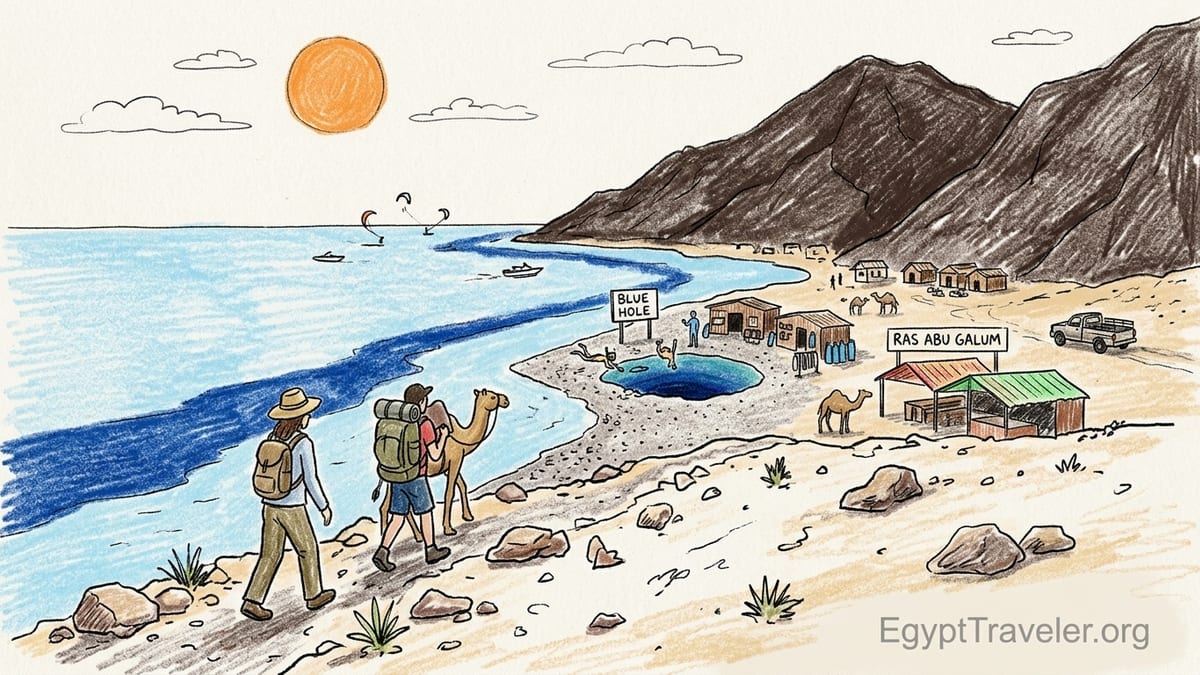
We stepped away from the last shack at the Blue Hole at around 8:30 a.m. The first couple of hundred meters were a gentle warm-up over compact sand and rounded stones. The strip of walkable land here is often no more than twenty or thirty meters wide, wedged between the steep dark-brown mountains and the turquoise shallows of the Gulf of Aqaba. Behind us Dahab had already vanished in the haze, and ahead of us the coast curved in a long, empty line.
Online descriptions often describe the hike as about 5 to 6 kilometers and roughly 1.5 hours one way, and that matched my experience. Walking at a relaxed but steady pace, with short pauses for photographs, we took just under two hours from the Blue Hole to reach the Bedouin huts at Ras Abu Galum. The time, however, felt longer because the terrain constantly shifted. One minute we were striding across firm gravel, the next we were picking careful steps through sections of larger rock or sinking slightly into soft sand.
The heat built quickly once the sun climbed above the ridge. Even in spring it felt ten degrees hotter on the bare slopes than it had in Dahab at breakfast. There are no trees and almost no shrubs high enough to cast usable shade, only a few low desert plants clinging to washes where rare winter rains run down from the mountains. The wind came and went, at times blasting in from the north with enough force to drive sand grains against our legs, at others falling away to nothing so that the air felt suddenly heavy and still.
Every few minutes we would glance seaward where the shallow reef flat ended in a darker band of blue, marking the drop-off. Through the clear water we could see patches of seagrass in the sandy channels, especially in the slightly deeper lagoons that dotted the shoreline. At one small bay my guide pointed to a sea turtle surfacing for air before disappearing back into the grass meadows, which serve as grazing grounds for them as well as nurseries for small fish. Here the coast is technically part of the Ras Abu Galum protectorate, and the limited vehicle access and low visitor numbers have kept the seagrass beds and fringing corals in noticeably better condition than many town reefs around Dahab.
First Glimpses of Ras Abu Galum and Life at the Edge
After about ninety minutes we reached a slightly wider arc of beach where the beige gravel shifted into finer sand. A few wooden shelters appeared in the distance, their palm-frond roofs blending into the colors of the hillside. This was the southern edge of Ras Abu Galum’s small Bedouin settlement, a cluster of huts, basic cafes and guest shelters that support both local families and the steady trickle of hikers, camel caravans and boats arriving from the Blue Hole.
There are no hotels or formal resorts here, only simple camps. My guide led us to a low, open-sided hut with mats on the floor and a kettle already on the coals. We did not stay overnight, but I asked out of curiosity about prices. At this camp an overnight stay in a basic beach hut cost around 350 to 400 Egyptian pounds per person including a simple dinner and breakfast, with shared toilets set a short walk behind the shore. Solar panels powered a few weak lights after dark, and there was no mobile data signal beyond the occasional bar flickering in and out.
For our midday stop we ordered sweet Bedouin tea and a lunch of grilled fish, rice and salad, cooked over a charcoal brazier behind the hut. The price was agreed up front at 250 Egyptian pounds per person, including unlimited tea and a large bottle of water. Facilities were modest but clean. A concrete cubicle with a squat toilet and a barrel of water served as the restroom, and a plastic drum of desalinated water near the kitchen was used for cooking and washing dishes. It was not luxurious, but by the time the fish arrived, perfectly charred at the edges and scattered with lemon and herbs, it felt like a feast.
I had carried my own mask, snorkel and thin wetsuit in my pack, and there was time for a short snorkel before continuing toward the Blue Lagoon. Entry here is almost the opposite of Dahab’s Lighthouse or the Blue Hole. Instead of stepping straight off a wall into deep water, you walk out gently over sand and seagrass until you reach the reef edge, then slip into a shallow channel that runs parallel to shore. The current on my visit ran very lightly from north to south, just enough that drifting back toward camp felt effortless.
Snorkeling the Protectorate Reef and Seagrass
Dropping into the water at Ras Abu Galum, the first thing I noticed was how quiet it felt compared with the busy Blue Hole. There were only two other small groups in the water, both staying close to their camp. I shuffled carefully across the sandy bottom until I reached a natural sandy gap in the coral about waist deep, where I put on my fins and floated forward into slightly deeper water.
The reef here is not as dramatically vertical as the Blue Hole’s wall, but it felt more alive. Finger corals and table corals jutted out between mounds of hard coral heads, leaving narrow lanes of sand in between. Clouds of anthias hovered over the staghorn colonies, darting back and forth, and a pair of parrotfish grazed noisily on the reef, their beaks scraping small clouds of crushed coral into the water column. In the seagrass patches closer to shore, mullet and juvenile wrasse nosed around for food, while a flounder lay nearly invisible on the sand until it flicked away in a puff of silt.
Staying within the shallow lagoon meant that the current was minimal, which was ideal for relaxed snorkeling. My guide made a point of reminding me not to stand on any coral and to watch the tips of my fins in the shallower sections, where the branching corals rose almost to the surface. From time to time he tapped his fingers together, drawing my attention to a masked butterflyfish or a lionfish hovering just under an overhang. The sense of being inside a protected area felt more than just bureaucratic. The combination of limited access and Bedouin management, dependent on healthy reefs for future visitors, was visible in the density and variety of marine life along this short stretch alone.
After about forty minutes the wind began to pick up again, ruffling the lagoon surface and making me feel the slight chill of staying still. We exited at the same sandy gap, rinsed off with a scoop of brackish water from a barrel and sat back under the palm-frond shade to dry in the sun. It would have been easy to stay all afternoon, but we still had one more stretch of the journey to complete before thinking about the long ride home.
Continuing to the Blue Lagoon and Choosing Transport
From Ras Abu Galum to the Blue Lagoon is another small but significant step further into isolation. Some experienced hikers continue on foot along the coast for approximately another hour and a half, but my day had already included a hot two-hour trek and a long snorkel, and I wanted to be sure of making it back to Dahab before dark. After a short discussion with my guide and the camp owner, we agreed on a different plan: a short local 4x4 ride to the Blue Lagoon and a boat back to the Blue Hole later in the afternoon.
The Blue Lagoon itself sits behind a low sand bar, with a wide, shallow pool of almost unreal turquoise water. Vehicle access is limited to local Bedouin 4x4s that cross the rough desert tracks behind the coast rather than driving along the shoreline. Our shared pickup truck, open in the back with low sideboards, cost 400 Egyptian pounds for two of us for the return journey Ras Abu Galum to the Blue Lagoon and back. We climbed into the back with four other visitors and a stack of kitesurfing gear, and the driver set off across a dusty plain between low hills.
The ride took about twenty minutes each way, rattling over stony ground and occasional short sand patches. There are no seat belts and no shade, so I wrapped my buff across my face against the dust and gripped the wooden rail while the truck bounced and swayed. It was not especially comfortable, and it would not suit anyone with back problems, but it was fast and avoided another exposed walk in the afternoon heat.
At the Blue Lagoon itself we stayed just over an hour. This is not a place for elaborate infrastructure. A couple of simple camps provided basic meals, tea and very simple overnight huts, while most of the activity focused on kitesurfing and swimming in the shallow water. I paid 150 Egyptian pounds for a plate of rice, vegetables and a soft drink and spent most of the time simply watching the kites carve back and forth in the steady wind. Beautiful as it was, the lagoon felt less intimate than the walk and snorkel earlier in the day. It was somewhere to rest and watch the light on the water rather than a destination packed with things to do.
Logistics of the Return: Boats, Time and Total Costs
Returning from this coastal journey is not something to leave to chance. From the beginning of the day we had agreed with our guide that he would secure boat places back from Ras Abu Galum to the Blue Hole at a specific time, and that we would then take a separate taxi back to Dahab. By mid-afternoon the wind along this coast can strengthen significantly, making the sea choppier and occasionally forcing small boats to wait for calmer conditions.
We left the Blue Lagoon in the same 4x4 just before 3:30 p.m. and were back in Ras Abu Galum around twenty minutes later. Our small speedboat was already waiting just offshore. Operated by local Bedouin from the protectorate, it was a simple open vessel with a single outboard engine and room for about ten passengers sitting on the wooden benches along the sides. We paid 300 Egyptian pounds per person in cash for the one-way ride to the Blue Hole, a price that, according to both our guide and other travelers I had spoken to, was fairly typical in 2026 for a pre-agreed group fare.
The ride south along the reef took just over twenty minutes. With the wind behind us we skimmed across small waves, sometimes close enough to the drop-off to see the darker blue band of deeper water sliding past. Spray soaked my trousers and I was glad I had wrapped my phone in a dry bag. There were no life jackets visible, which may be acceptable in calm seas to some but is important to know if you are not a confident swimmer. We passed one camel caravan still heading north along the shore, the animals’ silhouettes small against the massive dark-red slopes of the mountains. Watching them from the water gave me an appreciation of how narrow the walking strip really is.
At the Blue Hole jetty we stepped off the boat into a crush of day-trippers finishing dives and snorkel sessions. From here the logistics reverted to something more familiar. A line of pickup taxis waited just beyond the cafes, each quoting around 300 Egyptian pounds back to central Dahab by late afternoon. We shared with two other hikers, splitting the fare and paying 150 Egyptian pounds per couple for the 25-minute ride home, tired and crusted with salt but satisfied that every transfer had been clearly set and paid for rather than vaguely assumed.
Including everything, my personal spend for the day looked roughly like this: 10 US dollars for the Blue Hole and protectorate entry fee, around 300 Egyptian pounds for the morning taxi, 700 Egyptian pounds for the guide, 300 Egyptian pounds for lunch and tea at Ras Abu Galum, 400 Egyptian pounds for the shared 4x4 to and from the Blue Lagoon, 600 Egyptian pounds for the two boat seats back to the Blue Hole, and 150 Egyptian pounds for the shared taxi back to Dahab. Converted at the time, that placed the day in the mid-range category compared with organized excursions but with far more control over how the hours were spent.
Independent Hike vs Packaged Excursion
In Dahab, almost every tour office window advertises a combined Blue Hole, Ras Abu Galum and Blue Lagoon day trip. Typical 2026 prices started around 60 to 70 US dollars per person for a group excursion, which often includes hotel pickup, snorkel gear, lunch in a Bedouin camp and either a camel or boat segment. On paper that can look cheaper than organizing each component yourself, especially if you factor in guide fees and the possibility of small extra costs for tea or equipment.
The key difference lies in how time is allocated. Packaged trips usually allow a relatively short window at each stop, tightly scheduled to fit hotel pickups, lunch slots and sunset photo stops. Travelers are often guided directly from vehicle to snorkel spot to lunch mat with little chance to linger on the trail or explore quieter stretches of beach. When the Blue Hole is the highlight on the brochure, a significant portion of the day may be spent right there, with Ras Abu Galum and the Blue Lagoon filling the role of secondary add-ons.
By contrast, hiking independently from the Blue Hole to Ras Abu Galum placed the emphasis squarely on the landscape between them. The most powerful memories I carried home were not of the iconic chimney shape of the Blue Hole or the postcard-blue shallows of the lagoon, but of the silence when the chatter of the cafes fell behind and only the crunch of our boots and the sounds of the sea remained. I appreciated being able to pause whenever I wanted to look at a clump of desert plants, watch a heron stalking the shallows or simply drink water in the thin strip of shade cast by a boulder.
That said, independent hiking along this coast is not for everyone. The route is unmarked in places, heat can quickly become intense even outside midsummer, and there are no formal rescue services. Arranging a local guide, as I did, provided both a cultural bridge and an extra layer of safety. For travelers who prefer not to manage logistics or who are nervous about hiking in such exposed terrain, a well-reviewed packaged excursion still offers a way to experience the area, provided they read the itinerary carefully and choose operators who respect the protectorate rules.
The Takeaway
By the time I was back in Dahab, the sun was setting behind the Sinai mountains and the town’s lights were coming on one by one. My legs ached pleasantly from the hours of walking and my shoulders were pink from the sun despite long sleeves and sunscreen. Looking back on the day as a whole, the question that most friends later asked me was simple: was the hike itself more rewarding than the famous Blue Lagoon at the far end?
For me the answer was yes. The lagoon was beautiful, and I was glad to have seen its soft, shallow colors with my own eyes, but it felt like a backdrop for other people’s kitesurfing sessions rather than an end in itself. The walk between the Blue Hole and Ras Abu Galum, on the other hand, turned the entire coastline into the main event. It stitched together desert mountains, fragile seagrass beds, coral terraces and a small Bedouin community into one continuous story that I could feel with each footstep.
For travelers with limited time or lower heat tolerance, a realistic half-day version would be to taxi from Dahab to the Blue Hole early in the morning, hike on foot to Ras Abu Galum with a local guide, take time for lunch and a short snorkel there, and then return by boat to the Blue Hole for a late-afternoon taxi back. That concentrates your time in the most atmospheric section of the protectorate without the extra transfers needed to reach the Blue Lagoon.
If you have a full day, good footwear and a solid tolerance for sun, then the route I followed works well. Leave Dahab by 7:30 a.m., reach the Blue Hole before 8:30 a.m., hike to Ras Abu Galum, snorkel and eat, continue by 4x4 to the Blue Lagoon, and then reverse the chain with a boat back to the Blue Hole and a taxi into town before dark. However you shape it, what matters most is not collecting destinations but paying attention to the long, quiet spaces between them. On the coast north of Dahab, those spaces are where the Sinai really reveals itself.
FAQ
Q1. How long does it take to hike from the Blue Hole to Ras Abu Galum?
In normal conditions it took me just under two hours of steady walking with short photo stops to cover the roughly 5 to 6 kilometer coastal path between the Blue Hole and Ras Abu Galum.
Q2. Do I need a guide for the hike, or can I go alone?
Fit and experienced hikers sometimes walk the route independently, but I chose to hire a local guide for safety, navigation and help with arranging onward transport, which proved very useful when confirming boat times and prices.
Q3. How much water should I carry for the coastal walk?
I carried a little over three liters of water per person for the hiking and snorkeling part of the day, which felt appropriate in warm spring weather given that there is no reliable drinking water along the trail itself.
Q4. What footwear is best for the Blue Hole to Ras Abu Galum trail?
The route includes loose stones, sharp coral rubble and short sandy stretches, so closed, lightweight hiking shoes with firm soles were far more comfortable and safer than sandals or flip-flops.
Q5. How much did you spend on transport and fees in total?
Across the day I spent about 10 US dollars on the protectorate entry fee, roughly 450 Egyptian pounds on taxis, 600 Egyptian pounds on the boat, 400 Egyptian pounds on the 4x4 to the Blue Lagoon and back, and 700 Egyptian pounds on the guide, plus food and drinks.
Q6. Is snorkeling at Ras Abu Galum suitable for beginners?
Yes, the entry is from a shallow sandy area into a protected lagoon, and on my visit the current was light, but beginners should still wear fins, stay within their limits and avoid standing on coral.
Q7. Can I stay overnight at Ras Abu Galum or the Blue Lagoon?
Several simple Bedouin camps at Ras Abu Galum and near the Blue Lagoon offer basic beach huts, shared toilets and simple meals, with overnight prices around a few hundred Egyptian pounds per person including food.
Q8. Is the Blue Lagoon worth visiting if I do not kitesurf?
The Blue Lagoon is visually beautiful and peaceful, but if you do not kitesurf the main appeal is the scenery and quiet, so the coastal hike and snorkeling may feel like the more rewarding experiences.
Q9. What is the safest way to organize the return from Ras Abu Galum?
I agreed the exact boat time and price with my guide and the boat operator before starting the hike, then confirmed a separate taxi from the Blue Hole back to Dahab, which avoided relying on last-minute arrangements.
Q10. Is a half-day trip realistic, or do I need a full day?
A half-day trip is realistic if you focus on hiking one way between the Blue Hole and Ras Abu Galum with lunch and snorkeling, then return by boat, but combining that with the Blue Lagoon is more comfortable as a full day.