


When I planned my October 2026 trip to Egypt, all the online advice seemed clear: as a British traveler visiting South Sinai for under 15 days, I could rely on a "free Sinai visa" and breeze across the border. The small print suggested that this worked especially well if you flew into Sharm el Sheikh. What almost no one explained clearly was that entering Egypt overland at Taba is a very different financial story. By the time my partner and I reached Dahab, the supposedly “free” option from Israel via Taba had cost well over 250 US dollars in border charges and transfers alone, while a flight into Sharm would have been significantly cheaper and simpler.
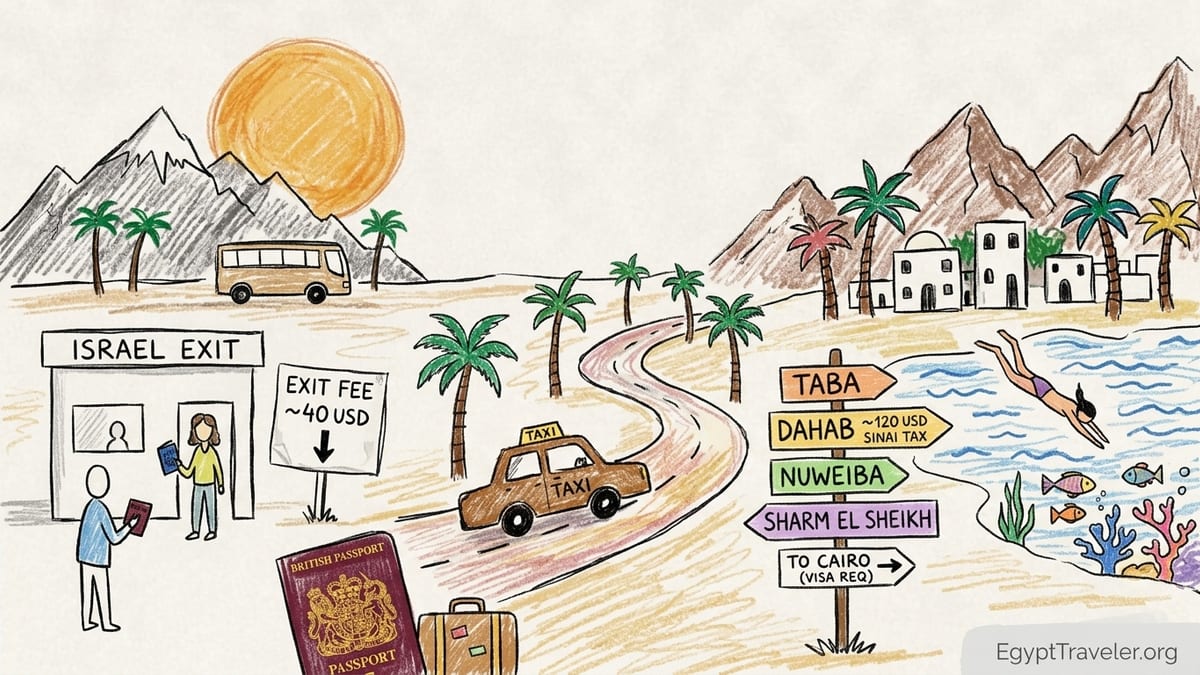
My Route, Nationality and Original Plan
I am a British passport holder traveling with my partner, also British, in October 2026. Our route was London to Tel Aviv, down to Eilat, then across the land border at Taba into Egypt, with Dahab as our final destination. The logic seemed sound. We wanted a few days in Israel first, followed by ten days of diving and work-from-beach time in Dahab. Countless blogs described the Sinai entry permission as "free" for up to 14 or 15 days in Sharm el Sheikh, Dahab, Nuweiba and Taba. The plan was simple: cross on foot at Taba, get the free entry stamp on the Egyptian side, and continue by road along the coast to Dahab, all without paying for a full Egyptian visa.
On paper, this matched the official guidance. As of late October 2026, the UK Foreign, Commonwealth & Development Office (FCDO) confirms that most British visitors to Egypt do usually need a visa, but that there is an exception for short stays in South Sinai. If you arrive by air into Sharm el Sheikh and stay for less than 15 days in South Sinai resorts like Sharm, Dahab, Nuweiba and Taba, you can receive a free entry permission stamp on arrival instead of buying a visa. The Egyptian Consulate in London echoes this, stating that UK, EU and US nationals going to these resorts only, for up to around two weeks, qualify for a free entry permission rather than paying for a regular visa.
The problem was that I treated these rules as if they applied identically to Taba land entry. They do not. The fine detail about land borders, local border taxes, and what happens if you continue beyond the immediate Taba area or outside Sinai rarely appears in older blog posts, and even some recent travel threads gloss over the costs. By the time I collected my receipts, what had been sold online as "free Sinai access" looked very different at ground level.
Sharm Airport Free Entry vs Taba Overland Reality
First, it is crucial to distinguish between arriving at Sharm el Sheikh Airport and entering Egypt overland at Taba. When you fly directly into Sharm as a British tourist and plan to stay less than 15 days in resorts such as Sharm, Dahab, Nuweiba or Taba, the process remains relatively straightforward. At the airport, if you stay within South Sinai and under the 15-day limit, you can skip the visa kiosks and obtain a free South Sinai entry stamp at passport control. You still need a passport valid for at least six months and to respect the geographic and time limits, but you do not pay the usual 30 US dollar visa on arrival fee that applies at major Egyptian airports.
Overland at Taba, the situation is more complicated, because two sets of authorities, two currencies and multiple types of fees are in play. On the Israeli side at the Menachem Begin / Taba crossing, there is an exit fee, usually payable in shekels but often quoted in US dollars. Rates change periodically, but it commonly amounts to the equivalent of around 35 to 40 US dollars per person for those leaving Israel via land borders, sometimes with a small card surcharge if you pay on site rather than online. This is not an Egyptian charge at all, yet many travelers casually roll it into the idea of a "border tax" without explaining which side it belongs to.
On the Egyptian side, local regulations and practices determine how much you pay depending on how far you intend to travel. In 2026, several regional operators and visa specialists, along with tax trackers used by corporate mobility firms, consistently report a specific Taba Sinai tax for those going beyond the immediate Taba area. For travelers who enter Egypt at Taba and remain within the local Taba zone only, some recent guidance suggests that the Egyptian charge can be around 20 US dollars per person. For those who intend to travel farther into Sinai, for example continuing by road down the coast to Nuweiba, Dahab or Sharm, figures of roughly 100 to 120 US dollars per person in taxes and mandatory local payments are frequently quoted.
Crucially, these amounts are not universal, not published clearly in a single official spot, and can change with little public notice. During my crossing, my partner and I each paid an Israeli exit fee just over the equivalent of 38 US dollars at the prevailing shekel rate, plus Egyptian-side payments that, when totaled on our receipts, came close to the 120 US dollar estimate per person once local border tax and processing charges were included. That meant that before paying a single Egyptian taxi or hotel, we had already spent approximately 316 US dollars between the two of us simply to leave Israel and enter Egypt, despite having repeatedly read that we could get into Sinai "for free".
UK 2026 Guidance vs What Actually Happened
The disconnect between official guidance and the practical experience lies mainly in the details that matter most to budget planning. The current UK FCDO entry requirements page for Egypt in October 2026 sets out a simple headline: British passport holders normally need a visa for Egypt, but those arriving by air to Sharm el Sheikh and staying less than 15 days in Sharm, Dahab, Nuweiba or Taba do not need a visa and can receive a free entry permission stamp. It also notes explicitly that if you arrive by land at Taba, you should see the "Entering Egypt from Israel" section, which stresses that arrangements differ for land entries.
The Egyptian Consulate in London reinforces this exemption for short resort stays but frames it mainly around air arrivals to South Sinai resorts. The consulate also explains that a standard single entry tourist visa costs 30 US dollars, whether obtained online via an e-visa or on arrival at approved airports, with a multiple entry version costing more. It does not, however, publish a clear fixed Egyptian-side tax schedule specifically for Taba land entries, particularly for those traveling beyond the immediate border region. Instead, travelers are left to piece together reports from border agencies, mobility firms, tour operators and recent travelers.
In my case, the theory and the reality diverged as soon as the Egyptian official at Taba saw that our final destination was Dahab rather than a hotel adjacent to the border. When we declared that we were continuing down the coast, we were told that additional regional taxes would apply. There was no suggestion that we needed to purchase a full Egyptian visa for Dahab itself, because Dahab is still in South Sinai, but the combination of a Sinai border tax and processing fees amounted to roughly 120 US dollars per person. We were not the only ones. Several other foreign couples in the same queue, including Germans and Canadians, paid similar totals, though exact amounts varied slightly with currency choice and card fees.
For travelers intending to continue beyond Sinai, for example taking a bus or flight from Sharm to Cairo or traveling overland to mainland Egypt, the cost impact can be even more significant. In addition to the reported Sinai tax of around 120 US dollars at Taba, those travelers typically still need to obtain a regular Egyptian visa. In 2026, that usually means paying 30 US dollars for a single entry visa on arrival at a major airport or arranging an e-visa in advance, along with any service fees charged by the provider. Some overland travelers have also been asked to present or purchase a guarantee letter through a local operator, which can easily add several tens of US dollars more in administrative cost, especially when organized last-minute at the border.
The Real Cost for a Couple Continuing to Dahab
To understand how this plays out in practice, it helps to look at the full door to door bill for a couple going from Eilat to Dahab via Taba in October 2026 using actual, verifiable prices. On our own crossing, two British adults paid the Israeli land exit fee at the Eilat side, which worked out at just over 38 US dollars per person in local currency on the day. That is around 76 US dollars gone before even reaching Egyptian soil. On the Egyptian side, the combination of Egyptian border tax and local charges added a further total just under 240 US dollars for both of us, which the officer itemized in US dollars even though part of it could be paid in Egyptian pounds. In round numbers, that meant about 316 US dollars simply to cross the border together and be legally present in Sinai en route to Dahab.
Transport then adds another significant layer. For a couple, the most common onward option from Taba to Dahab is a private car transfer. Several regional transfer specialists and booking platforms operating in 2026 consistently quote prices around 55 to 70 US dollars per small car for the two to three hour drive from Taba to Dahab, depending on time of day, vehicle class and how far in advance you book. On our journey, we prebooked a small car through a regional Sinai transfer service that charged 69 US dollars for the Taba to Dahab run, payable in cash to the driver on arrival.
Taken together, that meant a practical total of roughly 385 US dollars for two people just to traverse the short stretch from Eilat to Dahab: around 316 US dollars in combined exit and entry charges, plus 69 US dollars for the transfer. For comparison, at the same time, one way flights from Tel Aviv to Sharm el Sheikh via Cairo or occasionally direct charter options, combined with a Sharm to Dahab transfer in the 49 to 70 US dollar per car range, would have resulted in a similar or lower overall cost but with far less uncertainty at the border and no exposure to Taba-specific taxes. From the perspective of a British couple who could have flown directly into Sharm and enjoyed a genuinely free Sinai entry permission, our decision to cross at Taba had clearly been the more expensive and more stressful route.
It is vital to stress that the figures above are based on our own receipts and specific October 2026 conditions. They are not fixed tariffs guaranteed for every traveler. Border charges, exit fees, tax levels and exchange rates shift frequently, and different nationalities can face different treatment at the same crossing. However, they illustrate the scale of the difference between the tidy “free Sinai” headline and the messy, expensive reality of combining land exit fees, Sinai border taxes and long coastal transfers.
Why So Many Blogs Still Say Sinai Entry at Taba Is “Free”
A major planning problem is the persistence of outdated or oversimplified online advice. Many travel blogs and forum posts that rank highly in search results were first written years ago when border regimes were different, then updated sporadically with minor edits but without re-checking every specific fee. A typical line reads something like: “You can cross from Eilat to Taba on foot and get a free Sinai visa on the Egyptian side for stays up to 15 days in Sharm, Dahab, Nuweiba and Taba.” That phrase conflates the concept of a free entry permission stamp with the total cost of crossing, and in 2026 it is frequently misleading.
What many of those posts fail to mention is that “free” only describes the absence of a standard Egyptian tourist visa fee. It does not cover the Israeli exit fee that almost every traveler pays at the land border, nor the Egyptian Sinai-specific border tax that applies when you travel beyond the immediate Taba area. Most of the older posts also do not distinguish clearly between arriving by air at Sharm, where the free entry permission genuinely can involve no additional visa or regional tax charges, and entering overland at Taba, where there is now a documented Sinai border tax and a growing paper trail of travelers paying well over 100 US dollars per head for the privilege of continuing deeper into the peninsula.
Some 2025 and early 2026 forum threads already show travelers being caught off guard by new enforcement of these rules. A number of independent reports mention being charged substantial sums at Taba when upgrading or regularising their status after overstaying a Sinai-only stamp or traveling beyond the permitted region without a full visa. While individual anecdotes are never a substitute for official policy, the consistency of the amounts mentioned and the corroboration from visa-focused organizations in 2026 suggest that treating Taba as a free or nearly free land entry point into Egypt is now outdated guidance.
This matters for more than just budgets. It also affects itinerary planning, because expectations around time and paperwork at the border often stem from those older "simply walk across" descriptions. In reality, queuing to pay exit fees, queueing again to settle Sinai taxes, and dealing with questions about your onward plans can easily turn the crossing into a multi hour exercise. Travelers who arrive late in the day without reserved transfers or local currency can find themselves negotiating taxi rates in the dark with limited leverage and very few alternatives.
Cash, ATMs and Paying for Transfers from Taba
Border crossings are precisely the wrong place to discover that the only functioning ATM is out of service. Yet among the most common complaints from recent travelers in South Sinai is the unreliability of cash machines, especially at or near land borders and smaller resorts. The Taba crossing is no exception. On our October 2026 crossing, the Israeli side had working ATMs and card-friendly border tax kiosks, but once we stepped onto the Egyptian side, card acceptance became patchy and ATM availability far thinner.
Several Sinai-focused transfer operators stress that travelers should carry sufficient US dollar cash to cover both border payments and onward transport, precisely because local ATMs may be offline, empty or limited to domestic cards. US dollars remain the most widely accepted foreign currency at the border itself, and many drivers along the South Sinai coast still quote rates primarily in dollars even though they are happy to accept equivalent amounts in Egyptian pounds. In our case, the Egyptian side taxes could be paid either in dollars or in pounds at a posted daily rate, but the officer insisted that using US dollars would avoid confusion and would be quicker, which matched reports from other travelers.
Onward transfers from Taba illustrate how crucial advance planning can be. Reputable regional services in 2026 quote small car prices that cluster around three typical examples: approximately 49 US dollars per car to Nuweiba, 69 US dollars per car to Dahab, and about 100 to 110 US dollars per car to Sharm el Sheikh for daytime journeys, with nighttime surcharges in some cases. These are per vehicle rather than per person and can usually be booked online in advance, then paid in cash to the driver on arrival. On our trip, having a confirmed 69 US dollar Dahab transfer waiting just beyond the border was a huge relief after the surprise of higher than expected taxes.
Border taxis that you negotiate on the spot tend to start higher, especially when drivers know that you have already paid your way into Egypt and have few other options. Some travelers report initial asks of 80 to 100 US dollars to Dahab for a small car, which can be bargained down but not always to the level of prebooked services. Genuine public transport options, such as long distance buses, are extremely limited from Taba itself. Timetables change often, services can be infrequent or cancelled at short notice, and the security situation in parts of Sinai means that some routes are diverted or suspended altogether. Counting on a public bus directly from Taba to Dahab is therefore risky. In practice, most foreign visitors either prebook a private transfer or negotiate a taxi on site.
Taba Land Rules vs Nuweiba Ferry Procedures
The overland entry rules at Taba should also be distinguished from entry via Egypt’s Red Sea ferry ports, particularly Nuweiba. Travelers coming from Jordan by ferry, for example from Aqaba to Nuweiba, face a different set of regulations and charges. The Nuweiba ferry ports are international arrival points where standard Egyptian visa rules and port fees typically apply, and where many visitors either arrive with a pre-arranged e-visa or buy a visa on arrival if eligible. The South Sinai free entry permission, as described in UK and Egyptian consular guidance, mainly focuses on air arrivals to Sharm el Sheikh and does not function as a broad waiver of visa and port fees across all Red Sea maritime entries.
In practical terms, that means that someone sailing into Nuweiba from Jordan should not expect the same combination of “no visa fee plus only a small local tax” that some older Sinai-only overland advice implies. Nuweiba is treated more like an international port where standard visa-on-arrival practices are enforced, with port charges and shipping fees layered on top. Some tour operators who arrange diving and trekking trips that combine Jordan and Sinai do advertise packages in which these fees are folded into an overall price, but that does not make them disappear. For independent travelers, it is essential to check with both the ferry operator and Egyptian consular sources shortly before departure, since schedules, prices and procedures are especially susceptible to late changes.
By contrast, Taba remains a land border specifically connecting Eilat in Israel with the Egyptian Sinai. It is influenced not just by general Egyptian visa policy but also by bilateral agreements, regional security considerations and Sinai specific taxation rules. For many years this made Taba the “simple” back door into Sinai, especially from Israel, but in 2026 the combination of an Israeli exit fee, a Sinai tax on the Egyptian side and limited overland alternatives means that Taba is no longer the easy, nearly free option that older blogs describe.
Five Common Planning Problems at Taba
Several recurring issues now affect travelers who still plan around the idea of a free or cheap Taba crossing into Sinai. First, outdated visa information causes confusion about whether a full Egyptian tourist visa is needed. British travelers in October 2026 who fly directly into Sharm for less than 15 days and remain in South Sinai can still rely on a free entry permission, but those entering at Taba need to consider both Sinai tax rules and whether they intend to leave the peninsula. Misreading consular wording and assuming that every form of arrival into Sinai is visa and fee free leads to under budgeting and occasional disputes at the border when officials insist on additional payments.
Second, border taxes themselves are poorly understood. Many travelers arrive expecting to pay a single fee or none at all, only to encounter separate Israeli exit fees and Egyptian Sinai taxes. Because these are not capped in any clearly published way, and because different currencies and payment methods can produce slightly different totals, couples like us often discover only afterwards that they have spent well over 200 US dollars in combined charges that no one travel blog ever mentioned explicitly.
Third, cash planning is often inadequate. Relying on border ATMs or assuming that every fee can be paid by card is risky in Taba. Travelers who bring only minimal US dollar cash may find that they can pay Israeli exit fees with a card but must scramble to obtain dollars or Egyptian pounds on the Egyptian side, where options are fewer. In busy seasons, exchanging currency inside the terminal can involve long waits and unfavorable rates, further eroding any notional savings from skipping a visa.
Fourth, transfer pricing and availability are underestimated. Some travelers assume that they can simply hop on a cheap shared taxi or public bus from Taba to Dahab or Sharm the way they might from a European airport. In reality, buses can be sparse or non-existent from Taba itself, especially at night, and private car prices reflect both demand and distance. Without a prebooked ride, you may face expensive, last-minute negotiations in a situation where you have little bargaining power.
Fifth, delays at the crossing can snowball into further costs. Additional questioning, manual inspections or system outages on either side can produce long queues. When that happens, travelers who planned to reach Dahab or Sharm by mid afternoon might find themselves arriving late at night, incurring surcharges from taxi drivers, paying for missed hotel nights, or even abandoning non-refundable activities booked for the day of arrival. If your itinerary onward from Sinai involves fixed departures, such as flights from Cairo or ferries from Nuweiba, these delays can have serious knock-on effects.
The Takeaway
For British travelers in October 2026, the most reliable way to enjoy the benefits of the South Sinai free entry permission is still to fly directly into Sharm el Sheikh Airport and stay under 15 days within the main resort corridor that includes Sharm, Dahab, Nuweiba and Taba. In that scenario, the promise of “free” is relatively accurate. You skip the 30 US dollar visa fee and pay no Sinai specific border taxes on arrival, aside from the normal costs of flights and airport transfers. It is easy to book a private car from Sharm to Dahab in the 49 to 70 US dollar per car range, and the entire arrival process is generally more predictable and less stressful than an overland border crossing.
Taba, by contrast, now makes most sense only for specific short trips focused on the far north of Sinai. If you plan to stay in a hotel directly adjacent to the border, perhaps for a couple of nights at Taba Heights or one of the nearby beach resorts, and you treat the crossing as a side extension of a holiday already based in Israel, then accepting the Israeli exit fee and a modest Egyptian tax for the Taba area alone may still be reasonable. For such narrowly defined visits, the ability to walk across the border and be at your resort within minutes can still outweigh the costs and complications.
However, if your main goal is to reach Dahab, Nuweiba or Sharm el Sheikh, particularly as a British traveler who could otherwise arrive by air, you should think of Taba not as a budget shortcut but as a premium, complex route that layers multiple fees on top of long road transfers. Between the Israeli exit fee, the Egyptian Sinai tax that can reach around 120 US dollars per person for onward travel into the peninsula, and small car transfers that often fall in the 49 to 104 US dollar range depending on distance, the total can quickly exceed what you would have spent simply flying into Sharm and using the airport free entry permission.
None of these figures are guaranteed. They are drawn from official guidance, recent operator price lists, and our own October 2026 receipts, all of which can change at short notice. That is precisely why you should approach any article or blog that still describes Taba as a convenient, free back door into Sinai with caution. Before committing to an overland route, verify current FCDO and Egyptian consular advice for your nationality, check with at least one reputable Sinai transfer service about border-side pick up prices, and make sure you carry enough US dollar cash to handle both known fees and the inevitable surprises that come with this particular border.
FAQ
Q1. Is Sinai entry really free for British travelers in October 2026?
For British travelers flying directly into Sharm el Sheikh and staying under 15 days in specified South Sinai resorts, there is still a free entry permission stamp instead of paying the usual 30 US dollar Egyptian tourist visa fee. This applies when you arrive by air and remain within approved resort areas like Sharm, Dahab, Nuweiba and Taba, but does not remove Israeli exit fees or Sinai border taxes if you enter overland at Taba.
Q2. How much did crossing via Taba actually cost for a couple going to Dahab?
On my October 2026 trip, two British adults paid roughly 76 US dollars in Israeli exit fees plus just under 240 US dollars in combined Egyptian-side taxes and local charges, for a total of about 316 US dollars at the border alone. Adding a prebooked 69 US dollar private transfer from Taba to Dahab brought the door to door cost to around 385 US dollars for the couple, excluding accommodation and meals.
Q3. Do all travelers pay the same Sinai tax at Taba?
No. Published information on Sinai tax levels is limited, and the exact amount can vary by nationality, itinerary and current regulations. In 2026, several operators and mobility services describe a lower charge of roughly 20 US dollars when remaining in the immediate Taba area, and a higher band around 100 to 120 US dollars per person for those traveling farther into Sinai. These sums can change at short notice and are not guaranteed.
Q4. Will I need a full Egyptian visa if I cross at Taba?
If you are a British traveler who crosses at Taba and then stays solely within the South Sinai resort corridor for less than 15 days, officials may allow you to rely on a Sinai-only permission without purchasing a full visa, although you are still likely to pay Sinai taxes. If you intend to leave Sinai, travel to mainland Egypt or stay longer than the permitted period, you will need to obtain a standard Egyptian tourist visa, which generally costs 30 US dollars for a single entry in 2026, plus any service or guarantee-letter costs.
Q5. Do I need to bring US dollar cash for the Taba crossing?
Carrying US dollar cash is strongly advisable. While the Israeli exit fee can often be paid by card in shekels, Egyptian-side taxes and some local charges are frequently requested in US dollars or Egyptian pounds, and ATMs at or near the border can be unreliable. Many transfer drivers along the South Sinai coast also prefer to be paid in US dollars at pre-agreed rates.
Q6. How much should I budget for a private transfer from Taba?
In 2026, small car transfers arranged through regional services commonly cost around 49 US dollars to Nuweiba, 69 US dollars to Dahab and 100 to 110 US dollars to Sharm el Sheikh, per vehicle rather than per person. On-the-spot taxis at the border often start higher, especially at night, and genuine public transport options from Taba itself are limited and unreliable.
Q7. Are older blogs about the Taba crossing still accurate?
Many older or only lightly updated blogs still describe Taba as a simple, low cost gateway with a free Sinai visa and minimal charges. They often omit current Israeli exit fees, recent Sinai tax levels and the high cost of private transfers along the South Sinai coast. As of October 2026, relying solely on such posts without checking up to date official or operator information is likely to leave you underestimating both cost and complexity.
Q8. How do Taba land rules differ from arriving by ferry at Nuweiba?
Taba is a land border with its own Sinai-specific tax regime and Israeli exit fee component, while Nuweiba is an international ferry port where more standard Egyptian visa-on-arrival rules and port fees usually apply. The South Sinai free entry permission is mainly designed for air arrivals into Sharm rather than maritime arrivals, so travelers coming from Jordan by ferry to Nuweiba should not assume that Taba-style Sinai-only permissions or tax levels will apply.
Q9. When is it better to fly directly into Sharm instead of using Taba?
If your primary destination is Sharm, Dahab or Nuweiba and you are eligible for the South Sinai free entry permission, flying directly into Sharm is generally simpler and often cheaper overall. You avoid Israeli land exit fees and Taba Sinai taxes, and only need to arrange an airport transfer within South Sinai. This is especially true for British travelers in 2026 who can obtain the free entry stamp by air and stay under 15 days in the resort corridor.
Q10. When does entering via Taba still make sense?
Taba can still be worthwhile if you are already in southern Israel and want a short, tightly focused stay in the Taba resort area itself, or if flight options to Sharm are very limited or expensive on your dates. In those cases, paying the Israeli exit fee and a modest Egyptian tax for the immediate Taba zone may be acceptable. For longer trips deeper into Sinai, however, Taba is now better viewed as a niche, higher cost route rather than the free shortcut many older guides describe.