


The Egyptian Red Sea has a reputation for big walls, iconic wrecks and bright, fishy reefs, but not every famous site suits every diver. Conditions range from calm shore entries that work well for a first breath underwater to remote offshore reefs where liveaboards dodge strong currents and sudden weather changes. This guide looks at Egypt’s key regions and signature dive sites through a practical lens: certification level, dive type, access, safety standards and realistic 2026 prices, so you can match your ambitions to conditions you can enjoy safely.
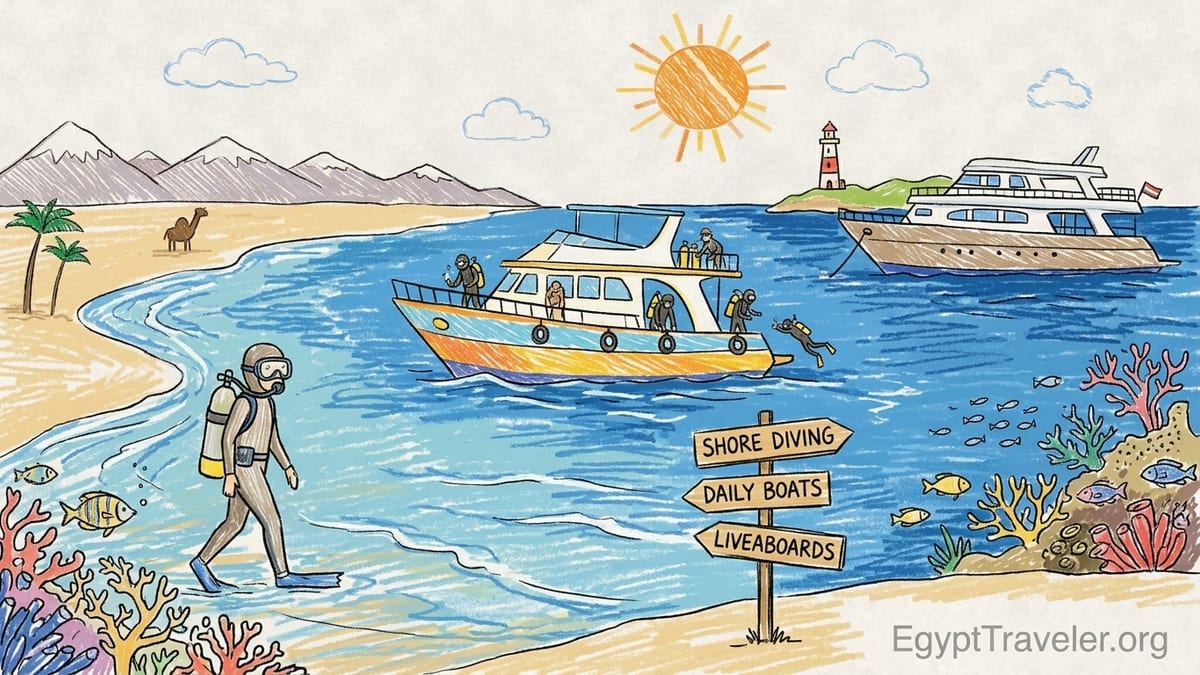
How Red Sea Diving Is Structured: Shore, Daily Boats and Liveaboards
Most recreational diving in Egypt is organised in three ways: shore-based house reefs, daily boats and liveaboards. In Dahab, Marsa Shagra and many El Quseir and Marsa Alam lodges, shore diving means you kit up at a dive center on land, then walk or take a short zodiac ride to a house reef or nearby bay. Depths on these fringing reefs usually start on sand at 3 to 6 metres and slope gradually to 20 metres or more, which is ideal for beginners, training dives and relaxed macro or coral photography. Shore entries are less weather dependent than offshore reefs and can be dived repeatedly in one day while you fine-tune buoyancy and air consumption.
Daily boats are the dominant model in Sharm el Sheikh, Hurghada, El Gouna and Safaga. You meet at the marina in the morning, sail 45 minutes to 2 hours to one or two sites, make two or sometimes three dives, then return late afternoon. A standard two-dive day including lunch in Hurghada or Sharm in 2026 is generally quoted around 70 to 100 euros per diver, with basic marine park fees sometimes extra and full equipment hire adding roughly 20 to 30 euros per day, depending on the center and gear quality. These boats open up outer reefs like Ras Mohammed’s Shark and Yolanda Reefs or Hurghada’s Giftun area without the cost or commitment of a liveaboard.
Liveaboards, locally called “safari boats,” are multi-day trips that sleep 16 to 28 guests and move between offshore sites such as the Brothers Islands, Daedalus and St John’s. A typical seven-night safari with three or four dives per day, full board and airport transfers has current list prices from roughly 1,000 to 1,300 euros per diver in 2026 for mid-range boats in Egypt, depending on season, route and cabin type. Park fees, fuel surcharges, crew tips and rental gear are often itemised on top. Liveaboards are the only reliable way to reach many of the Red Sea’s most remote reefs but are best suited to experienced, self-sufficient divers comfortable with repetitive deep and drift profiles.
Across all three models, the Chamber of Dive & Watersports (CDWS) sets standards for Egyptian dive operations. CDWS rules require, among other points, written emergency plans at each site, staff lists that include certified guides, oxygen administration capability and procedures for evacuating injured divers. These requirements are especially important on safari boats, which must be licensed with emergency ports marked on their itineraries and must stop diving if bad weather makes crossings unsafe.
Verifying Dive Operators and Understanding Safety Standards
Before booking any Red Sea diving, it is worth checking that both the operator and the individual guides are properly accredited. CDWS maintains online directories of licensed dive centers and liveaboards, and its technical regulations state that scuba diving activities for tourists must be carried out only by Ministry of Tourism licensed operators who are members of CDWS and supervised by CDWS certified dive guides or instructors. In practice, that means the name of the center and the safari boat should appear in CDWS listings, and you should see staff carrying CDWS professional ID cards alongside credentials from major training agencies such as PADI, SSI or CMAS.
Safety questions to ask are straightforward. Ask where emergency oxygen is stored on the boat or at the shore base, how much is carried, and who is trained to use it. CDWS emergency training modules emphasise that oxygen units must be available and that staff should be able to administer emergency oxygen promptly. Ask to see the written emergency plan that every operator is supposed to have, including how they contact the nearest recompression chamber, which coastal hospital they use and how quickly a speedboat or car can reach it. For liveaboards, clarify which “safe harbour” they would run to if someone needed evacuation from an offshore reef.
Equipment maintenance and insurance are other filters. Reputable centers keep a log of regulator servicing dates, visual and hydrostatic tests for tanks, and compressor air-quality tests. You can ask to check the last service records, especially if booking a long course or liveaboard where you will rely on rental gear for many dives. For insurance, confirm the operator has liability cover and make sure you carry personal dive accident insurance valid in Egypt that covers chamber treatment. If a quote seems far below typical Red Sea prices, ask what is excluded, especially park fees, marine permits, transfers, nitrox and tips, so you can compare like with like.
CDWS has also issued environmental preservation guidance. It forbids the use of metal “pointer sticks” that divers sometimes rest on coral and encourages operators to brief guests on avoiding contact with the reef, not feeding fish and controlling buoyancy near delicate soft corals. When comparing operators, favour those that talk proactively about conservation rules, limit group sizes underwater and refuse to offer risky practices such as casual wreck penetration for untrained guests or deep excursions beyond certification limits.
Beginner-Friendly Red Sea Hubs: Hurghada, El Gouna, Safaga and Marsa Shagra
For new divers and those planning an Open Water course, the easiest access and gentlest conditions usually come from mainland hubs. Hurghada and nearby El Gouna on the western shore offer dozens of CDWS-registered dive centers, sheltered inshore reefs and affordable prices. Discover Scuba or introductory dives from Hurghada daily boats currently cluster around 40 to 60 euros for two guided dives including basic rental kit, with some higher-end operations charging more where groups are smaller or gear newer. Two-tank certified-diver day boats commonly cost around 70 to 90 euros excluding equipment, which may add 20 euros for a full set.
The reefs around Hurghada and El Gouna, including parts of the Giftun area, feature coral pinnacles rising from sand at 10 to 15 metres, sloping walls and shallow plateaus that remain in the 5 to 18 metre range. Currents here are present but usually manageable, and surface chop is often mild in settled weather. Open Water divers can enjoy long, colourful dives on these sites without exceeding their 18-metre training limit, while Advanced Open Water divers can combine deeper sections to around 25 to 30 metres with shallower safety stops on top of the reef, which works well for fish life and photos.
Further south, Safaga and El Quseir see fewer resort crowds and have a quieter, more local feel. Safaga’s offshore reefs like Tobia Arbaa combine gentle slopes and coral blocks with modest currents, and many centers here specialise in teaching, using these sites for courses from Discover Scuba to Advanced and specialty training. Prices are broadly in line with Hurghada. El Quseir and Marsa Shagra, by contrast, lean heavily on shore-based house reefs. At Marsa Shagra’s well-known lodge, divers enter from the beach or zodiac onto a house reef where depths range from shallow seagrass beds to drop-offs that can comfortably serve everything from first dives to relaxed independent buddy dives for experienced guests, with on-site guides available for orientation.
These mainland bases are good choices if you want a mix of non-diving activities and easy access. Hurghada and El Gouna have large resorts, family-friendly hotels and nightlife, while Marsa Shagra and El Quseir are quieter and more focused on diving and snorkeling. For a first Red Sea trip, many instructors recommend starting here before progressing to more demanding currents and depths in Sinai or offshore liveaboards.
Iconic Sinai Reefs and Wrecks: Ras Mohammed, Straits of Tiran and SS Thistlegorm
At the southern tip of the Sinai Peninsula, Ras Mohammed National Park concentrates nutrient-rich water from the Gulfs of Suez and Aqaba, creating some of the most fish-dense walls in the Red Sea. Shark and Yolanda Reefs, reached by daily boat from Sharm el Sheikh in around 60 to 90 minutes depending on departure marina and sea state, are classic drifts. Divers usually drop near Anemone City, follow the vertical wall of Shark Reef, cross a shallow saddle and finish over the plateau where scattered bathtubs and toilets mark the lost cargo of the freighter Jolanda. Typical dive depths here are 15 to 30 metres, though the wall drops far deeper, and currents can range from mild to very strong in summer.
Because of these factors, most operators recommend Advanced Open Water or equivalent for Ras Mohammed’s signature routes and ask beginners to build experience on sheltered local reefs first. The open blue alongside Shark Reef requires disciplined buoyancy and depth monitoring to avoid accidental deep descents. Seasonal conditions vary: from June to August, water temperature peaks around 28 degrees Celsius and massive schools of snapper, batfish and unicornfish gather, but this is also when current shear and down-currents on the saddle are more common. Winter brings cooler but still comfortable water and often clearer visibility, with slightly less intense currents. Ras Mohammed is a protected national park, so expect entry fees added to boat prices, no anchoring on the reef, strict no-touch rules and potential fines for damaging coral.
North of Sharm, the Straits of Tiran help funnel water between Sinai and Saudi Arabia. Four main reefs, including Jackson and Thomas, rise almost vertically from deep water and are famous for strong currents, schooling fish and, in summer, chances of sharks. Daily boats from Sharm typically take 60 to 90 minutes each way. Depths on the plateau tops can be as shallow as 5 to 10 metres, but the outer walls drop steeply, and many signature sections run in the 18 to 30 metre range. These sites suit confident Advanced divers familiar with negative entries and drift techniques, not brand-new graduates.
The SS Thistlegorm, a British World War II freighter lying in about 30 metres of water in the Gulf of Suez, is Egypt’s best-known wreck. Day boats from Sharm often depart before dawn for a two-and-a-half to three-and-a-half hour crossing each way, while many northern liveaboards schedule at least two dives here. On the outside, divers can tour the intact bow with its deck guns, the midships blast area and the stern, all within a depth band from roughly 18 down to 30 metres. Inside, holds still contain trucks, motorbikes and other cargo. Ordinary recreational wreck diving on Thistlegorm generally means external tours and limited supervised swim-throughs in wide areas with clear exits, kept within recreational depth and no-decompression limits.
Full wreck penetration on the Thistlegorm, such as exploring deeper holds and overhead sections with no direct vertical access to the surface, is not suitable for casual tourists. These dives should be reserved for properly trained technical or advanced wreck divers with redundant gas supplies, reels and lights, and arranged only with operators experienced in such dives. When booking, ask explicitly whether dives are external or involve overhead penetration and choose based on your training, not on peer pressure or marketing photos.
Dahab’s Blue Hole, Canyon and Northern Sinai Shore Diving
Dahab, north of Sharm on the Gulf of Aqaba, operates very differently from resort hubs. Most diving is shore-based, with pick-up trucks taking divers to entry points like Lighthouse, Eel Garden, the Canyon and the Blue Hole. Depth profiles range from shallow sloping reefs ideal for Open Water training at Lighthouse to very deep vertical environments just offshore. Surface conditions are often calm near shore, but entry and exit can involve waves and rocky steps, and currents along the outer walls can be significant.
The Blue Hole itself is a near-vertical sinkhole with a shallow lip at about 6 metres and a void that drops to well over 90 metres inside and far deeper outside. On the outer wall there is a tunnel called the Arch, whose roof lies around 55 metres deep and whose bottom continues down into open sea. This depth is far beyond standard recreational limits, which internationally fall between 30 and 40 metres for typical training agencies, and the Arch is associated with a long history of fatal accidents among divers attempting to cross it without appropriate technical training, gas mixtures and equipment redundancies. Recreational dives at the Blue Hole, including the popular “Bells to Blue Hole” route, are planned to stay shallower, often with maximum depths in the 25 to 30 metre range on the outer wall, and do not include entering the Arch.
It is important never to treat the Blue Hole Arch as a casual challenge or a “must do” rite of passage for a Red Sea holiday. Divers who are only Open Water, Advanced or Deep specialty certified on single cylinders should stay strictly within their certified depth and no-decompression limits and follow the guide’s plan that keeps them well above the Arch roof. If an operator or guide suggests otherwise, that is a sign to walk away. Dahab offers plenty of excellent, safer dives, including the Canyon, where a crack in the reef slopes from about 20 to below 30 metres and can be enjoyed by properly briefed Advanced divers, and multiple colourful shore reefs in the 10 to 25 metre range that suit both beginners and photographers.
Northern Sinai shore diving appeals to independent-minded travelers. You can stay in small guesthouses, walk to dive centers on the seafront and plan a relaxed schedule of one or two dives per day. Costs here are often slightly lower than in Sharm, with guided shore dives priced per tank and gear rental added separately. For new divers, Dahab’s Lighthouse area and similar sheltered bays are appropriate training grounds, but the proximity of very deep water just offshore reinforces the need for conservative depth discipline and choosing CDWS-registered operators who take limits seriously.
Southern Reefs: Marsa Alam, Abu Dabbab, Elphinstone and Hamata
South of El Quseir, the coast around Marsa Alam combines seagrass bays that attract turtles and dugongs with offshore reefs known for sharks and healthy soft corals. Abu Dabbab, one of the best-known bays, has a shallow sandy entry, patch reefs and seagrass where green turtles and, occasionally, dugongs graze at depths from 3 to 15 metres. These conditions are ideal for Discover Scuba participants, Open Water students and snorkelers. Currents are usually mild close to shore, and shore access makes timing flexible around wind and waves. Several CDWS-registered centers in the area organise both shore and boat dives, and prices for two-shore-dive days and local courses are broadly similar to Hurghada.
Farther offshore, Elphinstone Reef rises from deep water and is known for steep walls, strong currents and seasonal pelagic sharks. This site is commonly reached by day boat from Marsa Alam or by liveaboard. Typical dive profiles involve dropping at one end of the cigar-shaped reef, descending to 20 to 30 metres along the wall or plateau and then letting the current carry you along, with safety stops in blue water. Currents can be strong and variable, with down-currents reported at times, and the reef’s position offshore means waves and surface chop can be more pronounced. Elphinstone is therefore recommended only for experienced Advanced divers with solid buoyancy, gas management and drift-diving comfort.
Marsa Shagra’s house reef bridges the gap between these extremes. From the lodge’s shore entry you can access north and south legs of a fringing reef with depths that allow everything from a 5-metre check dive to 30-metre wall explorations, all within the safety net of an on-site center and zodiac pickups. This makes Marsa Shagra a good choice for mixed-experience groups and photographers who want the freedom to dive unguided on familiar terrain after an initial orientation. Continuing south, Hamata and the Fury Shoals area open up more remote reefs with hard coral gardens and swim-throughs, generally dived by day boat from small ports or by liveaboard departing from Marsa Alam or Hamata itself.
Seasonally, water temperatures in southern Egypt track Sinai but can feel slightly warmer in shoulder seasons. Summer water can reach the high twenties Celsius, while winter can drop to the low twenties, especially at depth. Wind can be stronger from December to March, affecting small-boat crossings to Elphinstone and Fury Shoals. For beginners focused on relaxed reef life and turtles, Abu Dabbab and similar bays around Marsa Alam work in most seasons, while those targeting sharks at Elphinstone or deep plateaus further south often prefer late spring to autumn, accepting that currents will also be livelier.
Specialist Offshore Routes: Brothers, Daedalus and St John’s
Some of Egypt’s most storied reefs are too far offshore to be reached practically by day boats, so they are treated as specialist liveaboard itineraries. The Brothers Islands, two small outcrops in open sea east of El Quseir, are known for steep walls, strong currents, oceanic whitetip sharks and, at times, hammerheads. Depths on the reef face drop quickly, and many dives work in the 20 to 35 metre band along the wall before returning to a shallower area for a safety stop. Boats tie to fixed moorings, but surge and surface conditions can be challenging. Most safari operators require a minimum of 50 logged dives and Advanced certification for Brothers trips, and CDWS liveaboard regulations emphasise the need to stop diving when weather deteriorates.
Daedalus Reef, further south and even more isolated, is another offshore seamount famed for currents, walls and pelagic encounters. Access is almost exclusively by liveaboard, usually as part of deep south “Brothers & Daedalus” or “Daedalus & St John’s” routes. Here, dives often begin with negative entries to descend quickly into moving water, followed by drifts along the reef face at 20 to 30 metres and blue-water safety stops with little visual reference. This style of diving increases task loading and is not appropriate for new or nervous divers. Operators generally restrict such routes to guests with solid deep and drift experience and sometimes specify minimum logged-dive counts as a booking condition.
St John’s is a collection of reefs and coral pinnacles near Egypt’s southern border, reachable by liveaboard from Marsa Alam or Hamata after an overnight steam. Once there, conditions can be a little gentler than Brothers or Daedalus, with many dives in the 10 to 25 metre range among hard coral gardens, shallow plateaus and iconic formations such as canyon-like swim-throughs. Currents are present but variable, and surface conditions have more shelter among the scattered reefs. These routes still involve multiple days far from shore and require comfort with repetitive diving, but they are often recommended for experienced recreational divers who want dramatic reefs without the consistently harsh conditions of offshore seamounts.
Because these specialist offshore sites lie far from medical facilities, emergency planning is crucial. Liveaboard emergency plans, required by CDWS, should spell out evacuation routes, distances to emergency ports and how long it would take to reach a chamber. When comparing safari boats, ask how many oxygen sets are on board, whether there is a dedicated safety officer, how many guests are assigned to each guide in the water and whether nitrox is available. These details can be more important than cosmetic luxury when evaluating safety for advanced itineraries.
Costs in 2026: Courses, Day Boats and Liveaboards
Egypt is widely regarded as one of the most cost-effective destinations for learning to dive and for high-frequency diving. In 2026, sample price lists from established Red Sea centers show shore-based single house-reef dives with full gear around 55 euros, two-dive boat days around 75 to 90 euros without equipment and Open Water courses starting from roughly the mid-200 euro range, depending on location and class size. Hurghada day-trip dive operators often advertise introductory “Discover Scuba Diving” experiences between about 40 and 60 euros, including two guided dives, rental kit and lunch, with marine park supplements and hotel transfers added if trips visit protected offshore sites.
Marine park and government fees apply in several areas, including Ras Mohammed National Park and parts of the southern Red Sea. These can be charged per day or per trip and may be collected in cash on the boat or bundled into package prices. When comparing quotes, ask for a breakdown of what is included: base diving cost, equipment rental by item, national park fees, fuel surcharges where applicable, soft drinks and meals, transfers and tips. For liveaboards, published rates around 1,000 to 1,300 euros for a week in 2026 typically cover accommodation, three to four dives per day, meals and non-alcoholic drinks, but often exclude rental gear, nitrox, park fees and crew gratuities, which may be suggested as a percentage of trip cost.
Insurance and certification costs also matter. PADI, SSI and other agencies set their own certification and materials fees, which are usually bundled into course prices but sometimes itemised. Dive accident insurance for a week or two in Egypt is an additional, modest cost but an important one, as it covers recompression treatment if needed. When budgeting, many divers find that total in-country spending per person for a week of day-boat diving in a place like Hurghada, including dives, rental equipment, park fees and tips but excluding flights and hotel, often sits in the few-hundred-euro range, while a liveaboard week including extras tends to run over a thousand euros per diver.
Prices fluctuate with exchange rates, fuel and local regulations, so treat any example figures as current snapshots, not locked guarantees. Before you commit, request a written quote from the operator spelling out all compulsory charges and likely optional extras. This not only avoids surprise costs but is another test of professionalism: reputable centers are used to giving transparent breakdowns and will be clear if, for example, certain marine fees are subject to change by local authorities.
Decision Guide: Matching Sites to Your Level and Interests
Choosing among Egypt’s Red Sea regions can be overwhelming, so it helps to frame the decision around certification level, preferred dive style and tolerance for travel complexity. For brand-new divers and people planning an Open Water course, mainland hubs such as Hurghada, El Gouna, Safaga and shore-based lodges at Marsa Shagra or El Quseir usually give the smoothest experience. You will have easy shore or short-boat access to sheltered reefs in the 5 to 18 metre range, plenty of CDWS-registered schools and the option to add non-diving activities.
If you are a certified diver eager for colourful reefs and some gentle drifts but not yet comfortable with very strong currents, consider a mix of Hurghada or El Gouna daily boats for Giftun and Abu Nuhas area reefs, Marsa Alam bay and boat diving around Abu Dabbab, or Ras Mohammed and Straits of Tiran with careful operator and site selection. Many Sharm centers, for example, will take less experienced divers to calmer Ras Mohammed sites or inner Tiran reefs when conditions are appropriate and reserve the most exposed walls and saddles for more advanced groups.
For wreck enthusiasts, the SS Thistlegorm and the Abu Nuhas wrecks are the headline draws. Thistlegorm can be done as a long day trip by boat from Sharm el Sheikh or visited more flexibly on northern liveaboards that also include Ras Mohammed and Tiran. Abu Nuhas, with several wrecks clustered on a reef north of Hurghada, is accessible by day boat from Hurghada and El Gouna or via liveaboard. In both cases, basic external wreck tours are within reach of Advanced Open Water divers with good buoyancy and gas management, while any penetration beyond wide, naturally lit openings should be left to divers with formal wreck training and appropriate equipment.
Photographers and relaxed reef divers often gravitate to places with house reefs and flexible dive schedules. Marsa Shagra’s unlimited house-reef packages, Abu Dabbab’s turtle-filled shallows, and Dahab’s Lighthouse and Eel Garden shore dives all allow you to repeat sites at different times of day, control your own pace and avoid crowding. Advanced photographers who also want big schools of fish and dramatic walls may time trips to Ras Mohammed in early summer or book St John’s and southern liveaboards that combine easy shallows with striking topography.
Advanced liveaboard travellers focused on intense diving and pelagic encounters will look to itineraries that include Brothers, Daedalus and Elphinstone, ideally after building experience on easier routes. Here, the priority is not just the sites but the operator’s safety culture. Choose boats with a reputation for conservative briefings, realistic minimum experience requirements and strong adherence to CDWS safety and environmental regulations, even if that means accepting a cancelled crossing when wind and waves make offshore moorings unsafe.
FAQ
Q1. Is Egypt’s Red Sea suitable for complete beginner divers?
Yes, several regions such as Hurghada, El Gouna, Safaga, Abu Dabbab and Marsa Shagra offer sheltered reefs, gradual depth profiles and CDWS-registered schools that are well suited to Discover Scuba and Open Water training.
Q2. How dangerous is Dahab’s Blue Hole for recreational divers?
The shallow rim and outer wall can be dived safely within recreational limits with a good guide, but the Arch begins around 55 metres and is far beyond normal recreational depth, so it must never be attempted as a casual challenge on standard gear.
Q3. What are realistic 2026 prices for a two-dive boat trip in Egypt?
In 2026, many established Red Sea operators quote roughly 70 to 100 euros for a two-tank day boat excluding equipment, with full gear rental often adding around 20 to 30 euros and national park fees charged separately.
Q4. Do I need a liveaboard to dive Egypt’s best sites?
You can reach excellent reefs and wrecks like Ras Mohammed, Tiran, Abu Nuhas and even SS Thistlegorm by day boat, but remote sites such as Brothers, Daedalus and St John’s are effectively accessed only by liveaboard.
Q5. How can I check if a dive center or liveaboard in Egypt is legitimate?
Look up the operator and vessel in the CDWS directories, check that guides carry CDWS professional ID cards and agency instructor ratings, and ask to see their emergency plan and oxygen provision on site or on board.
Q6. What certification level do I need for Ras Mohammed and the Straits of Tiran?
Most operators recommend at least Advanced Open Water or equivalent and some prior drift experience, since typical depths run from about 15 to 30 metres with variable, sometimes strong currents and deep drop-offs.
Q7. Are wreck penetration dives on SS Thistlegorm suitable for ordinary tourists?
External tours and limited, wide swim-throughs can be appropriate for experienced recreational divers, but full wreck penetration into overhead sections should be reserved for divers with formal wreck or technical training and suitable redundant equipment.
Q8. When is the best season to dive Egypt’s Red Sea?
Diving is possible year-round; summer brings warmer water and schooling fish at sites like Ras Mohammed but also stronger currents, while winter offers cooler water, often excellent visibility and slightly calmer conditions on some reefs.
Q9. What safety equipment should I expect on Egyptian dive boats?
You should see clearly accessible emergency oxygen with enough capacity for multiple divers, first-aid kits, lifejackets, radio or satellite communications, and staff trained in emergency procedures, as required by CDWS regulations.
Q10. How should beginners choose between Hurghada, Sharm, Dahab and Marsa Alam?
Hurghada and El Gouna suit beginners wanting easy boats and resort amenities, Sharm adds famous but more advanced drifts, Dahab is more independent and shore-based, and Marsa Alam offers a quieter setting with turtle-filled bays like Abu Dabbab plus access to more challenging sites as you gain experience.