


The brochure promised I would be "swimming with wild dolphins in their natural home" by lunchtime. The WhatsApp message from the agent in Hurghada read like a dream: hotel pickup, a modern boat to "Dolphin House," guaranteed sightings, ethical practices and a price that, at first glance, seemed surprisingly low for a full day at sea. It was only when I started asking detailed questions about where we were going, which operator actually ran the tour and how they approached the dolphins that the whole cheerful promise began to unravel.
Meeting the Real Operator Behind a Hurghada Dolphin House Trip
My first encounter with Egypt’s Dolphin House industry began not at sea, but in a hotel lobby in Hurghada. Like many visitors, I was approached by a freelance seller offering a "Dolphin House" excursion the next day. The destination, I was told, was simply "Dolphin House," as if there were only one such place in the Red Sea. When I pressed for details, I eventually learned that the tour would be operated by a local boat company departing from Hurghada Marina and heading to the northern reefs often marketed as Dolphin House, particularly the Shaab El Erg area, several hours north of the city by day boat.
The advertised package looked familiar from local posters: a large shared boat carrying around 40 to 60 passengers, buffet lunch, snorkeling gear and two to three stops at reefs where Indo-Pacific bottlenose dolphins are frequently seen. The price, quoted in October 2026, was around 30 to 40 euros per adult when booked through a street agent, with children discounted and hotel-based reps often quoting more for essentially the same product. That figure did not include the optional extras that quietly add up, such as underwater photography, wetsuit rental or tips for crew, which were strongly encouraged though not formally compulsory.
The promises were much less modest. The flyer used language like "swim side by side with dolphins" and described the trip as "ethical dolphin watching with no harassment," yet when I asked the agent which guidelines the crew followed he could only reply that they "respect the animals." When I asked whether the operator followed the dolphin-watching code produced by HEPCA, the leading Red Sea conservation NGO, he admitted he did not know the document and simply assured me that "the captain has years of experience with dolphins." Experience, however, is not the same as regulation.
By the time I paid my deposit, I knew the name of the boat, the license number and the departure harbor, but I still did not know which reef we were visiting beyond the vague label "Dolphin House." That ambiguity proved to be the first warning sign, because in Egypt this name covers very different places with very different rules.
Not One Dolphin House but Three Very Different Worlds
Across Egyptian tourism marketing, "Dolphin House" is used as a catch-all slogan. In practice, there are at least three main dolphin-focused areas that visitors are sold under that name, and confusing them hides crucial ethical differences. From Hurghada and El Gouna, most "Dolphin House" day boats head to northern reefs such as Shaab El Erg, El Fanous or Abu Nugar, where Indo-Pacific bottlenose dolphins sometimes interact with boats that also cater to ordinary snorkeling and diving. These trips are usually day excursions with multiple reefs on the itinerary, and dolphin encounters, while common enough to be confidently marketed, are not the sole focus of the trip.
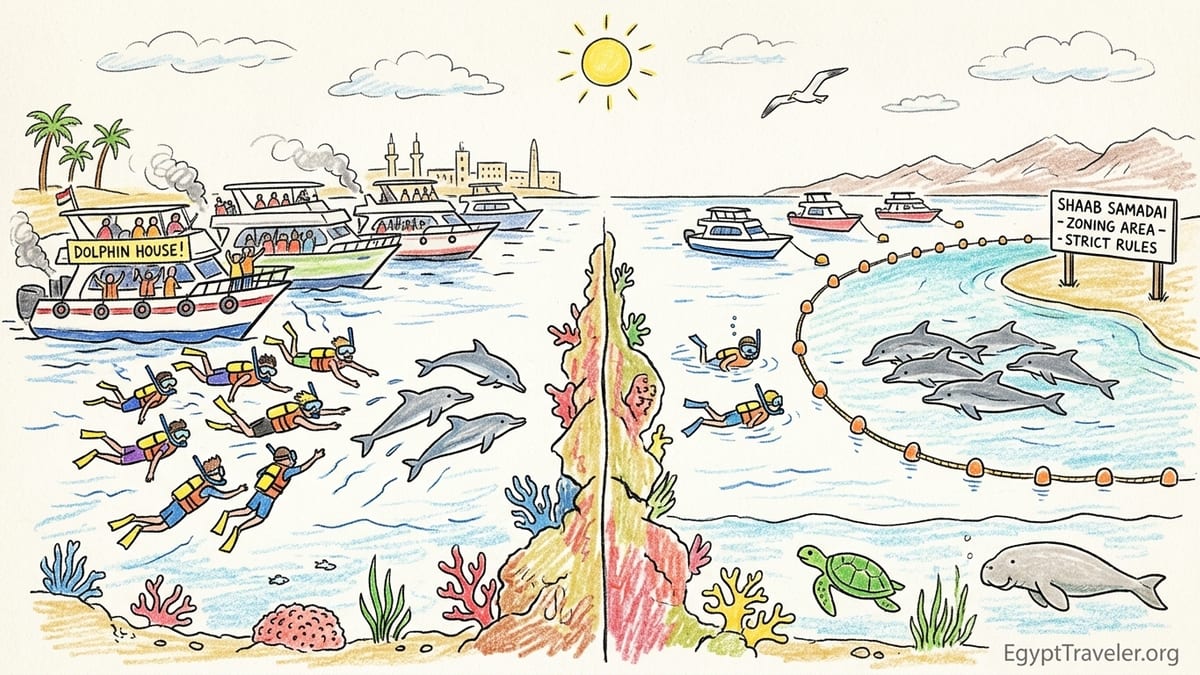
Further south, near Marsa Alam, "Dolphin House" almost always refers to Shaab Samadai, a horseshoe-shaped reef about an hour and a half by boat from Marsa Alam’s small harbor. Samadai has become a symbol of both dolphin tourism and its regulation. It is a legally designated protected area managed under a zoning system created after years of intense pressure from daily dolphin-swim tours. Access is controlled, visitor numbers are capped and boats must moor at fixed buoys rather than chase dolphins inside the lagoon. The entire experience is framed by a management plan negotiated between HEPCA, Egypt’s environmental authorities and local operators.
At the southern end of this story lies Sataya, also marketed as "Dolphin House," usually visited from Hamata or as part of multi-day trips from Marsa Alam. Sataya is another large reef with a shallow lagoon used by spinner dolphins and promoted heavily as an all-day or liveaboard-style swim-with-dolphins experience. For years, unlike Samadai, Sataya had far fewer formal restrictions, and research has highlighted higher levels of disturbance there. When I asked Marsa Alam dive centers to compare the two, several described Sataya as "crowded" and "less controlled" at peak times, in contrast with the stricter rules at Samadai.
Lumping these three areas together under a single "Dolphin House" label does more than confuse travelers. It obscures the fact that you are not buying one generic dolphin trip, but entering a particular set of ecological and regulatory circumstances. As a traveler you cannot make an informed ethical choice if you do not know whether you are heading for a northern bottlenose site with no special zoning, a regulated spinner dolphin reserve at Samadai or a high-pressure resting lagoon at Sataya.
Two Dolphin Species, Two Different Daily Rhythms
The dolphins themselves deepen the ethical divide between these sites. Around Samadai and Sataya, the main attraction is the spinner dolphin. This small, slender species is famous for its acrobatic spinning leaps, but its most important characteristic for tourism is its daily rhythm. Scientific work in the Red Sea and elsewhere has shown that spinner dolphins tend to feed offshore at night, targeting deep-water fish and squid, and then move into shallow, sheltered lagoons in the morning to rest and socialize during the day. HEPCA describes both Samadai and Sataya as classic spinner resting habitats, with sandy-bottomed lagoons and protective reef walls that create a calm refuge after nocturnal foraging.
That daily cycle matters. When tourists arrive at these reefs in late morning, they are entering what should be the dolphins’ resting period. Research from Red Sea sites and from Hawaii has documented that when swimmers enter resting bays in large numbers, spinner dolphins are more likely to shift from resting to active behaviors like milling, traveling or avoiding boats, sometimes abandoning the core resting area earlier in the day. At Samadai, a study that combined surface observations with statistical modeling found that the presence of swimmers in the designated tourism zone was associated with more frequent transitions from resting to travel or avoidance, even under the regulated system. The same body of research compared Samadai with unregulated or less regulated sites and noted stronger disturbance signals where there were no time or zone restrictions.
In the northern Red Sea around Hurghada, by contrast, most dolphin encounters advertised on Dolphin House trips involve Indo-Pacific bottlenose dolphins. These are larger, more robust animals than spinners, and they do not rely on a single shallow lagoon in the same way. Bottlenose dolphins around Shaab El Erg or El Fanous are often observed moving through reef systems in small groups, sometimes bow-riding or approaching boats out of apparent curiosity. Yet they too have feeding and resting needs, and repeated high-speed approaches, tight circling by multiple boats or being surrounded by swimmers can still disrupt natural behavior and expose them to risk from propellers.
When I asked operators in Hurghada whether they brief guests on the species they were likely to see, very few mentioned anything beyond simply "dolphins." Only a handful of higher-end dive centers in Marsa Alam explained upfront that Samadai and Sataya were spinner resting sites, that the animals would be in a resting phase and that part of the reason for staying at the edge of the lagoon was precisely to avoid pushing them out of the calm water they sought after a night of hunting.
Samadai: How a Crowded Dolphin House Became a Regulated Reserve
To understand why Samadai looks and feels different today, it helps to go back to the early 2000s. As dolphin-swim tourism took off along Egypt’s southern Red Sea, Samadai became a star attraction. By the summer of 2003, conservationists recorded days when an estimated 500 to 800 tourists were brought into the inner lagoon to swim with the dolphins. Boats would anchor or drift close to the resting pod, unloading waves of snorkelers and often surrounding the animals. HEPCA and independent researchers began to document changes in the dolphins’ use of the reef, including a decline in how often they entered the lagoon on busy days and more frequent avoidance behavior.
The response was a management plan that has become a case study for whale and dolphin tourism worldwide. In 2004, Samadai was designated a protected area, and a zoning system was implemented. The inner arc of the lagoon, known as Zone A, was declared a strict no-entry area reserved solely for dolphins. A surrounding belt of water, Zone B, was opened to swimmers and snorkelers but closed to motorized traffic, which must remain in Zone C, the outer anchoring and activity area. Boats are required to use fixed moorings rather than drifting or chasing dolphins, and daily visitor numbers are limited through a ticketing system administered with local authorities.
On my own visit to Samadai, these rules were more than just words in a booklet. Before leaving Marsa Alam harbor at around 8 am on a medium-sized day boat with perhaps 25 guests, we were given a briefing that went beyond standard life-jacket instructions. The guide explained that we would not be allowed to swim into the inner lagoon where the dolphins rest, that engines must be in neutral while guests were in the water in Zone B and that we should not attempt to approach or touch any dolphins that chose to pass by. Once on site, rangers patrolled by zodiac, watching for boats that stray into Zone A or use speed to cut off the pod’s path.
The result is an experience that, while still very much a commercial wildlife attraction, feels more structured and less frantic than unregulated sites. You are acutely aware that you are a guest under rules designed around the dolphins first and tourism second. For some visitors this may feel like a limitation compared with freer swim-chase experiences offered elsewhere. For others, including many repeat divers I spoke to, the existence of firm boundaries at Samadai is the only reason they are willing to participate in dolphin tourism at all.
Sataya and the Cost of Unregulated Pressure
Sataya, by contrast, has for many years stood as an example of what happens when intense dolphin-swim demand meets a lack of comparable regulation. Scientific projects that compared spinner behavior at three types of Red Sea sites described Sataya as a location with heavy tourism use but few restrictions, and recorded that resting dolphins there showed stronger disturbance responses during the middle of the day than at either regulated Samadai or a remote control site where tourism was absent. In particular, dolphins at high-pressure sites were more likely to switch from resting to traveling or avoidance when surrounded by swimmers or approached repeatedly by boats.
Accounts from guides and visiting divers in 2025 and 2026 echo this picture. Boats often arrive at Sataya early in the morning and stay for many hours, rotating wave after wave of snorkelers into the shallow lagoon. On busy days, several day boats and small liveaboards may be present, and pods are sometimes flanked by dozens of lifejacketed tourists encouraged to "keep up" with the animals as they try to rest or move slowly through the lagoon. While some responsible operators voluntarily limit the number of in-water sessions and maintain distance, others still market "all-day swimming with dolphins" with little reference to codes of conduct.
When I asked Marsa Alam-based companies why they might choose Samadai over Sataya, a pattern emerged. Those that emphasize conservation said they prefer Samadai because of the official zoning, ranger presence and clearer boundaries for guests. Others admitted that they send boats to Sataya specifically because "guests want more time with the dolphins" and there is less likelihood of being stopped for infractions. In other words, traveler expectations and marketing slogans at times incentivize exactly the kind of pressure that research warns against.
There have been discussions in recent years about bringing Sataya under a similar management framework to Samadai, with time-area closures, caps on boat numbers and formal codes of conduct. Some local guides told me that informal agreements now exist about avoiding the innermost lagoon at certain times, but concrete, consistently enforced rules remain patchy. Until those are in place, Sataya will continue to raise difficult questions for travelers who care about animal welfare but are tempted by the promise of an almost guaranteed, close-up dolphin experience.
How My Hurghada Dolphin House Trip Measured Up in Practice
Back in Hurghada, my own Dolphin House excursion to the northern reefs provided a real-time test of the fine words used in marketing. The day began smoothly, with hotel pickup and a short transfer to Hurghada Marina. The boat was a typical local day vessel around 20 to 25 meters long, with two decks, shaded seating and a crew of six plus a guide. Safety provisions were reasonable: there were visible lifejackets, a basic first aid kit and a briefing in English and German that covered where to jump, how to use masks and the plan for the day’s snorkeling stops.
The first encounter with dolphins, however, immediately exposed the tension between ethics and expectation. As we approached Shaab El Erg, the captain spotted a small pod of bottlenose dolphins near the outer reef. Engines throttled down somewhat, but there was no attempt to maintain a specific minimum distance. Our guide, enthusiastic and well-meaning, called everyone to the bow and urged us to get into snorkeling gear "quickly so you can swim with them when we stop." Within minutes, we were one of three tourist boats converging on the same pod, each launching swimmers from the bow as soon as the dolphins surfaced nearby.
HEPCA’s guidelines for dolphin watching in the Red Sea recommend that vessels maintain a respectful distance, avoid sudden course changes, refrain from encircling animals and keep engines in neutral whenever swimmers are in the water close to dolphins. In practice, our boat did not formally chase the pod at high speed, but nor did it keep to a fixed path. Instead, it moved in gentle arcs to intercept the dolphins’ expected route, at times coordinating informally with other boats to place snorkelers ahead of the pod in the water. Guests were told not to touch the animals, but there was visible encouragement to "swim hard" to stay close, and at least one swimmer extended an arm toward a passing dolphin before being shouted at by the guide.
Was this outright harassment? Compared with some more aggressive accounts, no. The captain avoided sharp turns at close range, and when dolphins changed direction the boat did not attempt to cut them off completely. Yet it also fell short of the stricter interpretation of "non-disturbance" promoted by conservationists. The pod altered course twice in a way that seemed to be an avoidance response, and at one point surfaced at a noticeably greater distance from the cluster of tourist boats before disappearing altogether. The entire encounter lasted perhaps twenty minutes. The remaining hours of the trip were spent snorkeling on reefs with no dolphins in sight, a welcome relief for any animal-conscious traveler but perhaps a disappointment for those who believed the "swim-with" promise.
Safety, Hidden Extras and the Fine Print of Dolphin Tourism
Beyond the ethical treatment of dolphins, the structure of these tours raises more terrestrial concerns. At the booking stage, few sellers in Hurghada, Marsa Alam or Hamata clearly explain what is and is not included in the headline price. Egyptian environmental authorities levy fees for visiting protected marine sites, and at locations such as Samadai this appears as a per-person ticket that supports mooring maintenance and ranger patrols. Some operators include this in the quoted price, while others add it on board as an unexpected charge. On my Samadai trip, the conservation fee was included in the upfront cost explained by the dive center. On the Hurghada Dolphin House excursion, staff collected a separate, smaller marine park fee in cash once we were already at sea, a practice that left several guests confused.
Extras follow a predictable pattern: professional photographs and videos of guests with dolphins, wetsuit rental for those who find the water cool in winter, and, increasingly, "VIP" upgrades promising fewer people on board or access to a faster speedboat. Some private speedboat operators in Hurghada advertise three-hour Dolphin House runs for around 150 euros per boat for small groups, underlining how tempting it can be to trade crowding for exclusivity. Yet a smaller vessel does not automatically mean more responsible behavior. In fact, speedboats are more capable of quickly intercepting a moving pod, and without a strong conservation ethic they may pressure dolphins even more, simply with fewer human witnesses.
Safety at sea varies widely. On calmer summer days the Red Sea can appear like a giant swimming pool, yet wind can rise quickly, especially in spring and autumn, creating short, steep waves that make open-deck boats roll heavily. On a later trip from Hamata, I watched as a group of inexperienced snorkelers were encouraged to enter the water in moderate chop near Sataya, several quickly becoming anxious as they drifted away from the guide. Lifejackets helped, but there was little structured assessment of who was a confident swimmer and who needed closer supervision. For families with young children, older travelers or anyone with mobility issues, the romantic idea of "swimming with wild dolphins" may not adequately prepare them for clambering up ladders in waves while holding fins, masks and sometimes cameras.
Crowding is another persistent issue. Even on a reasonably well-run Hurghada day boat there were bottlenecks at the stern ladder when thirty people attempted to enter or exit the water simultaneously at the first dolphin sighting. In this crush, the ability of guides to monitor individual safety and compliance with dolphin rules drops sharply. It is striking that the most orderly in-water sessions I experienced were not on the cheapest mass-market trips but on more modestly sized boats that capped guest numbers significantly below their legal maximum and scheduled their day to avoid peak arrival times at key sites.
Marketing Promises vs the Reality of Wild Animals
As I compared these different experiences, I kept returning to the words used in brochures and online ads. "Guaranteed dolphins, or your money back" was a line I saw more than once, usually in association with Sataya or Hurghada speedboat trips. One operator in Marsa Alam went as far as to promise that "you will swim with dolphins for at least one hour." When I asked how they could make such a guarantee with wild animals, the answer was revealing: "The dolphins are always there, they live in the lagoon." Scientifically, this is not how wild dolphin presence works. Even at sites described as resident, research has shown day-to-day and seasonal variation in how often pods enter a particular reef, how long they stay and where in the reef they rest.
At Samadai, long-term monitoring by HEPCA and academic partners has documented years when spinner dolphins were present almost daily, and other periods when their use of the lagoon shifted, possibly in response to environmental changes and varying tourism pressure. The management plan explicitly acknowledges this uncertainty by focusing not on guaranteeing sightings but on minimizing disturbance when the animals are present. Even under that plan, there are days when guests at Samadai do not see dolphins at all, and responsible operators explain this upfront. At Sataya and the northern Hurghada reefs, where no equivalent formal management plan exists, the temptation to overstate predictability is stronger.
The language of "ethical" or "eco-friendly" dolphin encounters also demands scrutiny. Several tour companies now advertise their Dolphin House trips as "ethical" without clearly defining what they mean. When I asked for specifics, only a minority referred to concrete rules: maximum time alongside a pod, minimum approach distance, a ban on entering the inner lagoon at spinner resting sites or an internal cap on the number of guests in the water at once. Others simply equated ethics with avoiding physical contact or not feeding the animals, a very low bar in a context where behavioral disturbance from proximity and duration of interactions can be just as harmful as overt harassment.
As a traveler, one of the clearest tests you can apply is how an operator responds when you ask what will happen if dolphins are not present. If the answer is that the trip will still run as a reef-snorkeling excursion, with the focus shifting to corals, fish and perhaps turtles, you are dealing with a company that at least acknowledges uncertainty. If, on the other hand, they brush off the question with assurances that "dolphins are always there" or imply that the captain will keep searching until they find a pod, you should consider whether your money will be supporting relentless pursuit in order to fulfill a marketing promise.
The Takeaway
After following the Dolphin House trail from Hurghada’s marinas to the regulated reserve at Samadai and the high-pressure lagoon at Sataya, my own attitude to swimming with wild dolphins has changed. I began, like many visitors, thinking of it as a dreamy highlight of a Red Sea holiday. I ended with a more sober understanding that these tours exist on a spectrum from cautiously managed wildlife watching to ethically troubling disturbance of resting animals, and that the difference often lies in details hidden behind the generic label "Dolphin House."
If you decide to book a dolphin-focused trip in Egypt, treat the conversation like an interview. Ask the seller exactly which reef you are visiting and which species you are likely to encounter. Request the name of the operating boat company, not just the agent, and check whether they refer to any code of conduct for dolphin encounters. Ask how many people will be on board, how many will be allowed in the water at one time and what distance and speed rules the crew follow around dolphins. Pay attention to how they speak about the animals: as wild beings with their own rhythms and needs, or merely as a box to tick on your bucket list.
For many travelers, the most responsible choice may be to skip in-water dolphin encounters altogether, especially at resting lagoons like Sataya where regulation remains limited. The Red Sea is extraordinarily rich in other experiences that do not rely on swimming into the heart of a dolphin’s bedroom. Day boats from Hurghada can take you to reefs alive with anthias, butterflyfish and the occasional turtle. From Marsa Alam, seagrass meadows at places such as Abu Dabbab offer the chance to see green turtles and, in some seasons, dugongs without entering a spinner dolphin resting zone. Offshore reefs accessible by liveaboard from multiple ports reveal walls of coral and schooling fish that rival any reef system in the world.
Ultimately, the ethical question is not whether humans and dolphins can ever share the water, but under what conditions, and at what cost to the animals. Research from the Red Sea and other regions shows that well-designed rules, backed by enforcement and visitor education, can reduce but not entirely remove the impact of tourism on resting dolphins. It also shows that unregulated or weakly regulated swim-with activities risk pushing these animals to change their behavior in ways that may, over time, drive them away from the very refuges they need to survive. As travelers, we cannot control every aspect of what happens at sea, but we can choose which kinds of practices our money rewards.
FAQ
Q1. What exactly is meant by "Dolphin House" in Egypt?
"Dolphin House" is a marketing term used for several different Red Sea reefs where dolphins are regularly seen, notably Shaab El Erg near Hurghada, Shaab Samadai near Marsa Alam and Sataya Reef near Hamata. Each site has different species, regulations and levels of tourism pressure, so knowing which one you are booking is essential.
Q2. Which dolphin species are usually seen at Samadai and Sataya?
Samadai and Sataya are known for spinner dolphins, a smaller, agile species that feeds offshore at night and uses their shallow lagoons by day as resting and socializing areas. These sites are not feeding grounds but daytime refuges, which is why tourism there can easily disturb animals during their rest period.
Q3. What species is most often encountered on Hurghada Dolphin House trips?
Most Dolphin House excursions from Hurghada and El Gouna, especially those visiting reefs such as Shaab El Erg or El Fanous, encounter Indo-Pacific bottlenose dolphins. These are larger than spinners and move more widely between reefs, although their natural behavior can still be disrupted by repeated close approaches and swimmer pressure.
Q4. How is Samadai Reef managed to protect dolphins?
Samadai operates under a formal management plan that divides the reef into zones. The inner lagoon is a no-entry area reserved for dolphins, swimmers are confined to a surrounding belt where boats cannot enter and vessels must use fixed moorings in the outer zone. Visitor numbers are limited through a ticket system, and rangers monitor compliance with rules on distance, speed and swimmer behavior.
Q5. Why is Sataya considered more problematic from an ethical standpoint?
Sataya has attracted many boats offering all-day swim-with-dolphin experiences, but historically it has lacked the same level of zoning and visitor controls as Samadai. Research and guide reports indicate that dolphins there can face prolonged, close-range pressure from multiple boats and large groups of swimmers, especially in the middle of the day when they should be resting.
Q6. What are the key elements of responsible dolphin-watching behavior?
Responsible operators keep a respectful distance, avoid sudden course changes or surrounding animals, maintain low speed near dolphins, place engines in neutral while swimmers are nearby and never allow touching, feeding or chasing dolphins in the water. They also limit the duration and number of in-water sessions to reduce cumulative disturbance.
Q7. Are claims of "guaranteed dolphins" realistic?
No guarantee is truly honest when dealing with wild animals. Even at reefs where dolphins are frequently present, their daily and seasonal patterns vary, and there are days when they do not appear. Promises of guaranteed sightings or set minimum swim times may encourage operators to pursue pods too aggressively to avoid disappointing guests.
Q8. What safety issues should travelers consider on Dolphin House tours?
Safety considerations include the sea state, the size and condition of the boat, availability of lifejackets, clarity of briefings and the guide-to-guest ratio in the water. Rougher conditions, crowded ladders and strong currents can challenge inexperienced swimmers, especially when their attention is focused on dolphins rather than on staying close to the guide.
Q9. How can I choose a more responsible operator?
Ask specific questions before booking: which reef you will visit, how many people will be on board, whether the company follows any written dolphin guidelines, how many in-water sessions they schedule and what happens if dolphins are not present. Look for operators who emphasize respect for animal welfare, accept the uncertainty of wildlife encounters and are transparent about conservation fees.
Q10. What are good alternatives if I decide not to swim with dolphins?
If you prefer to avoid in-water dolphin encounters, the Red Sea still offers rich experiences. You can join reef snorkeling trips from Hurghada, explore turtle and seagrass sites near Marsa Alam or choose diving and snorkeling tours focused on coral reefs and fish rather than on close encounters with large marine mammals.