


I landed in Hurghada with a suitcase full of rash vests and far too many expectations. The brochure photographs showed a sweeping sandy crescent, turquoise shallows and a jetty that seemed little more than a decorative line across a bright blue lagoon. The promise was simple: all-inclusive, five stars, “direct beach and reef access” in Sahl Hasheesh, a purpose-built bay about 18 kilometres south of Hurghada airport, with house reefs and nine kilometres of swimable beach. On paper it looked like effortless Red Sea paradise. In reality, the beach holiday I bought and the one I actually got were not the same thing.
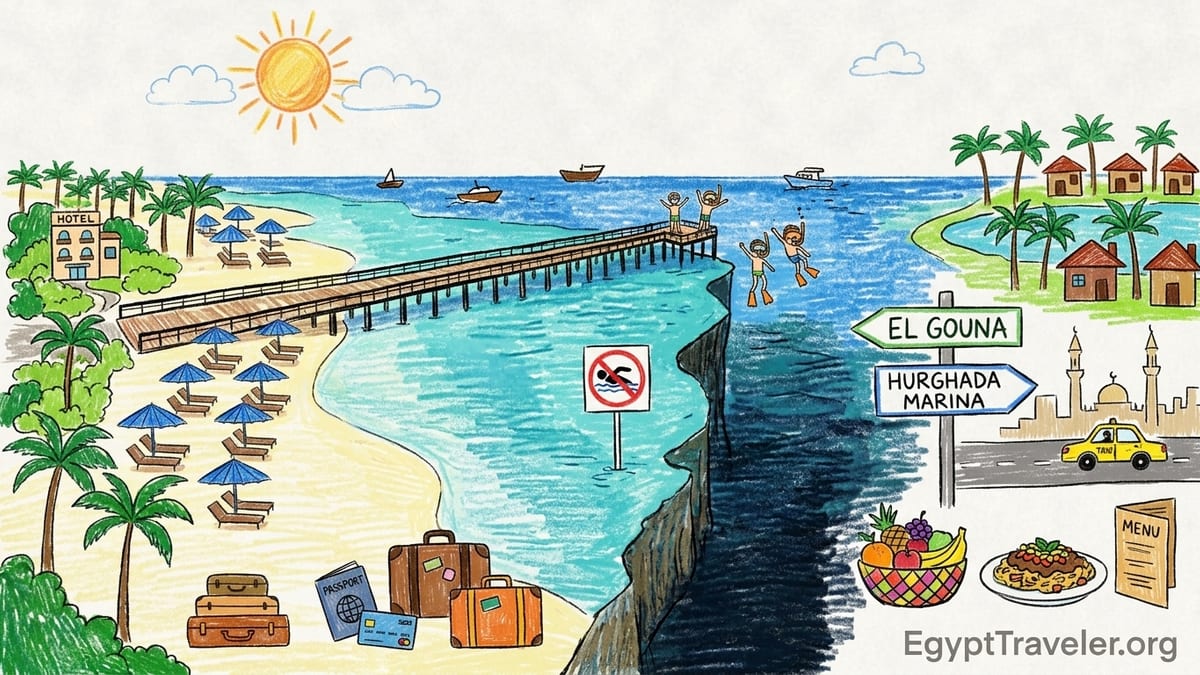
What I Thought I Was Booking in Sahl Hasheesh
I booked a week at a large all-inclusive resort in Sahl Hasheesh, a master-planned bay south of Hurghada, precisely because the marketing leaned so heavily on beach and reef access. The hotel website talked about a “silky sandy beach” and “live coral reef resting at the end of the hotel pier,” language you will also find in the room directories and brochures of several Sahl Hasheesh properties. The aerial photos were everywhere: symmetrical rows of parasols on pale sand, a long pier pointing to a reef that looked, from above, like a neat ribbon of turquoise and dark blue. It strongly suggested that I would be able to walk out from my sunbed into fish-filled water and that snorkeling the house reef would be a casual daily routine, not an expedition.
Geographically, the choice seemed sound. Sahl Hasheesh sits only about 20 to 30 kilometres south of central Hurghada and roughly 18 kilometres from the airport, so it is close enough for a straightforward transfer yet far enough from town to feel like a self-contained bay with reefs and its own promenade. Guides to the area describe it as a quiet alternative to Hurghada, “best for couples, house-reef snorkelling and long sandy beaches,” while emphasising that life largely revolves around the hotels and the water rather than a town centre packed with local restaurants and markets.
The price, booked through a European tour operator, looked like excellent value: just under the local equivalent of 900 to 1,000 euros per person for seven nights in late spring 2026, including flights, transfers and an advertised “ultra all-inclusive” package. For context, domestic bank promotions have recently advertised three-night all-inclusive stays at well-known Hurghada resorts such as Desert Rose for around 31,000 Egyptian pounds during peak Eid dates, which suggests that a week outside the busiest holidays at a similar or slightly quieter bay can indeed be sold as a relative bargain. On the spreadsheet, my package seemed to fit that narrative.
The description on my booking confirmation promised “sandy beach, lagoon area suitable for non-swimmers, jetty access to house reef, all-inclusive meals and drinks, evening entertainment and non-motorised watersports.” It is only when you compare such phrases to the granular reality on the ground that you see how much interpretive stretch there really is.
What the Aerial Photos Don’t Tell You About the Beach
The greatest disconnect between the resort’s advertising and my actual experience was the beach and how you could, or could not, get into the water. Sahl Hasheesh is repeatedly described in promotional material as having a long sandy beach with coral reefs just offshore, and that is broadly true. But this part of the Red Sea is also defined by a wide reef flat, where the seabed is extremely shallow for a long distance, then drops off suddenly where the living reef wall begins. To protect the fragile corals and for basic safety, most hotels restrict real swimming and snorkeling to the area reached from the end of a jetty.
In my resort’s photos, the pier appeared as a delicate line over luminous shallows. On arrival, I discovered it was nearly 250 to 300 metres long, a solid walk in strong sun before you even put your mask on. The “sandy beach” was accurate as a description of the upper shoreline, where children build sandcastles and loungers are lined up, but at the water’s edge the seabed was a mix of hard-packed sand and flat, sharp limestone with scattered coral outcrops. Signs warned guests not to walk beyond the roped shallow area without protective shoes, and staff politely discouraged anyone trying to step across the reef flat where the water was knee-deep but dotted with fragile coral heads.
The reality for non-swimmers and families with small children was a narrow, ankle-deep paddling strip in front of the beach and then, via the jetty, an abrupt transition to deep water. Trip reports and hotel replies for several Sahl Hasheesh properties use similar wording: the beach is sandy, but “the entry is a bit rocky” and there is a “natural sandy lagoon with 2 metres depth directly from our jetty.” In practical terms, that means you climb down a ladder at the far end of the pier straight into water that is around chest-deep or more for an adult, with waves and currents depending on wind. There is no long, waist-deep gradient where a cautious swimmer can gradually ease in.
This design can work beautifully for confident swimmers, snorkelers and divers, but it undermines the idea of an uncomplicated family beach holiday. On an aerial photo, a reef flat looks like a dreamy pale platform. On-site, it is an obstacle that dictates exactly where you can swim. That is not deception in a legal sense, but the photos are selective truth: they show you what the resort wants you to see and omit the practicalities that matter if one member of your party cannot swim.
Depth, Wind, Rules and the Reality of Reef Access
The pier was the resort’s lifeline to the living reef, and its use was tightly regulated. At the time of my visit, swimming from the jetty was limited to roughly 8:00 to 17:00 under lifeguard supervision, in line with rules enforced at other Hurghada-area resorts where swimming after 17:00 is explicitly prohibited by the Red Sea coastguard. The lifeguards were diligent and, to their credit, did their best to keep things safe. They checked that everyone leaving the ladder had fins and a mask, whistled people back from drifting too close to the drop-off, and closed the jetty several times during the week when the wind picked up and whitecaps appeared beyond the reef line.
Water depth at the end of the jetty hovered between 6 and perhaps 10 metres, depending on tide, with the reef wall rising almost to the surface. This creates spectacular snorkeling when visibility is good: clouds of anthias and butterflyfish, occasional blue-spotted rays, and hard corals that, while patchy in places, were noticeably healthier than some of the more trampled reefs closer to central Hurghada. It is easy to see why area guides describe Sahl Hasheesh and Makadi Bay as house-reef destinations where “with a mask you reach coral and fish within twenty metres” of leaving the jetty.
Yet the fact that worthwhile snorkeling was only available from the pier, within fixed lifeguard hours and subject to wind closures, fundamentally shaped my Red Sea holiday. Early-morning swims at sunrise and quiet dusk dips were off the table. On two blustery days the jetty was closed for hours at a time, leaving the beach as a decorative strip of sand fronting water that was only safe to paddle in. Guests who had booked primarily for the house reef spent those days in a holding pattern around the pool or bar, refreshing weather apps while the red “no entry” flag snapped in the wind.
It is worth stressing that none of this information appeared in the resort’s pre-arrival materials. Only when I examined the printed all-inclusive information sheet at check-in did I see the exact beach and pier hours, lifeguard rules and the admonition that access might be restricted “in case of unsafe sea conditions as determined by management and coastguard.” Had that wording been part of the online description, I might still have booked, but I would have done so with a more realistic sense of what my days would look like.
From “Snorkeling From the Beach” to Paying for Boat Trips
The next disconnect lay in the question of whether meaningful snorkeling could truly be done from shore, or whether you were in practice pushed towards paid boat trips. My reservation promised “snorkeling directly from the beach jetty” and glossy brochures often treat Sahl Hasheesh, Makadi Bay and Soma Bay as interchangeable house-reef havens. Independent snorkeling guides, however, draw sharper distinctions. Reviews and area descriptions regularly highlight that some parts of Makadi Bay and Soma Bay have steeper drop-offs and more dramatic reef walls, particularly around jetties that lead straight to deep water, while other hotels sit behind long, shallow flats where the living coral begins far from the shore.
Standing at the end of my resort’s pier, it was clear that the reef here, though alive in sections, had seen years of fin kicks and unintentional contact. There were fish, but the coral was not as diverse or as colourful as in the promotional images used for the “Red Sea snorkeling” section of my tour operator’s website. Those photos, I later recognised, could have been taken at almost any Red Sea site, from more pristine house reefs south of Safaga to offshore spots near Soma Bay that guides now single out as superior to both Makadi and Sahl Hasheesh. They were not dishonest, but they were generic reef images standing in for a specific, and more worn, local reality.
By the third day, a pattern had emerged. Serious snorkelers were leaving the resort altogether and buying spots on full-day or half-day boat trips. In 2026 prices, excursions sold at the in-house dive centre to nearby reefs or the popular Giftun and Orange Bay sandbar areas typically cost the equivalent of 30 to 60 euros per person, including lunch and equipment. Hotel-run reps framed these as add-ons for enthusiasts. In practice, anyone who wanted to see truly vibrant, less damaged coral felt compelled to sign up at least once or twice. For a couple or family, that meant adding somewhere between 120 and 300 euros of extra spend on top of the supposedly “complete” all-in package.
This is where marketing language such as “snorkeling paradise at your doorstep” becomes problematic. Yes, you can technically snorkel from the pier within its opening hours. But if the quality of that snorkeling does not match what you were led to imagine, and if you must pay for trips to other reefs to experience the Red Sea you thought you were booking, then the value proposition of your all-inclusive resort shifts substantially.
The Price of Being Far from Hurghada, and What That Really Means
Location is often sold as a serene advantage for Sahl Hasheesh and Makadi Bay. Tourist information describes these bays as 20 to 30 kilometres south of Hurghada, with Makadi about 30 kilometres away and Soma Bay a further 15 kilometres or so down the coast. What this means in practice is that you are one long taxi ride from the markets, restaurants, bars and marina of central Hurghada and, in the other direction, another significant drive from the lagoon town of El Gouna to the north.
On my week in Sahl Hasheesh, the resort offered a paid shuttle to Hurghada’s Marina Boulevard and Sheraton Road shopping area a few evenings a week, priced in the region of 10 to 15 euros per person round-trip. That is broadly in line with what independent drivers quote for hotel-to-town transfers, with recent travellers reporting informal taxi fares from bays like Sahl Hasheesh or Makadi to central Hurghada that, once converted from local currency at current inflated exchange rates, often land in the 15 to 25 euro range each way if you book privately and agree the price in advance.
In my case, two evening visits to town for a change of scene and dinner away from the buffet added roughly 80 euros in transport alone for two people, plus the cost of meals. A modest dinner with mezze, grilled fish and soft drinks in a central Hurghada restaurant catering to tourists can easily reach the local equivalent of 15 to 25 euros per person at 2026 prices, more in trendier venues. By the time we had shopped for souvenirs and tipped drivers, each night out nudged the “cheap all-inclusive week” closer to what we might have spent on a flexible stay in a mid-range hotel in central Hurghada itself.
That contrast became clearer when I compared notes with travellers staying in Hurghada proper and in El Gouna. Guides to the region now suggest that mid-range hotels in El Gouna, 20 kilometres north of Hurghada, typically cost between roughly 4,000 and 6,000 Egyptian pounds per night on a bed-and-breakfast basis in 2026, while comparable Hurghada hotels run between 2,000 and 4,000 pounds. Package deals discussed in traveller forums often reference one-week, all-inclusive stays in Hurghada or El Gouna in the 600 to 900 euro range, depending on season. When you factor in what I spent on taxis, excursions and outside meals, my supposedly self-contained Sahl Hasheesh package was not dramatically cheaper than constructing a stay in a central hotel plus independent food and activities. I had traded flexibility and local atmosphere for a beach whose use was much more constrained than the advertising suggested.
Unpacking “All-Inclusive”: What Was Actually Included
The all-inclusive formula was another area where reality was more bounded than the brochure tone implied. Because many Hurghada-area hotels must spell out their concept for tour operators, it is possible to compare what different properties include in their packages. Typical documents list main buffets for breakfast, lunch and dinner, one or more snack points, and a selection of local alcoholic and soft drinks by the glass in certain bars at set times. Anything beyond that tends to come with caveats or surcharges, and the small print matters.
At my resort, the check-in sheet confirmed that imported spirits, bottled premium beers and fresh juices were not included. One à la carte dinner in a speciality restaurant was part of the package per stay, but further visits incurred a service charge. The minibar in the room contained only a couple of small water bottles and soft drinks that were replenished once daily; anything else had to be requested and was charged. Bottled water for excursions was technically part of the all-inclusive offer but had to be collected from specific bars during opening hours. Room service was entirely chargeable. The spa, even for basic access to sauna or steam room, was extra.
For comparison, all-inclusive descriptions from other Hurghada properties spell out similarly precise boundaries: a given resort in town, for instance, clarifies that guests receive two free hours of billiards per stay, 30 minutes of complimentary fitness centre access daily, and free Wi-Fi only in certain areas and time bands. Another large hotel near Hurghada marina stipulates that swimming is prohibited after a set evening hour by coastguard rule and that the all-inclusive package is strictly for personal consumption, forbidding guests from bringing drinks or even bottled water purchased outside into the resort. None of this is unreasonable from a business standpoint, but it illustrates how the “all” in all-inclusive is carefully scoped.
On the food side, the buffet at my Sahl Hasheesh resort did offer some variety: grilled meats, pasta, predictable international dishes, salads and desserts. Egyptian cuisine, however, appeared more as a token feature than a meaningful presence. There might be one tray of koshari on a theme night, some tahini and baba ghanoush among the dips, and occasional freshly baked flatbread, but the default seemed aimed squarely at Central and Eastern European tastes. Those who wanted to explore Egyptian food in any depth had to venture into Hurghada or El Gouna, paying separately for meals that could easily match or surpass the daily per-person food budget embedded in their package.
By the end of the week, when I sat down with receipts, I realised that tips, extra coffees from the paid café, the single spa session I allowed myself, and the inevitable “not included” drinks had added well over 150 euros to my cost. Add in two snorkelling day trips at about 50 euros per person each and the evening outings to Hurghada, and my supposedly fixed-price holiday had grown by at least 400 euros for two people. The resort did not spring surprise fees; the information was technically available if you read every line. The disappointment lay in the gap between the carefree “leave your wallet at home” tone of the brochure and the more nickel-and-dimed feeling on the ground.
Five Clear Ways the Holiday Fell Short
Looking back, I can pinpoint at least five concrete disappointments that others considering a Hurghada-area all-inclusive should be aware of. The first was the mismatch between the advertised sandy beach and the actual limitations on water entry. A resort can have truly beautiful sand and still be a challenging place to get beyond shin-deep without reef shoes or a long walk along a hot jetty. For families expecting a gentle, waist-deep lagoon in front of their sunbeds, that difference matters enormously.
The second disappointment was the constrained snorkelling schedule. Because reef access was only via the pier and subject to lifeguard hours and wind closures, my ability to plan morning or evening swims or to pop in for a quick snorkel whenever the mood struck was curtailed. This might sound minor, but if the house reef is your main reason for choosing Sahl Hasheesh or Makadi over a central Hurghada hotel, those missing hours begin to feel significant.
A third issue was the quality of the reef compared to the expectation created by generic Red Sea imagery in marketing. The coral at my resort’s house reef was not dead, but it also was not the untouched underwater garden implied by photos that may in fact come from less-visited sites further south or offshore. After speaking to other travellers and local guides, it became clear that those who prioritised top-tier snorkelling from shore were gravitating towards more remote spots south of Safaga or carefully selected Soma Bay properties rather than the big all-inclusive clusters nearer Hurghada.
The fourth disappointment concerned the practical isolation of the resort. Being 20 to 30 kilometres from Hurghada’s centre meant that any desire to eat in a local restaurant, stroll a real marina or shop outside the hotel complex translated into an organised shuttle or negotiated taxi, each with its own cost and minor hassle. That isolation makes sense if your goal is to stay put and treat the resort as a self-contained bubble. If you chose Hurghada to combine sea and some taste of Egyptian town life, however, a distant bay can leave you feeling cut off.
Finally, the fifth disappointment was the scope of the all-inclusive package relative to the marketing promise. Once you understand that imported drinks, most spa access, specialised activities and genuinely interesting excursions are always extra, you realise that even a competitively priced package can creep up to what you might have paid for a stay in El Gouna or central Hurghada with independently chosen meals and tours. None of this involves outright dishonesty by staff or management; it is simply the cumulative effect of optimistic advertising language bumping against the specific, bounded realities of Red Sea resorts.
Would I Have Been Better Off in El Gouna or Central Hurghada?
The question that inevitably followed my week in Sahl Hasheesh was whether I would have been better served by staying in central Hurghada or in El Gouna and building my own version of a Red Sea holiday. After digging into current price ranges and speaking to others during and after my stay, the answer is nuanced but, for my priorities, leans towards yes.
Central Hurghada, especially around the marina and the main Sheraton Road strip, offers a dense cluster of mid-range hotels at lower nightly rates than comparable all-inclusive properties in outlying bays. Based on recent guidance, a clean, well-located hotel in town can cost in the 2,000 to 4,000 Egyptian pound per night range, including breakfast. El Gouna, while generally more expensive, positions itself as an upmarket lagoon town with cafés, marinas and an easy, walkable centre. There, per-night prices for decent mid-range accommodation commonly run between 4,000 and 6,000 pounds, sometimes higher at peak times, especially for packages arranged through European agencies.
At first glance, combining such accommodation with daily restaurant meals and a couple of paid snorkelling or diving trips might appear more expensive than a single all-inclusive price. But when I added everything I actually spent in Sahl Hasheesh, including boat trips, taxis, outside meals and “extras” not covered by my bracelet, the totals converged. The difference is that in town or in El Gouna, your additional spend buys you more choice: a range of Egyptian and international restaurants, multiple dive centres and excursion operators, and a real local or resort-town atmosphere instead of a single, curated environment.
There are also subtle but important differences in how you access the sea. Central Hurghada is less about pristine house reefs and more about launching points for boat trips, while El Gouna excels at calm lagoon waters and kitesurfing rather than dramatic drop-offs right off the beach. Guides comparing El Gouna and Hurghada emphasise that if snorkelling directly from shore is your top priority, you may still gravitate towards specific hotel strips in Makadi Bay or Soma Bay, or towards more specialised properties where the reef begins closer and the entry is better suited to non-swimmers. The key is that you must match your priorities to the exact micro-location and not rely on the generic “Red Sea equals easy snorkelling from the beach” story told by glossy flyers.
The Takeaway
My week in Sahl Hasheesh did not deliver the frictionless, wallet-free, reef-at-your-feet escape I had imagined when I clicked “book now,” but it also was not a disaster. The sun shone, the staff were courteous, and the Red Sea, when I reached it under the right conditions, was still compellingly blue. The problem was not the existence of rules, depth changes or all-inclusive fine print. It was the way marketing language and carefully framed aerial photographs glossed over the practical details that make the difference between a dream beach holiday and a mildly frustrating one.
If you are a confident swimmer who enjoys deep water, does not mind a long walk along a pier and plans to spend extra on at least one or two boat trips anyway, you can absolutely get good value from a Hurghada-area all-inclusive, especially in bays like Sahl Hasheesh, Makadi and Soma where the house reefs, even in their worn sections, still offer plentiful marine life. Couples who like the idea of a quiet, contained environment with minimal interaction with town life may also appreciate these resorts, particularly outside peak school-holiday periods when families dominate.
Families with young children, mixed-ability swimmers and travellers who care as much about wandering markets and trying local restaurants as they do about lying on a lounger should proceed more cautiously. Before booking, you should verify in writing whether the beach has true sandy entry into swimmable depth or a long reef flat that requires jetty access; ask for the exact length of the pier, typical water depth at the ladder and the standard opening hours and closure rules for the jetty. Request a clear copy of the current all-inclusive concept that sets out what is and is not included, from imported drinks and bottled water to à la carte meals, spa access, watersports and late checkout.
You should also map the resort’s location relative to central Hurghada, the airport and alternatives like El Gouna, then research realistic taxi or shuttle prices so you can budget for leaving the complex. Finally, consider the cost of at least one or two off-site snorkelling or diving trips if seeing healthier reefs is important to you, and fold those figures into your overall comparison with a stay in town or in another Red Sea destination.
The truth about Hurghada’s all-inclusive resorts is not that they are uniformly misleading or poor value, but that the headline promises rarely tell the whole story of the beach and reef you are actually buying. If you take the time to interrogate those promises with very specific questions about access, depth, rules and inclusions, you stand a much better chance of landing in the right bay, at the right hotel, for the Red Sea holiday you really want.
FAQ
Q1. Can I usually walk straight into the sea from the beach at Hurghada all-inclusive resorts?
In many Red Sea resorts near Hurghada, including Sahl Hasheesh and Makadi Bay, a wide shallow reef flat means real swimming often starts only from the end of a long jetty, not directly off the sand.
Q2. Are house reefs in Hurghada as colourful as the photos in brochures?
Some house reefs are still attractive, but many near big resorts show wear from years of use; promotional images often use generic Red Sea reef photos that may not reflect the specific hotel’s reef condition.
Q3. Is worthwhile snorkelling possible without paying for boat trips?
Confident swimmers can enjoy decent snorkelling from certain jetties, especially in parts of Makadi Bay and Soma Bay, but travellers seeking the best coral and fish diversity often choose at least one or two paid boat excursions.
Q4. How far are bays like Sahl Hasheesh and Makadi from central Hurghada?
Sahl Hasheesh lies roughly 18 to 20 kilometres south of the airport, while Makadi Bay is about 30 kilometres from central Hurghada; reaching town typically means a 30 to 45 minute taxi or shuttle ride each way.
Q5. Do all-inclusive packages in Hurghada really include “everything”?
They generally cover buffet meals and local drinks, but imported alcohol, speciality restaurants, spa access, some watersports, premium coffee and late checkout are frequently charged separately.
Q6. Is El Gouna more expensive than Hurghada’s all-inclusive resorts?
El Gouna hotels often cost more per night than equivalent central Hurghada properties, but when you add excursions, taxis and extras to an all-inclusive stay in a remote bay, the overall spend can be similar.
Q7. Are Hurghada all-inclusive resorts good for non-swimmers and small children?
Some have sheltered paddling areas, but where reef flats dominate, there may be limited shallow swimmable water; it is important to confirm the exact beach profile before booking with non-swimmers.
Q8. How much extra should I budget on top of an all-inclusive package?
Depending on your habits, realistic additional costs for tips, a couple of excursions, taxis and non-included drinks can easily add several hundred euros to a week-long stay for two people.
Q9. Is staying in central Hurghada better than a remote bay for first-time visitors?
Central Hurghada offers easier access to restaurants, markets and the marina, while remote bays offer quieter, resort-focused stays; first-timers who want a mix of town life and sea may prefer being based in town.
Q10. What should I ask a resort before committing to an all-inclusive Red Sea holiday?
Ask about the exact beach and reef access, pier length and hours, typical water depth, coastguard rules, detailed all-inclusive inclusions and exclusions, shuttle options to town and the cost and availability of snorkelling or diving trips.