


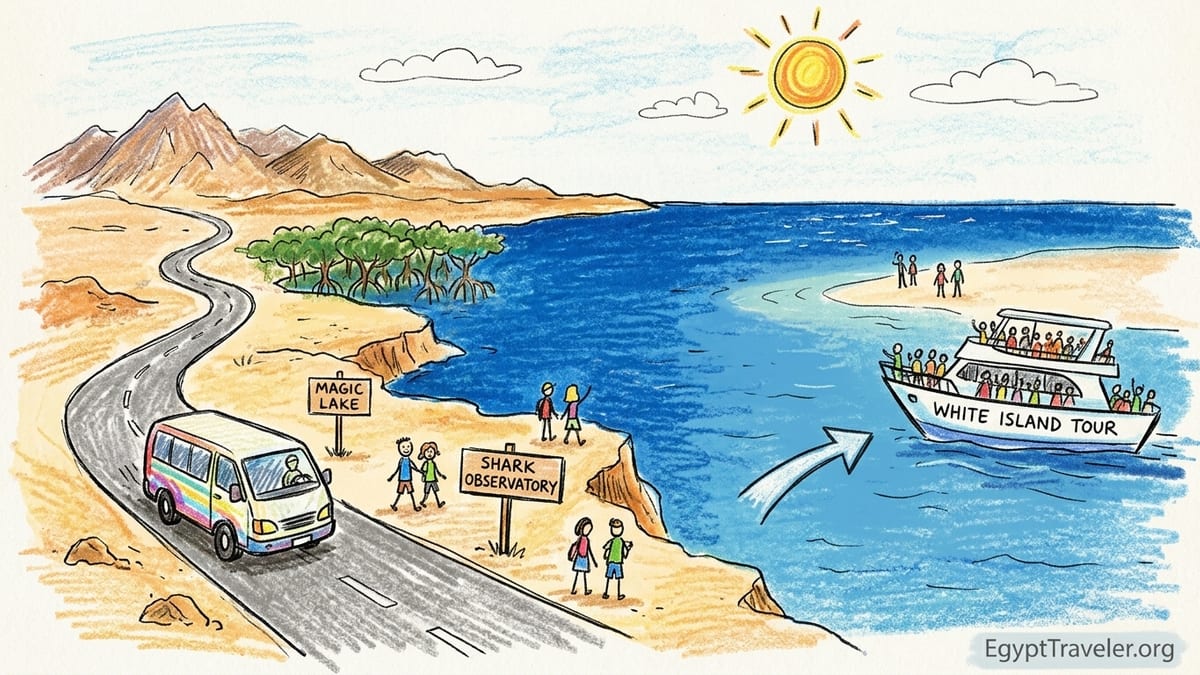
I had seen the dreamy photos of White Island long before I ever set foot in Sharm el-Sheikh: a crescent of sand in turquoise shallows, people posing in ankle-deep water with cruise-ship grins. When I finally booked a trip to Ras Mohammed National Park, I did something different. Instead of another full-day boat to the tidal sandbank, I chose a road excursion that stayed almost entirely on land, tracing the protected headland itself from desert cliffs down to mangrove channels and shore-access reefs. It turned out to be the only way I really understood why Ras Mohammed matters as a national park rather than just a pretty backdrop for social media.
Leaving Sharm by Road Instead of Chasing the Sandbank
My day started in Sharm el-Sheikh’s hotel zone just after 8:00 in the morning, when a shared minibus pulled up outside the lobby. I had booked a Ras Mohammed National Park by bus tour through a local operator that focuses specifically on the land route, similar in structure to the six-hour excursions advertised by companies such as Discovery Tours and Haqqi Tours. The selling point was clear: we would drive between lookouts, mangroves, the desert fissure and the so-called Magic Lake, with shore snorkeling from a beach inside the park, instead of spending most of the day on a boat that might or might not land on White Island, depending on tides and sea conditions.
The minibus was air-conditioned and licensed for park access, with a guide who carried the necessary paperwork. Independent self-drive in rental cars is technically possible for some visitors, but access regulations and the need to pay park and vehicle fees at the gate mean that most travelers still come either with an organized bus excursion or through a cruise-line coach. Our group was a mix of couples and families, twelve people in total, which felt small enough that we could ask questions and linger at viewpoints without being herded on and off a large coach.
From the hotel belt near Naama Bay, it took roughly an hour to reach the main Ras Mohammed gate at the southern tip of the Sinai Peninsula. Here the desert drops away to the sea in two directions: the Gulf of Suez to the west and the Gulf of Aqaba to the east. That double-coast position is one of the reasons the area was set aside as a national park in the 1980s, combining marine and terrestrial protection at the point where two gulfs, different water masses and migratory routes meet.
At the gate our guide handled the formalities. Current information from the Egyptian Environmental Affairs Agency indicates that foreign visitors pay around 5 US dollars per person and a similar amount per vehicle, with higher rates for buses and camping and recent decisions to adjust fees still being phased in for some South Sinai parks. The exact amount we paid was just under the equivalent of 10 US dollars per adult including both personal and transport components, folded into the tour price and shown itemized on the receipt. It was a modest sum for entry into one of Egypt’s most famous protected areas, but also a reminder that the national park is not simply a backdrop for excursions; it is a managed conservation area that relies partly on these fees.
Shark Observatory and the Meeting of Gulfs
Our first major stop was the Shark Observatory, reached after a short drive along a paved road. Nothing about it resembles an aquarium viewing tunnel. Instead we climbed a set of concrete steps up a fossilized coral cliff until the land simply stopped and the view dropped into blue. Below us the Gulf of Suez spread like a sheet of ink, and far down the wall we could see the pale shadow of the fringing reef. On calm days, guides say you sometimes spot sharks cruising along the drop-off. The sea was ruffled when we were there, so any moving shape was quickly swallowed by glare, but the scale of the reef wall was memorable enough without wildlife cameos.
Standing there, my guide used the view to explain why Ras Mohammed is so significant ecologically. To the west, the Gulf of Suez is shallower and oil shipping passes up toward the canal. To the east, beyond the low hills, the Gulf of Aqaba plunges to great depths close to shore. Ras Mohammed sits like a wedge between them. Corals cling to steep walls where cooler, deeper water rises and mixes with the warmer layers on top. Those reefs support fish populations that spill out into both gulfs. At the same time, the headland acts as a flyway stop for migratory birds that follow the Red Sea corridor between Africa and Eurasia.
From Shark Observatory the contrast between desert and sea is almost violent. Behind the viewpoint, the land is all chalky beige, scattered with fossil coral and soft sand. Ahead of it, the water turns from transparent turquoise over the reef flat to deep ultramarine over the drop-off in just a few meters. There are no palm trees here, no cafes, no changing cabins. The park regulations, posted at various points and reflected in official documents, prohibit collecting corals or shells, feeding fish or straying off designated tracks. The absence of beach infrastructure is not an oversight, it is a deliberate choice to keep human impact under control in one of the Red Sea’s most heavily visited protected areas.
We stayed around 25 minutes, which felt reasonable, though the operator’s advertising promised “up to 40 minutes” at the viewpoint. Some of that difference came from our own group’s timing: a few late risers had delayed hotel pickup, and the guide clearly wanted to protect time at the lake and beach later in the day. It was my first small reminder that printed itineraries should be read as outlines, not precise promises, especially when grouped transport and park regulations are involved.
The Desert Fissure and Earth in Motion
From the high cliff we drove inland over gently undulating desert towards one of Ras Mohammed’s more unlikely attractions: a narrow geological fissure in the ground, often called the “earthquake crack” in tour brochures. It is not as dramatic as the marketing photos suggest, but it is a striking physical reminder that the Sinai is not fixed rock but an area where tectonic plates meet and pull apart.
The fissure sits in a flat section of desert where the ground appears to have been split open along a fracture line. We walked carefully to the edge and looked down into a chasm only a few meters wide but significantly deeper than it appears in photographs. Inside, layers of rock tilted at angles spoke of slow crustal movements over time. Our guide explained that the crack is linked to movements along the Gulf of Aqaba, itself part of the larger rift system that separates the African and Arabian plates. The story may be simplified for tourists, but the basic principle is real: this dry, silent landscape is shaped by forces that also defined the deep gulfs framing the park.
Unlike some heavily developed viewpoints elsewhere in the region, there are no railings here, only painted markers and a rope barrier set back from the edge. We were asked to keep to a defined path and to avoid throwing anything into the crack. It was a small example of how lightly managed many of Ras Mohammed’s land attractions still are. A carelessly tossed plastic bottle or a stone dislodged by someone climbing down for a photo would stay there a very long time.
We spent roughly 15 minutes at the fissure, almost exactly matching the operator’s stated schedule. It does not sound like much, but in the fierce late-morning sun it was enough. By this point I was grateful for the closed-toe walking shoes I had chosen instead of open sandals. The ground is a mix of compacted sand and small stones, and even in October the heat radiating up from it made the idea of thin flip-flops feel unwise. Anyone planning a similar land tour should treat this as a short desert walk, not just a bus stop.
Magic Lake and the Myth of Miraculous Waters
From the fissure we descended towards a shoreline hollow that holds one of Ras Mohammed’s most photographed sights: a hyper-saline lagoon that tour operators usually call Magic Lake. From above it resembles an oval of intense blue-green glass sunk into the beige desert, fringed by a coarse sandy beach and low rock ledges. Environmental descriptions refer to it as a very salty coastal lagoon connected to the Red Sea, with limited water exchange and high evaporation. That combination concentrates salt and gives the water its particular color and buoyancy.
As we walked down to the shore, our guide mentioned some of the stories that float around the lake. Some claim that swimming there will change your life, that if you make a wish and hold your breath you will somehow reset your fortune, or that the lake constantly shifts among several colors throughout the day. There is a grain of truth to the last point: changing sun angles affect the way the water reflects and absorbs light, so the color does soften and deepen as the day passes. But there is nothing supernatural about it, and no scientific evidence suggests that the water has any healing properties beyond what you would expect from a warm, salty swim.
The reality is more grounded but still enjoyable. The salinity makes floating relatively easy, a bit like the more famous experience at the Dead Sea but on a much smaller, quieter scale. I waded in from the sandy edge, feeling the water thicken slightly around my skin. We had been explicitly told not to apply sunscreen immediately before entering the lake, to reduce the amount of oils and chemicals entering this closed system. There are no showers here to rinse off, which reinforces the need to come into the water as clean as possible and to avoid staying in too long if you have sensitive skin.
The stop at Magic Lake was advertised as 45 to 60 minutes with an opportunity to swim or snorkel. In practice we spent about 40 minutes. That was comfortable for a leisurely swim and a slow walk along the shore to appreciate how the basin is carved into old coral terraces. There were no fish to see comparable to the offshore reefs, so the short snorkeling session some in our group attempted felt more like a novelty than a serious marine experience. For me, the real attraction here was the contrast between this enclosed bowl of gleaming water and the open gulfs visible from other parts of the park.
Mangroves at the Edge of the Desert
From Magic Lake we drove west toward a low-lying coastal strip where the desert meets another, very different type of ecosystem: a mangrove channel. Ras Mohammed shelters stands of Avicennia marina mangroves, among the northernmost naturally occurring mangroves in the Red Sea. These salt-tolerant trees filter seawater at their roots and play an outsized role in stabilizing shorelines and providing habitat for juvenile fish and invertebrates.
The first impression was almost surreal after the stark cliffs and bare sand. A tangle of grey-green roots and branches rose out of shallow water, dotted with fiddler crabs that vanished the moment a shadow crossed them. Our guide explained that the trees cope with salt by excreting it through their leaves and roots, and that the thick mats of roots trap sediment that would otherwise be washed away. Standing quietly and watching the water around the roots, I could see tiny fish flicker in and out of the shadows. For them, this is a nursery ground, a safe in-between zone before they swim out to the deeper reefs.
We were not allowed to enter the water here and signs asked visitors to stay on a defined boardwalk and compacted path. Stepping on the soft intertidal mud or leaning on the trees would damage the roots and compress the habitat. The restrictions might frustrate those who see every new scenic spot as a place to paddle, but they are exactly what make a land-based visit to Ras Mohammed valuable: you begin to see the park as an integrated system where mangroves, shorelines, lagoons and reefs work together rather than as a set of unconnected photo stops.
This part of the tour took around 20 minutes. No one complained. By early afternoon the sun was high and there is almost no shade apart from the minibus itself. Our guide insisted that everyone finish at least one large bottle of water by this point and reminded us that dehydration is one of the most common problems for visitors who underestimate the combination of heat, salt and excitement. The tour price included bottled water and a simple lunch box, but anyone prone to overheating would be wise to bring extra fluids and an electrolyte drink.
Shore Reefs, Snorkeling Access and Safety on Land Tours
Snorkeling was not the central focus of this road-based day, but it did feature, and how it was managed said a lot about Ras Mohammed’s regulations. Our final major stop inside the park was at a designated beach area with access to a fringing reef, similar in layout to Marsa Bareika or Marsa Ghozlani, where operators that specialize in land tours often take their guests for shore entry.
The rules were clear from the start. Our guide, working with a licensed snorkeling instructor, briefed us on the layout: sand entry on a marked corridor, then a swim of about fifty meters over seagrass and patchy coral heads before reaching the main drop-off. We were told not to stand on any coral, not to chase turtles or fish, and to follow the buoy line that kept swimmers away from the shallowest, most fragile sections. Life jackets were available for those who were not confident swimmers, and anyone entering the water had to do so within sight of the guide.
These measures align with Egyptian guidelines that snorkeling and diving in national parks should be conducted through licensed operations with qualified supervisors, a response to past incidents where unsupervised swimmers were injured. On our visit the sea state was moderate, with a light current running along the reef. It was easy enough for average swimmers but clearly not the place to learn from scratch without guidance. I watched several people in the group who had come mostly for the land scenery decide to stay waist-deep near the shore, which felt wiser than forcing themselves to the outer wall.
For those of us who did swim out, the reward was immediate. Even in a relatively short session of twenty to thirty minutes, I saw parrotfish crunching at algae on the coral, a pair of masked butterflyfish weaving in and out of branching structures, and the shadow of a larger jack passing below in the deeper blue. Compared with the classic boat tours that advertise three open-water reef stops of up to ninety minutes each, this was modest, but it fit the rhythm of the day. We had come to see how the reef connects with the desert, not to log maximum snorkel hours.
Back on shore, the lack of permanent facilities mattered again. There were basic toilets and a shaded picnic shelter but no freshwater showers. Those who had rented snorkeling equipment from Sharm-based shops had to rinse their masks and fins with bottled water. My operator had included mask, snorkel and fins in the tour price, with the option to rent wetsuits at an extra charge from a partner shop in town. That packaged arrangement is worth looking for if you do not want to carry wet gear back to a hotel with carpeted rooms.
Road Excursion Versus White Island Boat Trips
Spending a full day on the road inside Ras Mohammed highlighted just how different this experience is from the heavily marketed boat excursions to White Island. Boat trips, often branded as “Ras Mohammed and White Island,” typically involve a bus transfer to Sharm’s port, followed by a day at sea with two or three snorkeling stops and, tide permitting, a visit to the White Island sandbank. The island itself is not a fixed landmass but a shallow sand formation that appears at low tide and may vanish almost completely at high tide, which means that no operator can guarantee the precise look or duration of the stop on a given day.
On several company descriptions I checked before booking, the White Island landing was advertised as “up to one hour on the sandbank” or “around 45 minutes, depending on conditions,” with the rest of the eight-hour day devoted to sailing and reef snorkeling. Some honest operators note that on windy days or when tides are unfavorable, you may only circle the area or swim in deeper water nearby, and that there are no facilities on the sand itself. In other words, a White Island boat day is primarily a marine excursion with the sandbank as one highlight, not a tour of the terrestrial park.
By contrast, our land tour barely mentioned White Island except to clarify what it is and what it is not. We could see the general offshore area from certain viewpoints along the coast, a paler patch of water where waves broke over the sand, but it was very much in the background. The focus stayed on the headland’s geology, lagoons and mangroves, and on short walks that tied those elements together. For travelers who have already dived or snorkeled elsewhere on the Red Sea, or who simply prefer to be on solid ground, this difference in emphasis is crucial.
Another point of contrast lies in how time gets distributed. Our operator had promised around six hours from hotel pickup to drop-off, with three major stops and several shorter ones. That matched reality almost exactly; we left just after 8:00 and were back a little after 2:00 in the afternoon. Friends who booked White Island boat days, on the other hand, reported nine-hour commitments that included long transfers and port waiting times, even when actual snorkeling time was not dramatically longer. Neither is objectively better, but they are not interchangeable experiences, and marketing that blends them under a single “Ras Mohammed trip” label can easily mislead first-timers.
Practicalities: Costs, Comfort and What I Actually Paid For
The financial and practical side of a land-based Ras Mohammed visit is worth detailing, because glossy brochures rarely show the breakdown. In late 2026, shared minibus tours from Sharm advertising the combination of Shark Observatory, Magic Lake, the fissure, mangroves and a shore snorkel were generally priced in the range of 20 to 35 US dollars per adult, depending on group size and whether lunch and equipment were included. My own booking sat just under the midpoint of that range and specified that the national park entrance and vehicle fees, guiding, bottled water and a simple boxed lunch were covered. Snorkeling gear added a small supplement for those who needed it.
Comparative listings for boat trips during the same period showed full-day Ras Mohammed and White Island yacht excursions for roughly 26 to 35 US dollars per adult, including lunch and basic snorkeling equipment but often excluding the park fee, which was paid in cash at the port or on board. At first glance the prices seem similar, but the value proposition changes if you consider what you personally want from the day: hours in the water on a boat, or a stitched-together picture of the park’s land and sea from multiple short stops.
The environmental fees may feel like small print, yet they are important. Official documentation from Egypt’s environmental authorities confirms a fee structure for individuals and vehicles entering Ras Mohammed, usually charged per day and valid from sunrise to sunset. On our tour, the guide collected our passports at the gate and handled the tickets. No one was asked to pay anything extra on the spot, which suggests that the operator had calculated the fees into the package instead of dangling a lower headline price and passing the park cost to guests on arrival.
Comfort-wise, a road excursion demands slightly different preparation from a boat day. Sun exposure is relentless when you are stepping in and out of the minibus into open desert, so a broad-brimmed hat, high-SPF sunscreen applied well before swimming, and lightweight long sleeves made a noticeable difference for me. For footwear, solid walking shoes or sports sandals are far more useful than flimsy flip-flops, given the rocky ground at Shark Observatory and around the fissure. In terms of food, expect a simple cold lunch on a land tour, versus a hot buffet on many boats. Anyone with specific dietary needs should confirm provisions with the operator in advance or bring their own snacks.
The Takeaway
By the time we drove back past the park gate and out onto the highway toward Sharm, Ras Mohammed had shifted in my mind from a postcard of reefs and a tidal sandbank to a layered landscape stitched together by geology and water. The reefs were impressive during our limited snorkel, but what stayed with me most strongly was the combination of desert and sea: the abrupt cliff at Shark Observatory where land stopped and deep water began, the silent crack in the ground hinting at tectonic forces below, the improbable mangroves filtering salt at the very edge of aridity, and the concentrated blue of Magic Lake set into its pale basin.
If I had to choose one element as the most memorable, it would be that overall desert-and-sea scenery rather than a single reef or rock. The sense of standing in a place where two gulfs meet, where birds cross between continents and where corals, lagoons and dunes fold into each other, lingered longer than any individual fish sighting. I understood why the park was protected in the first place, beyond its current status as an excursion highlight.
Who, then, should opt for a land-based Ras Mohammed tour instead of the more heavily marketed White Island boat trips? In my view, travelers who are curious about ecosystems and geology, photographers who appreciate stark desert vistas, and anyone who prefers shorter swims and more walking will get far more out of a road day. It suits visitors who have already booked a separate dedicated snorkel or dive trip elsewhere, or those who feel unsteady on boats but still want to see what makes the southern tip of Sinai special.
White Island excursions still have their place. If your main priority is spending as much time as possible in the water, with extended snorkel stops on offshore reefs and a chance, conditions allowing, to wade across a photogenic sandbank, then a regulated boat trip with a reputable operator is the logical choice. But it should be understood for what it is: a marine-focused day that may include little or no contact with Ras Mohammed’s terrestrial landscapes. For a fuller, more grounded understanding of the park as a protected area where desert, mountains, mangroves and reefs meet at the junction of two gulfs, the land route that I followed from Sharm el-Sheikh remains the more revealing path.
FAQ
Q1. Is it possible to visit Ras Mohammed National Park on land without joining a tour?
Independent visits by private car are technically possible for some travelers, provided you comply with park regulations, pay entrance and vehicle fees at the gate and are comfortable navigating the roads yourself. However, many visitors find that a licensed land tour offers simpler logistics, structured stops at places like Shark Observatory, Magic Lake and the mangroves, and the added benefit of a guide who can interpret what you are seeing.
Q2. How much does it cost to enter Ras Mohammed National Park on a land excursion?
On my trip the park entry and vehicle fee came to just under the equivalent of 10 US dollars per adult, bundled into the overall tour price. Official information indicates that foreign visitors pay a per-person fee in US dollars along with a separate charge for cars, minibuses or buses. Exact amounts and how they are itemized can change, so it is worth asking your operator to confirm whether these environmental fees are included or payable in cash at the gate.
Q3. What should I wear for a land-based day in Ras Mohammed?
Expect strong sun, reflective sand and some uneven ground. Lightweight clothing that covers shoulders, a hat with a brim, sunglasses and high-factor sunscreen are all important. Closed shoes or sturdy sandals are better than flip-flops for climbing to Shark Observatory and walking around the desert fissure. Pack a swimsuit under your clothes or bring it along for swimming in Magic Lake or at the designated beach, plus a light towel that dries quickly.
Q4. Is there much snorkeling on a road excursion compared with a White Island boat trip?
A land-based Ras Mohammed tour usually treats snorkeling as one element among several, often with a single shore-entry session from a beach inside the park and an optional dip in Magic Lake. In contrast, White Island boat days are primarily about time in the water and may include two or three extended reef stops plus a sandbank landing if tides allow. If you want hours of snorkeling on offshore walls and pinnacles, a boat trip is more suitable. If you prefer shorter, supervised swims framed by walks and viewpoints, the land route is a better fit.
Q5. Are the stories about Magic Lake’s healing or color-changing water true?
Magic Lake’s appeal lies in its high salinity, protected setting and rich blue-green color, not in any proven supernatural properties. The water can appear to change shade throughout the day as the sun moves, but this is a simple effect of light and angle, not magic. There is no scientific evidence that the lake has special healing powers beyond the normal benefits and precautions associated with floating in warm, salty water.
Q6. Can I see wildlife on a land tour, or is everything underwater?
Most of Ras Mohammed’s famed biodiversity is underwater on the coral reefs, but the land route still offers glimpses of wildlife and important habitats. At the mangrove channel you may see fish fry sheltering among the roots and small crabs on the mud; in the sky, the park lies on the path of migratory birds that use the Sinai as a corridor between Africa and Eurasia. Reptiles and small mammals tend to stay hidden in the heat of the day, so any sightings on a short tour are a bonus rather than a guarantee.
Q7. How does the time at each stop compare to what operators advertise?
On my excursion, the operator advertised roughly 40 minutes at Shark Observatory, 45 to 60 minutes at Magic Lake and a similar amount at the beach, plus shorter visits to the fissure and mangroves. In practice we spent closer to 25 minutes at the viewpoint, about 40 minutes at the lake and just under an hour at the beach, with timings adjusted for group pace and weather. It is best to treat published schedules as approximate and to focus more on the overall mix of stops than on minute-by-minute promises.
Q8. Are there food and drink facilities inside Ras Mohammed?
Services inside the park are limited by design. On my visit there were basic toilets and a simple shaded area near the beach, but no cafes or shops at the main stops. Our tour included bottled water and a packed lunch, which we ate at one of the sheltered spots. Travelers who need specific foods, snacks for children or extra drinks should bring them from Sharm, bearing in mind that all waste must be packed out or disposed of properly in the park’s bins.
Q9. Is a land tour suitable for families with children?
Families with school-age children who can cope with heat and short walks often enjoy the variety of a land tour, from climbing to Shark Observatory to paddling in Magic Lake. Parents should be prepared for high temperatures, minimal shade and basic facilities, and may want to bring extra water, sun-protective clothing and simple activities to keep younger children occupied during the drives. For very small children or anyone who struggles with walking in soft sand and on rocky paths, a carefully chosen boat trip with shaded deck space may be more comfortable.
Q10. If I have time for only one Ras Mohammed experience, should I pick the land tour or the White Island boat trip?
The choice depends on your priorities. If your main goal is to snorkel or dive on offshore reefs and you like the idea of a tidal sandbank stop, a reputable Ras Mohammed and White Island boat trip makes sense. If you are more interested in understanding the park as a whole, seeing how desert, mangroves, lagoons and reefs fit together, and spending more time on your feet than on a deck, then a land-based excursion like the one I took will give you a deeper sense of place. Both are valid, but they offer very different ways of meeting Ras Mohammed.