


Egypt’s Red Sea Riviera actually means two quite different coasts. On the African mainland you have Hurghada, El Gouna, Sahl Hasheesh, Makadi Bay, Soma Bay, Safaga, El Quseir and Marsa Alam, stretched along hundreds of kilometres facing the Eastern Desert. Across the water on the Sinai Peninsula sit Sharm el-Sheikh and its bays, plus Dahab, Nuweiba and Taba. Where you choose to base yourself will shape everything from your flight options and visa to how you get into the sea each day, and even whether classic excursions such as Luxor are realistically possible.
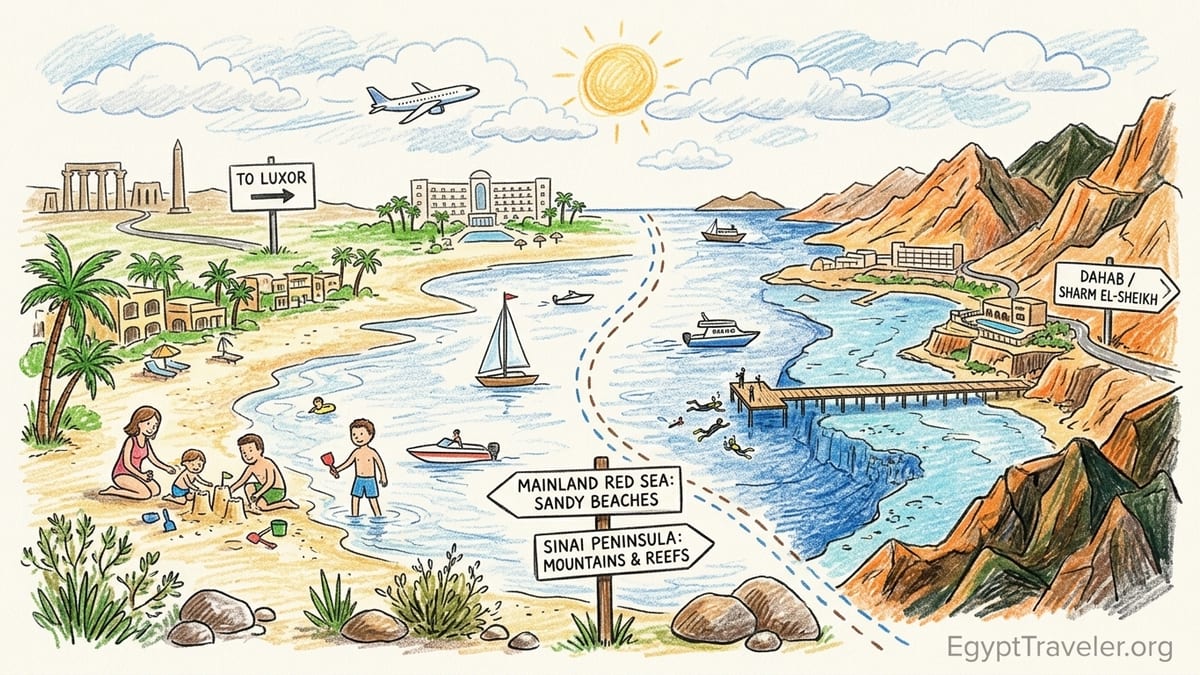
Mainland Red Sea vs Sinai: Two Very Different Coasts
The first big decision is whether to stay on the African mainland or on the Sinai Peninsula. Most classic Red Sea package resorts, including Hurghada, El Gouna, Sahl Hasheesh, Makadi Bay, Soma Bay, Safaga, El Quseir and Marsa Alam, line the mainland coast south of Hurghada International Airport. This side works best if you want easier access to Nile Valley highlights such as Luxor, which can be visited on a long but manageable day trip from Hurghada-area resorts by road or domestic flight.
The Sinai Peninsula, by contrast, centres on Sharm el-Sheikh and its string of separate bays, along with Dahab, Nuweiba and Taba along the Gulf of Aqaba. These destinations face dramatic mountain backdrops and some of Egypt’s most famous dive sites around Ras Mohammed and the Straits of Tiran. However, once you commit to Sinai you are effectively separated from mainland Egypt by the Gulf of Suez and long overland distances. A side-trip from Sharm or Dahab to Luxor or Aswan usually means a domestic flight via Cairo rather than a straightforward road excursion.
Getting this regional choice wrong can quietly steal entire days from your holiday. For example, combining a one-week stay in Dahab with a wish-list visit to Luxor and the Valley of the Kings would involve at least two early-morning airport transfers, a flight connection in Cairo each way and a night or more away from the Red Sea. By comparison, staying in Hurghada or Makadi Bay typically allows a pre-dawn coach to Luxor, a full day of temples and tombs, and a late evening return, all from the same beach hotel.
Climate and sea conditions also differ slightly. Mainland resorts around Hurghada tend to have broader natural beaches and more options for gradual sandy entry, while many Sinai bays sit directly on fringing coral reef where access to swimmable depth is via floating jetties. Wind exposure also shifts as you move north or south. This matters if you are planning to learn to snorkel with children, want waist-deep lagoons for kitesurfing, or prefer glassy-calm water over rolling chop.
Understanding Beach Types: Sand, Lagoon or Jetty-over-Reef
Before comparing specific resorts, it helps to understand three basic Red Sea beach types you will encounter across Egypt’s Riviera. The first is a classic sandy entry beach where you can walk straight from soft sand into shallow water that gradually deepens. Parts of Hurghada’s city shoreline, sections of Makadi Bay and Sahl Hasheesh, and some family-focused hotels in El Gouna and Safaga offer this style of beach. It suits small children, less confident swimmers and anyone who wants to wade or paddle rather than jump straight into deep water.
The second type is a shallow lagoon, usually man-made or modified, often backed by hotels, villas and marinas. El Gouna’s entire resort town is built around a network of lagoons rather than one continuous open beach. Inside these lagoons, water is usually calm with limited waves, which is excellent for stand-up paddleboarding and for beginners trying kitesurfing on waist-deep sandbars. The trade-off is that you may need to take a boat or walk to an outer reef for serious snorkeling in clear water with abundant coral.
The third and most common along reef-heavy stretches is a fringing coral reef accessed by jetty. This is typical in Sharm el-Sheikh’s Sharks Bay, many Nabq resorts, and the cliff-backed Hadaba/Ras Um Sid area, as well as at certain Marsa Alam eco-villages. The shoreline here is often rocky or covered in living coral heads, which must not be walked on. Hotels build floating pontoons that extend beyond the shallow reef flat into deep blue water, where you descend metal ladders straight into several metres of depth above the drop-off. The reward is immediate access to rich marine life, but there is no ankle-deep paddling and currents can sometimes be strong.
When you compare potential bases, picture how you actually like to use the sea. A family with toddlers might be far happier in Makadi Bay, where several hotels have broad sandy entries, than at a Nabq resort where every swim involves a long walk down a jetty and a sudden step into deep water. Serious snorkelers may prefer the jetty-and-reef model at Hadaba or Marsa Alam, where you can drift over intact coral gardens within minutes of leaving your sunbed.
Hurghada, El Gouna and Nearby Bays: Mainland All-Rounders
Hurghada remains the main gateway to Egypt’s central Red Sea and one of the country’s busiest tourist hubs. The international airport lies a short drive from most city hotels and from out-of-town bays like Sahl Hasheesh and Makadi. Within Hurghada itself you find a spread of large all-inclusive resorts on the southern beaches and a more urban mix of mid-range hotels and apartments in the city, particularly around the Marina, Sheraton Road and El Dahar neighbourhoods. This is one of the few Red Sea areas where you can combine resort facilities with a genuine Egyptian city outside the gates, complete with local cafés, fruit markets and everyday shops.
Typical winter room rates in Hurghada show its broad range. It is often possible to find reputable mid-range all-inclusive resorts around the southern beaches for moderate nightly prices per couple, while high-end properties and boutique options along the coastline climb higher. Because competition is intense, Hurghada frequently offers some of the best-value bundles of flights plus hotel on the entire Riviera, which makes it attractive for first-time visitors and families watching costs.
El Gouna, about half an hour north of Hurghada airport, is a planned lagoon town with its own small private airstrip, marinas, golf course and an internal shuttle network of boats and tuk-tuks. The resort is known for its calm lagoon beaches, waterfront promenades and independent restaurants clustered around Abu Tig Marina and Downtown. Instead of one main strip, you hop between neighbourhoods where you might eat at an Italian trattoria one night, a Lebanese restaurant the next, then listen to live music in a marina bar. It suits travellers who like a tidy, controlled environment with good English signage and a social scene that does not depend wholly on hotel buffets.
South of Hurghada, Sahl Hasheesh, Makadi Bay and Soma Bay form a chain of self-contained resort zones. Sahl Hasheesh is an elegant master-planned bay with a long promenade, a small central piazza and calm water with easy house-reef snorkeling close to shore. Makadi Bay offers a cluster of mid-range and upper-mid-range hotels, many with sandy entries and nearby reefs that make an excellent first snorkel for children and beginners. Soma Bay pushes further into the desert and feels more remote; it is known for strong winds that attract kitesurfers and sailors as well as for a championship golf course and a dedicated diving lodge with easy boat access to offshore reefs.
Safaga, El Quseir and Marsa Alam: Quieter Reefs and Wildlife
Continuing south, Safaga, El Quseir and Marsa Alam appeal to travellers seeking quieter atmospheres and more time in nature. Safaga sits about an hour south of Hurghada airport and has long, wind-exposed beaches that attract kitesurfers and windsurfers. A handful of large resorts spread out along the shore, generally with competitive prices compared with the more famous bays closer to Hurghada. Evenings here are very low-key, often limited to hotel bars and a short stroll along the beach, which suits guests who prioritise daytime watersports over nightlife.
El Quseir lies further down the coast and mixes Red Sea resort life with a small historic town. Several beach hotels stretch north and south of town, some with broad sandy entries, others with house reefs accessible from short jetties. The town itself, with its old port and narrow streets, provides a glimpse of traditional Egyptian life that you rarely see from behind resort walls. Travellers sometimes take an inexpensive taxi into El Quseir to visit simple fish restaurants and local coffee houses before returning to modern beachside rooms.
Marsa Alam and the surrounding coastal strip mark the point where wilderness and reefs become the main attraction. While Marsa Alam has an airport, many travellers arrive via road transfers of around three hours from Hurghada to resorts and eco-villages scattered along the coast. Well-known marine sites in this region include bays where dugongs occasionally graze seagrass, offshore reefs frequented by green turtles and, with specialist operators, day trips to more remote spots that sometimes see spinner dolphins. Accommodation ranges from full-service resorts with family pools to more basic tented eco-camps where electricity is limited and the focus is entirely on diving, freediving and stargazing.
Because Marsa Alam’s reefs often drop into deep water close to shore, snorkeling can be spectacular, with hard coral gardens and frequent encounters with schooling fish just a short swim from the jetty. At the same time, these bases are isolated. Independent restaurant choices are usually confined to hotel outlets or simple roadside cafés, and nightlife rarely extends beyond a bar terrace under the stars. For wildlife-oriented travellers willing to trade shopping and bar-hopping for early-morning dives and quiet beaches, this is one of the most rewarding stretches of Egypt’s Red Sea.
Inside Sharm el-Sheikh: Naama Bay, Sharks Bay, Hadaba and Nabq
Sharm el-Sheikh is often described as one destination, but on the ground it is a string of distinct bays. Where you stay within Sharm will affect your beach type, nightlife options and even wind and wave conditions. Naama Bay sits roughly in the middle and has the most walkable environment, with a long pedestrian promenade lined by hotels, beach clubs, bars and independent restaurants. Here you can step out of a mid-range hotel and choose between Egyptian grills, fast-food chains, seafood places and shisha cafés without needing a taxi. Beaches are a mix of sandy entries and short jetties, and the atmosphere suits those who want a classic resort-strip feel.
Just north of Naama, Sharks Bay lies closer to the airport and offers a slightly quieter feel with better access to house reefs and the boat jetties for trips to the Straits of Tiran. Many hotels here are built on stepped terraces down to the sea, with jetty access over fringing reef into clear, relatively deep water. Nightlife is more hotel-centered, although a short taxi ride takes you to the small entertainment complex around SOHO Square, which has international restaurants, ice skating and music nights that appeal to families and couples alike.
South of Naama, the cliff-backed Hadaba and Ras Um Sid area focuses strongly on reef access. Hotels along this stretch typically sit atop low cliffs with stairways or elevators down to floating jetties, where you drop straight into excellent snorkeling. Local divers rate several Hadaba hotel reefs among the best accessible directly from accommodation in Sharm, with colorful walls of soft corals and frequent turtle and moray sightings. In the evenings you can take a short ride to Sharm’s Old Market, where local seafood restaurants and souvenir stands provide a more Egyptian-feeling alternative to Naama’s promenade.
Furthest out, Nabq Bay spreads along a long, shallow shoreline north of the main town. Many of Sharm’s largest all-inclusive resorts stand here, with wide sandy beaches and views across to Tiran Island, but much of the immediate shoreline is a protected marine area so swimming may involve walking over sandbars at low tide or using designated access channels. Nabq is noticeably windier than central Sharm, which kitesurfers welcome but can make winter sea dips feel cooler. Distances into Naama Bay or the Old Market are longer, so you should be comfortable with taxis or hotel shuttles if you want nights out beyond your resort.
Dahab, Nuweiba and Taba: Laid-back Sinai Alternatives
Two hours or so north of Sharm by road, Dahab has evolved from a backpacker hangout into a low-rise town that still feels far more independent than the big resort complexes. The seafront promenade in the Lighthouse and Mashraba areas is lined with small dive centres, cafés and family-run guesthouses. Many visitors stay for a week or longer, renting simple apartments or mid-range hotels and diving daily at shore sites such as the Canyon and Blue Hole with long-established local operators. Freediving, rock climbing in nearby wadis and yoga retreats add to the easy-going, long-stay atmosphere.
Beaches in Dahab are mixed. There are some small sandy patches suitable for paddling, but much of the shoreline is rocky with direct step-in access over stones into relatively deep water, especially at the main dive entrances. This works well for confident swimmers and divers who value flexibility to walk to the water with their gear, but is less ideal for families expecting resort-style beaches with sunbeds and shallow sand shelves. Instead, the appeal lies in the ability to stroll out in the evening for falafel or fresh fish from local grills, or to buy fruit juice from a stall between dives, all without needing hotel wristbands.
Nuweiba and Taba, further north along the Gulf of Aqaba coast, are quieter still. Accommodation is a mix of simple beach camps, mid-range hotels and a handful of larger resorts near Taba Heights. These areas attract repeat visitors from Egypt, Israel and Jordan who come for uncrowded beaches, long views of the mountains of Saudi Arabia across the water and a slow rhythm of swimming, reading and simple meals by the sea. Nightlife is minimal and many stays revolve around diving or snorkeling excursions paired with side trips to desert canyons and highland oases.
Because these northern Sinai resorts lie close to land borders, they are also used by some travellers as part of overland itineraries connecting Jordan’s Aqaba or Israel’s Eilat with Egypt. In that context, they can be pleasant, low-key stops at the beginning or end of a longer Middle East journey. For a straightforward one-destination beach holiday focused mainly on resort facilities and organized excursions, however, first-time visitors usually find Sharm or Hurghada-area bases more convenient.
Access, Excursions and Approximate Costs
From Europe and the Gulf, direct charter and scheduled flights serve Hurghada, Sharm el-Sheikh and, to a lesser extent, Marsa Alam. Hurghada functions as the main hub for mainland resorts, with road transfers ranging from 30 minutes to El Gouna or Sahl Hasheesh up to around three hours for more southerly Marsa Alam properties. Sharm serves Sharm’s own bays plus road-linked Dahab, Nuweiba and Taba. If you plan to divide time between mainland and Sinai, factor in either domestic flights via Cairo or a long overland route that crosses the Suez area, which usually adds at least a full day’s travel.
Luxor excursions are a key point of difference. From Hurghada, Makadi Bay or Safaga, tour operators routinely offer long day trips by coach that leave before dawn, spend several hours at Karnak Temple, Luxor Temple and the West Bank tombs, and return late evening. These are tiring but workable within a one-week stay. From Sharm, similar tours involve early domestic flights via Cairo or connecting journeys that can make the excursion both more expensive and more exhausting. If visiting the Nile Valley is a non-negotiable part of your trip, a mainland Red Sea base is usually the smarter choice.
Hotel prices vary widely by season, star rating and booking channel, but patterns emerge. In high winter season, El Gouna and Soma Bay often price slightly above comparable Hurghada and Makadi Bay resorts, reflecting their master-planned environments and added facilities such as golf courses and marinas. Sharm’s Naama Bay and Sharks Bay generally cost more per night than some large Nabq all-inclusives, where the trade-off is distance from town and greater wind exposure. Dahab’s small hotels and apartments can keep overall budgets lower for longer stays, especially for divers who prioritise simple rooms and spending more on daily dives.
Excursions and local spending also shape relative costs. A couple based in Naama Bay might dine several nights at independent restaurants, visit the Old Market by taxi and pay local dive centres for day boats to Ras Mohammed, which spreads their spending across multiple providers. A family in an all-inclusive Makadi Bay resort may spend less day-to-day but pay extra for a single big-ticket Luxor tour. Divers in Marsa Alam who opt for eco-lodges with full-board and unlimited house-reef access may find that, once transfers are included, their total cost for a very dive-focused week is not dramatically higher than a more mainstream Hurghada package.
Visas and the Sinai-only Entry Permission
Entry rules can influence where you base yourself, especially around Sinai. Many nationalities, including most citizens of the European Union, the United Kingdom and the United States, can obtain a standard 30-day Egyptian tourist visa either online through the official e-visa portal or on arrival at major airports such as Cairo, Hurghada and Sharm el-Sheikh. Fees and exact procedures are updated periodically, so it is important to check official government or embassy sources close to your departure date.
Alongside the regular visa, there is a separate South Sinai entry permission, sometimes called the Sinai-only stamp. For eligible nationalities arriving directly into South Sinai for short resort stays, border officials may grant a free entry stamp valid for up to about 14 or 15 days that allows travel only within designated Gulf of Aqaba and South Sinai coastal areas, including Sharm el-Sheikh, Dahab, Nuweiba, Taba and nearby inland sites such as St Katherine. This stamp does not permit onward travel to mainland Egypt or other regions beyond Sinai. Travellers using it cannot legally fly on to Cairo or Hurghada, nor take long overland routes out of Sinai, without first obtaining a full visa.
Whether you can use the Sinai-only entry permission depends on both your nationality and your itinerary. Some nationalities that require visas in advance for Egypt in general are not eligible for the free Sinai stamp and must hold a regular visa even to stay only in Sharm or Dahab. Others may technically qualify, but still choose to buy a full visa on arrival if they are considering last-minute trips outside Sinai, such as a Nile cruise or a visit to the pyramids near Cairo. Cruise passengers and travellers entering at certain ports can face slightly different procedures again.
If your plans include any movement beyond South Sinai, or if you are combining Sinai with mainland Red Sea resorts around Hurghada or Luxor, you should obtain a standard tourist visa rather than relying on a Sinai-only stamp. Travel industry guidance in 2025 and 2026 reinforces that liveaboard dive itineraries leaving Sinai waters, domestic flights to Cairo or Hurghada, and overland journeys beyond the Gulf of Aqaba coast all require the correct all-Egypt visa. Because rules can change with little notice and some nationalities face extra security checks, the safest approach is to confirm requirements with the Egyptian consulate or an official government portal well before you travel and again shortly before departure.
Choosing the Right Base: Families, Couples, Divers and Local Life
For families, especially with younger children or less confident swimmers, mainland bays with sandy-entry beaches usually work best. Makadi Bay and Sahl Hasheesh combine sheltered swimming, house-reef snorkeling close to the sand and a compact resort layout where everything is within a short walk. Several Hurghada city resorts also have gently shelving beaches paired with access to shopping centres and aquaparks. In Sharm, Naama Bay is the most practical choice if you want a promenade to stroll with pushchairs in the evening and a wide choice of restaurants beyond hotel buffets, although you should still check individual hotel beach setups carefully.
Couples who favour calmer, more upscale surroundings often gravitate to El Gouna, Soma Bay or selected Sharm bays. El Gouna offers stylish lagoon-front and marina hotels where you can spend days moving between cafés, beach clubs and boat trips without feeling confined to a single property. Soma Bay, with its golf course, thalassotherapy centre and good kitesurfing conditions, appeals to active couples who enjoy both spa time and watersports. In Sharm, Sharks Bay and parts of Hadaba combine strong reef access with quieter evenings, while Naama’s central strip suits those who enjoy more nightlife.
Divers and dedicated snorkelers should weigh Marsa Alam, Hadaba/Ras Um Sid and Dahab particularly carefully. Marsa Alam is strongest for wildlife-oriented reefs, with regular sightings of turtles and, with the right operator, the possibility of dugongs and offshore pelagic encounters. Sharm’s Hadaba area gives daily access to vibrant hotel house reefs and short boat rides to Ras Mohammed and Tiran. Dahab attracts independent divers who prefer shore entries, multiple small dive centres and the option to stay for two or three weeks, combining advanced dive training with a relaxed town atmosphere and affordable apartments.
Travellers who want more local life outside resort compounds tend to be happiest in Hurghada city, El Quseir, Dahab or central Sharm rather than in fully gated zones. In Hurghada you can take local minibuses, browse fruit and spice stalls in El Dahar, or spend evenings at the Marina without leaving the urban fabric. El Quseir offers an authentic small-town feel alongside resort comfort, while Dahab’s cafés and dive shops blur into the daily life of residents and long-stay expats. In Sharm, Naama Bay and the Old Market provide at least some sense of being in a broader town rather than a single island-like resort.
First-time visitors with a one-week holiday and no fixed diving agenda usually find that Hurghada, Makadi Bay, Naama Bay or El Gouna strike the best balance. These places have straightforward airport access, a wide range of hotel prices, established excursion infrastructure for desert trips and boat days, and enough choice of independent restaurants to vary your evenings. Once you know whether you prefer sandy paddling beaches, jetty-over-reef snorkeling or calm lagoons, you can fine-tune future visits towards more specialized hubs like Soma Bay for wind, Marsa Alam for wildlife, or Dahab for long-stay diving and climbing.
FAQ
Q1. Is Hurghada or Sharm el-Sheikh better for a first Red Sea holiday?
Both work well, but Hurghada is often better if you want the option of a day trip to Luxor and a wider choice of hotel prices, while Sharm excels for easy access to famous dive sites like Ras Mohammed and the Straits of Tiran. Your decision should mainly depend on whether Nile Valley excursions or Sinai’s reefs matter more to you.
Q2. Which Red Sea areas have the easiest sandy-entry beaches for children?
Mainland bays such as parts of Hurghada, Makadi Bay, Sahl Hasheesh and some Safaga resorts offer broad sandy entries where you can walk gradually into the water. In Sharm, beach conditions vary by hotel, but Naama Bay and some Nabq stretches have more sand underfoot than the jetty-only cliffs of Hadaba.
Q3. Where is best to stay if I want to visit Luxor as a day trip?
Choose a mainland base around Hurghada, Makadi Bay or Safaga, which are connected to Luxor by long but regular coach excursions and, in some seasons, domestic flights. From Sharm, Dahab or Marsa Alam, reaching Luxor usually involves extra flights or overnight stays, which makes it harder to fit into a short beach break.
Q4. Is Dahab suitable for families, or only for divers and backpackers?
Dahab can work for adventurous families with older children who are confident in the water and happy with simple, low-rise accommodation. However, it does not offer the broad sandy resort beaches, kids’ clubs and large pool complexes that you find in Hurghada, Makadi Bay or many Sharm resorts.
Q5. Do I need a full Egyptian visa if I am only staying in Sharm el-Sheikh?
Some nationalities can receive a free short-stay Sinai-only entry permission if they arrive directly into South Sinai and remain within its coastal resorts. If you plan to travel outside Sinai or your nationality is not eligible for the Sinai stamp, you will need a standard Egyptian tourist visa. Always confirm current rules with official sources before you travel.
Q6. Which area is best for kitesurfing and wind sports?
El Gouna, Safaga and Soma Bay on the mainland, and windier stretches of Nabq in Sharm, are all popular with kiters and windsurfers. They combine reliable wind with shallow training areas or wide beaches, though facilities and crowding differ between specific kite centres and hotels.
Q7. Where should serious snorkelers and divers base themselves on the Red Sea Riviera?
If rich reefs are your main goal, consider Marsa Alam for wildlife-oriented diving, Sharm’s Hadaba or Sharks Bay for daily access to reefs plus boat trips to Ras Mohammed and Tiran, or Dahab for independent shore diving and longer stays. Hurghada, Makadi Bay and Soma Bay also offer strong diving infrastructures with many PADI and SSI centres.
Q8. Are mainland resorts or Sinai better for a quieter, low-key escape?
Quieter options exist on both coasts. On the mainland, El Quseir and much of the Marsa Alam region feel far removed from city life. In Sinai, Nuweiba, Taba and some smaller corners of Dahab offer simple beach camps and low-rise hotels where evenings revolve around the sea and the stars rather than nightlife.
Q9. How do hotel prices compare between Hurghada, El Gouna and Soma Bay?
Hurghada usually offers the broadest range and some of the lowest per-night prices, especially in larger all-inclusive resorts. El Gouna and Soma Bay tend to price somewhat higher for comparable star ratings, reflecting their planned environments, marinas, golf and spa facilities, though off-season and early-booking deals can narrow the gap.
Q10. If I mainly want local life and independent restaurants, where should I stay?
Hurghada city, El Gouna, Dahab and central Sharm around Naama Bay are the strongest choices. All four offer promenades or town centres with Egyptian cafés, seafood places, street food and small shops, so you can step beyond the hotel gate and explore on foot in the evenings.