


The Red Sea has a well-earned reputation for coral walls, warm water and teeming fish life, but many guides skip the practical details that matter once you are standing on the beach in a mask and fins. This guide focuses on how to actually snorkel Egypt’s Red Sea: where you can walk in from shore, which reefs require a boat, what kind of marine life to expect and how to stay safe while protecting fragile habitats. It covers the main resort zones around Hurghada and Marsa Alam, as well as key Sinai sites such as Ras Mohammed and Dahab, and gives special attention to Abu Dabbab Bay, famous for turtles and the possibility, never the guarantee, of seeing a dugong.
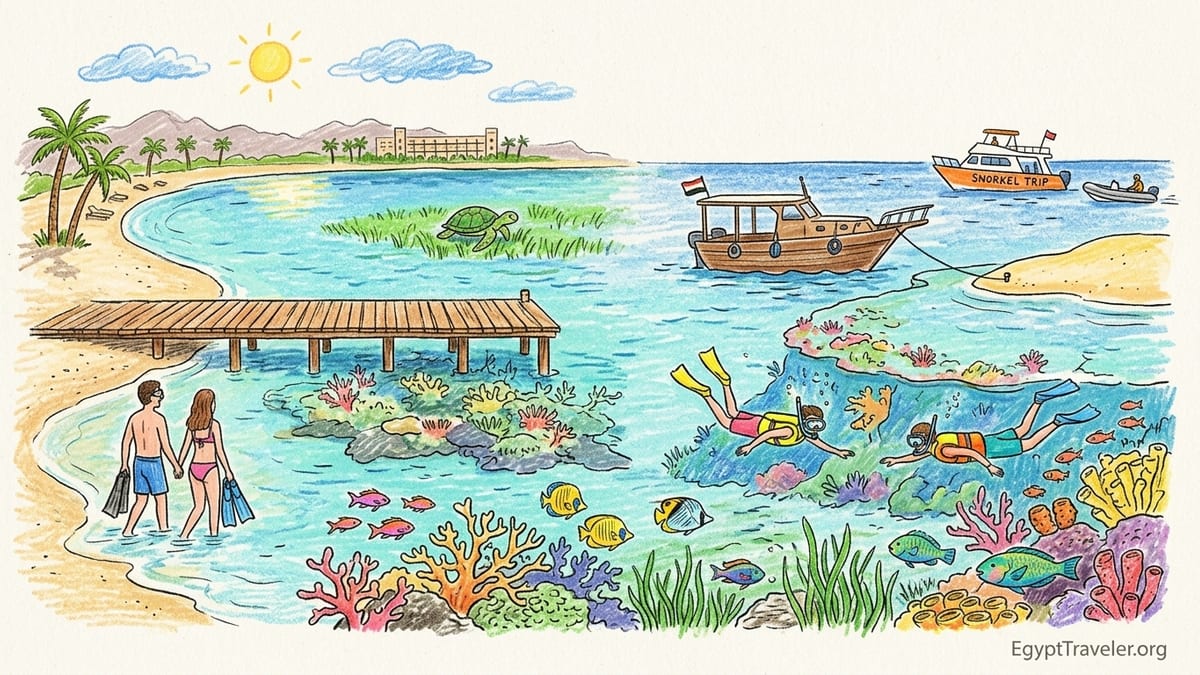
How the Red Sea Snorkeling Experience Works
Snorkeling in Egypt usually fits into three categories. Around many resorts you enter directly from a beach or via a jetty that drops you at the edge of a fringing reef. In other areas, especially islands off Hurghada and offshore reefs in Sinai, you reach coral shelves by boat. Finally, there are specialist wildlife habitats, such as seagrass bays where green turtles graze or offshore walls where pelagic fish may appear. Understanding which category a site belongs to helps you match it to your swimming ability, comfort with waves and expectations for what you might see.
Water entry is a key difference between regions. In older resorts such as Sharm el Sheikh and some parts of Hurghada, coral grows right up to the shoreline. To avoid trampling the reef, hotels install long floating jetties that may close during strong winds or heavy swell. Families with small children sometimes find this limiting. By contrast, several bays around Marsa Alam and southern Hurghada have sandy entries where you can walk out through shallow water before reaching the coral drop-off, which is easier for cautious swimmers.
Currents in the Red Sea are variable. Sheltered bays and lagoons can feel almost pool-like on calm days, while exposed headlands and outer reefs may have noticeable drift. Conditions also change with seasons and weather systems. Even experienced snorkelers should listen to local briefings and stay within designated areas, since some famous sites are deliberately zoned so that strong currents flow past, rather than through, swimming zones.
Finally, it is important to separate marketing promises from marine reality. Operators may highlight turtles, dolphins or dugongs in their brochures, but wild animals move on their own schedule. Some bays, such as Abu Dabbab and Marsa Mubarak near Marsa Alam, do have genuinely high chances of turtle sightings, yet no responsible guide can guarantee encounters. Thinking in terms of “good habitat where turtles are often seen” is far more accurate than expecting specific animals on demand.
Shore-Access Snorkeling Around Hurghada and Marsa Alam
Between Hurghada and Safaga, hotel house reefs dominate the snorkeling experience. In Sahl Hasheesh and Makadi Bay, many resorts are fronted by shallow lagoons with patch reefs and sandy corridors where novice snorkelers can stand if they become uncomfortable. Guests usually enter from the beach and fin slowly toward darker blue areas where coral heads cluster and reef fish become more abundant. Day visitors can sometimes buy a beach pass from hotel reception, but access policies change frequently, so it is wise to confirm directly with a chosen property before planning around its reef.
Farther south, Soma Bay has earned a quieter reputation. Its headland shelters a series of fringing reefs reached by long wooden jetties. Several dive centers here, including well-established international operators, welcome snorkelers on guided house-reef sessions. This is a good middle ground for confident swimmers who prefer to avoid crowded island boats yet still want drop-off reefs with clear water and decent coral. Entry is usually via ladder at the jetty’s end, which can feel exposed in wind, so it suits people comfortable swimming in open water with fins.
Around Marsa Alam, shore-access snorkeling becomes even more interesting. Many small bays, locally known as “marsa,” combine sandy entries with seagrass meadows and outer coral gardens. Marsa Shagra, north of Marsa Alam town, is one of the best-known examples. It is run as a dedicated eco-camp with strict house-reef rules and is usually reserved for in-house guests and pre-booked day users who pay for access, equipment and guiding. The central lagoon has an easy sand-bottom entry and gentle slopes, while the north and south reefs drop into deeper water with more dramatic coral and occasional turtles. Because of the camp’s managed access, this is not a casual walk-up option but an excellent choice if you plan your stay around snorkeling or diving.
Other Marsa Alam hotel house reefs, particularly around Coraya Bay and along the coastal strip north of the town, show a similar pattern. Guests snorkel directly from resort jetties over coral shelves that quickly turn into walls. Some resorts occasionally sell day-use passes that include reef access, but availability can depend on occupancy and season. If you are staying elsewhere and want to sample a specific house reef, it is better to email the hotel or its on-site dive center in advance than rely on turning up at the gate.
Boat-Access Reefs and Island Trips off Hurghada and Sinai
In Hurghada, some of the most talked-about excursions are to Giftun Island and its satellite beach clubs such as Orange Bay and Mahmya. Boats typically depart from Hurghada Marina or nearby piers for a full-day trip that includes two or three snorkeling stops over reefs, plus time ashore on a sandy island or sandbar. Prices in late 2026 commonly start from a modest amount per person on shared boats, while higher-end or smaller-group options cost more but can feel less crowded. The snorkeling quality on the outer Giftun reefs is generally good, with hard corals, bright anthias and abundant butterflyfish, though specific sites vary by operator and conditions.
Orange Bay itself is often marketed for its photogenic turquoise shallows and wooden cabanas rather than exceptional coral. The main swimming area in front of the beach is mostly sand with scattered patches of seagrass, ideal for paddling and relaxed floating but not for serious reef exploration. Actual snorkeling tends to happen at separate reef stops before or after the island visit. Mahmya, another Giftun-based beach club reached by shuttle boat, promotes quieter surroundings and capped visitor numbers, with snorkeling conducted off dedicated boats at nearby reefs. When choosing among these trips, it is worth reading recent descriptions carefully and asking whether the focus is on time on a sandbar or on extended reef snorkeling.
On Sinai, Ras Mohammed National Park sits at the southern tip of the peninsula, within driving and boating range of Sharm el Sheikh. It protects an extensive network of reefs with over two hundred coral species and a very high diversity of fish. Shore-access snorkeling is permitted at designated sites such as Marsa Ghozlani, Marsa Bareika and Old Quay, where park infrastructure allows entry from small beaches or short jetties while keeping visitors away from the most fragile coral heads. To reach the famous vertical walls of Shark Reef and Yolanda, however, you usually join a boat departing from Sharm’s ports, since those sites are exposed to deep water and currents.
Regulations in and around Ras Mohammed are strict. Snorkeling and diving must take place with licensed operators and professional guides, who are trained in first aid and carry emergency oxygen. This requirement was introduced after a series of incidents involving unsupervised visitors in strong currents. It means that casual self-guided snorkeling is typically limited to hotel house reefs or simple beach zones, while more ambitious outings within the park are structured activities with briefings, life jackets available for less confident swimmers and set time windows in the water.
Beyond Ras Mohammed, other Sinai reefs also require a boat. Tiran Island, east of Sharm, features large reef systems where shallow plateaus give way to steep slopes. Snorkeling trips combine several stops, with participants entering from the stern of the boat and following ropes or guides along the reef edge. Currents here can sometimes be noticeable, which is why organized tours keep groups close to the boat and insist on buoyancy aids for weaker swimmers.
Abu Dabbab Bay and Neighboring Seagrass Habitats
Abu Dabbab Bay, around 30 kilometers north of Marsa Alam town, has become one of Egypt’s best-known turtle sites. The bay is a shallow crescent with a sandy bottom covered in seagrass, flanked by fringing coral on both sides. Snorkelers usually enter from the beach, wading out until the water reaches waist or chest depth before putting on fins. Green turtles frequent the seagrass meadows to feed, and on many days multiple individuals can be seen surfacing for air around snorkelers who remain calm and give them space.
The same habitat has historically been used by dugongs, large herbivorous marine mammals sometimes called sea cows. In recent years, sightings have become less predictable, and even operators who know the bay well emphasize that meetings with a dugong are a matter of luck. A small number of day boats and zodiacs may search the outer areas of the bay when a dugong is rumored to be around, but conservation guidelines from both local managers and environmental groups are clear: boats must keep respectful distances and avoid surrounding or harassing the animal.
Abu Dabbab Beach is managed as a controlled access site with daily visitor limits and an entry fee payable at the gate or through tour operators. Terms and conditions posted by the management underline that touching, chasing, feeding or closely approaching sea turtles, dugongs or coral formations is strictly forbidden, and that staff may remove anyone who ignores instructions. This is not simply bureaucracy. Turtles that are repeatedly harassed may abandon a feeding ground, and stressed dugongs are more vulnerable to boat strikes or disease. Observing animals calmly from a few meters away, taking photos without flash and allowing them a clear path to the surface are all basic responsibilities for visitors.
Nearby Marsa Mubarak, accessible from Port Ghalib by day boat and from some shore-based accommodations with prior arrangement, offers a similar combination of seagrass and coral. Many operators highlight its high probability of turtle sightings and the occasional visit of a dugong. However, casual public shore access is limited and can depend on agreements between landowners, dive centers and local authorities. Most travelers experience Marsa Mubarak on organized boat trips that include equipment, guiding and lunch on board. This setup has the advantage of structured safety supervision, though it may feel busy at peak times when several boats share the bay.
Coraya Bay, slightly north of Port Ghalib, is built around a sheltered natural harbor with hotels along its rim. The inner part of the bay features sandy shallows suitable for first-time snorkelers, while the outer reefs at the bay’s mouth drop into deeper water where stronger swimmers can explore more varied coral. Access for day visitors is typically restricted to guests booked at the bay’s hotels or through pre-arranged day-use packages that may include meals and the use of sunbeds. Marsa Shagra, as mentioned earlier, runs on a similar model and prioritizes overnight guests who book dedicated snorkeling or diving packages.
To the south, Abu Ghusun is better known among divers for the wreck of the Hamada than for easy snorkeling, though on calm days, parts of the shore reef can be explored from the surface. The entry involves uneven rocks and can be affected by swell, so this site is more suitable for confident swimmers accompanied by local guides who know the safest paths in and out of the water. Compared with Abu Dabbab or Marsa Mubarak, it feels remote and sees far fewer casual visitors, which some experienced snorkelers consider a plus and others an unnecessary complication.
Sharm el Luli, Wadi el Gemal and Scenic Southern Bays
South of Marsa Alam, Wadi el Gemal National Park protects a huge sweep of coastline, inland desert and islands. Within this protected area, Sharm el Luli, also known as Ras Hankorab, has often been promoted as one of Egypt’s most beautiful beaches, with a white sand crescent and turquoise lagoon framed by low headlands. In the past, snorkelers could access coral gardens by walking along the shore and entering from shallow sandy spots. However, park authorities have periodically closed sections of the area to visitors in order to protect habitats and manage pressure, including announcing the complete suspension of visits to Ras Hankorab until further notice in a recent directive.
This means that conditions at Sharm el Luli are in flux. Some local operators now route their southern excursions to alternative beaches and offshore reefs within Wadi el Gemal where access remains permitted, while others wait for updated instructions from the park authority. Travelers interested in this region should check the latest situation with reputable Marsa Alam-based dive centers or tour desks, and be prepared to adjust plans. Even when open, the focus at Sharm el Luli has always been its scenery and sense of space rather than having the single most spectacular coral in Egypt.
Other bays south of Marsa Alam town, some unnamed on tourist maps, still offer classic combinations of sand, seagrass and coral terraces. Access is usually via small tracks from the coastal road to rudimentary beach shelters or informal camps. Facilities can be extremely basic, often limited to shade, simple toilets and perhaps a tea or soft-drink stand. This style of snorkeling day suits independent travelers comfortable bringing their own equipment, snacks and plenty of drinking water, and who understand that there may be no lifeguard on duty.
Within Wadi el Gemal and other protected areas, visitors should expect to pay modest conservation or entry fees collected either at roadside checkpoints or by licensed operators. Receipts are normally issued. In return, you gain access to a relatively undeveloped stretch of coastline where reefs have, so far, been spared the dense hotel construction seen further north. However, this remoteness also means that medical help is farther away, so conservative decisions about conditions and personal limits are especially important.
Sinai Shore Reefs: From Sharm’s Headlands to Dahab’s Bays
On the Sinai Peninsula, some of the most rewarding snorkeling is available directly from the shore. Ras Um Sid, on the headland south of Sharm’s main bay, has long been a favorite. Visitors typically reach the water via stairs and a jetty from small beach clubs perched on the cliffs. Once you step off the ladder, you are immediately above a steeply sloping reef alive with anthias, parrotfish and occasional larger visitors such as napoleon wrasse. The entry feels exposed and the water becomes deep within a few fin kicks, so this site suits swimmers who are comfortable floating above blue depths.
Sharks Bay, close to Sharm el Sheikh airport, offers a slightly gentler profile. Several hotels and beach clubs share a narrow strip of shoreline, each with their own small jetties or sandy entries. The inshore reef has shallow terraces followed by drop-offs, offering options for both beginners and more experienced snorkelers. Access arrangements vary: some properties sell day passes that include sunbeds and reef access, while others restrict use to in-house guests. Because the bay faces toward Tiran Island, wind and surface chop can pick up, but current close to shore is usually manageable.
Farther north, Dahab has a more relaxed, backpacker-oriented atmosphere and a string of shore sites along its promenade and coastal road. The Lighthouse area in central Dahab is perhaps the most accessible, with entry from stone steps or gently shelving rocks into a sheltered bay used both by training divers and snorkelers. The seabed here is a mix of sand and coral bommies, making it a good first taste of the Red Sea for nervous swimmers. Several freediving and dive centers line the waterfront and can provide guides or safety floats for those who want extra support.
Eel Garden, just north of Dahab’s main strip, features a sandy slope populated by colonies of garden eels, visible from the surface when the light is right. Entry can involve negotiating waves over a rocky ledge, and the site is exposed to wind, so visitors often time their outings for mornings when conditions are calmer. Three Pools, south of Dahab, consists of three natural basins in the reef flat connected by channels. Snorkelers enter from a small beach and follow marked paths to avoid trampling coral. Ras Abu Galum, further up the coast and within a protected area, is usually reached by boat or coastal camel ride. Its reefs are more remote and can feel untouched compared with city-adjacent sites, but safety and access are tightly controlled under national park regulations, which require that snorkeling be organized through licensed operations.
Safety, Access Rules and Conservation Ethics
Across both the Red Sea coast and Sinai, Egypt’s authorities and industry bodies have strengthened rules to make snorkeling safer and more sustainable. In national parks such as Ras Mohammed, Nabq and Abu Galum, snorkeling and diving activities are required to be conducted through licensed operations that employ qualified guides and follow official safety standards. This grew out of concerns about unregulated trips where visitors entered the water in strong currents or without proper supervision. For travelers, this means that choosing recognized dive centers or tour companies is more than a matter of comfort; it is also a legal and safety requirement in many protected areas.
Weather-related closures are another practical factor. Hotels and beach clubs commonly shut their jetties when wind or waves reach certain thresholds, to reduce the risk of accidents on ladders and prevent inexperienced swimmers from being swept beyond the reef. On such days, staff may recommend staying inside sheltered lagoons or skipping snorkeling entirely. It can be tempting to look for unofficial entry points along the coast, but these shortcuts often lead directly over living coral or into unmonitored areas with boat traffic, both of which carry avoidable risks.
Conservation rules are particularly strict at sensitive sites like Abu Dabbab Bay. The management emphasizes that turtles and dugongs are protected species and that any harassment, chasing, feeding or physical contact is forbidden. Snorkel guides and beach staff are authorized to intervene if they see visitors attempting to ride turtles or block their path to the surface for photographs. Similar principles apply throughout the Red Sea: standing on coral, breaking off pieces as souvenirs, collecting shells inhabited by living organisms and discarding litter in the sea are all prohibited and, in many areas, punishable by fines.
Choosing operators that visibly follow these rules is one of the most effective actions individual travelers can take. Look for dive boats that brief guests on not touching coral, that avoid anchoring directly on reefs, and that keep group sizes manageable. Onshore, simple habits such as applying reef-friendly sunscreen well before entering the water, securing loose equipment to avoid dropping objects on the reef and giving large animals plenty of space all add up. Coral reefs recover slowly from damage, and seagrass meadows that support turtles and dugongs depend on clean, undisturbed water.
Matching Sites to Your Swimming Ability and Goals
Beginners and cautious swimmers usually do best in bays with sandy bottoms and limited current. Around Hurghada, sheltered lagoons at Sahl Hasheesh, Makadi Bay and parts of Soma Bay fit this description, especially when you stay within clearly marked swimming zones near lifeguard stations. In Marsa Alam, Abu Dabbab’s gently sloping sand and long, shallow seagrass meadows create a forgiving environment where you can float while adjusting to fins and a mask. Dahab’s Lighthouse bay plays a similar role on Sinai, combining easy access with the option to stay close to shore.
Families traveling with children might prioritize sites where non-snorkelers can relax on the beach while others are in the water. Orange Bay and similar Giftun-area beach clubs excel here: adults who want a short reef visit can join guided snorkel sessions from the boat, while younger or less confident family members wade and play in the shallow turquoise sandbar. The trade-off is that the best coral is not directly off the beach itself. In Marsa Alam, hotel-based house reefs at Coraya Bay or Marsa Shagra give families a base with shade, bathrooms and restaurants, plus structured access to both easy and more advanced snorkeling zones.
Stronger swimmers and underwater photographers often seek longer stretches of drop-off reef with more dramatic structure and fish life. Ras Um Sid, the outer reefs of Tiran and the boat-access walls of Ras Mohammed stand out for their steep profiles and potential for schooling fish. Around Hurghada, reefs on the seaward side of Giftun and other offshore pinnacles attract larger numbers of anthias, fusiliers and occasional jack or barracuda compared with inner lagoons, though visibility varies with currents and plankton. In the deep south, Marsa Shagra’s outer reefs reward long, relaxed drifts along the wall when conditions are calm.
Travelers whose primary goal is to see turtles should focus on seagrass habitats rather than random coral heads. Abu Dabbab and Marsa Mubarak near Marsa Alam are prime examples, with multiple operators specifically offering “turtle bay” trips. Even there, sightings are not guaranteed, but the odds are significantly higher than on general-purpose reef excursions. Snorkelers hoping for dugongs must accept that these are elusive animals and that any meeting will be brief and on the dugong’s terms. Chasing rumors of yesterday’s sighting rarely pays off, while calmly enjoying a rich seagrass meadow increases your chances of a rewarding, if unscheduled, encounter.
The Takeaway
Egypt’s Red Sea coast is a mosaic of very different snorkeling experiences, from crowded but convenient island sandbars to quiet seagrass bays and dramatic offshore walls. Deciding where to go is less about compiling a ranking of “best” reefs and more about matching specific sites to your comfort in the water, your appetite for boat trips and your expectations about marine life. Shore-access lagoons around Hurghada and Marsa Alam work well for first-timers, while more exposed sites like Ras Um Sid, Tiran reefs and Ras Mohammed’s walls suit strong swimmers who relish depth and current.
Abu Dabbab deserves its reputation as a standout turtle destination, not because it guarantees charismatic megafauna but because it combines easy entry, clear conservation rules and a healthy seagrass ecosystem that genuinely supports these animals. Neighboring bays such as Marsa Mubarak and carefully managed house reefs at Coraya Bay or Marsa Shagra broaden the options for travelers willing to plan ahead and respect access conditions. On Sinai, combining a hotel house reef with at least one organized trip to Ras Mohammed or Tiran gives a balanced taste of that region’s variety.
Wherever you go, the same principles apply. Choose reputable operators, respect closures during rough weather, avoid putting hands or feet on coral and give turtles, dugongs and all other marine life generous space. The Red Sea’s appeal lies not only in bright fish and clear water, but also in the chance to participate, briefly and lightly, in a complex ecosystem. A practical, respectful approach to snorkeling keeps that experience available for the next visitors, and for the creatures that call these reefs home.
FAQ
Q1. Do I need to be a strong swimmer to snorkel in Egypt’s Red Sea?
Many sites are suitable for modest swimmers, especially sheltered bays with sandy entries such as Abu Dabbab, Sahl Hasheesh lagoons and Dahab’s Lighthouse. However, you should always feel comfortable floating in deep water with fins and a mask, and consider using a buoyancy vest or noodle on boat trips where depth and current are greater.
Q2. Is Abu Dabbab Bay better than Marsa Mubarak for seeing turtles?
Both bays are well known for green turtles feeding on seagrass. Abu Dabbab has the advantage of straightforward beach entry and a clearly managed access system, while Marsa Mubarak is more often visited by boat from Port Ghalib. Neither site can guarantee turtles on a given day, but spending unhurried time over the seagrass in either bay gives you a strong chance of sightings.
Q3. Can day visitors use hotel house reefs around Marsa Alam and El Quseir?
Some hotels and eco-camps offer paid day-use packages that include reef access, meals and facilities, but others limit their reefs strictly to in-house guests. Policies change with occupancy and season, so it is important to contact the property or on-site dive center in advance rather than assuming you can walk in and snorkel.
Q4. Is Orange Bay in Hurghada good for snorkeling or only for beach time?
Orange Bay itself is best thought of as a scenic sandbar and shallow swimming area. The more interesting snorkeling usually happens at separate reef stops included on the same boat trip. If your priority is coral rather than photos on the sandbar, ask tour sellers how many and which reef stops are planned, and how long you will actually spend in the water.
Q5. Are there age limits for children snorkeling at sites like Ras Mohammed or Tiran?
Most licensed operators accept children, but they may set minimum ages or require life jackets and close adult supervision, especially on trips with deep water entries and potential current. Check details before booking, and be realistic about each child’s confidence and swimming ability, since open-sea conditions can be more demanding than hotel pools.
Q6. What kind of wetsuit or exposure protection should I bring?
Water temperatures in the northern Red Sea are generally warm, but many snorkelers appreciate a thin shorty suit or long-sleeved rash guard for sun protection and comfort during extended sessions. In the cooler months, especially from late autumn to early spring, a thicker shorty or full suit can make multi-hour days on the water far more pleasant.
Q7. Can I snorkel independently in Ras Mohammed National Park without a guide?
Within the park, most structured snorkeling now takes place through licensed operators and guides for safety and conservation reasons. There are a few designated shore sites where independent visitors may enter the water from beaches, but regulations are strict and can change. For the famous wall sites and boat-access reefs, you should plan on joining an organized trip.
Q8. How can I tell if a tour operator is following good environmental practices?
Look for clear briefings about not touching coral or wildlife, visible care in where the boat anchors or moors, manageable group sizes and guides who stay in the water with snorkelers. Operators that support local conservation initiatives or highlight protected-area rules in their materials are usually making a genuine effort to minimize impact.
Q9. Are sharks a concern for snorkelers in Egypt’s Red Sea?
Sharks are present in the Red Sea but encounters with snorkelers in popular coastal areas and on standard day trips are rare. Most species are shy and keep their distance. Following local advice, staying with your group and avoiding behaviors like spearfishing or feeding fish further reduce already low risks.
Q10. What should I do if I see someone touching turtles, dugongs or coral?
If it is safe and appropriate, you can politely remind them of the rules and explain that contact harms both animals and the reef. On guided trips or managed beaches, it is usually more effective to alert a guide, lifeguard or staff member, who has the authority to intervene and, if necessary, remove repeat offenders from the water.