


I woke before sunrise in a comfortable Red Sea resort north of Marsa Alam, the kind of place where lawns are irrigated, buffets are generous and the sea is packaged into neat swim zones and house reefs. By early evening I would be standing in hot, empty light beside a line of mangrove trees at the edge of Wadi El Gemal National Park, salt dust on my ankles, no jetty or sunbed in sight. The day in between showed me how demanding, and how rewarding, this protected area can be when you step beyond the resort strip.
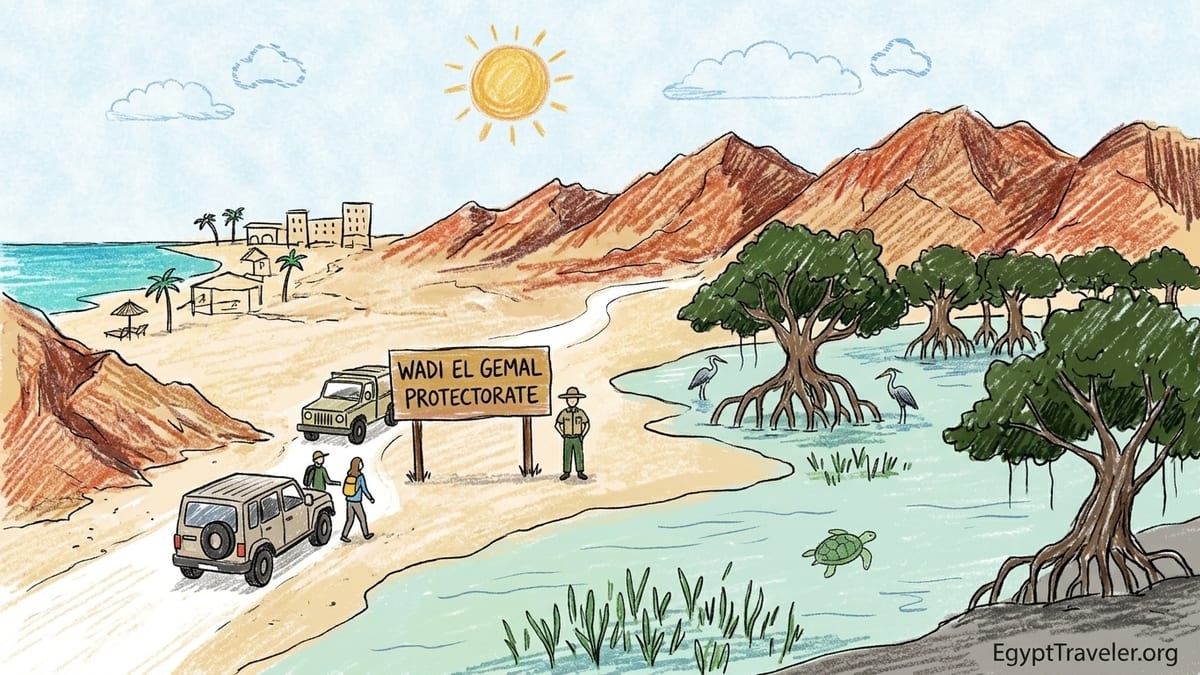
Planning for a Protected Area, Not a Resort Excursion
My base was a mid-range beach resort about 25 kilometres north of Marsa Alam town, one of the many all-inclusive properties strung along Egypt’s southern Red Sea. From there, booking a standard boat trip or a half-day to a popular turtle bay would have been effortless. Visiting Wadi El Gemal, by contrast, took more thought. This is not a single cove or a jetty; it is a national park of roughly 7,450 square kilometres combining some 4,770 square kilometres of land and about 2,100 square kilometres of marine area, stretching from desert mountains down into mangrove-fringed shores and offshore islands.
Wadi El Gemal was formally declared a protected area by Egyptian decree in 2003, and management plans that followed treat it as a mosaic of sensitive zones rather than an open playground. Rangers based at the main gate south of Marsa Alam oversee regulations on where vehicles can drive, where visitors can camp, which islands can be landed on and in what season. The scale alone makes it clear why you cannot simply rent a car and improvise. Desert wadis, seagrass bays, nesting bird islands and culturally important sites overlap in ways that are not always visible on a tourist map.
The night before my visit, I sat with the resort’s in-house tour desk and compared options. They could arrange a classic “sea and desert” outing focused on snorkelling and a short off-road loop, or a longer route that threaded through the park’s southern coastline. I opted for a private full-day trip with a driver and a nature guide who holds a permit to work inside the protectorate. That choice more than doubled the cost compared with a standard boat excursion, but it meant we could move at our own pace and stay within current park rules.
By the time we agreed on a plan, it was already clear that Wadi El Gemal would ask more of me than the resort. The park office requires entry fees, excursions are limited to a set of recognised sites, and there is no food infrastructure once you leave the highway. We stocked up on five litres of water per person, simple picnic supplies from the resort kitchen and extra sun protection. My guide politely reminded me that, unlike on the hotel beach, there would be no shade structures, freshwater showers or snack bars, and that if wind or visibility made snorkelling unsafe we would simply not enter the water.
The Road South and Changing Expectations
We left the resort just after 7 a.m. in an air-conditioned 4x4, joining the coastal highway that runs south from Marsa Alam toward Berenice. Within 20 minutes the manicured hotel grounds gave way to open desert plain, low gravel hills on our left and the Red Sea on our right. The drive to the main gate of Wadi El Gemal took a little under an hour including a brief fuel stop; signs for the protectorate appear without much fanfare near Abu Ghosoun village.
At the entrance checkpoint my passport details were checked and the guide handled the permits. National park entry fees for foreign visitors are set centrally in Egypt and have been adjusted in recent years, so we confirmed the current rate in advance through the guide rather than relying on out-of-date guidebooks. I paid in Egyptian pounds, received a paper ticket for the day and noted that even this administrative moment felt different from the resort world, where access to the sea is bundled invisibly into room rates.
From the gate we continued south on the tarmac highway for roughly 30 kilometres. The coast here is subtle, a narrow strip of pale sand and low rock shelves between blue water and rust-coloured hills. Unlike around Hurghada or even central Marsa Alam, there are almost no permanent structures on the shoreline inside the park boundaries. Occasional ranger pickup trucks and modest Bedouin shelters near fishing spots are the only signs of human presence from the road.
Originally, I had imagined starting the day at Ras Hankorab, widely marketed as Sharm el Luli, a bay of white sand that appears constantly in Marsa Alam brochures. On the ground, that turned out to be impossible. My guide explained that visits to Ras Hankorab had been suspended by the Red Sea National Parks Authority in 2025 because of environmental concerns and legal disputes over encroachments. A circular from the chamber of diving and water sports confirms that all tourism operations there were ordered to stop until further notice. Hearing this while looking at the unmarked turnoff on the highway was sobering. It was a live reminder that in a protected area access can close for the sake of the ecosystem, regardless of how popular a beach has become online.
Rethinking “Paradise Beach” Without Ras Hankorab
Missing Sharm el Luli changed the emotional tone of the morning. Before travelling, I had read conflicting descriptions of its sands and water colours, ranging from “Maldives-like” to more measured accounts that emphasised pale yellow sand and a shallow lagoon. Without being able to set foot there, I could not add my own verdict, and that absence is part of an honest account of Wadi El Gemal today. For travellers arriving in 2026, it is essential to confirm whether Ras Hankorab is open instead of assuming that every brochure shot is accessible.
Instead of driving illegally down the rough access track to the closed bay, we continued deeper into the park toward areas that remain open to visitors under ranger supervision. The guide was candid that some local operators still try to sneak clients onto closed beaches, driving off the authorised tracks to avoid checkpoints. Refusing that option felt like a small but important decision. Vehicle tracks in the fragile coastal crust can last for years, and I did not come to contribute to the scars.
As we skirted the boundary of the Hankorab area, I could see why it had attracted so much attention. From the highway the lagoon gleamed a different shade from the open sea, a pale blue-green band behind the first line of dunes. But what I also saw were tyre marks looping into the desert, informal parking areas and wind-blown plastic snagged on shrubs. Even from a distance, the signs of visitor pressure were visible, making the closure easier to accept as a necessary pause.
The decision to adhere to conservation rules set the tone for the rest of the day. We would work with the park as it exists now, not as a collage of social media images, and we would aim to experience places that can absorb careful visitation. The natural alternative by late morning was the Qulaan mangrove system near Hamata, a short way further south, where the park authority has explicitly encouraged structured, low-impact tourism.
Arriving at Qulaan: First Glimpse of the Mangrove Lagoons
About 120 kilometres south of Marsa Alam town, near the small settlement of Hamata, the line of the coast changes character. Here the sea is scattered with low islands and sandbars and the shore is lined by one of the most extensive mangrove stands in Egypt. A signed side road led us from the highway towards Qulaan, a shallow bay where the desert drains into a network of tidal channels and pools shaded by Avicennia marina, the grey mangrove that dominates the northern Red Sea.
The final approach was on a compacted sand track, manageable in a regular vehicle when dry but rough enough to justify our 4x4. We passed a small ranger outpost where my guide briefly spoke with staff about the day’s conditions. Access here is controlled but not militarised. Visitors are asked to keep vehicles on the main track, to park in designated clearings rather than beside the trees, and to stay on footpaths when moving between shore and mangroves. From the parking area it was a few hundred metres walk to the main lagoon edge.
The first impression was of space and horizontality. Unlike the steep house-reef drop-offs at many Marsa Alam resorts, Qulaan’s coastline lies almost flat. At mid-tide when we arrived, the water formed a wide, glassy sheet only knee-deep in places, reflecting the washed-out blue of the late morning sky. The mangrove trees stood in loose lines running roughly parallel to the shore, their roots like dark fingers in the pale sand. Between the trees, patches of open water shimmered an opaque turquoise, shifting with each breath of wind.
There were a handful of other visitors, most of them Egyptians on family outings from nearby towns, and a small eco-tent area managed in cooperation with local Ababda community associations and park authorities. Simple wooden platforms and low shelters marked the main viewing area, set back from the densest tree stands so that people could sit in the shade without trampling roots. It felt modest, functional and in clear contrast to the intensive infrastructure of the resort coast.
Walking the Shoreline: Permitted Paths and Boundaries
Before we set off on foot, my guide outlined the basic rules for visitors at Qulaan. Vehicles must stop at the designated parking area. From there, a set of sandy footpaths, some marked by low stones, lead to different viewpoints along the lagoon. The park discourages walking directly among the densest mangrove clumps, and there are a few small signs reminding visitors not to climb trees, break branches or wade through the root zones. According to the ranger, these paths were laid out to concentrate trampling pressure and to keep people away from bird resting spots and turtle nesting patches on the upper beach.
We followed a main path that ran parallel to the shoreline for about ten minutes before curving gently out toward a low spit of sand. From there, views opened across the lagoon to a scattering of low islets that form part of the Qulaan archipelago. On a clear day, you can sometimes see the outlines of the Hamata islands further off, although landings there are strictly regulated and usually reserved for organised snorkelling trips with licensed boats departing from the harbour north of the village. From where we stood, those islands were simply a darker band on the horizon, reinforcing how much of the park’s richness lies beyond what a single-day visitor can reach.
The boundary between permitted exploration and sensitive habitat was not marked by fences but by subtle cues: a ranger’s pointed glance when someone edged too close to the mangrove roots, a stone line steering feet away from a vegetated dune, the absence of obvious tracks beyond a certain point. I noticed that these soft controls depend heavily on visitors’ willingness to cooperate. Where they failed, the evidence was immediate. Scuffed sand exposed the top of a root system in one spot, and a torn plastic bag hung from a branch above another.
Even with these scars, the atmosphere was quiet. The only loud sounds were the calls of wading birds feeding in the shallows and the crunch of our own footsteps. Coming from the piped music and poolside announcements of the resort that morning, the contrast was almost disorienting. Comfort here came not from amenities, but from a sense of space and subtle life.
Understanding the Mangrove Ecosystem in Real Time
Standing ankle-deep at the edge of the lagoon, my guide started to talk about the mangroves not as scenery but as infrastructure for the entire coast. In Egypt, two mangrove species are present in the Red Sea, but here the dominant tree is Avicennia marina, adapted to withstand high salinity and extreme heat. The gnarled, above-ground roots that look like shoals of black pencils are pneumatophores: breathing organs that allow the tree to exchange gases in oxygen-poor, waterlogged sediments.
As we watched, small fish flickered between the roots, using them as a nursery ground away from larger predators in the open water. Crabs emerged from burrows to pick at decomposing leaf litter, recycling nutrients that would otherwise be lost. Higher up the trunks, clusters of tiny snails grazed on biofilm, while overhead an egret picked its way methodically along the fringe, each step stirring miniature avalanches of silt. It was an object lesson in how tangled these food webs are. Remove the trees and you simplify the shoreline into a bare sand flat, stripping away habitat for juvenile fish, invertebrates and the birds that feed on them.
My guide also stressed the stabilising role of mangroves. The dense root systems trap sediment carried down from the desert wadis during rare flash floods and from tidal currents on ordinary days. That trapped sediment gradually builds low platforms resilient to erosion. In storms, these patches act as natural breakwaters, absorbing wave energy that would otherwise chew directly at the shoreline and infrastructure further inland. Given the remoteness of Qulaan, it is easy to forget that this process has implications for human safety and investment along more developed parts of the Red Sea as well.
Then there is the role of mangroves in carbon storage. Globally, coastal wetlands such as mangroves and seagrass meadows absorb and lock away significant amounts of what scientists call blue carbon in their soils. While my guide resisted putting a number on it for this particular bay, he explained that the organic-rich sediments beneath our feet were quietly working as a long-term carbon sink. Damaging them through off-road driving or unrestricted construction releases that stored carbon and reduces the coast’s resilience to climate change. Hearing this while a tourist speedboat in the distance carved a white line of wake across an adjacent bay made the abstract language of climate policy feel very concrete.
Snorkelling Among Seagrass and Reefs Without the Hype
By early afternoon the heat had become intense, with temperatures likely in the mid-thirties Celsius. We retreated briefly to the shade of a simple shelter for lunch, eating flatbread, cheese and tomatoes we had brought from Marsa Alam. There is no restaurant at Qulaan, only a basic tea stall when local staff are present, so anyone used to ordering from a pool bar menu will need to adjust expectations. After a rest, conditions in the lagoon still looked calm enough for a short guided snorkel along the outer edge where the mangrove channel meets seagrass and patch reef.
Access to the water was via a gently shelving sandy stretch, not a jetty or ladder. The first few metres were cloudy from the stirred-up sand of previous swimmers, but beyond that the visibility cleared. Near shore, we floated above a dense bed of seagrass, its blades swaying in the tidal current like a rippling lawn. This is the quiet engine of the ecosystem, providing food for herbivorous fish and, in some areas of the park, for green turtles and dugongs. We did not see either on this brief swim, and my guide was careful not to raise expectations. He mentioned that turtles are sometimes spotted feeding in nearby bays early in the morning, but sightings are never guaranteed.
Further out, scattered coral bommies rose from the seagrass, hosting a familiar cast of Red Sea reef life. There were clouds of anthias over branching corals, parrotfish cropped at the algae, a pair of butterflyfish hung in mid-water. Compared with the more vertical house-reef walls at the resort, this was a quieter, more horizontal experience. Colour was present but subtler than in the hyper-saturated promotional photos, especially under the strong overhead sun. Patches of coral damage were visible too, likely from past anchor drops or trampling, reminding me that even in a protected area the underwater world is not untouched.
We kept the snorkel short, around 30 minutes, both because of the sun and to avoid lingering too long near a resting sandbank where birds had gathered. Back on shore, my guide pointed out the faint line of a no-go zone marker further along the lagoon. Beyond that, the mangroves merged into an area reserved for research and bird nesting, closed to casual visitors. In a conventional holiday context, such restrictions might feel frustrating. Here, understanding the reasons behind them made them feel like part of the privilege of visiting at all.
Traces of History in a Living Landscape
On the drive back north through the park, we detoured briefly inland along the lower section of Wadi El Gemal itself, following a graded track that hugs the gravel floor of the valley. The wadi cuts deep into the Eastern Desert mountains, and for thousands of years has served as a route between the Nile and the Red Sea. Somewhere beyond my line of sight, in the higher reaches, lie the ancient emerald mines once worked in Pharaonic times and later by the Romans, often cited as some of the earliest known emerald sources in the world.
We did not attempt to visit the mining sites. Access to archaeological areas in the park is tightly controlled, both for safety and for heritage protection, and many lie far beyond what a single-day coastal trip can reach. Instead, my guide pointed out more modest traces of human use visible from the main track: faint caravan paths etched across the desert pavement, a collapsed stone shelter near a dry well, and the silhouettes of distant power lines that now shadow parts of the wadi. These glimpses were enough to hint at the valley’s role in connecting inland routes with Red Sea ports, without romanticising it as an open-air museum.
Further south in the park, communities of Ababda and Bishariya people continue to live with the rhythms of grazing, small-scale fishing and plant collection. Many of the guides and rangers working in Wadi El Gemal today are Ababda, bringing knowledge of seasonal winds, wildlife behaviour and safe routes that predates its designation as a national park. My own guide was clear that he spoke only for himself, not for the community as a whole, and I did not record or reproduce personal conversations beyond what he was comfortable sharing. Instead, we discussed how official initiatives now explicitly link local livelihoods and conservation, including partnerships between community associations, eco-lodges and national park authorities.
These human layers matter because they challenge the illusion that Wadi El Gemal is “empty.” The mangrove lagoons, seagrass bays and desert wadis are shaped not only by climate and geology but by decisions about grazing rights, fishing practices, road building and tourism regulation. Experiencing the park even briefly made it impossible to treat it as a backdrop to my own leisure.
Visitor Pressure, Impacts and the Ethics of Going South
As the day wore on, I became more attuned to the subtle ways visitor pressure manifests even in a relatively remote protected area. Along parts of the coastal track, parallel lines of tyre imprints veered off the main route toward improvised picnic spots. Near one small cove outside the park but along the same corridor, I saw a pile of mixed rubbish: plastic bottles, food packaging, a broken pair of snorkel fins. None of it was dramatic, but taken together it showed how quickly these landscapes can absorb the habits of easier, more developed stretches of coast.
My guide talked about past episodes in which unregulated beach use, including at Ras Hankorab, led to serious concerns from environmental groups. Reports submitted in recent years have described the spread of semi-permanent structures, off-track vehicle movements across dunes and even construction activity inside the park boundaries. These are not abstract threats. Mangrove roots crushed by tyres, for instance, die back slowly, leaving gaps vulnerabilities to erosion. Turtle nests compacted by repeated trampling may never hatch. Even snorkelers standing up on fragile corals in shallow water can leave pale scars that take years to heal.
Visitor numbers to Wadi El Gemal remain modest relative to mass tourism hubs further north, but they are growing. Community-based ecotourism projects around Abu Ghosoun and Hamata aim to channel this demand into lower-impact activities, such as guided birdwatching, small-group snorkelling and educational walks, with revenue-sharing arrangements that incentivise local guardianship. Yet these initiatives can only do so much without a matching change in visitor behaviour. Saying no to illegal shortcuts, packing out your own waste and accepting that some iconic spots may close altogether are part of the ethical cost of enjoying a wild coastline.
For me, the most striking contrast was psychological. The resort environment subtly invites you to believe that every desire can be met with a service: shade, cold drinks, a safe swimming area, a sunset cruise, all on demand. Wadi El Gemal operated on a different logic. Here, you accept what the day and the regulations allow. If winds pick up, you do not snorkel. If a bay is closed, you move on rather than arguing. That mental shift felt as much a part of the experience as any photo I took.
Practicalities: Time, Heat and the Real Cost of the Day
We left the resort at 7 a.m. and returned just after 6 p.m., making this effectively an eleven-hour day out. Total driving time was around five hours, including the stretch from the resort to the park gate, onward to Qulaan and back north with a brief inland detour. The rest of the time was spent walking along the lagoon, resting in shade and snorkelling. Anyone imagining a quick, lazy beach hop will find the distances and exposure surprising.
In terms of heat, travelling in the cooler months from November to March offers more comfortable conditions, but even then midday sun can be intense with very limited natural shade away from the mangroves themselves. I found a wide-brimmed hat, long-sleeved lightweight shirt and high-factor reef-safe sunscreen essential. We each drank more than four litres of water. There are no reliable shops inside the park itself, so all supplies need to be purchased in Marsa Alam or at your resort beforehand.
Money-wise, costs for such a day can add up. My privately organised trip included a 4x4 vehicle, licensed guide and fuel, and was booked through the resort in coordination with a local operator who works regularly in Wadi El Gemal. Prices in late 2026 for comparable full-day excursions generally fall in the range of the equivalent of 80 to 120 US dollars per person for two people sharing, depending on negotiation, fuel prices and whether lunch is provided. Park entry fees and any additional site charges are usually added on top and may be quoted in US dollars or Egyptian pounds; visitors should verify the current official rates with the guide or park office before departure.
Compared with a standard half-day boat snorkelling trip from Marsa Alam, which many resorts sell for noticeably less, Wadi El Gemal is a more significant investment in both money and effort. There are no sunbeds, bathrooms are basic at best, and delays due to police checkpoints or park administration are always possible. Yet the sense of immersion is correspondingly deeper. You are not one of a hundred swimmers shepherded along a reef, but a small group moving carefully through a broader landscape.
The Takeaway
So was the day in Wadi El Gemal worth it, especially given that one of its most photographed beaches was off-limits during my visit? For me, the answer was yes, but in a way that has little to do with ticking off postcard views. The value lay in feeling how desert, mangrove, seagrass and reef interlock along this stretch of coast, and in navigating a space that is managed first as a protected area and only second as a tourist destination.
For photographers, the rewards are subtle but substantial. Qulaan’s vast tidal flats, mangrove silhouettes and clear, shallow water create strong compositions, especially in the low light of early morning or late afternoon. The palette is natural rather than saturated: creamy sand, muted blue-green water, grey trunks, the occasional bright flash of a bird or fishing boat. Those seeking dramatic, vertical reef walls or guaranteed sunset shots over infinity pools may be disappointed. Those interested in textures and the play of light over water and roots will find ample material.
Wildlife travellers should approach Wadi El Gemal with humility. You may or may not see turtles, dolphins or dugongs, even in areas known for them. Birdlife around the mangroves is more reliable, with herons, egrets and waders commonly present, but again the richness varies with season and tide. The real attraction is not the checklist but the opportunity to observe how protected habitats function when they are given space and time.
For visitors who feel restless after a few days of resort comfort, the park offers a way to recalibrate your relationship with the Red Sea. It asks you to plan, to accept constraints and to carry your own weight in terms of water, food and responsibility. In exchange, it offers moments that feel uncurated: the sound of wind over a dry wadi floor, the slow arch of a crab’s track across a sand bar, the unbroken horizon over a mangrove lagoon. Leaving at dusk, dusty and tired, I felt less like I had consumed an attraction and more like I had briefly shared space with a larger, ongoing story.
FAQ
Q1. How far is Wadi El Gemal from Marsa Alam resorts?
From the main resort strip north of Marsa Alam town, it typically takes about one hour by car to reach the park’s main gate and around two hours to reach the Qulaan mangrove area near Hamata.
Q2. Can I currently visit Sharm el Luli (Ras Hankorab)?
At the time of my visit, official notices from the Red Sea National Parks Authority and tourism bodies indicated that tourist access to Ras Hankorab was suspended until further notice due to environmental and legal concerns. Travellers should check the latest status locally and avoid operators offering unofficial access.
Q3. Do I need a guide to visit Wadi El Gemal?
While it is technically possible to drive the coastal highway independently, using a licensed guide familiar with park regulations and conditions is strongly recommended for accessing permitted sites like Qulaan, arranging permits and avoiding no-go areas.
Q4. What should I bring for a day trip into the park?
Bring plenty of drinking water, sun protection, modest clothing for strong sun, sturdy sandals or shoes, simple food, any snorkelling gear agreed with your guide and a bag to carry out all rubbish. Do not rely on shops or restaurants inside the park.
Q5. Is the snorkelling better than on Marsa Alam’s resort house reefs?
Snorkelling in Wadi El Gemal offers a different experience, with shallow seagrass meadows, mangrove channels and patch reefs rather than dramatic drop-offs. Coral and fish life are rich but not guaranteed to be more spectacular than well-managed resort reefs.
Q6. Are there toilets and shade at Qulaan mangrove lagoons?
Facilities are basic. At the time of my visit there were simple shelters providing shade near the main viewing area and very simple toilet arrangements, but nothing like the infrastructure of a resort beach.
Q7. Can I visit the ancient emerald mines on a day trip?
The historic emerald mining areas lie deep in the Eastern Desert and access is strictly controlled. They are not realistic or appropriate destinations for a casual coastal day trip and usually require special permits and dedicated expeditions.
Q8. Is Wadi El Gemal suitable for children?
Families with children who are comfortable with heat and simple conditions can enjoy the park, especially the gentle shallows at Qulaan, but parents must be prepared for long drives, limited facilities and strong sun without playground-style amenities.
Q9. How much does a full-day trip typically cost?
In late 2026, private full-day trips with a licensed guide and vehicle from Marsa Alam to sites within Wadi El Gemal commonly cost in the region of the equivalent of 80 to 120 US dollars per person for two people, plus park entry fees.
Q10. What is the best time of year to visit?
The cooler months from November to March usually offer more comfortable air temperatures and gentler light. Summer brings higher heat and stronger sun, which increase the need for careful planning around hydration and exposure.