

I arrived in Hurghada like most visitors, rolling my suitcase straight from the airport into an all inclusive resort on the southern hotel strip. For two days the Red Sea, the buffet and the pool bar became my entire world. From my balcony I could see Hurghada’s low skyline shimmering in the distance, but it felt abstract, almost like a painted backdrop behind the beach. On my third morning I decided to close the gate of the resort behind me and spend a full day in the city itself, to see what Hurghada feels like when you are not wearing a plastic wristband.
Leaving the Resort Bubble
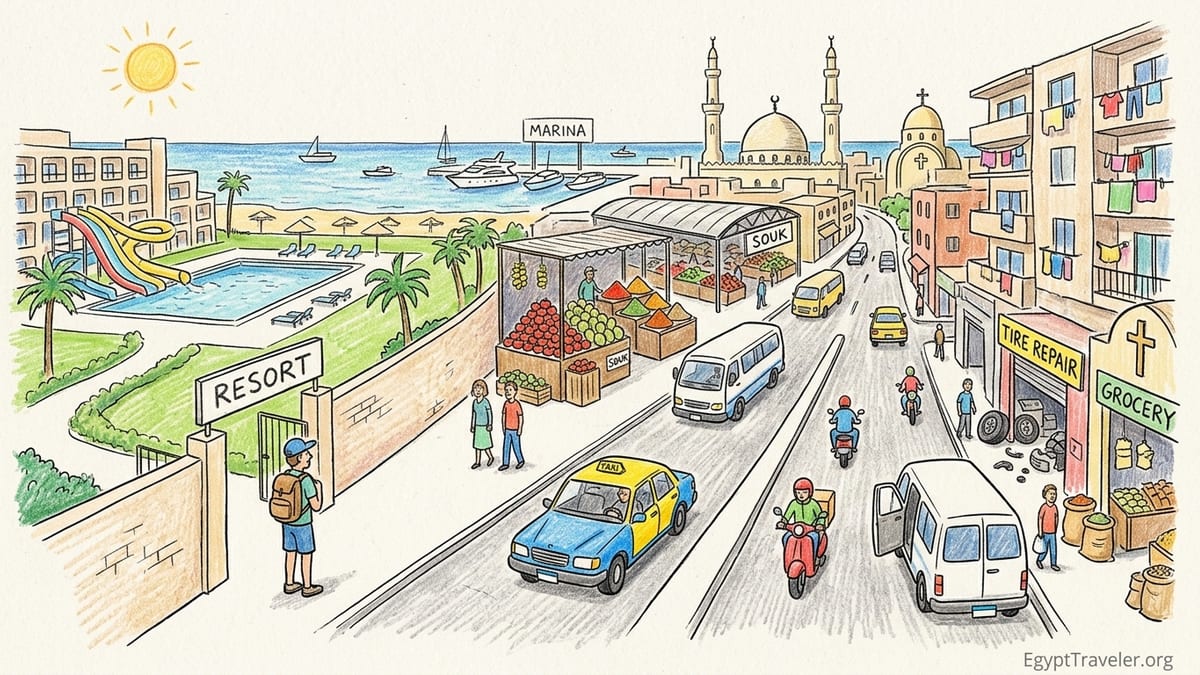
My base was a large mid range beachfront hotel in the southern part of Hurghada, one of the long line that stretches along Village Road. The front gate opened not onto the sea, but onto a busy dual carriageway of honking microbuses, yellow and blue city taxis and delivery scooters stacked with bread. Standing there with my daypack, a cap against the October sun and some Egyptian pounds in small notes, I already felt the difference between curated holiday space and working city.
I asked the security guard how much a taxi to El Dahar should cost. He shrugged and suggested around 120 to 150 Egyptian pounds, but added that I should agree the fare before getting in. Just outside the gate I flagged a battered Hyundai taxi. The driver started at 250 pounds to “Old City”. I answered in basic Egyptian Arabic, asking for the meter. He laughed, switched it on and pulled away from the hotel strip. The meter crept up as we left the manicured lawns, water slides and chain pharmacies behind, passing apartment blocks with laundry hanging on balconies, corner kiosks selling bottled water and mechanics’ workshops spilling onto the pavement. By the time we reached El Dahar Square in about 20 minutes, the meter showed just under 100 pounds, and I rounded it up to 120 with a small tip.
My expectations were fuzzy, shaped by guidebook shorthand that folds Hurghada’s older areas into an amorphous “old town”. On the map, though, the city was clearly a string of distinct zones: El Dahar to the north as the original Hurghada, Sakkala as the busier middle strip and the modern Hurghada Marina attached to the harbor. I decided to treat them as separate neighborhoods connected by the same sea breeze and public buses, and let the day reveal whether they really belonged to one city or to different tourism economies.
Morning in El Dahar: Markets, Bread and Everyday Errands
El Dahar Square was a proper urban roundabout of the kind resorts conceal: traffic threading itself through without clear lanes, microbuses idling with doors open, and a constant choreography of pedestrians. I started walking toward the municipal fruit and vegetable market, a covered complex a few minutes from the square that locals simply call the souk. Inside, the air was thick with coriander, dill and the sweetness of ripe guava.
Stalls were piled high with pyramids of tomatoes, onions, potatoes and cucumbers. Seasonal prices posted on cardboard signs lined up roughly with what local media had reported earlier in the year: around 15 to 20 Egyptian pounds for a kilo of tomatoes, 18 to 25 for cucumbers, 10 to 15 for onions and higher, around 30 to 35, for lemons after a recent spike. I watched women haggle over a kilo of green beans, a vendor weighing out exactly 1.05 kilograms and trimming the extra without drama. There was no dual pricing board for “tourists” and “Egyptians”. If you had small bills and spoke politely, you paid what everyone else paid.
Behind the produce, a row of spice sellers formed a colorful border to the market. Mounds of turmeric, cumin, paprika and hibiscus were scooped into plastic bags on request. One older man pointed wordlessly to his hand written sign listing prices by the 100 grams. Coarse sea salt flavored with dried lemon peel was marked around 15 to 20 pounds per 100 grams, cumin a little less. I bought a small bag of hibiscus flowers and another of cumin, together coming to about 40 pounds, and he efficiently sealed them with a candle flame. It felt like an everyday transaction, not a choreographed tourist sale.
Hunger hit as I left the market, so I followed the smell of fresh bread into a narrow side street. Every few blocks in El Dahar you find a government subsidized bakery, its facade dark from years of flour dust and heat. Men loaded stacks of round baladi loaves onto wooden racks. At the counter, locals were paying in ration cards, so I looked instead for a private bakery a little farther along. There I found trays of still warm sesame bread rings and simple sugar biscuits. A ring of bread cost around 5 pounds, a square of basbousa cake closer to 15. I bought one of each and ate standing under the thin shade of a palm tree, watching a tricycle cart stacked high with plastic water tanks rattle past.
Workshops, Side Streets and Saint Shenouda Church
Leaving the main market, I wandered deeper into El Dahar’s grid of ordinary streets. The touristic trinket shops that cluster closer to the hotel strip were almost entirely absent here. Instead, ground floor units were taken by tire repair shops, mobile phone stores, barber shops with rotating chairs and small groceries spilling sacks of rice and lentils onto the threshold. Above them, families had draped blankets over balcony railings, and satellite dishes competed for roof space.
On one street, the air changed from dust to the metallic sweetness of machine oil. A mechanic worked with the front of a microbus practically dismantled onto the pavement, pieces arranged in a puzzle only he understood. Next door, a carpenter smoothed the edge of a plywood counter for what looked like a future cafe. Little of this was photogenic in a conventional sense, yet it spoke much more about Hurghada’s life than any infinity pool. I passed a stationary shop where schoolchildren were choosing new exercise books, their parents comparing prices on pencil packs that hovered around 10 to 15 pounds.
From El Dahar Square, the pale facade and single dome of Saint Shenouda Coptic Orthodox Cathedral rise a short walk inland, slightly set back from the busier commercial streets. The church is dedicated to Saint Shenouda the Archimandrite, an important figure for the Coptic Orthodox Church, and serves Hurghada’s Christian community as both a place of worship and a social anchor. Arriving mid morning on a weekday, the gates were open but there were only a handful of worshippers inside, lighting candles in front of icons or sitting quietly in the pews.
I stepped through the gate with shoulders and knees covered, and paused to ask the attendant at the entrance if it was acceptable to visit. He nodded me in, and I slipped my shoes off instinctively even though it was not required in the way it is in a mosque. Inside, chandeliers lit a high ceiling painted with saints and angels in the distinctive Coptic style. The atmosphere was calm and contemplative. I deliberately kept my camera in my bag, not wanting to turn people’s prayers into an image. The church felt less like a tourist “sight” and more like a community living room, the place where baptisms, weddings, funerals and weekly services mark the rhythm of the Coptic minority’s life in a predominantly Muslim city.
From El Dahar to the Harbor: Fish Market and El Mina Mosque
Around midday I made my way from El Dahar down toward the harbor district. Rather than take another taxi, I followed the flow of people to a microbus stand. White and blue Toyota vans idled with doors open, each one calling its destination in quick Arabic. I caught the word “Sakkala” and climbed aboard, handing the conductor 10 pounds. The minibus wound its way south, picking up and dropping off passengers in a flexible choreography before stopping near the older harbor area, close to both the working fish market and the gleaming minarets of El Mina Mosque.
The fish market sits just behind the waterfront, a shaded, concrete floored hall lined with waist high tables. By early afternoon the peak rush had passed, but the slabs still held an impressive spread: silvery sardines, red mullet, squid coiled in white loops, and heavier fish like sea bream and sea bass laid out on crushed ice. Local news reports earlier in the year had cited starting prices around 70 pounds per kilo for some smaller fish at Hurghada’s market, with more popular species like sea bream and shrimp going significantly higher and fluctuating with the catch and fuel costs. Written signs matched that general range: piles of small fish in the bracket of 70 to 90 pounds per kilo, mid range fish between 120 and 180, and premium prawns well above that.
Vendors were busy gutting purchases on request, tossing heads and innards into plastic tubs and rinsing the fillets with seawater. A couple of small eateries at the edge of the market offered to cook your fish for you. At one basic place with plastic tables I pointed to a modest sea bream weighing just under a kilo and asked, again in simple Arabic, to have it grilled. The fish itself came to the equivalent of perhaps under 200 pounds at that day’s market rate; the restaurant added a cooking fee that covered salad, tahini, rice and bread. The final bill was around 320 pounds. The fish arrived blackened at the edges and fragrant with charcoal, stuffed with a handful of chopped herbs. It was one of those uncomplicated meals that locks a place in your memory far more firmly than any resort dinner theme night.
After lunch I walked toward El Mina Mosque, the large white complex visible from almost everywhere along Hurghada’s harbor. Completed in the last couple of decades, it is not an ancient monument but a relatively new landmark that has quickly become the city’s symbolic mosque. Its twin minarets rise roughly 40 meters over a cluster of domes, and the polished courtyard reflects the harsh afternoon light. The entrance for visitors is controlled and well signed. I arrived between prayer times, when non Muslims are allowed into the courtyard and, if modestly dressed, into a side section of the main hall.
At the gate, visitors were reminded of the dress code: shoulders and knees covered for everyone, and hair covered for women. A small stand offered long cover up robes to borrow or rent for a small fee, especially for women who arrived in shorts or sleeveless tops. Entry itself was free, though a small tip to the attendant who watched over visitors’ shoes was quietly appreciated. Inside, the main prayer hall stretched wide, carpeted wall to wall, with calligraphy friezes running around the dome. I kept my visit short and low key, conscious that this was not a museum but a functioning place of worship where people came to pray five times a day. The loudspeakers that reached my hotel beach also anchored the daily rhythm here.
Sakkala and the Shift Toward Tourism
From the harbor it was a short walk into Sakkala, the central strip that often gets bundled generically into “downtown Hurghada” in package brochures. The shift in atmosphere from El Dahar was immediate. Shop signs switched more often into English, Russian and sometimes German. Cafes offered shisha pipes beside laminated menus listing cappuccino and fresh mango juice in large fonts. Pharmacy chains, ice cream parlors and money exchange booths lined Sheraton Road, Sakkala’s main artery.
Here the economy spoke more directly to holidaymakers. While in El Dahar almost all shops seemed to exist first of all to serve residents, in Sakkala they existed to catch the eye of visitors strolling in the evening. Beachwear stores displayed snorkels, flip flops and “Hurghada Red Sea” T shirts; tour agencies competed to sell boat trips, desert safaris and quad bike rides. Prices often appeared first in euros and dollars, with Egyptian pound equivalents in smaller print, the reverse of what I had seen in the fruit market.
Persistent sales approaches were part of the street soundtrack, though seldom aggressive. Walking along Sheraton Road, I heard a familiar rhythm: “Hello my friend, where are you from? You want boat? You want safari?” It would have been easy to frame this as harassment, but in reality it felt like the normal hustle of a tourism corridor where competition is intense and margins are thin. A firm “la, shukran” and continued walking closed most interactions quickly. Compared with the matter of fact transactions in El Dahar, Sakkala was more performative, its economy relying on personality and persuasion as much as on product.
I ducked into a small side street cafe that seemed to straddle both worlds. There was a television showing a football match, a few Egyptian men drinking tea and smoking, and a corner with a coffee machine and cakes clearly aimed at tourists staying in nearby guesthouses. A double espresso cost the equivalent of roughly 60 to 80 pounds, several times what tea had cost at a simpler place in El Dahar, but still reasonable by European standards. I sat for half an hour, listening to a conversation switch between Arabic and Russian at the next table, another little reminder that Hurghada is both resort town and migrant workers’ hub.
Hurghada Marina: A Polished Waterfront
By late afternoon I followed the signs to Hurghada Marina, the gated waterfront development that attaches to the harbor like a glassy new limb. Security guards checked bags lightly at the entrance, a protocol more about maintaining a sense of exclusivity than strict control. Inside, the environment changed yet again. The pavement was spotless, lined with manicured palm trees and low pastel buildings that housed restaurants, bars and boutiques. Yachts and dive boats bobbed at the quays, their hulls reflecting in still water.
Restaurant menus here were almost entirely in foreign languages, quoting prices in euros and dollars as often as in pounds. Italian, Lebanese and generic “international” cuisines dominated. Where a grilled fish meal at the working market had cost me around 320 pounds including sides, main courses here ranged from the equivalent of 400 to 700 pounds or more, depending on the place, and seafood platters climbed higher. The marina’s ice cream stands sold scoops priced in euro-cent style decimals, even though you could pay in local currency. Couples in resort wear posed for photos against the line of boats, and commercial photographers circulated discreetly, offering to capture the moment for a fee.
Walking the length of the marina, I felt a curious sense of dislocation. Technically I was still in Hurghada, still beside the same Red Sea whose breeze I had felt in El Dahar’s streets that morning. Yet the carefully curated views, the polished decking and the soundtrack of English pop made this feel almost like a transplanted corner of a Mediterranean resort somewhere else entirely. Many of the workers here spent their nights in the same kind of apartment blocks I had seen earlier, commuting each day into this bubble of affluence to serve a clientele that might never venture as far north as El Dahar.
The question that had followed me since the morning returned: did these areas feel like one city or like economically separate zones that barely touched? Geographically they were neighbors; the minibus ride between El Dahar and the harbor took less than half an hour. Yet the prices, languages and social codes shifted dramatically across that short stretch. In El Dahar, my few hundred pounds had gone toward vegetables, spices, bread and everyday services. In the marina, the same amount could vanish in a single round of cocktails.
Taxis, Negotiations and the Question of Tours
As the sun slipped lower behind the line of hotel towers, I weighed my options for getting back to my resort. Minibuses still rattled along Sheraton Road, but with camera and spice packets in my bag I opted for a taxi from Sakkala rather than navigate unfamiliar routes in the dark. Along the curb, several drivers called out “Taxi, where hotel?” I chose one with a visible meter and a car that looked mechanically sound.
When I mentioned my hotel on Village Road, the driver quoted 200 pounds as a straight fare. I countered by asking to use the meter. He agreed without argument, perhaps guessing that the traffic at that hour would keep the fare in his favor. As it turned out, the ride cost just over 110 pounds, and again I rounded up to 130. The negotiation had been brief and cordial. The key, I realized, was to carry small notes in local currency, to know a rough expected range, and to treat the process as a normal part of travel in a service based economy rather than as a personal duel.
On the way back I reflected on the leaflets I had seen advertising organized “Hurghada City Tours” for around 20 to 30 euros per person. These packages, usually booked through hotel desks or street agencies, promise a half day in Hurghada that typically includes hotel pickup, a stop in El Dahar market, a visit to El Mina Mosque, perhaps a quick look at Saint Shenouda Church and some free time at the marina, punctuated by visits to perfume or souvenir shops where the agency likely earns commission. For many visitors, that format feels safe and efficient, particularly for those short on time or nervous about independent exploration.
Having now moved between these places on my own, I questioned how much additional culture a paid tour would have added. The minibus from El Dahar to the harbor had cost me about 10 pounds, a fraction of a euro. Taxis, negotiated with a little patience, had been affordable. Walking slowly through the markets and side streets unchaperoned had allowed me to linger where I wanted and bypass the commission based shops entirely. A guide could certainly have offered more historical context, especially inside the church or mosque, but most of what I needed to navigate respectfully was visible on signs or communicated by attendants.
If I had been traveling with small children, with mobility issues or with no experience in North African cities, an organized tour might have provided welcome structure. Yet on this particular day, it seemed that what I would have gained in logistical convenience, I might have lost in unscripted encounters: the mechanic working on his microbus, the schoolchildren buying notebooks, the quiet moment in the church courtyard, the chance to choose my own fish at the market instead of being ushered to a preselected restaurant.
The Takeaway
I left my hotel that morning expecting to tick off a few “old Hurghada” sights before returning to the comfortable unreality of the resort. Instead, the day fractured my mental map of the city into distinct layers. El Dahar revealed itself as a functioning Egyptian town with markets where people came to buy tomatoes, herbs and school supplies, not to entertain visitors. Sakkala showed its role as a middle zone, a place where tourists and locals share pavements, coffees and football matches. The marina embodied Hurghada’s aspiration to be a polished, international waterfront, an aspirational stage where visitors and residents perform different versions of the same seaside dream.
In practical terms, the day was not complicated. Travel times were short. From my hotel gate to El Dahar took about 20 minutes by taxi, another 20 to 25 minutes by minibus from El Dahar to the harbor area, and around 15 to 20 minutes back to the hotel by taxi from Sakkala in late afternoon traffic. My spending, excluding the hotel’s all inclusive buffer, remained moderate: a handful of small market purchases for under 100 pounds, bakery snacks for perhaps 30, spices for around 40, a filling grilled fish lunch at the market for about 320, coffees and drinks in Sakkala for 150 or so, and taxis and minibuses that together came to under 300. For less than what many people might spend on a single resort excursion, I had bought myself a full day of seeing Hurghada in its own terms.
Most importantly, leaving the resort materially changed my understanding of the city. From within the hotel compound, Hurghada had seemed almost placeless, one more sun and sea destination on a line of similar resorts scattered from the Caribbean to Southeast Asia. Beyond the gate, it became a specific Egyptian city with its own religious rhythms, economic challenges and small daily rituals. Hearing the same call to prayer bounce off the walls of El Mina Mosque, Saint Shenouda’s church courtyard and the tiled corridors of my hotel tied these worlds together in unexpected ways.
For future visitors, I would not suggest abandoning the pleasures of the Red Sea. The coral reefs, warm water and lazy afternoons remain Hurghada’s star attractions. But I would strongly recommend devoting at least half a day to El Dahar, Sakkala and the harbor. Go with Egyptian pounds in your pocket, a willingness to use local transport, and a mindset that sees bargaining and brief conversations as part of normal economic interaction rather than as something to be feared. The reward is not a checklist of monuments but a more textured sense of where your resort is actually located, and of the people who keep both the city and the hotels running.
FAQ
Q1. Is it safe to leave my Hurghada resort and explore El Dahar on my own?
El Dahar felt busy but generally safe during the day, with families shopping and children walking to school. Normal big city precautions apply: keep valuables out of sight, cross streets carefully and use licensed taxis or clearly marked minibuses. If you are nervous, start with a short daytime visit and avoid deserted streets late at night.
Q2. How much cash in Egyptian pounds should I budget for a half day in the city?
For a self guided half day covering taxis or minibuses, a simple market meal, snacks and a few small purchases, the equivalent of 800 to 1000 Egyptian pounds in small notes was sufficient for me. Bring extra if you plan to eat in the marina or do significant shopping, where prices align more with international resort levels.
Q3. Do I need to dress differently in El Dahar and at El Mina Mosque than at my resort?
In El Dahar and Sakkala, modest clothing that covers shoulders and at least to the knee is respectful and makes you stand out less than beachwear. Inside El Mina Mosque, shoulders, legs and for women hair should be covered; robes and headscarves are often available at the entrance for a small fee. In the marina and resort zones, dress codes are more relaxed, but you will still feel more comfortable leaving swimwear for the beach and pool.
Q4. Can non Muslims visit El Mina Mosque and non Orthodox visit Saint Shenouda Church?
Non Muslims are generally welcome at El Mina Mosque outside prayer times, provided they follow the dress code and behave respectfully. Saint Shenouda Church also receives visitors, especially outside service hours. In both places, avoid photographing worshippers without consent, keep your voice low and follow any instructions from attendants or signage.
Q5. How do I use the local minibuses between El Dahar, Sakkala and the harbor?
Minibuses are shared white or blue vans that run fixed routes but stop on demand. Locals often call out destinations like “Sakkala” or “Dahar.” You can flag one from the roadside, confirm it is going your way, then pay the small fare, typically a handful of pounds, directly to the driver or conductor. Have exact change ready and follow what other passengers do when getting on and off.
Q6. Are the markets and fish hall in Hurghada worth visiting if I am not planning to cook?
Yes. The fruit and vegetable market in El Dahar and the fish market by the harbor are vivid windows into local life, even if you never light a stove. At the fish market, small restaurants will grill your chosen catch for you, turning the visit into a very fresh lunch. In the produce market, you can buy ready to eat fruit, bread, sweets or small bags of spices as practical souvenirs.
Q7. How persistent are the shopkeepers and tour sellers in Sakkala and the Marina?
In Sakkala and the marina, many shopkeepers and tour sellers will call out to invite you into their stores or to offer excursions. Some will follow you a few steps or repeat offers, but most accept a clear, polite “no, thank you” if you keep walking. Viewing these approaches as part of the local service economy rather than as hostility makes interactions more relaxed on both sides.
Q8. Is an organized Hurghada city tour a good idea, or should I go independently?
Organized city tours can be useful if you are short on time, unfamiliar with similar cities or prefer a structured schedule with hotel pickup. However, much of Hurghada is easy to explore independently with taxis and minibuses, and doing so lets you choose how long to spend in each place and avoid commission based shopping stops. If you value flexibility and are comfortable navigating, a self guided outing offers more room for spontaneous experiences.
Q9. How different are prices between El Dahar, Sakkala and Hurghada Marina?
In broad terms, everyday goods in El Dahar, such as vegetables, bread and basic services, are priced for local residents and are relatively inexpensive. Sakkala sits in the middle, with many businesses targeting tourists but still serving locals. The marina is the most upscale and international, with restaurant and bar prices closer to what you might expect in European resort towns. Planning where to eat and shop with this gradient in mind can help you manage your budget.
Q10. Did visiting the city change how you felt about staying in an all inclusive resort?
Yes. After a day in El Dahar, Sakkala and the harbor, the resort felt less like an isolated destination and more like one element in a wider, working city. Knowing where staff went home to, where families shopped and where religious communities gathered gave depth to an otherwise generic beach holiday. I enjoyed the resort comforts more, not less, once I had seen the streets, markets and public spaces that sustain Hurghada beyond the hotel fences.