

Tell Basta, the ancient city of Per-Bastet or Bubastis, sits today on the edge of Zagazig in Egypt’s eastern Nile Delta. Once a capital of Egypt and the cult centre of the cat goddess Bastet, it is now a low, windswept mound dotted with granite blocks, a Roman well and a compact site museum. Visiting is rewarding if you arrive with context, realistic expectations and a plan to combine it with Tanis rather than treating it as a stand-alone blockbuster attraction.
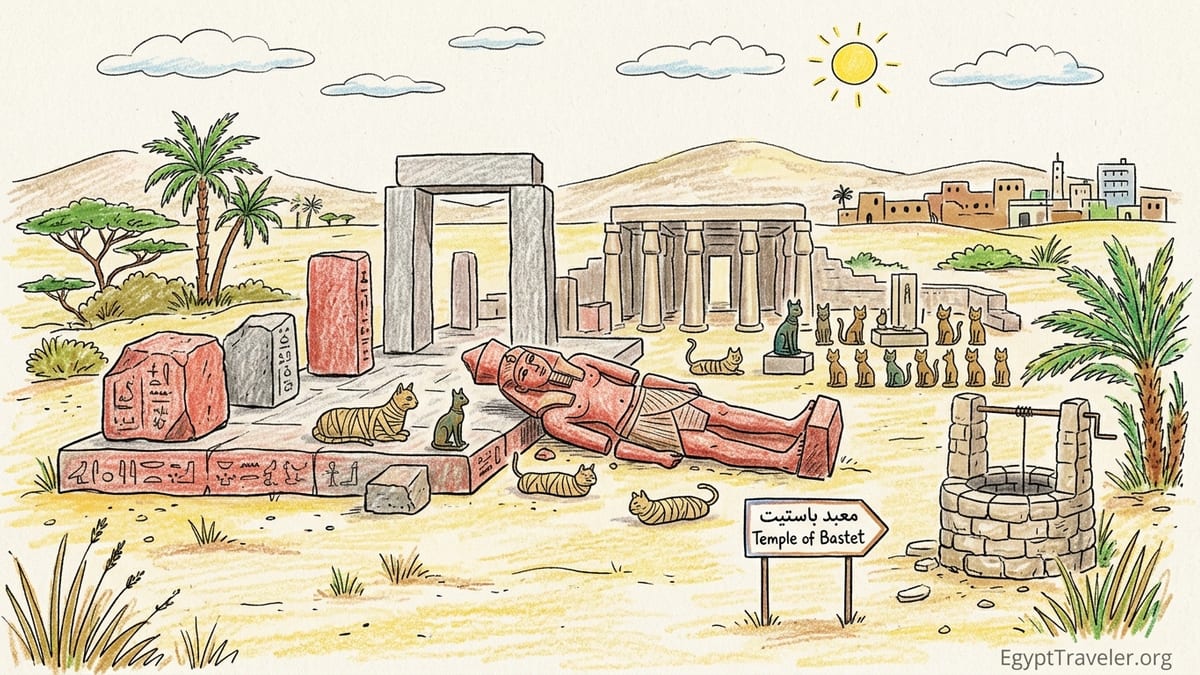
Understanding Bubastis: From Cat Goddess Cult Centre to Capital City
The Ministry of Tourism and Antiquities identifies Tell Basta as the site of ancient Per-Bastet, better known by its Greek name Bubastis, capital of the 18th Lower Egyptian nome in the New Kingdom and a royal capital during the 22nd Dynasty. In practical terms, that means when you walk across the dusty mounds today you are standing in what was once one of the most politically important cities in the Delta, a place where kings resided and major religious festivals drew pilgrims by the thousands.
Bubastis was famous above all as the principal cult centre of Bastet, the feline goddess associated with fertility, maternity and household protection. Early on she could be shown as a lioness-headed woman, but in later periods she was depicted more as a domestic cat, reflecting a gentler, protective side of her character. Ancient texts and reliefs indicate that Egyptians brought mummified cats to Bubastis as votive offerings, and the area was known for cat cemeteries and shrines dedicated to beloved animals as well as the goddess herself.
During the 22nd Dynasty, founded by Libyan-descended rulers such as Shoshenq I, Bubastis rose to national prominence as a royal residence. This political role translated directly into monumental building at the Temple of Bastet, where kings reused granite blocks from older monuments and commissioned colossal gateways and columned halls. Even though only fragments survive on the surface today, the quantity of inscribed blocks and royal statues recovered by archaeologists underlines how grand the city once was.
For modern visitors, this long history matters because it changes how you read a seemingly bare site. A line of squared granite blocks becomes the outline of a once massive temple platform, while an isolated statue base gains meaning as part of a royal processional way. Arriving with an understanding of Bubastis as both a religious sanctuary and a political powerhouse will make the walk across Tell Basta significantly richer.
The Temple of Bastet Today: Fragmentary but Evocative
Herodotus described the Temple of Bastet in the 5th century BC as one of the most beautiful in Egypt, ringed by water channels and shaded by tall trees. None of that lush setting is visible now. Excavations have revealed the foundations of the temple enclosure, patches of pavement and scattered architectural blocks. The temple you see today is an exercise in imagination, linking low stone lines in sand to the accounts of ancient visitors and the plans drawn by 19th century excavators.
On the ground, you will walk past rough granite blocks carved with the names of rulers such as Khufu and Khafre, reused in later construction, and elements attributed to 22nd Dynasty kings like Osorkon I and Osorkon II. Many pieces are jumbled, stacked or lying flat. It is not an intact temple like Edfu or Dendera but rather a deconstructed architectural kit. A knowledgeable guide can point out, for example, a red granite block with traces of a sed festival scene or the base of a Hathor-headed column that once lined a hypostyle hall.
To one side of the main temple platform, excavations have identified a separate sanctuary linked to the 6th Dynasty king Pepi I, and elsewhere archaeologists have uncovered part of a palace complex of Middle Kingdom ruler Amenemhat III. You may see only scattered bricks and stone outlines, but in context these remains illustrate how Bubastis layered temples and royal residences on top of each other over many centuries.
Because the site is relatively quiet, you can often move freely among the ruins, pausing to examine hieroglyphs up close or to photograph details without crowds. Photography rules may change, but at the time of writing visitors commonly use phones and small cameras without extra fees at open-air Delta sites. Always confirm any restrictions with your guide or at the ticket office when you arrive.
Key Archaeological Highlights: Royal Sculpture, Roman Well and Cat Traditions
The most visually striking objects at Tell Basta are its royal statues, particularly the colossus of Queen Meritamen, daughter of Ramesses II, which has become something of an emblem for the site. The statue lies in sections in the open air, its elegantly carved features and royal regalia still visible despite erosion. Guides often stop here to explain Ramesside building activity in the Delta and to contrast Bubastis with better-known Ramesside sites such as Pi-Ramesses and Luxor.
Another feature that regularly captures visitors’ attention is the Roman-period well associated in local tradition with the journey of the Holy Family in Egypt. The Ministry of Tourism and Antiquities lists Tell Basta as one of the stations on the Holy Family route, and modern pilgrims sometimes visit specifically to see the well and the associated modern church. For a traveler, this layered significance shows how the same ground has been reinterpreted from pharaonic times through Christian and Islamic periods to the present.
Although the famous cat cemeteries of Bubastis are not as theatrically displayed here as in some museums, the association with feline cults remains strong. Some guides will point out deposits of broken cat statues or fragments of mummified animals that have been studied by archaeologists. More of the cat-related material culture, including bronze cat figures and decorated stelae, is now conserved in regional museums in Egypt and in international collections. When you walk the sandy paths, keep in mind that much of the most delicate material has been removed for preservation, which is another reason why the surface impression can feel sparse.
Scattered across the tell, you will also notice truncated column drums, fragments of gateways and granite thresholds bearing traces of ancient door sockets. Many of these fragments came to light during modern Egyptian excavations in the 20th century. While casual visitors may see only broken stone, an Egyptologist can read them as evidence for specific building phases and ritual routes within the temple complex.
Tell Basta Museum: Bringing Context Indoors
On the edge of the archaeological zone, the Tell Basta Museum in Zagazig gathers finds from excavations across Sharqiya Governorate into a single, air-conditioned space. The museum is modest compared with the Egyptian Museum in Tahrir or the Grand Egyptian Museum, but it provides essential context for what you have just walked over outside. Displays cover themes such as daily life, religious practice and royal patronage in the eastern Delta, using objects from Bubastis and nearby sites.
The museum opened to the public in 2018 after a long gestation and typically operates daily with winter hours around 9:00 to 17:00 and extended summer hours to about 18:00. According to recent local reporting and official price lists, standard adult tickets for Tell Basta, which include access to the museum, are priced at roughly 150 Egyptian pounds for foreign visitors and 10 Egyptian pounds for Egyptians, with half-price rates for students. These figures are subject to change, especially with currency fluctuations, so treat them as indicative rather than fixed.
Inside the museum, you might see, for instance, a line of cat figurines dedicated to Bastet, limestone reliefs from the Temple of Bastet, and small objects such as cosmetic vessels, amulets and tools excavated from domestic quarters. Labels are mostly in Arabic with some English, so travelers who do not read Arabic will benefit from either a guide or a good background guidebook to make the most of the displays.
One practical advantage of visiting the museum is the chance to cool down and regroup between walking the mounds and making the onward drive to Tanis. In summer, when temperatures in Zagazig can easily sit in the high 30s Celsius by midday, a half-hour pause in an indoor space can make the difference between an enjoyable archaeological day and an exhausting slog.
Getting to Bubastis via Zagazig and Why It Pairs Naturally with Tanis
Tell Basta lies roughly 80 kilometres northeast of Cairo and about 3 kilometres southeast of central Zagazig. In theory you could reach it independently by taking a regular Egyptian National Railways train from Cairo’s Ramses Station to Zagazig, then a taxi to the site. In practice, travellers who are not used to the Nile Delta’s busy traffic and informal local transport often find it far more efficient to arrange a private day tour from Cairo that combines Bubastis with Tanis at San el-Hagar.
Several local tour operators and international booking platforms sell private Tanis and Bubastis day trips, typically framed as a 10 to 12 hour excursion with hotel pickup in Cairo or Giza. A common pattern sees drivers using the main desert and agricultural roads east from Cairo, reaching Tell Basta for a mid-morning visit of about 60 to 90 minutes before continuing deeper into the Delta to Tanis for two to three hours, then returning to Cairo by early evening. As of 2026, advertised prices for such private tours often fall in the range of 80 to 150 US dollars per person in a small group, depending on vehicle, guide level and inclusions like lunch or entrance fees.
Pairing Bubastis and Tanis makes sense both geographically and thematically. Both lie in the eastern Nile Delta, both served as royal capitals in later periods of ancient Egyptian history, and both now present as open fields of ruins rather than fully reconstructed temples. Tanis, sometimes dubbed the Thebes of the North, compensates for Bubastis’s fragmentary feel with a denser concentration of fallen colossi, obelisks and temple blocks, as well as the context of royal tombs whose treasures rivalled those of Tutankhamun. Seeing the two together turns a day into an exploration of how power and religion shifted across the Delta rather than an isolated visit to a single low mound.
Attempting Bubastis as a stand-alone day trip from Cairo can feel anticlimactic if your expectations are set by Giza or Saqqara. The travel time from Cairo, usually two hours each way including traffic, is substantial for a relatively compact site. Linking it to Tanis, and ideally building in a short city stop in Zagazig for a coffee or snack at a local café, turns the logistics into a fuller regional experience instead of simply checking off a single ruin.
Practicalities on Site: Tickets, Guides and Expectations
At the Tell Basta entrance, you will find a small ticket office where staff sell combined tickets for the archaeological zone and the museum. Official price lists from the Ministry of Tourism and Antiquities give baseline rates, but do not be surprised if posted prices and opening hours are adjusted seasonally or in response to national holidays. As a rule of thumb, expect summer hours around 9:00 to 18:00 and winter hours around 9:00 to 17:00, with last entry approximately an hour before closing.
Guiding standards in the Delta can vary. Some private tours from Cairo include a licensed Egyptologist who travels with you from the capital; others rely on local site guardians who know the terrain intimately but may speak limited English. If you are booking through an agency, ask clearly whether the guide is a state-licensed Egyptologist and whether they will accompany you for the entire day, including Tanis. If you arrive independently, you might hire a local guide on the spot or use a detailed guidebook and pre-downloaded maps to orient yourself.
Facilities at Tell Basta are basic but improving. There are usually simple restrooms near the entrance, and occasionally a small kiosk or vendor selling bottled water and soft drinks. It is wise to bring your own water, sun hat and snacks from Cairo or Zagazig. Footpaths are mostly unpaved, so closed shoes or sturdy sandals are preferable to flip-flops, particularly if you plan to clamber gently around blocks and uneven surfaces for photography.
Most importantly, adjust your expectations. Bubastis is not a place of soaring pylons and roofed hypostyle halls. It is a site for travelers who enjoy piecing together fragments, tracing faint outlines in the sand and connecting what they see to what they have read. If that appeals, the quiet and the lack of crowds can be a welcome change from the tour-bus bustle of more famous monuments.
The Takeaway
Tell Basta, ancient Per-Bastet, rewards visitors who arrive with curiosity, context and patience. The Temple of Bastet has been stripped to its foundations and scattered blocks; royal statues lie broken in the open, and the Roman well sits in a modest compound rather than a grand basilica. Yet when you view these remains as the residues of a once-thriving capital where kings built, pilgrims brought cat mummies and later Christians traced the footsteps of the Holy Family, the experience becomes far richer than the surface might suggest.
Combining Bubastis with Tanis on a private day trip from Cairo is the most efficient and satisfying way to approach the eastern Delta. You gain a narrative that links two former capitals, see how royal power and religious devotion moved across the landscape, and enjoy the freedom of exploring largely uncrowded archaeological fields. It is not a glossy, heavily curated experience; it is closer to walking into an enormous, outdoor research project where the pieces are still being assembled.
For travellers who have already seen the Nile Valley classics and want to dig deeper into Egypt’s layered history, Bubastis offers a chance to stand in a place that was once central to the story yet now lies quietly on the margins. Bring good shoes, plenty of water, a discerning guide and a willingness to imagine, and Tell Basta will repay the journey from Cairo with a very different, and more contemplative, kind of encounter with ancient Egypt.
FAQ
Q1. How long does it take to visit Tell Basta and the Temple of Bastet?
Most visitors spend about 60 to 90 minutes walking the temple area and nearby ruins, plus another 30 to 45 minutes inside the Tell Basta Museum.
Q2. Is Tell Basta worth visiting if I have never been to Egypt before?
It can be rewarding, but first-time visitors usually get more out of Giza, Saqqara and Luxor. Tell Basta is best for those who already know the main sites and want something more offbeat.
Q3. Can I visit Tell Basta independently by public transport from Cairo?
Yes, you can take a train from Cairo to Zagazig and then a taxi to the site, but most travellers find a private car or guided day tour easier and more time efficient.
Q4. Are there English-speaking guides available at the site?
Sometimes local guides speak basic English, but availability is not guaranteed. Booking a licensed Egyptologist guide through a tour operator in Cairo gives you more reliable commentary.
Q5. What should I wear when visiting Bubastis and Tanis?
Light, breathable clothing that covers shoulders and knees, a wide-brimmed hat, sunglasses and sturdy closed shoes or sandals are ideal for sun, dust and uneven ground.
Q6. Are there food and drink options near Tell Basta?
There may be small kiosks selling bottled water and soft drinks near the entrance, but it is safer to bring your own water and snacks from Cairo or central Zagazig.
Q7. Is photography allowed at the Temple of Bastet and in the museum?
Photography is usually allowed in the open-air ruins with phones and small cameras, but museum and tripod rules can vary. Always check posted signs or ask staff on arrival.
Q8. How much does a combined Tell Basta and Tanis day trip from Cairo cost?
Private full-day tours commonly range from about 80 to 150 US dollars per person in a small group, depending on the operator, vehicle type, guide and whether lunch is included.
Q9. When is the best time of year to visit Bubastis and the eastern Nile Delta?
The cooler months from roughly November to March are most comfortable, with milder daytime temperatures and softer light for walking open archaeological sites.
Q10. Is Tell Basta safe to visit for foreign travellers?
Tell Basta lies in a typical provincial area and is generally considered safe when visited on an organized tour or with a trusted driver, following normal travel precautions.