


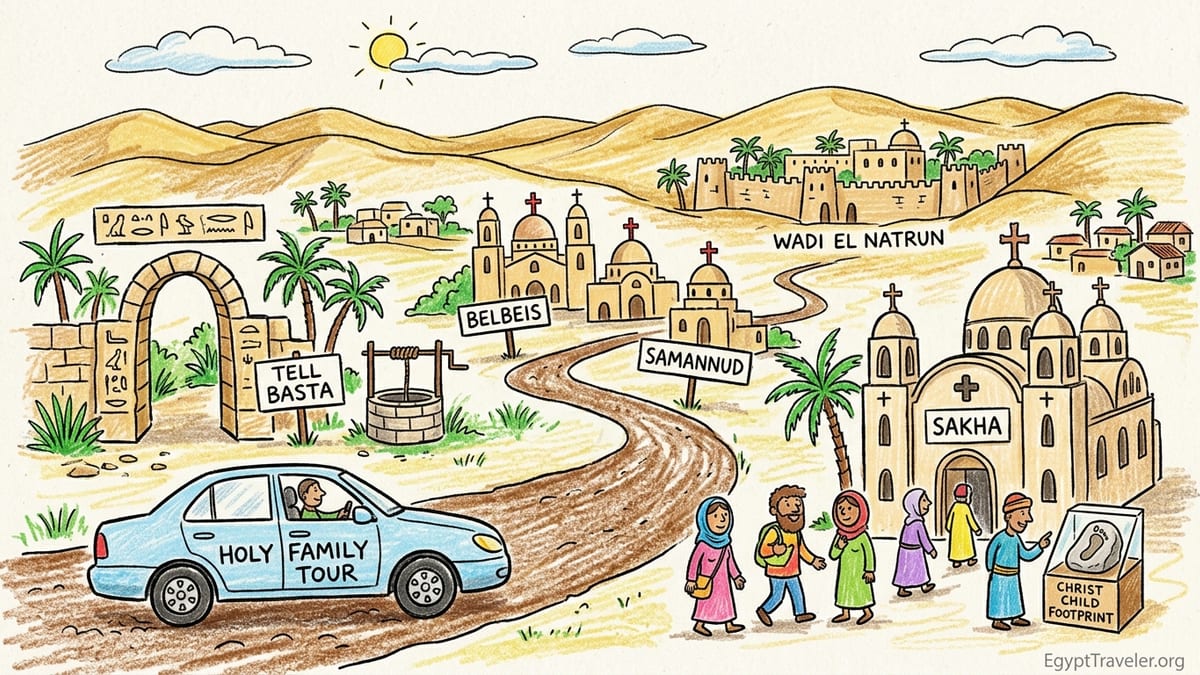
For many Christian travelers, following the Holy Family’s footsteps across Egypt is both a spiritual longing and a logistical puzzle. The official route recognized by Egypt’s Ministry of Tourism and Antiquities stretches from Sinai to Upper Egypt, but the Lower Egypt section in the Nile Delta is where many modern visitors choose to begin. Concentrating on Tell Basta, Belbeis, Samannud, Sakha and Wadi El Natrun allows pilgrims to experience authentic churches, holy wells, footprint stones and living monasteries within a manageable radius of Cairo and Alexandria.
Understanding the Lower Egypt Section of the Holy Family Trail
Egypt’s Ministry of Tourism and Antiquities identifies 25 official points along the Holy Family route, several of them in the Nile Delta and the Western Desert just north of Cairo. In practical terms, Lower Egypt’s key stations for most visitors are Tell Basta in Sharqia, Belbeis on the road to the Delta, Samannud in Gharbia, Sakha in Kafr El Sheikh, and the monastic valley of Wadi El Natrun in Beheira. These sites are spread between roughly 70 and 170 kilometers from Cairo, so they can be combined into one ambitious loop or broken into two or three shorter excursions depending on time and stamina.
Traditions around the Holy Family’s stay in the Delta come from Coptic sources and local oral history rather than archaeological proof. The ministry’s own publications present them as devotional heritage, anchored by surviving churches, wells and icons associated with the journey. At Tell Basta, for example, a well is venerated as the place where the infant Jesus drank; in Sakha, a basalt stone is cherished for bearing the footprint of the Christ Child. Wadi El Natrun is associated with the Holy Family’s passage through the Western Desert and later became one of the most important monastic centers in the Christian world.
For today’s traveler, this means that a visit to the Lower Egypt stations is as much about engaging with living Coptic communities as it is about seeing monuments. You will often encounter local worshippers, priests and church servants who share stories that go well beyond guidebooks. Planning with this human dimension in mind makes the difference between a simple sightseeing trip and a meaningful pilgrimage.
Tell Basta: Wells, Ruins and the First Delta Stop
Tell Basta, close to the modern town of Zagazig in Sharqia Governorate, is traditionally the first Delta station after the Holy Family entered Egypt from the northeast. In pharaonic times this was Bubastis, a major center of worship for the cat goddess Bastet, and you still see remnants of temples and colossal stone blocks scattered across the archaeological mound. Within this landscape, Coptic tradition places a well that miraculously filled with fresh water for Mary and the Child when they were thirsty in the summer heat.
Today, visitors typically combine Tell Basta’s Holy Family site with the broader archaeological zone. The Holy Family well, located near a simple modern chapel, is modest compared with other pilgrimage shrines, but local Christians hold it in deep reverence. Do not expect polished visitor infrastructure here: surfaces are uneven, signage can be sparse and English explanations are limited. It is wise to travel with a licensed Egyptologist guide from Cairo who is familiar with the site and can translate conversations with the on-site guardians.
A realistic way to visit is by private car or pre-booked vehicle from Cairo, a journey of around 90 minutes depending on traffic. As of 2026, full-day private car and driver services from reputable Cairo agencies often start around 100 to 150 US dollars for a small group, including fuel but excluding entry tickets and tips. Many operators are willing to create a Holy Family themed itinerary that combines Tell Basta with Belbeis or with other Delta stations if you request this explicitly when you book.
Belbeis: Martyrs, Old Churches and a Transitional Stop
Belbeis sits on the historical road from Cairo to the Delta and appears in medieval chronicles as an important fortified town. In the Holy Family tradition, it is remembered as another rest stop on the family’s journey westward. Although Belbeis is less prominent in modern ministry brochures than Sakha or Wadi El Natrun, it has long been associated with early Christian communities and martyrs, and some local churches link their origins to the passage of the Holy Family through the area.
Pilgrims visiting Belbeis today usually come to see older Coptic churches in the center of town, where icons depicting the Holy Family are displayed and feast days draw large crowds. Depending on the parish, you may be invited to step down into small subterranean spaces or side chapels thought to be among the earliest prayer spots. Here, the experience is not about a single dramatic artifact but about joining local worship for a short time, listening to hymns in Coptic and Arabic and observing how the Holy Family story still shapes community identity.
Belbeis is relatively close to Cairo, so many travelers visit on the same day as Tell Basta or on the way toward Samannud. Roads can be busy with trucks and local traffic, especially at the start and end of the workday, so consider planning mid-morning or early-afternoon departures. While independent travelers can reach Belbeis using Uber-type apps from Cairo’s eastern districts, negotiating a round-trip fare with waiting time in advance is essential, as ride-hailing coverage in smaller Delta towns is inconsistent. A private driver arranged through your hotel concierge or a Cairo travel office is usually more reliable for a multi-stop Holy Family day.
Samannud: The Grinding Stone and a Lived-in Delta Parish
Further into the central Delta, the town of Samannud in Gharbia Governorate preserves one of the most tangible relics linked to the Holy Family tradition: a large stone basin or grinding stone kept in the Coptic Church dedicated to the Virgin Mary. Local tradition holds that Mary used this stone to grind grain to feed her family during their stay. While historians cannot verify such details, the stone has been revered by generations of local Christians and is a focal point of devotion.
Inside the church, visitors often see families bringing their children to touch the stone, sometimes leaving offerings of candles or small donations. The atmosphere is intimate and parish-based rather than tourist-oriented. Foreign pilgrims are usually welcomed warmly, particularly if they dress modestly and move quietly during services. If you visit during a liturgy, you will hear the distinctive Coptic Orthodox chant, and the priest may offer to anoint visitors with holy oil or bless religious objects brought from home.
Samannud is typically reached from Cairo or Belbeis by road via Tanta or Mansoura. Many Holy Family focused tours arrange a full-day circuit that includes Samannud and Sakha, with a lunch stop in a regional city such as Tanta where simple local restaurants serve grilled chicken, kofta and rice for the equivalent of 5 to 10 US dollars per person. When negotiating with a driver, keep in mind that traffic on Delta roads can be slow and that parking around central churches is often congested. Allow generous time buffers so that your pilgrimage does not turn into a rush between appointments.
Sakha: The Footprint Stone of the Christ Child
Sakha, in Kafr El Sheikh Governorate north of the central Delta, is one of the most important Lower Egypt stations on the official Holy Family route. The town’s Church of the Holy Virgin Mary is renowned for housing a basalt stone bearing what believers recognize as the footprint of the Christ Child. According to Coptic tradition, the Holy Family rested here on their way across the Delta and Jesus’ foot pressed into the soft stone, leaving a mark that later hardened. The stone disappeared for centuries before being rediscovered and enshrined in the modern church.
Inside the church, the footprint stone is usually displayed in a glass case in a side chapel or sanctuary niche, often surrounded by candles and icons. Pilgrims queue quietly to approach, touch the glass and cross themselves. Some bring small cloths that they rub along the glass, then keep as personal blessings. Visiting outside peak feast days means you can contemplate the stone at your own pace, but on major Marian feasts the church fills with worshippers from across the Delta, and it is common to see pilgrim buses from Cairo parked on the streets nearby.
For most visitors, Sakha is the emotional heart of a Lower Egypt Holy Family pilgrimage, so it is worth planning your route so that you are not rushed here. Many travelers stay overnight in Tanta or even return to Cairo and then make a dedicated day trip to Sakha and back. If you are relying on a private car, ask the driver to remain nearby while you are in the church, as taxis within Sakha itself can be scarce. Dress standards are conservative: women commonly cover shoulders and knees and may choose to bring a light scarf to cover their hair inside, while men are expected to avoid shorts.
Wadi El Natrun: Monastic Valley of the Western Desert
West of the Nile Delta, between Cairo and Alexandria, lies Wadi El Natrun, a desert depression once mined by the ancient Egyptians for natron salts and later transformed into one of the world’s great centers of Christian monasticism. Coptic tradition holds that the Holy Family passed through this barren valley, and centuries later, from the fourth century onwards, hermits and monks established communities here. At its height, hundreds of monasteries dotted the area; today four major monastic complexes remain active and open to visitors: the Monastery of Saint Bishoy, the Syrian Monastery, the Monastery of Saint Macarius the Great and the Baramus Monastery.
Each monastery is enclosed by high defensive walls and contains multiple churches, refectories and living quarters for monks. At Saint Bishoy, pilgrims venerate the relics of Saint Bishoy himself, whose incorrupt body is displayed in a shrine. The Syrian Monastery preserves richly painted medieval wall paintings in some chapels, while Baramus is often described as the oldest of the four and has an austere, fortress-like appearance. The Monastery of Saint Macarius is both a spiritual center and a working agricultural estate, with fields and date palms stretching around the complex.
For modern pilgrims, Wadi El Natrun is one of the most accessible desert monastic zones in Egypt. The valley lies just off the main highway linking Cairo and Alexandria, and many travel agencies offer day trips by minivan that depart Cairo early in the morning, visit two or three monasteries, include a simple lunch and return by evening. Prices vary widely, but group tours can start around 70 to 100 US dollars per person, while a private car with English-speaking escort usually costs more. The Ministry of Tourism and Antiquities has supported virtual tours and infrastructure upgrades in the valley, yet the feel on the ground remains authentically monastic rather than commercial.
Within the monasteries, visitors are expected to respect quiet zones and follow the guidance of the gatekeeper monks. You may be assigned a monk or lay guide who leads you to the main churches, relic shrines and historic wells, sometimes including the Ein El Hamra spring that local tradition associates with the Holy Family’s need for fresh water in the desert. Photography rules vary; in some churches interior photography is discouraged, especially during services. Modest dress is essential, and both men and women should be prepared for security checks at the gates, which are routine and not directed at pilgrims personally.
Planning a Realistic Holy Family Route Through the Delta
Although it is theoretically possible to visit all five Lower Egypt stations in two very long days from Cairo, most travelers find the experience more rewarding if they slow the pace. A practical approach is to divide the journey into at least two segments. One common pattern is to dedicate one day to the eastern and central Delta, focusing on Tell Basta, Belbeis and Samannud, and another day to the northern and western points, Sakha and Wadi El Natrun. This allows time for prayer, conversation and unhurried meals rather than constant driving.
For example, you might begin Day One with an early departure from Cairo to Tell Basta, spend an hour at the Holy Family well and the surrounding archaeological area, then continue to Belbeis for a late-morning visit to its historic churches. After lunch on the road, you could reach Samannud in the afternoon in time to visit the Virgin Mary Church and its grinding stone, staying until vespers. Overnight options range from returning to Cairo, which takes around 2 to 3 hours depending on traffic, to staying in a regional city like Tanta where mid-range hotels offer basic but comfortable rooms in the 50 to 100 US dollar range.
On Day Two, you might travel north toward Sakha, arriving late morning when churches are usually open but not yet crowded, then continue west or southwest to Wadi El Natrun for an overnight stay at a roadside hotel or simple guesthouse, or return to Cairo in the evening. Travellers with an extra day sometimes choose to spend more time in Wadi El Natrun, allowing for quiet walks around the monastery walls, attending an early morning liturgy and speaking at length with monks about their life and the Holy Family tradition. When arranging a driver or tour, be explicit that you want to prioritize time inside churches and monasteries rather than souvenir stops.
Because public transport between these specific Holy Family sites is limited and often involves multiple changes of microbuses, private transport is the most realistic option for foreign visitors. Licensed guides not only smooth logistics but also help with introductions to priests and church servants, which can make it easier to access relic chapels or crypts that might otherwise remain closed. When comparing guide services, look for companies that explicitly advertise Holy Family route experience and ask if they have worked with church authorities in these towns before.
Church Etiquette, Customs and Practicalities on the Route
Visiting active Coptic churches and monasteries in the Delta is very different from touring ancient temples or museums. Most of the Holy Family sites are first and foremost places of worship for local communities, so pilgrims should approach them with humility and cultural sensitivity. Modest clothing is required: shoulders and knees covered, no low-cut tops, and long shorts or trousers for men. Women are not always required to cover their hair, but carrying a light scarf is appreciated, especially in more traditional parishes.
When entering a church, it is customary to pause, cross yourself if that fits your tradition, and approach icons and relics quietly. Photography of people at prayer should be avoided unless you ask permission. In Sakha and Samannud in particular, pilgrims often kiss icons or the glass covering holy objects; if you are not comfortable doing this, a respectful bow or moment of silent prayer is equally acceptable. Dropping a small donation into the church box before leaving is customary, and foreign visitors may choose to give amounts equivalent to 5 to 10 US dollars to support maintenance and charitable work.
Practical considerations matter as well. Many church courtyards and monastery grounds in the Delta and Wadi El Natrun have limited shade, so a hat, sunscreen and water are essential, especially from April to October when temperatures can rise significantly. Restroom facilities are usually basic; carrying tissues and hand sanitizer is wise. In smaller towns like Belbeis or Samannud, English is not widely spoken outside the church community, so having a guide or at least Arabic phrases at hand makes everyday interactions smoother, from buying bottled water to arranging taxis.
Security around religious sites in Egypt is generally visible, with police checkpoints on approach roads or officers posted near entrances. This is intended to protect worshippers and visitors, and foreign pilgrims are routinely waved through after a brief check of passports or vehicle details. Carry a photocopy of your passport and keep the original secure but accessible. Travel insurance that explicitly covers road travel in Egypt is also advisable given the amount of time you will spend in vehicles between sites.
The Takeaway
Focusing on the Lower Egypt segment of the Holy Family route allows modern pilgrims to trace a coherent arc from the Delta’s ancient towns to the monastic silence of the Western Desert without attempting to cover the entire country in one journey. Tell Basta’s humble well, Belbeis’s lived-in churches, Samannud’s grinding stone, Sakha’s revered footprint and the timeworn walls of Wadi El Natrun’s monasteries together create a tapestry of devotion that spans centuries and social classes.
By planning realistic itineraries, investing in reliable private transport and guides, and respecting local church etiquette, visitors can move beyond checklist tourism into genuine encounter. Conversations with priests in small town parishes, shared prayers before the footprint stone in Sakha, or a quiet moment beside the relics in a Wadi El Natrun monastery often leave a deeper impression than any photograph. The Lower Egypt Holy Family trail is not simply a map of stops; it is an invitation to journey slowly, listen attentively and allow the land and its people to shape your understanding of the Gospel stories.
FAQ
Q1. How many days do I need to visit Tell Basta, Belbeis, Samannud, Sakha and Wadi El Natrun?
Most travelers allow two to three days. Two full days from Cairo are enough for a focused visit, while three days give more time for prayer and rest.
Q2. Can I visit these Holy Family sites using public transport instead of private cars?
In theory yes, but in practice it is complicated, with multiple microbus changes and little English signage. For most foreign pilgrims, private transport is far more practical.
Q3. Is it better to book a packaged Holy Family tour or arrange my own driver and guide?
Packaged tours simplify logistics, while arranging your own driver and licensed guide offers more flexibility. Many visitors choose a private, customized itinerary booked through a Cairo agency.
Q4. Are the churches and monasteries along this route open every day?
Most are open daily, but opening hours vary and may change around major feasts or fasts. It is wise to have a guide call ahead or check locally the day before you visit.
Q5. What should I wear when visiting Coptic churches and Wadi El Natrun monasteries?
Dress modestly with shoulders and knees covered. Lightweight long trousers or skirts and tops with sleeves are recommended, and women may bring a scarf for their hair.
Q6. Is it safe to travel to these Delta towns and Wadi El Natrun independently?
These areas are routinely visited by Egyptian and foreign pilgrims. Security is visible and routes are generally considered safe, provided you use reputable drivers and follow local advice.
Q7. Can non-Christians visit the Holy Family sites and monasteries?
Yes. Non-Christians are usually welcome as long as they behave respectfully, follow dress codes and avoid disrupting services. The sites are both religious shrines and part of Egypt’s shared heritage.
Q8. Are there entrance fees for the churches and monasteries on this route?
Most churches do not charge formal entrance fees but appreciate donations. Some monasteries may have small visitor contributions or parking charges for vehicles.
Q9. Is photography allowed at the Holy Family sites?
Exterior photography is usually fine, but rules for interiors vary. Always ask before shooting inside churches or monasteries, and avoid photographing people at prayer without consent.
Q10. When is the best time of year to follow the Lower Egypt Holy Family trail?
The most comfortable months are from October to April, when temperatures are milder. Summer visits are possible but require extra care with heat, hydration and sun protection.