


Halfway between Cairo and Alexandria, the sunken salt lakes and ochre sands of Wadi El Natrun shelter four working monasteries that helped shape Christian monasticism worldwide. Today Saint Macarius, Saint Bishoy, Al-Baramus and the Syrian Monastery remain living spiritual communities that also welcome curious travelers. This guide explains why the valley matters, what you can see inside each complex and how to plan a respectful, rewarding visit without rushing.
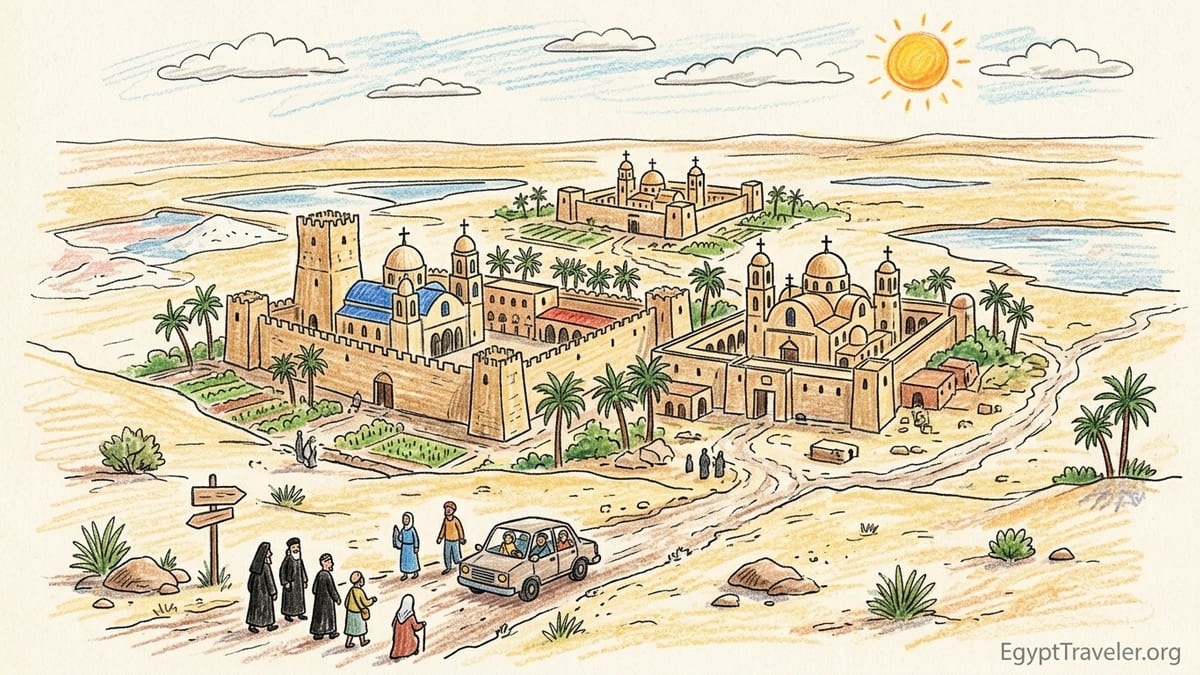
Why Wadi El Natrun Matters in Christian Monasticism
Wadi El Natrun is a long, low depression in the western desert of Egypt, roughly a ninety minute to two hour drive from central Cairo depending on traffic. In late antiquity its saline lakes supplied natron, the mineral used in ancient mummification and soap making. From the fourth century it became known for something very different: a gathering place for Christian hermits and monks who came seeking silence and seclusion. By the sixth century, historical sources describe hundreds of monastic settlements across this region of the Nitrian Desert, clustered around sites such as Nitria, Kellia and Scetis, the last corresponding to Wadi El Natrun today.
The pioneering figure here is Saint Macarius of Egypt, who around the year 330 established a monastic colony in Scetis. Over time small clusters of cells and caves evolved into organized monastic communities with churches, refectories, libraries and defensive towers. These early experiments in communal desert life influenced the development of Christian monasticism far beyond Egypt. Many of the Desert Fathers whose sayings still circulate in modern spirituality, including Arsenius, Moses the Black and Poemen, lived or passed through this valley.
At its peak, Wadi El Natrun probably hosted dozens of communities. Raids, plagues and political change gradually reduced their number. Today four historic monasteries survive in active use: Saint Macarius, Saint Bishoy, Al-Baramus and the Syrian Monastery. Egypt’s Ministry of Tourism and Antiquities describes them as among the earliest surviving Christian monastic foundations anywhere, and they remain key stops on the country’s Coptic heritage and Holy Family pilgrimage routes. For travelers, this means a rare chance to walk through spaces where early Christian history, medieval art and contemporary monastic life intersect.
Unlike ruined archaeological sites, the monasteries of Wadi El Natrun are not open-air museums. They are working religious houses with fixed prayer schedules, rotating groups of novices and visiting pilgrims from Egypt and abroad. Bells ring for the liturgy in the early morning. Monks in black robes move between workshops, refectories and gardens. A visit here requires a more reflective pace and a basic understanding of local customs, which this guide will help you develop.
Planning Your Visit: Access, Time and Practical Logistics
Most visitors reach Wadi El Natrun by private car or hired driver from Cairo or Alexandria, often arranged through a Cairo hotel, a local tour operator or an app-based taxi booked for a full-day hire. As of mid 2026, a full-day car with driver from Cairo commonly costs the equivalent of 80 to 150 US dollars depending on vehicle type and whether you book through a tour company or directly with a driver. The main road is the Cairo–Alexandria Desert Road, from which a clearly marked turnoff leads to the monasteries. Travel times vary with traffic but a typical one-way journey from central Cairo is around 90 minutes.
In terms of timing, first-time visitors who are interested in history and art should plan at least a full day for Wadi El Natrun. A realistic schedule might include two monasteries in depth with a short stop at a third. That allows time to linger in churches, talk with a monk if invited and sit quietly in the courtyards. Attempting all four in a single day is technically possible if you keep moving, but most travelers find that the visits blur together and the experience becomes perfunctory. If you have a particular interest in Coptic art or monastic spirituality, consider an overnight in nearby towns such as Badr City or on the desert road, returning the next morning to visit the remaining monasteries at a calmer pace.
There is no single entrance ticket covering the four monasteries. Entry to each complex is generally free, with optional donations to church boxes or specific projects such as restoration funds. Some monasteries maintain simple guesthouses that host pilgrims and retreatants, often by advance arrangement and generally prioritizing Coptic Orthodox visitors or other Christians referred by a priest. These stays are not commercial hotels: rooms tend to be basic, with simple food, early bedtimes and expectations that guests will respect the rhythm of community prayer.
Public facilities inside the monasteries are limited but improving. Expect basic restrooms and small kiosks or bookshops selling icons, incense, spiritual books in Arabic and sometimes English, and bottled water or soft drinks. There are usually no full-service cafés on-site, so travelers often bring snacks or plan to stop for a late lunch at a roadside restaurant on the way back to Cairo or Alexandria. The summer heat can be intense, frequently above 35 degrees Celsius in the afternoon, so lightweight clothing, a hat and sufficient drinking water are essential.
Monastery of Saint Macarius: Spiritual Heart of the Valley
Many Copts regard the Monastery of Saint Macarius as the spiritual heart of Wadi El Natrun, since it stands near the place where Saint Macarius first settled in the desert in the fourth century. Architecturally, the monastery presents a compact rectangle of fortified walls, with a gatehouse leading into a main courtyard shaded by palms. Within this enclosure, visitors find a cluster of churches, chapels, refectories and monastic cells, punctuated by domes and the square mass of the medieval keep or qasr, the defensive tower that once sheltered monks during raids.
Inside the main church, travelers can see the shrine of Saint Macarius and the relics of other early saints associated with the monastery. The interior combines thick, whitewashed walls with painted wooden screens and a forest of columns supporting low domes. There are icons of Christ, the Virgin and Coptic saints in the modern style, along with older wall paintings in some chapels that have been consolidated or carefully restored. Light filters in through small high windows, creating an intimate atmosphere. When liturgy is not in progress, visitors are often free to enter respectfully, stand quietly near the back and take in the space.
One of the most evocative experiences at Saint Macarius is joining the monks for part of a service, even briefly. On many days, the Divine Liturgy starts around dawn and may continue into mid-morning. Visitors who arrive before 9:00 a.m. often hear the chant of Coptic hymns and the resonant sound of cymbals and triangle from within the church. Modest, unobtrusive participation is welcomed: stand to one side, avoid flash photography and follow the posture of the congregation. The monastery’s guesthouse sometimes hosts small retreat groups who stay several days, joining the cycle of prayer and eating simple vegetarian meals in the refectory.
Outside the churches, travelers can explore the surrounding courtyards and gardens. Paths lead past workrooms where monks engage in manual labor such as icon painting, carpentry or agricultural tasks. Saint Macarius Monastery has long been associated with theological scholarship and spiritual guidance, and its library contains important Coptic and patristic texts, though access for casual visitors is usually limited. If you are particularly interested in manuscripts or theology, it can help to identify yourself to a monk and briefly explain your interest; occasionally a member of the community will offer a short informal tour or conversation.
Monastery of Saint Bishoy: Relics, Martyrs and Living Devotion
The Monastery of Saint Bishoy lies a short drive from Saint Macarius and is often paired with it on day trips. Founded in the fourth century by Saint Bishoy, revered in Coptic tradition for his humility, it is one of the best-known monasteries in Egypt. On approach, visitors see high enclosure walls, clusters of domes and, again, the prominent fortress-tower that once served as refuge in times of danger. Within the walls, the complex feels slightly more open than Saint Macarius, with larger courtyards and extensive recent construction to support the stream of pilgrims.
Inside the church of Saint Bishoy, travelers encounter the saint’s relics in a shrine that attracts a steady flow of Coptic worshippers. On many weekends and feast days, families arrive by bus from Cairo, the Nile Delta or Upper Egypt to attend liturgy, baptize children in the monastery’s baptistery or ask for the saint’s intercession. The church interior displays layers of history, from ancient stone and brick fabric to wooden screens and icons in both older and contemporary styles. The air often carries the scent of frankincense, and you may see women tying ribbons near icons as a sign of prayer.
One of the most historically charged sites here is the Well of the Martyrs, associated with the massacre of monks in the fifth century. Tradition holds that raiders washed their swords in this well after killing the community, and it has become a place of solemn remembrance. A visit combines history and devotion: guides or monks sometimes recount the story to groups, and pilgrims may pause for prayer. The monastery also houses the relics of several popes of the Coptic Orthodox Church, adding to its status as a major pilgrimage destination.
Monastic life at Saint Bishoy is very much alive. Between services, you might see monks moving swiftly between the bakery, gardens and workshops, or greeting lay visitors they recognize from previous retreats. The guest facilities here are more developed than at some other monasteries, occasionally hosting conferences or youth meetings organized by Coptic parishes from around Egypt or the diaspora. For independent travelers, this means that weekends and major feast days can be extremely busy. If your main goal is quiet contemplation or photography of the architecture, consider visiting on a weekday outside major church feasts when the atmosphere is calmer.
Al-Baramus Monastery: Fortress in the Desert
North of the other monasteries, Al-Baramus, also known as the Monastery of the Romans or Paromeos, has a slightly more remote feel. The name probably refers to early Roman saints associated with the foundation, hinting at the valley’s international connections even in antiquity. Architecturally, Al-Baramus is notable for its massive defensive tower, thought by some specialists to be among the earliest surviving examples in the region. The tower rises above the rest of the complex like a squat keep, with narrow openings and a once-usable drawbridge that could be pulled up in case of attack.
Visitors entering Al-Baramus pass through an introverted world of thick walls, narrow passageways and small courtyards. The principal church, dedicated to the Virgin Mary, features a characteristic Coptic basilican layout with wooden iconostasis, domed sanctuaries and simple stone columns. There are several chapels, some with faded medieval wall paintings still visible on the plaster, showing saints, angels and geometric motifs. The overall impression is sober and monastic rather than ornate. Light pools softly on the stone floors, and the acoustics are striking when a monk chants the psalms.
Because of its relative quiet compared with Saint Bishoy, Al-Baramus is a good place to pay attention to the details of monastic architecture. Visitors can observe how dwellings cluster around the churches, how water is stored and distributed and how the fortress is integrated into daily life. In some seasons, parts of the gardens are cultivated with olives, fruit trees or vegetables, demonstrating the self-sufficient ethos that has shaped desert monasticism for centuries. If you are accompanied by a guide who speaks Arabic and has a relationship with the community, you may be invited into additional chapels or rooftops that are not immediately obvious from the main paths.
The monastery’s small shop usually offers hand-painted icons, wooden crosses and religious books in Arabic and sometimes English, often less commercial in feel than shops in urban churches. Prices are modest by international standards and sales contribute to the monastery’s maintenance. For example, a small hand-painted icon might cost the equivalent of 10 to 30 US dollars, while simple wooden crosses and bracelets are often just a few dollars, making them accessible souvenirs for visitors who want to support the community without spending heavily.
The Syrian Monastery: Painted Walls and Cross-Cultural History
The Syrian Monastery, often called Deir Al-Surian, sits close to Saint Bishoy but has a distinct history and atmosphere. Its name recalls the Syrian monks who settled here in the late first millennium, bringing with them Syriac traditions and manuscripts. Although its foundations date back to the fourth century, it gained particular prominence as a center of Syriac scholarship, and for centuries its library housed rare manuscripts in Syriac, Coptic, Arabic and Ethiopic. Scholars from Europe visited in the nineteenth century, and some manuscripts were transferred to major libraries abroad, though important holdings remain.
For most travelers, the Syrian Monastery’s highlight is the extraordinary painted decoration of its churches and chapels. The Church of the Virgin, the Cave Church of the Virgin and the Church of the Archangel Michael include medieval wall paintings that are among the most important in Egypt. The images, many dating from around the ninth to thirteenth centuries, depict Christ, the Virgin, Old and New Testament scenes and a rich company of saints. While some areas have suffered from time and smoke, recent conservation has stabilized many of the paintings, and their colors and expressive faces remain impressive in the soft interior light.
Walking through the Syrian Monastery, visitors notice how architecture and art work together. Low doorways and small courtyards create a sense of intimacy, leading to chapels whose walls are covered almost entirely in fresco. The ceilings often feature painted crosses or stylized stars. In certain chapels, a monk or local guide may point out particular scenes, such as a depiction of the Nativity or the Ascension that differs subtly from Western artistic conventions, reflecting Eastern Christian theology. For travelers who have seen the painted monasteries of other regions, such as Cappadocia or Mount Athos from the outside, these interiors provide a parallel but distinct tradition within the Coptic world.
The monastery still functions as a living community. Bells ring, monks follow a daily schedule of prayer and work, and visitors are expected to adjust to that rhythm. When services are underway, some chapels may be closed to tourists. Patience and flexibility are important. Outside liturgical times, however, the community is generally welcoming, and English or French speaking visitors sometimes find that a monk who studied abroad or worked with foreign conservators is willing to answer questions. Given the site’s artistic importance, many organized cultural tours make the Syrian Monastery a priority stop, often spending more time here than at the other monasteries.
Dress, Behavior, Photography and the Question of Guides
Although Wadi El Natrun lies in the desert, travelers should not dress as if going to the beach. The monasteries are working Christian religious sites set within a predominantly Muslim country that values modesty. For men, long trousers and a short or long-sleeve shirt are appropriate. For women, trousers or a skirt that covers the knees and a top with covered shoulders and a modest neckline are advisable. A light scarf can be useful both for sun protection and to cover your head inside churches if you wish, which many local women do as a sign of respect.
Behavior should match the monastic context. Speak quietly, silence your phone and avoid eating, drinking or chewing gum inside churches. If you enter a liturgy in progress, stand near the back or along the side aisle and follow the lead of the congregation. During processions or censing, step aside to give the clergy room. Affectionate physical contact, loud group conversations and intrusive photography are best avoided in sacred spaces. Many monks are friendly but also value their privacy. Asking before taking a close-up photo of a monk is courteous and, in some communities, explicitly required.
Photography policies vary slightly between monasteries and over time. As a general rule, still photography without flash is usually tolerated in courtyards and exterior spaces. Inside churches, it is safer to ask a monk or attendant on duty. In some chapels with fragile wall paintings, photography may be restricted to protect the art. Signs at entrances or near icons often indicate current rules. Professional photographers who wish to use tripods or conduct a dedicated shoot should expect to request special permission and may be refused if the community is uncomfortable with the arrangement.
Visitors often ask whether they need an official guide. It is certainly possible to visit Wadi El Natrun independently with a hired driver, and many Egyptians do so, especially those already familiar with Coptic tradition. However, a knowledgeable guide who understands both Coptic history and local monastic etiquette can add substantial value. For example, a bilingual guide can explain the stories behind specific icons, translate when a monk addresses the group and time the visit around liturgical schedules. Many Cairo-based tour operators offer day trips that include Wadi El Natrun alongside other Coptic sites, typically pricing them between 80 and 150 US dollars per person for small groups including transport. Independent travelers on a tighter budget sometimes share a car and rely on printed notes or offline guides, accepting that they may miss some nuance.
How Many Monasteries to See and How Long to Stay
With four active monasteries spread across a relatively compact area, the natural temptation is to plan a checklist-style day trip, stopping briefly at each site. In practice, the valley rewards a slower approach. Each monastery has a distinct character: Saint Macarius for its spiritual legacy and intense liturgical life, Saint Bishoy for its relics and strong popular devotion, Al-Baramus for its fortress architecture and contemplative atmosphere and the Syrian Monastery for its painted walls and cross-cultural history. Treating them as four variations on the same theme misses this richness.
If you have only a single day, many seasoned travelers recommend choosing two monasteries to explore thoroughly and perhaps driving through or making a short stop at a third. A classic combination is Saint Macarius and the Syrian Monastery, balancing deep history, liturgy and exceptional art. Another approach pairs Saint Bishoy with Al-Baramus, contrasting the busy pilgrimage site with the more austere fortress complex. Spending two to three hours at each allows time to attend part of a service, sit silently in a church, explore the defensive tower and speak with a monk if the opportunity arises.
Travelers with a strong interest in Coptic heritage often allocate two days. On the first day, you might arrive early, attend morning liturgy at Saint Macarius, then explore its churches and courtyards, followed by an unhurried afternoon at Saint Bishoy including a visit to the Well of the Martyrs. The second day can then focus on Al-Baramus and the Syrian Monastery, with extra time for close study of wall paintings, photographic documentation where permitted and perhaps a guided explanation of the monastic library’s history. This extended stay allows you to experience the valley at different times of day, from the cool early morning light to the long shadows before sunset.
Some visitors, especially Christian pilgrims, arrange overnight stays at one of the guesthouses, integrating elements of retreat into their trip. A typical pattern might involve arriving in the afternoon, checking into a simple room, joining evening prayers, eating a basic communal meal and rising early for the dawn liturgy. Such stays require advance contact, usually in Arabic or through a local priest or travel coordinator, and are not guaranteed for walk-in visitors. For those who can arrange them, they offer a deeper window into monastic life than any day trip can provide, but they also demand a willingness to adapt to early hours and a quiet, structured environment.
FAQ
Q1. Do I need a special permit or ticket to visit the Wadi El Natrun monasteries?
Most visitors do not need a special permit to enter the monasteries, and there is usually no ticket fee. Security officers at the main access roads sometimes check identification, and foreign travelers should carry their passports. Donations inside the monasteries are welcome but not obligatory.
Q2. What is the best time of year and time of day to visit?
The most comfortable months are typically from late October to early April, when daytime temperatures are milder. Within a given day, early morning is ideal both for cooler weather and for experiencing part of the liturgy. Afternoons in summer can be very hot and physically draining, especially in enclosed stone spaces.
Q3. Can non-Christians visit the monasteries?
Yes, non-Christians are generally welcome as respectful visitors. The monasteries are religious spaces rather than museums, so everyone is expected to dress modestly, move quietly and avoid behavior that would disturb prayer. Non-Christians are free to observe services from the back of the church, though they do not receive communion.
Q4. Are women allowed to enter all areas of the monasteries?
Women may visit the main church areas, courtyards and many chapels in each monastery, but some inner spaces, monastic quarters and certain rooftops are reserved for monks only. Signs or attendants usually indicate restricted areas. As a general rule, women should dress modestly with covered shoulders and knees, and many local women choose to cover their heads inside churches.
Q5. Is it safe to travel to Wadi El Natrun independently?
As of 2026, Wadi El Natrun lies along a major highway with regular traffic between Cairo and Alexandria, and many local pilgrims travel independently. Security checkpoints are present on approach roads, and the monasteries maintain their own gates. As with any trip in Egypt, travelers should monitor current advisories, use reputable drivers or transport providers and avoid night driving if unfamiliar with the route.
Q6. How much cash should I bring and are cards accepted?
There are no widely available card payment facilities inside the monasteries themselves. Bring enough cash in Egyptian pounds to cover your driver or tour balance, snacks, bottled water and any donations or purchases from monastery shops. For most visitors, the equivalent of 40 to 80 US dollars in local currency is more than sufficient for a day trip, excluding pre-arranged transport.
Q7. Can I stay overnight in one of the monasteries?
Some monasteries, particularly Saint Macarius and Saint Bishoy, operate simple guesthouses primarily intended for Christian pilgrims and retreatants. Stays typically require advance arrangement, often through a priest or monastery contact, and are not guaranteed for last-minute visitors. Accommodation is basic, with shared facilities and early schedules, but offers a unique opportunity to share in the community’s rhythm of prayer.
Q8. Is a local guide really necessary, or can I just walk around?
It is possible to walk around on your own and appreciate the architecture and atmosphere, especially if you have done some reading in advance. However, a local guide who knows Coptic history and speaks Arabic can help navigate the complexes, explain icons and wall paintings, translate conversations with monks and adjust the route according to current liturgical activities, which many visitors find significantly enhances the experience.
Q9. What should I do if I arrive during a church service?
If you enter while a service is underway, step quietly inside, stand near the back or at the side and avoid walking in front of the altar area. Refrain from using flash photography, keep your phone silent and follow the posture of the congregation. You are not required to stay for the full service but should leave as quietly as you entered.
Q10. Are children welcome, and is the visit suitable for families?
Families with children do visit the monasteries, especially Egyptian Coptic families who come for baptisms or feast days. Children should be supervised closely, taught to speak softly inside churches and discouraged from running or climbing on structures. The complexes involve walking on uneven surfaces and stairs, so sturdy shoes and sun protection are important for younger visitors.