


The Nile Delta is one of Egypt’s most densely populated yet least understood regions for foreign visitors. For many travelers, it is a blur seen from a bus window between Cairo and Alexandria. Look closer, however, and the Delta reveals Ottoman-era river ports, desert monasteries that shaped early Christianity, low-key Mediterranean resorts and little-visited archaeological capitals. This guide focuses on what you can experience on the ground today, traveling through the western, central and eastern Delta with practical advice on routes, expectations and highlights.
How the Nile Delta Fits Together for Travelers
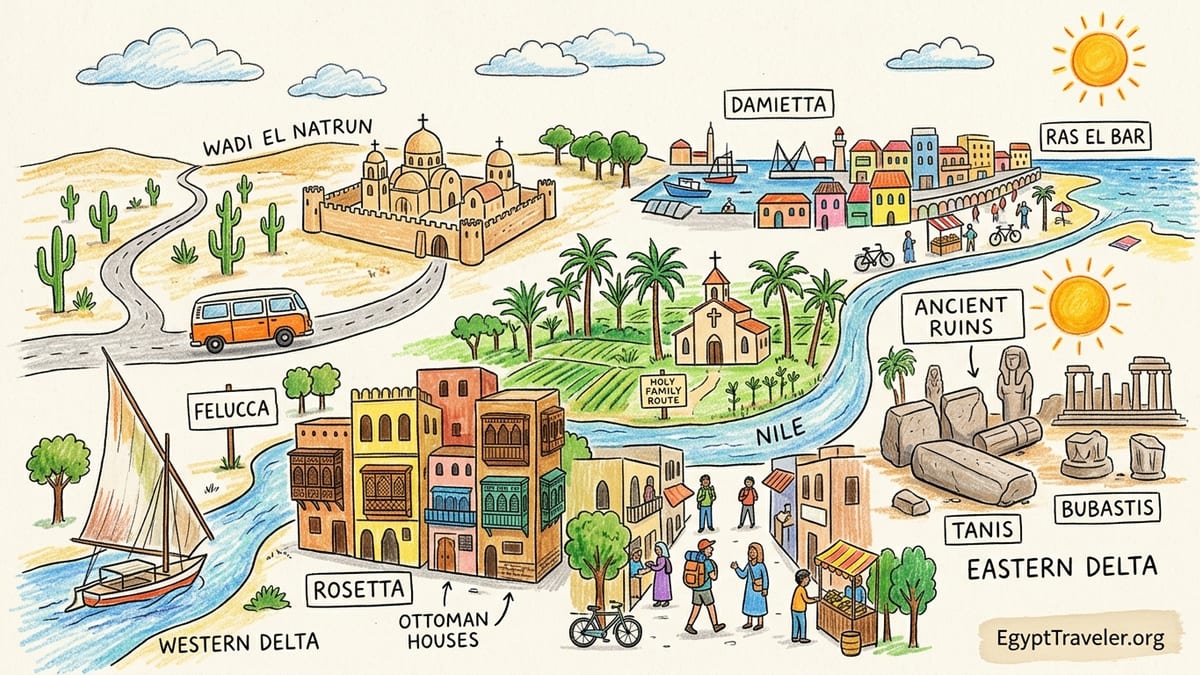
For travel planning, it helps to think of the Nile Delta not as a single blob north of Cairo but as three broad zones. The western Delta includes Rosetta (Rashid) on the Rosetta branch of the Nile and the desert monasteries of Wadi El Natrun along the Cairo–Alexandria Desert Road. The central Delta holds the Holy Family pilgrimage routes that pass through provincial towns and villages between Cairo and the Mediterranean. The eastern Delta, harder to reach, is where you find the great but little-visited ruins of Bubastis near Zagazig and Tanis near modern San El Hagar.
Infrastructure is improving, but this is still a region of slow trains, crowded microbuses and few English signs. Do not expect the polished tourism machine of Luxor or Sharm el Sheikh. Instead, think of the Delta as a field trip into everyday Egypt, where you might combine a monastery visit with a lunch of taameya sandwiches from a street stall, or end a day of temple-hopping with grilled fish on the Damietta corniche. Budget travelers can get by on roughly the same daily costs as Cairo, with local buses rarely more than the equivalent of a few US dollars for intercity hops.
For a compact itinerary, allow two or three days for the western Delta around Rosetta and Wadi El Natrun, two days for Damietta and Ras El Bar on the Mediterranean, and at least one long day (or preferably an overnight) for the eastern sites of Bubastis and Tanis. Independent travel is feasible, but a private car and driver arranged through a Cairo or Alexandria agency simplifies the more remote segments, especially in the east where public transport to archaeological sites can be patchy.
Western Delta: Ottoman Rosetta and Desert Monasteries
Rosetta, or Rashid, lies about 65 kilometers east of Alexandria on the westernmost arm of the Nile. Historically it rivaled Alexandria as a port and is now one of the best places in Egypt to see intact Ottoman domestic architecture. Recent heritage projects have been restoring its old quarter, where a cluster of 18th and 19th century merchant houses line narrow lanes near the riverfront. Walking these streets feels like stepping into a three-dimensional history book, with carved mashrabiya balconies and central courtyards that catch the Delta breeze.
The Rashid National Museum occupies a historic Ottoman house and tells the story of the Rosetta Stone’s discovery, with a replica of the famous slab and exhibits on local life. Nearby, houses such as Beit Amasyali and other restored mansions often open to visitors, showcasing woodwork, rooftop views and traditional grain mills. A taxi can take you a few kilometers out of town to Fort Julien, the squat riverside fort where the Rosetta Stone was found. Entry fees for these sites are usually modest, similar to small museums elsewhere in Egypt, though they can change so it is wise to carry some extra local currency.
Reaching Rosetta is straightforward from Alexandria. Shared microbuses and local buses run from Alexandria’s main bus terminals, typically taking 90 minutes to two hours depending on traffic. From Cairo, you can either travel to Alexandria first or use long-distance buses that cut across the western Delta. Most travelers find basing in Alexandria and doing Rosetta as a day trip most efficient, returning to the city’s wider hotel choices at night.
About halfway between Cairo and Alexandria, but inland in the desert rather than in the green Delta, Wadi El Natrun preserves four active Coptic monasteries that rank among the oldest in the world. St Macarius, St Bishoy, El Baramos and the Monastery of the Syrians form a chain of walled complexes with mud-brick churches, defensive towers, ancient frescoes and palm gardens. It is possible to visit two or three in a single day from Cairo by arranging a car along the Desert Road, with journey times of roughly 90 minutes to the first monastery.
These are living religious communities, not open-air museums, so visitors should dress modestly, speak quietly and be prepared for parts of the monastery to be off-limits without a resident monk. Most monasteries do not charge an entrance fee, but a small donation is appreciated. Simple guesthouses exist for pilgrims, though reservations usually require direct contact and are easier for Arabic speakers or those traveling with a church group. For most foreign travelers, a day visit with a private driver or pilgrimage tour is the most practical option, as Desert Road microbuses rarely stop exactly at the monastery gates.
Central Delta: Following the Holy Family Route
The central Nile Delta between Cairo and the coast is crisscrossed by traditions of the Holy Family’s flight into Egypt. Modern pilgrimage routes promoted by the Coptic Church and the Egyptian tourism authorities link churches, shrines and tree-shaded springs where local believers say Mary and Joseph rested with the infant Jesus. While some of the most famous Holy Family sites sit within Cairo itself, others lie in little-visited Delta towns where travelers are rare.
An example is the area around Belbeis and nearby villages, reachable by road from Cairo in about 90 minutes depending on traffic. Here you may find modest churches marking legendary resting places. These are functioning parish churches rather than large monuments, so facilities are basic and English may be limited. Travelers interested in the religious dimension of Egypt, rather than just its pharaonic past, will find the experience moving, especially if visiting during a local feast day when families gather with candles and embroidered icons.
Because central Delta Holy Family sites are scattered and often embedded in dense urban neighborhoods, this is the region where a specialist local guide or driver is most valuable. Public transport between towns exists in the form of microbuses that depart from chaotic stations, but for visitors unfamiliar with Arabic they can be confusing. A realistic approach is to choose one or two key stops that can be integrated into a transfer between Cairo and the coast. For instance, you might travel with a driver from Cairo to a Holy Family church in the Delta, then continue on to Damietta for the night.
Facilities for tourists in these central Delta towns are generally limited to simple local hotels and street food. Expect inexpensive meals of koshari, ful and taameya, and small neighborhood bakeries selling fresh flatbread. Dress conservatively, be ready for curious stares and choose daylight hours for your visits. With a flexible attitude, the central Delta can be one of the most rewarding areas for cultural immersion, revealing how Christian and Muslim communities share the same crowded streets.
Eastern Delta: Bubastis and Tanis for Archaeology Enthusiasts
The eastern Nile Delta rarely appears on first-time itineraries, yet it holds two major archaeological sites: Bubastis near the modern city of Zagazig, and Tanis near the village of San El Hagar. Both require more effort to reach than Giza or Saqqara, but they reward visitors who want to stand among ruins without crowds or vendors.
Bubastis, once the cult center of the cat goddess Bastet, lies on the edge of Zagazig, which is about an hour northeast of Cairo by road or rail in good traffic. Much of Bubastis has been robbed for building stone over the centuries, but you can still see scattered granite blocks, column bases and the outlines of temple structures. For many visitors, the main appeal is the atmosphere: a quiet archaeological zone fringed by modern houses, where you can walk along sandy paths with only the calls of nearby roosters and distant traffic for company. Taxi drivers in Zagazig are generally familiar with the site and can wait while you explore for an hour or two.
Further north, Tanis is more remote and feels substantially more adventurous. It lies near San El Hagar, northeast of Zagazig, and is best reached by private car from Cairo or Ismailia, often taking three hours or more each way. On arrival, you enter a broad archaeological field dotted with colossal granite blocks, toppled statues and the remains of temple precincts that once formed a royal capital of the 21st and 22nd dynasties. The site is expansive, with low mounds and excavated areas that can require some imagination, but many travelers relish the chance to wander a pharaonic capital in near solitude.
Facilities at Tanis are minimal. There may be a small ticket office and a local guardian, but you should not count on cafés, shade structures or formal restrooms. Bring plenty of water, sun protection and sturdy shoes, as you will likely be walking on uneven ground under direct sun for several hours. This lack of infrastructure is precisely why most big bus tours skip Tanis, but for independent travelers it adds to the sense of discovery.
Because both Bubastis and Tanis are in agricultural governorates, road conditions can vary with truck traffic and local construction. Many visitors arrange a day trip through a Cairo travel agency that can provide a driver familiar with the route and handle any necessary permits or checkpoints. Prices for such a private excursion are comparable to long day trips to Wadi El Natrun or Fayoum, particularly if shared between two or three travelers.
Damietta and Ras El Bar: Life Where the Nile Meets the Sea
On the northeastern edge of the Delta, the city of Damietta sits on the Damietta branch of the Nile, while the resort town of Ras El Bar spreads along the sandy tongue where the river finally meets the Mediterranean. This is one of the most atmospheric corners of the Delta, pairing working port activity with relaxed seaside promenades.
Damietta itself is known across Egypt for its furniture workshops and sweet pastries. Walking the central streets, you can peer into carpentry shops where workers craft ornate bedroom sets destined for households all over the country. The riverside corniche offers views of fishing boats and cargo vessels, and is lined with simple cafés serving strong coffee and fresh juice. Prices here reflect a primarily local clientele: grilled fish dinners in midrange restaurants are typically significantly cheaper than in Alexandria, and small hotels cater mainly to Egyptian business travelers and families.
Ras El Bar, about 15 to 20 kilometers from central Damietta, functions as the city’s beach resort. In summer, Egyptian families rent seasonal villas or stay in local hotels to enjoy the relatively mild Mediterranean climate compared with inland cities. A paved corniche runs along the shore, where visitors stroll in the evening sea breeze, buy corn on the cob from street vendors or take photos at the point where the waters of the Nile and the Mediterranean visually converge. During high season the town can feel crowded and lively, while in winter it is much quieter and some seasonal cafés close.
Getting to Damietta from Cairo usually involves a long-distance bus journey of around four to five hours, departing from major bus stations on the city’s eastern side. From Alexandria, routes via the coastal highway or inland roads can take roughly three hours by car or bus depending on traffic. Once in Damietta, shared microbuses and taxis shuttle back and forth to Ras El Bar throughout the day, with fares typically costing the equivalent of a few US dollars at most. Independent travelers will find navigation manageable, though English is less widely spoken than in Cairo; it helps to have key place names written in Arabic script.
Planning Routes and Practicalities Across the Delta
Because the Nile Delta is crisscrossed by canals, railway lines and busy agricultural roads, planning an efficient route matters more here than in more linear destinations such as Upper Egypt. One practical pattern is to start in Cairo, make a loop through Wadi El Natrun and Rosetta, then continue along the coast toward Damietta and loop back via the central or eastern Delta. Another option is to base in Cairo and Alexandria and use them as hubs for day trips, returning each night to more predictable hotels and services.
Public transport is plentiful but fragmented. Intercity buses and trains connect major towns like Cairo, Zagazig, Mansoura, Damietta and Alexandria, but timetables can change and stations are often crowded. Microbuses fill the gaps, running frequent but informal services between smaller towns and villages. For a traveler who speaks some Arabic and is comfortable with improvisation, these can be an economical way to move around. Those who prefer predictability may prefer hiring a car and driver for specific days, especially when combining multiple remote sites like Bubastis and Tanis.
Accommodation options vary. In Alexandria you will find everything from international chain hotels to heritage guesthouses on the corniche. In Damietta and Ras El Bar, expect midrange Egyptian-style hotels with tiled floors, balconies and basic amenities. Rosetta, Wadi El Natrun and smaller Delta towns often have very limited or purely local lodging; many visitors simply return to Alexandria or Cairo after their day’s exploring. If you plan to stay near a monastery in Wadi El Natrun or a religious site in the central Delta, it is wise to confirm arrangements well in advance through a local contact or reputable agency.
Weather is another factor. From October to April, temperatures across the Delta are generally mild and comfortable, especially along the coast where sea breezes moderate the heat. July and August can be hot and humid, particularly in inland towns surrounded by irrigation canals. Mosquitoes may be active near water in the evening, so bringing repellent is sensible. Modest clothing that covers shoulders and knees is not only respectful at religious and rural sites but also helps with sun protection.
Which Delta Experiences Suit Which Traveler
If your primary interest is Ottoman architecture and urban history, the western Delta around Rosetta should be your priority. A day spent wandering its restored houses, visiting the Rashid National Museum and exploring Fort Julien provides a concentrated look at how a provincial port thrived during the Ottoman period. Combining this with time in Alexandria’s own Ottoman-era streets makes for an architecturally rich two- or three-day segment within a longer Egypt itinerary.
Travelers drawn to Coptic heritage and early Christianity will find Wadi El Natrun and the central Delta Holy Family sites most rewarding. Wadi El Natrun offers monumental monasteries and a tangible sense of continuity, as monks walk the same pathways used by their predecessors for more than a millennium. The central Delta churches, by contrast, are intimate and grounded in contemporary village life. Together they illustrate the breadth of Christian experience in Egypt, from desert asceticism to bustling parish communities.
For dedicated archaeology enthusiasts willing to trade comfort for discovery, the eastern Delta’s Bubastis and especially Tanis are compelling. Here you can stand beside colossal granite fragments, walk through barely marked temple precincts and imagine the royal processions that once crossed this landscape. The lack of visitor infrastructure means you will need to be self-reliant, but you are also unlikely to compete with tour groups for space or photos. Many travelers who make the effort describe these sites as highlights precisely because of their remoteness.
If you are more interested in living Egyptian culture than in ruins, Damietta and Ras El Bar offer the strongest experiences. Watching furniture makers at work, browsing local markets, sampling seafood and joining families on the seaside corniche provide intimate glimpses of everyday life outside the main tourist centers. Even a short overnight trip from Cairo can reset your image of modern Egypt, adding texture to a journey otherwise dominated by pyramids and temples.
FAQ
Q1. Is it realistic to visit Rosetta, Wadi El Natrun and Alexandria in one day from Cairo?
It is possible but rushed. A more comfortable plan is to focus on either Wadi El Natrun or Rosetta in a single day from Cairo, or to base in Alexandria and visit Rosetta as a dedicated day trip.
Q2. How difficult is it to visit the Wadi El Natrun monasteries independently?
With a private car or taxi from Cairo or Alexandria it is straightforward, as the monasteries sit near the main Desert Road. Using public microbuses is possible but less predictable because vehicles may not stop directly at the monastery entrances.
Q3. Are women welcome at Coptic monasteries and Holy Family sites in the Delta?
Yes, women are welcome, but modest dress is important. Long trousers or skirts, covered shoulders and a scarf for churches are recommended. Some monastic guesthouses reserve overnight stays for men only, so day visits work best for mixed groups.
Q4. Is Tanis safe to visit given its remote location?
Tanis is in an agricultural area rather than a conflict zone, and day trips are commonly arranged through Cairo-based operators. The main challenges are long travel times and limited facilities rather than personal security, provided you follow current travel advisories.
Q5. Can I reach Bubastis and Tanis using trains and taxis only?
Bubastis near Zagazig can be reached by train from Cairo followed by a local taxi. For Tanis, public options become more complicated, so most visitors arrange a private car for at least part of the journey to avoid long waits and confusing connections.
Q6. When is the best time of year to visit Damietta and Ras El Bar?
From late autumn to spring, roughly October through April, temperatures are pleasant and the Mediterranean coast is comfortable. July and August bring higher humidity and large crowds of Egyptian holidaymakers.
Q7. Are there beach facilities at Ras El Bar suitable for families?
Yes. Ras El Bar has family-oriented beaches with sun loungers, simple cafés, lifeguards in busy seasons and shallow areas suitable for children, though parents should always supervise closely.
Q8. Is it necessary to join a tour to explore the Nile Delta, or can I go independently?
Confident travelers can explore independently using a mix of trains, buses and hired cars, especially in the western Delta and Damietta. For more remote sites like Tanis or scattered Holy Family locations, hiring a driver or joining a focused tour reduces stress.
Q9. What language challenges should I expect in the Delta?
English is less common than in central Cairo or major resort areas. Staff at hotels in Alexandria and some larger Delta cities may speak English, but in smaller towns and villages basic Arabic phrases or a translation app are very helpful.
Q10. How many days should I allocate to the Nile Delta within a longer Egypt trip?
If you only want a taste, one or two days around Rosetta or Damietta works. To include Wadi El Natrun, Holy Family sites and the eastern archaeological zones, plan at least four to six days within a broader Egypt itinerary.